

How to Explain Complex Articles Without Losing Accuracy
Dense articles are difficult to explain for a simple reason: they contain more than information. They contain claims, assumptions, definitions, evidence, context, uncertainty and sometimes a very specific structure of reasoning.
If you remove too much, the explanation becomes easy but wrong. If you preserve everything, the explanation stays accurate but remains hard to understand. The real skill is learning how to explain complex articles in a way that keeps the meaning intact while making the path through that meaning easier to follow.
This guide gives you a practical method you can use for academic papers, policy articles, technical essays, industry reports, long-form journalism or any dense reading you need to explain to someone else.
What an accurate explanation should preserve
An accurate explanation is not just a shorter version of the article. It is a faithful reconstruction of the article's meaning for a specific reader.
Before you simplify anything, identify what cannot be lost. In most complex articles, accuracy depends on preserving five things:
- The main claim or question the article is trying to answer
- The reasoning that connects one idea to the next
- The evidence used to support the claim
- The key terms that have a specific meaning in context
- The limits, uncertainty or conditions attached to the conclusion
For example, suppose an article argues that remote work improves productivity only when teams have clear documentation and fewer synchronous meetings. A weak explanation would say, “Remote work improves productivity.” That sounds simpler, but it removes the condition that makes the claim accurate.
A better explanation would say, “The article argues that remote work can improve productivity, but mainly in teams that document decisions clearly and reduce unnecessary meetings.”
The second version is still simple, but it keeps the original relationship between claim and condition.
Start by defining the explanation goal
You cannot explain an article well until you know what the explanation is for. A student preparing for class needs something different from a manager briefing a team. A researcher comparing methods needs different detail from a creator turning an essay into a newsletter.
A good starting question is: What does the reader need to be able to do after reading your explanation?
They might need to:
- Grasp the main idea quickly
- Decide whether the article is relevant
- Understand the logic deeply enough to discuss it
- Teach the idea to someone else
- Compare it with another source
- Turn it into notes, slides or a brief
The goal determines how much detail to keep. If the reader only needs a quick orientation, you can compress examples and background. If the reader needs to make a decision based on the article, you must preserve evidence, assumptions and limitations.
This is why reading mode matters. A quick explanation can be useful, but it is not always enough. If you are deciding how deeply to process a source, the distinction between a fast overview and a close reading is worth making explicit. unrav.io covers this distinction in its guide to choosing between a quick grasp and a deep dive.
Read for structure before you rewrite
Many people try to explain complex articles by simplifying sentence by sentence. That usually creates a patchwork summary: accurate in pieces, but unclear as a whole.
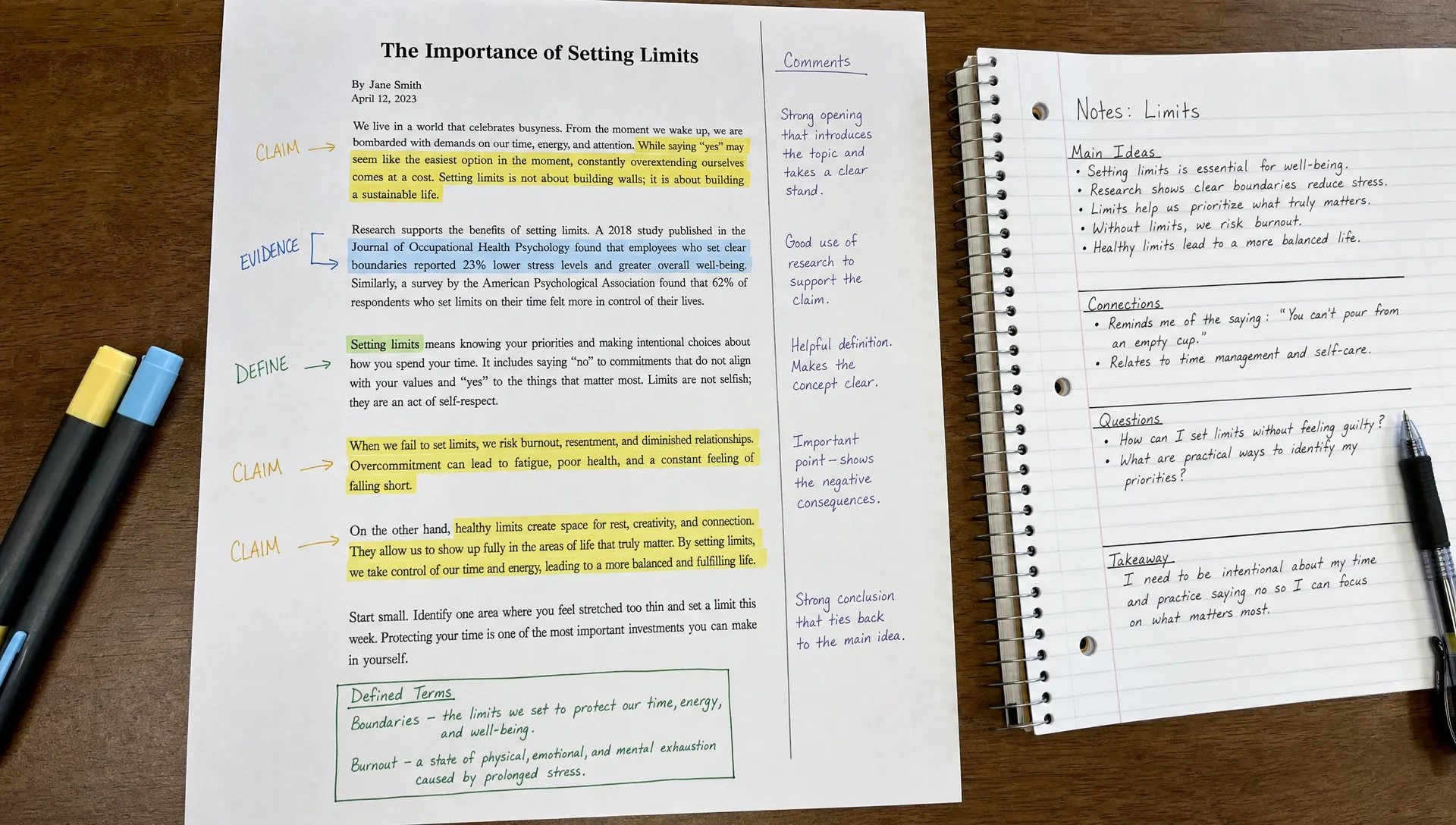
Instead, read for structure first. Ask what role each section plays in the article. Is it defining a problem? Reviewing prior work? Introducing evidence? Making a counterargument? Drawing implications?
Once you see the structure, you can explain the article in a cleaner order without distorting it.
A useful structure map might look like this:
| Article part | What to look for | What your explanation should preserve |
|---|---|---|
| Introduction | Problem, question or tension | Why the article exists |
| Background | Context, definitions, prior debate | What the reader needs to know first |
| Main argument | Central claim and reasoning | The logic of the article |
| Evidence | Data, examples, citations or cases | Why the author believes the claim |
| Limitations | Conditions, uncertainty or exceptions | Where the claim should not be overstated |
| Conclusion | Implications or next steps | What changes if the article is right |
This table is not a rigid template. Some articles do not follow a clean academic structure. Opinion essays, investigative pieces and technical explainers may move differently. The point is to identify function before rewriting content.
Separate the claim from the evidence
One of the easiest ways to lose accuracy is to blend the author's claim with the evidence for that claim.
A claim is what the article argues. Evidence is what the article uses to support that argument. Interpretation is what the author thinks the evidence means. These are related, but they are not the same.
Consider this sentence:
“Based on interviews with 40 teachers, the article argues that AI writing tools change how students approach drafting, especially when teachers redesign assignments around process rather than final output.”
This sentence contains a lot. To explain it accurately, you should keep the parts separate:
- Evidence: interviews with 40 teachers
- Claim: AI writing tools change how students approach drafting
- Condition: the effect depends on assignment design
- Interpretation: process-focused teaching may matter more than banning tools
If you explain this as “AI helps students write better,” you have introduced a stronger claim than the article may support. If you say “teachers think AI changes writing habits when assignments focus on process,” you stay much closer to the source.
This distinction is especially important in research articles, where methods and limitations affect what the findings mean. If your source is scientific, it may help to use a more specialized workflow for summarizing a scientific article in plain English.
Translate terms, but do not erase technical meaning
Complex articles often rely on specialized vocabulary. The goal is not to remove every difficult term. The goal is to explain each term clearly enough that the reader can follow the argument.
There are three safe ways to handle technical language.
First, keep the term and define it. This works when the term is central to the article. For example, if an article is about “cognitive load,” do not replace the term with “mental effort” every time. Define cognitive load as the amount of mental effort required to process information, then continue using the term when needed.
Second, translate the term into plain language when it is not central. If an article says “utilize” you can usually say “use.” If it says “ameliorate” you can say “improve.” These changes improve readability without changing meaning.
Third, give a concrete example after the definition. Abstract terms become easier to understand when readers can see them in use. If the article discusses “selection bias,” you might explain that a survey of only highly motivated students may not represent all students.
The risk is oversimplification. Some terms carry distinctions that plain words may blur. For example, “correlation” and “causation” should not both become “connection.” They mean different things. When a distinction matters to the argument, preserve it.
For a deeper look at how wording changes comprehension, see unrav.io's article on how language affects understanding of complex ideas.
Keep the author's level of certainty
Accuracy is not only about facts. It is also about strength of claim.
Complex articles often use careful language because the evidence supports a limited conclusion. Words like “suggests,” “may,” “is associated with,” “in this sample” and “under these conditions” are not filler. They signal uncertainty, scope or evidence quality.
When you explain the article, do not accidentally turn cautious language into certainty.
| Original wording | Less accurate explanation | More accurate explanation |
|---|---|---|
| “The findings suggest a relationship” | “The study proves a relationship” | “The study suggests a relationship” |
| “In this sample” | “This is true for everyone” | “This was found in the group studied” |
| “May reduce risk” | “Prevents the problem” | “May lower the risk” |
| “Associated with” | “Causes” | “Is linked with” |
This matters in academic, medical, legal, financial and technical writing. A clear explanation that overstates certainty can be more harmful than a difficult original.
Use a layered explanation
A layered explanation gives readers understanding in stages. Instead of forcing every detail into one paragraph, you move from simple to specific.
A strong layered explanation often has three levels.
The first level is the core idea. This is the one-sentence version of what the article says. It should be short, but not vague.
The second level is the reasoning. This explains how the article gets from problem to conclusion. It should include the main evidence or logic.
The third level is the nuance. This is where you add limits, definitions, disagreements or conditions that prevent the explanation from becoming misleading.
Here is a simple example.
Core idea: “The article argues that shorter workweeks can improve productivity in some organizations.”
Reasoning: “It says productivity may improve because employees spend less time in low-value meetings, have more recovery time and become more deliberate about priorities.”
Nuance: “The article does not claim this works everywhere. It emphasizes that results depend on workload design, management habits and whether the same amount of work is simply compressed into fewer days.”
This structure is useful because readers can stop at the level they need. A busy colleague may only need the core idea and reasoning. A student or analyst may need the nuance as well.
Use examples carefully
Examples make complex ideas easier to understand, but they can also distort the article if they are too narrow or too dramatic.
A good example should clarify the concept without pretending to be the full argument. If the article discusses “network effects,” you might explain that a communication app becomes more useful as more people join it. That example works because it shows the mechanism.
But if the article is about network effects in healthcare data sharing, a social media example may be too loose unless you explain the difference. The reader might remember the example instead of the actual argument.
Use examples with clear labels:
“An example would be...”
“One way to picture this is...”
“In the context of the article, this means...”
Those labels signal that the example is a teaching aid, not a replacement for the source.
Avoid the most common accuracy mistakes
When people explain complex articles, the same errors appear again and again. Most are not intentional. They happen because the explainer is trying to be helpful and clear.
One common mistake is removing qualifiers. If the article says a finding applies to “early-career employees in large firms,” do not shorten that to “employees.” The narrower group matters.
Another mistake is flattening disagreement. Many complex articles include debates between perspectives. If you summarize only the author's preferred view, readers may miss why the article is arguing against something.
A third mistake is turning process into outcome. If an article explains how something might happen, do not present it as proof that it already happens in every case.
A fourth mistake is replacing unfamiliar words with familiar but inaccurate words. “Incentive” is not always the same as “reward.” “Risk” is not always the same as “danger.” “Model” can mean a theory, a statistical tool or a simplified representation depending on the field.
Finally, avoid cutting the method when the method controls the meaning. In research-based articles, how the evidence was gathered often determines what can be concluded from it.
A practical workflow for explaining complex articles
You can use this workflow whether you are writing study notes, preparing a meeting brief, teaching a topic or turning a long article into content.
- Identify the article's purpose: Write one sentence explaining why the article was written. Is it solving a problem, challenging an assumption, reviewing evidence or proposing a new framework?
- Find the central claim: Locate the main point the article wants readers to accept. If there are several claims, rank them by importance.
- List the key terms: Note any words that carry specific meaning. Define them before you simplify them.
- Trace the reasoning: Write down the major steps in the argument. Use connectors like “because,” “therefore,” “however” and “as a result” to preserve logic.
- Attach evidence to claims: For each major claim, identify what supports it. Do not let evidence disappear into a vague statement like “the article explains.”
- Preserve limits: Capture the scope, uncertainty and exceptions. This is where many explanations lose accuracy.
- Rewrite for the reader: Use shorter sentences, familiar wording and a clearer order, but check every simplification against the original.
- Test the explanation: Ask whether a reader could repeat the main idea without overstating it. If they would walk away with a stronger, broader or simpler claim than the article supports, revise it.
This workflow is slower than copying a few highlights, but it saves time later because the final explanation is usable. It can become a brief, a study guide, a class contribution, a team summary or the start of a content outline.
If your next step is turning the explanation into durable study or work material, unrav.io also has a guide on how to turn articles into notes for work or study.
How AI can help without replacing your judgment
AI tools can help explain complex articles faster, but they should not be treated as final authority. The best use is to make reading and reframing easier while you stay responsible for checking meaning.
For example, you can use AI to ask for a plain-language explanation, a list of key claims, a breakdown of unfamiliar terms or a teaching version for a beginner. You can also ask it to separate claims from evidence or identify possible limitations.
unrav.io is designed for this kind of comprehension work. It can help reframe articles, PDFs, YouTube videos, podcasts or pasted text through different thinking modes depending on whether you want a quick grasp, deeper insight or a teachable explanation. That makes it useful when you are not just trying to shorten content, but trying to understand it from the right angle.
Still, the same rule applies: verify important details against the original source. If you are working with legal, medical, academic or high-stakes professional material, the explanation should guide your reading rather than replace it.
Example: from dense paragraph to accurate explanation
Imagine an article includes this paragraph:
“Although generative AI systems can increase the speed of first-draft production, their effect on writing quality depends heavily on the writer's ability to evaluate, revise and contextualize outputs. In educational settings, productivity gains may therefore mask weaker learning outcomes if students submit AI-assisted drafts without engaging in revision or reflection.”
A shallow explanation would be:
“AI makes writing faster, but students may learn less.”
That is not wrong, but it is thin. It misses the condition that quality depends on evaluation and revision.
A more accurate explanation would be:
“The article says generative AI can help people produce first drafts more quickly, but speed does not automatically mean better writing or better learning. In schools, students may benefit less if they submit AI-assisted work without reviewing, revising or thinking through the ideas themselves.”
This version is still readable. It avoids jargon. But it keeps the main relationship between speed, quality, revision and learning.
Frequently Asked Questions
How do you explain complex articles in simple terms without changing the meaning? Start by identifying the article's main claim, evidence, key terms and limits. Then rewrite the explanation in clearer language while preserving the strength and scope of the original claim.
What is the biggest mistake when simplifying a complex article? The biggest mistake is removing conditions or uncertainty. A statement like “may improve outcomes in one sample” should not become “improves outcomes for everyone.”
Should I define every difficult word in the article? No. Define terms that are central to the argument. Replace unnecessary jargon with plain language, but keep technical terms when they carry a meaning that simpler words would blur.
Can AI accurately explain complex articles? AI can help create drafts, clarify terms and reframe dense material, but you should check important claims against the source. It is most useful as a reading companion, not as a substitute for judgment.
How long should an explanation of a complex article be? It depends on the goal. A quick brief may need one paragraph. A study guide or professional summary may need sections for the claim, evidence, definitions, implications and limitations.
Take the next step
Explaining complex articles well is not about making everything shorter. It is about making the reasoning easier to follow without stripping away the parts that make the article true.
Use a simple rule: simplify the path, not the meaning. Keep the claim, evidence, definitions and limits visible. Then adapt the language and structure for the person who needs to understand it.
If you want help moving from dense content to clearer understanding, unrav.io can help you reframe articles, PDFs, videos and text into more useful explanations without treating summarization as the whole task.