
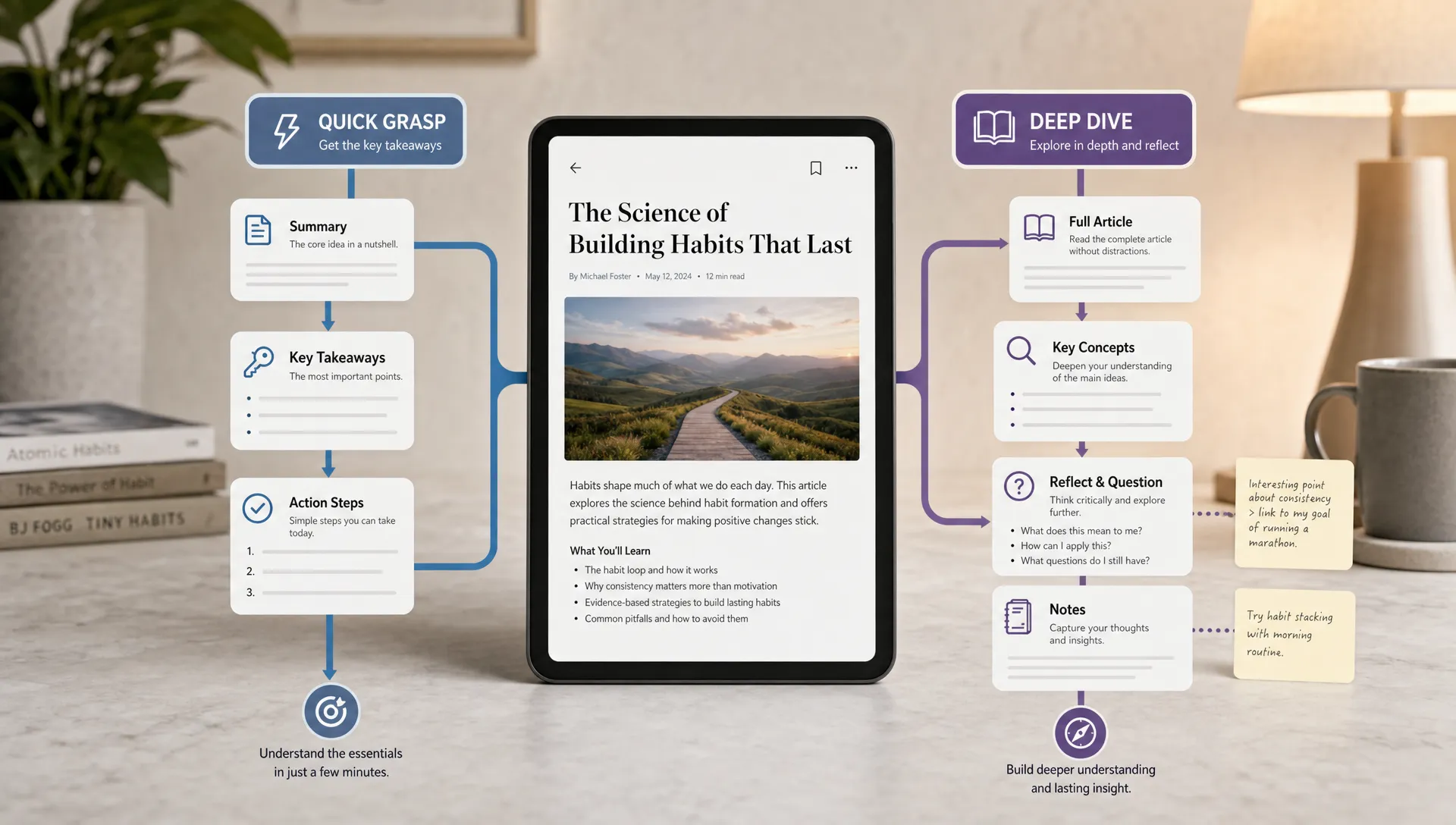
Quick Grasp or Deep Dive? Choose the Right Reading Mode
You do not need the same kind of attention for every piece of content you open. A news article, a research paper, a product report, a textbook chapter, and a two-hour lecture all ask different things from you. The mistake is treating them all the same.
Sometimes you need a quick grasp: the main idea, the structure, the relevance, and whether the content deserves more time. Other times, you need a deep dive: the evidence, assumptions, definitions, methods, and implications.
Choosing the right reading mode before you begin can save hours. More importantly, it can help you understand better because your attention is aimed at the right target.
What a reading mode actually is
A reading mode is the purpose you bring to a piece of content. It shapes what you look for, what you ignore, how slowly you move, and what kind of notes you take.
Most people switch modes unconsciously. They skim one article, over-read another, and get stuck halfway through a PDF without deciding what they were trying to learn. A more deliberate approach is simple: before you read, ask, “What do I need from this?”
For most learning and knowledge work, the two most useful modes are quick grasp and deep dive.
Quick grasp is for orientation. You want to understand what the content is about, why it matters, how it is organized, and whether it is useful for your current goal.
Deep dive is for mastery. You want to understand the reasoning, evidence, details, trade-offs, and connections well enough to use the material in your own thinking, writing, teaching, or decision-making.
Neither mode is “better.” The right choice depends on the task.
Use quick grasp when you need orientation
Quick grasp is not lazy reading. It is strategic reading. It helps you avoid spending deep attention on content that is not important enough, not relevant enough, or not ready to be studied in detail.
This mode is especially useful when you face information overload. If you have ten tabs open, six PDFs saved, three videos bookmarked, and a deadline approaching, your first job is not to understand everything. Your first job is to decide what deserves deeper attention.
Use quick grasp when you need to:
- Decide whether an article, paper, video, or PDF is worth reading fully
- Prepare for a meeting, seminar, or discussion quickly
- Get the basic argument before class or before a lecture
- Compare several sources at a high level
- Refresh your memory on something you already read
- Extract the main point from a long piece of content
In quick grasp mode, you are looking for the content’s shape. What problem is it addressing? What answer does it propose? What are the major sections? What is the conclusion? What seems useful, questionable, or worth returning to?
For example, a student might use quick grasp before reading a textbook chapter to identify the key concepts and avoid getting lost in examples. A researcher might use it to screen abstracts and introductions before choosing which papers to analyze. A founder or analyst might use it to extract the main claims from a market report before deciding whether to read the full document.
The output of quick grasp should be short, but not vague. A good quick grasp gives you enough clarity to make a decision.
Use deep dive when the details matter
Deep dive mode is for content that deserves sustained attention. You slow down, question the author, inspect the evidence, and connect the ideas to what you already know.
This mode is necessary when misunderstanding the material would create problems. If you are citing a paper, preparing for an exam, writing a report, teaching a concept, or making a decision based on the content, quick grasp alone is usually not enough.
Deep dive mode is useful when you need to:
- Understand a research method, argument, or framework
- Evaluate whether evidence supports a conclusion
- Compare findings across multiple sources
- Turn content into study notes, a briefing, or teaching material
- Identify assumptions, limitations, or counterarguments
- Apply the ideas to a project, decision, or piece of writing
In deep dive mode, you are not just asking “What does this say?” You are asking “How does it work?”, “Why does it matter?”, “What is missing?”, and “Can I explain this accurately to someone else?”
If you are working with academic material, this is especially important. A shallow summary can hide the difference between a strong finding, a weak correlation, a limited sample, and a speculative conclusion. For a more focused academic workflow, see this guide to creating a scientific paper summary for faster reading.
A simple way to choose: match the mode to the risk
One practical way to choose a reading mode is to ask how much risk there is in being wrong or incomplete.
If the risk is low, quick grasp may be enough. If the risk is high, deep dive is safer.
| Situation | Better mode | Why |
|---|---|---|
| You are deciding whether to save an article for later | Quick grasp | You only need relevance and main idea |
| You are preparing to cite a research paper | Deep dive | You need methods, limits, and evidence |
| You are comparing ten sources for a project | Quick grasp first | You need triage before close reading |
| You are studying for an exam | Deep dive | You need recall, examples, and connections |
| You are scanning industry news | Quick grasp | Most items do not need full analysis |
| You are writing a client brief or policy memo | Deep dive | Misreading details can affect decisions |
| You are trying to understand a confusing concept | Deep dive | You need explanation, not just summary |
| You are reviewing a video before sharing it | Quick grasp | You need the thesis, structure, and usefulness |
A helpful rule: if you only need to decide what to do next, use quick grasp. If you need to act on the content with confidence, use deep dive.
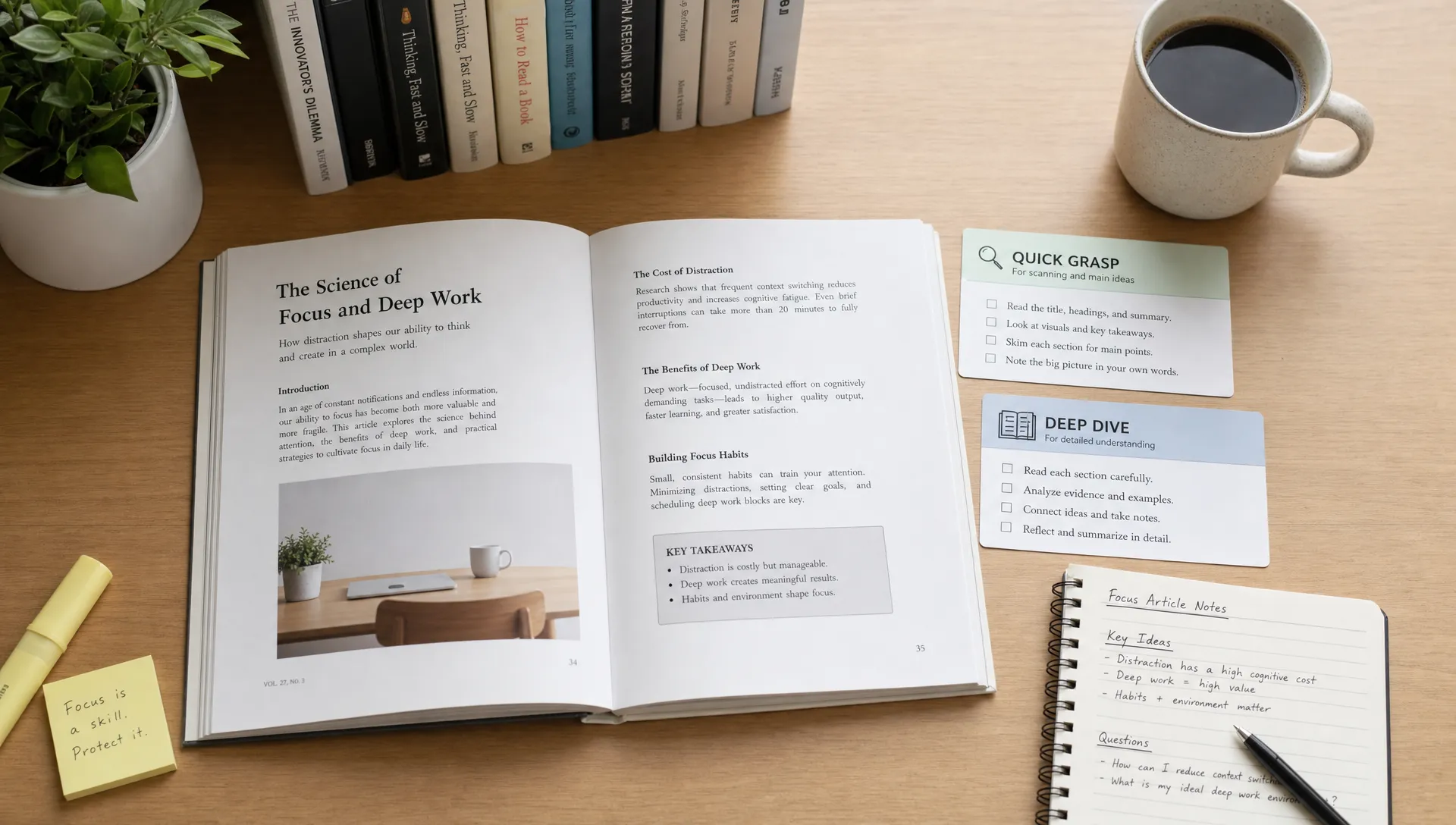
Quick grasp and deep dive work best together
The best readers do not choose one mode forever. They move between modes.
A smart workflow often looks like this:
- Start with quick grasp: Identify the topic, purpose, main claim, structure, and relevance.
- Choose what deserves attention: Mark the sections, claims, examples, or timestamps that matter most.
- Deep dive selectively: Read closely where the content is important, dense, or questionable.
- Reframe the material: Turn it into notes, questions, a plain-English explanation, or a teaching outline.
- Check your understanding: Try to explain the idea without looking. If you cannot, return to the confusing part.
This matters because deep reading everything is not realistic. But skimming everything leaves you with fragile understanding. The middle path is to grasp first, then dive where it counts.
This is also where AI reading tools can be helpful. unrav.io is built around the idea that content can be reframed depending on your goal. You can use it to get a quick grasp of an article, PDF, YouTube video, podcast, or pasted text, then shift toward a more detailed explanation when you need more depth.
The key is not to treat AI output as a replacement for judgment. Treat it as a way to orient your attention, clarify structure, and decide where your own thinking should go next.
What to look for in quick grasp mode
When you are in quick grasp mode, avoid trying to capture every detail. Your goal is to build a usable mental map.
A strong quick grasp should answer five questions:
- What is this content about?
- What problem or question does it address?
- What is the main claim or takeaway?
- How is the content structured?
- Why might this matter for my goal?
For a research paper, that might mean reading the title, abstract, conclusion, headings, figures, and introduction before touching the methods in detail. For a video, it might mean identifying the main segments and the speaker’s core argument. For a long report, it might mean reading the executive summary, section headings, charts, and recommendations.
Good quick grasp notes are short and directional. They might look like this:
| Content type | Quick grasp output |
|---|---|
| Research paper | Main question, finding, method type, and relevance |
| Textbook chapter | Core concepts, key terms, and likely exam topics |
| Business report | Main recommendation, supporting signals, and risks |
| YouTube lecture | Main lesson, section breakdown, and useful timestamps |
| Long article | Thesis, key arguments, and whether to read fully |
If your quick grasp notes become long enough to resemble the original, you are drifting into deep dive mode without deciding to.
What to look for in deep dive mode
Deep dive mode requires a different kind of attention. You are not just extracting the main idea. You are testing and integrating it.
In deep dive mode, focus on:
- Definitions and terms that carry the argument
- Evidence, examples, data, or citations
- Steps in the reasoning
- Assumptions the author depends on
- Limitations, uncertainty, or missing context
- Connections to other material you have read
- Questions you still cannot answer
This is where simple summaries often fall short. A summary can tell you what a paper concludes, but not whether the method supports that conclusion. It can tell you what a chapter covers, but not which ideas you need to practice. It can tell you what a video says, but not whether the explanation is reliable.
For a broader explanation of this problem, read how summarizing falls short without real understanding. The point is not that summaries are bad. It is that summaries need to be matched with the right reading goal.
Deep dive notes should usually include your own thinking, not just extracted points. Write down where you agree, where you are unsure, and what you need to verify. If you are preparing to use the material in a paper, report, lesson, or presentation, this layer of interpretation is essential.
How different readers can choose the right mode
The same article can call for different modes depending on who is reading it.
A student reading before class may only need quick grasp at first: key terms, main argument, and questions to bring to discussion. The same student preparing for an exam later needs deep dive: definitions, examples, comparisons, and practice explaining concepts from memory.
A researcher screening papers may use quick grasp to identify which studies are relevant. But when a paper becomes part of a literature review, deep dive becomes necessary. Methods, sample size, limitations, and how the findings compare with other studies all matter.
A professional reading a long industry report may start with quick grasp to find the recommendation and major trends. If that report informs a strategy document, they should deep dive into the assumptions, data sources, and risks.
A content creator may use quick grasp to turn a long interview or article into an outline. But if they want to create a thoughtful essay, script, or newsletter, they need deep dive mode to understand nuance and avoid flattening the original ideas.
An educator may use quick grasp to preview material for a lesson. Then deep dive helps them simplify without distorting, choose examples, and anticipate where learners may struggle.
When the problem is not just length but tangled relationships between ideas, a visual approach can help. In those cases, a mind map maker for reading and research can support the transition from quick grasp to deeper understanding.
Common mistakes when choosing a reading mode
The first mistake is using quick grasp when you actually need evidence. This happens when someone reads only an abstract, summary, or AI-generated overview, then cites the material as if they understood the full argument. Quick grasp can tell you whether something is relevant. It cannot always tell you whether it is reliable.
The second mistake is deep diving too early. If you start close reading before you know why the content matters, you may waste time on irrelevant detail. This is common with PDFs, textbook chapters, and long reports. Orientation first prevents unnecessary effort.
The third mistake is confusing length with importance. A short article may deserve a deep dive if it contains a key argument. A long document may only need quick grasp if it is peripheral to your goal.
The fourth mistake is asking an AI tool for “a summary” without specifying the mode. A short summary, a study guide, a critique, a plain-English explanation, and a teaching outline are different outputs. The clearer your purpose, the more useful the result.
How to prompt for the mode you need
Whether you are using unrav.io, another AI tool, or your own note-taking system, it helps to name the mode explicitly.
For quick grasp, ask for orientation:
“Give me a quick grasp of this article: the main point, the structure, the key claims, and whether it is useful for someone studying [topic].”
For deep dive, ask for reasoning:
“Help me deeply understand this paper. Explain the research question, method, evidence, assumptions, limitations, and how the conclusion follows from the results.”
For teaching, ask for explanation:
“Reframe this content so I can teach it to a beginner. Include key concepts, examples, common misunderstandings, and questions to check understanding.”
For content creation, ask for transformation:
“Turn this long article into an outline for a newsletter. Keep the nuance, identify the strongest ideas, and suggest where I should verify details before publishing.”
This is where reading modes become practical. You are not just asking for less text. You are asking for the right kind of understanding.
Frequently Asked Questions
Is quick grasp the same as skimming? Not exactly. Skimming is a technique, while quick grasp is a goal. You may skim to get a quick grasp, but the goal is to understand the main idea, structure, and relevance well enough to decide what to do next.
When should I avoid quick grasp mode? Avoid relying only on quick grasp when you need accuracy, evidence, citation, or detailed understanding. Research papers, legal documents, technical specifications, and exam material often require a deeper pass.
Can I start with deep dive right away? Yes, if you already know the content is important and you understand your purpose. But for unfamiliar or large volumes of material, starting with quick grasp usually helps you focus your deep reading.
How can AI help me choose a reading mode? AI can help by giving you an initial overview, identifying structure, surfacing key questions, or reframing content for study, teaching, or analysis. You still need to judge what matters and verify important details.
What is the best mode for studying? Use both. Start with quick grasp to see the chapter, paper, or lecture as a whole. Then deep dive into definitions, examples, problem areas, and the ideas most likely to matter for exams or assignments.
Choose the mode before you read
The fastest readers are not always the ones who read every word quickly. Often, they are the ones who know what kind of reading a situation requires.
Use quick grasp when you need orientation, triage, or a first layer of understanding. Use deep dive when the content affects your work, research, teaching, writing, or decisions. Move between the two instead of forcing every article, PDF, video, or report into the same workflow.
If you want help switching modes, unrav.io can reframe articles, PDFs, videos, podcasts, and pasted text depending on what you are trying to understand. Start with a quick grasp, then go deeper where the material deserves your attention.