
How Language Affects Understanding of Complex Ideas
When a research paper, report or lecture feels impossible to follow, the problem is not always the idea itself. Often, the language carrying the idea makes the work harder than it needs to be.
A concept may be learnable, but if it is wrapped in undefined terms, long sentences, hidden assumptions or vague examples, readers spend their attention decoding the wording instead of building the idea. This matters for students trying to study faster, researchers comparing papers, professionals reading dense reports and creators turning complex material into clearer content.
Language affects understanding because it shapes what we notice, how much we can hold in memory and how easily we can connect one idea to another. Good language does not remove complexity. It makes the structure of the complexity visible.
Language is not just packaging
It is tempting to treat language as decoration added after the real thinking is done. In practice, language is part of the thinking process. The words, syntax and examples used to explain an idea determine how a reader builds a mental model of it.
For example, compare these two explanations:
| Dense version | Clearer version |
|---|---|
| The intervention demonstrated efficacy through the modulation of participant behavior across multiple conditions. | The intervention worked because it changed how participants behaved in several test conditions. |
The second version is not less intelligent. It makes the same relationship easier to see: something worked, and it worked by changing behavior.
This is the central issue in understanding language: comprehension depends on more than definitions. Readers also need relationships, sequence, contrast, cause, evidence and limits. If the language hides those signals, even familiar words can become confusing.
Word choice determines what readers can see
Every field uses specialist vocabulary. In biology, economics, law, philosophy and software engineering, technical terms allow experts to communicate precisely. The problem begins when those terms are used without enough context for the reader’s level.
A word like “model” can mean a statistical tool, a simplified representation, a machine learning system, a theory or a physical prototype. A word like “significant” can mean important in everyday speech, but statistically unlikely to be due to chance in research writing. When a writer assumes that every reader shares the same meaning, confusion enters quietly.
This does not mean you should avoid technical terms. It means you should introduce them carefully. A good explanation often follows a simple pattern: use the term, define it in plain language, then show it in action.
For example:
“Cognitive load is the amount of mental effort required to process information. If a paragraph contains too many new terms at once, the reader’s cognitive load rises and understanding drops.”
That version preserves the term but gives the reader a working handle. If you are reading, the same principle applies in reverse. When a dense passage feels unclear, identify the terms doing the most work and translate them into your own words. If you cannot translate them yet, mark them as unresolved rather than pretending they are understood.
Sentence structure controls mental effort
Complex ideas often require complex relationships. The issue is not sentence length alone. A long sentence can be clear if its logic is well ordered. A short sentence can be confusing if it uses vague pronouns or leaves out the relationship between claims.
Consider this sentence:
“Because the dataset was collected before the policy change, and because several demographic variables were missing, the authors caution that the observed increase cannot be treated as proof that the policy caused the outcome.”
It is long, but the logic is visible. The reader can follow the sequence: two limitations lead to a cautious interpretation.
Now compare it with this:
“The increase was observed, although limitations were present, which affected interpretation.”
This version is shorter, but less clear. What limitations? What did they affect? How did they change the interpretation?
Dense language often creates problems through:
- Long noun phrases, such as “the implementation-related variability of participant response patterns”
- Hidden verbs, such as “conduct an analysis” instead of “analyze”
- Unclear pronouns, such as “this,” “it” or “they” without a clear reference
- Stacked clauses that delay the main point until the end
- Passive voice that hides who did what when the actor matters
The fix is not to make everything simplistic. The fix is to make the main action and relationship visible. If a sentence explains cause and effect, make the cause and effect easy to locate. If it compares two theories, name both theories. If it adds a limitation, signal that limitation clearly.
Structure helps readers connect ideas
Understanding rarely comes from one sentence alone. It comes from seeing how sentences build on each other. This is where structure becomes essential.
A well structured explanation tells the reader what role each part plays. One paragraph may define a concept. The next may explain why it matters. Another may show an example. Another may name a limitation. Without those signals, the reader receives information but cannot easily organize it.
Transition words are small but powerful. Words like “because,” “therefore,” “however,” “for example,” “in contrast” and “as a result” tell the reader what kind of relationship to expect. They are not filler. They are navigation tools.
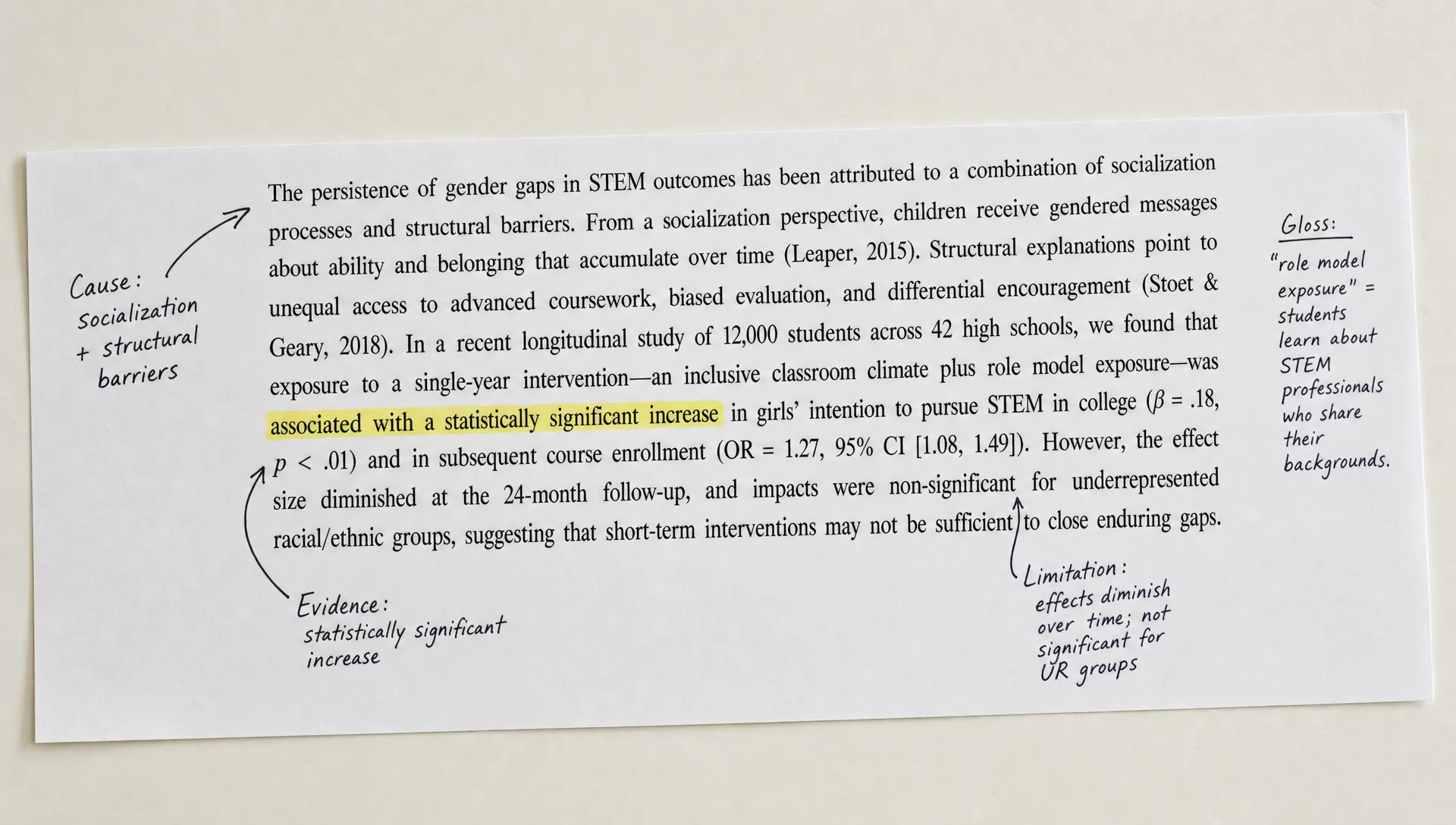
For dense reading, it helps to label each paragraph by function:
| Paragraph function | Question it answers |
|---|---|
| Definition | What is this idea? |
| Context | Why does it matter here? |
| Mechanism | How does it work? |
| Evidence | What supports it? |
| Contrast | How is it different from another idea? |
| Limitation | Where does the claim stop applying? |
This is especially useful for research papers and technical reports. If every paragraph feels equally important, you have to hold too much in memory. If you can identify each paragraph’s function, the document becomes easier to navigate.
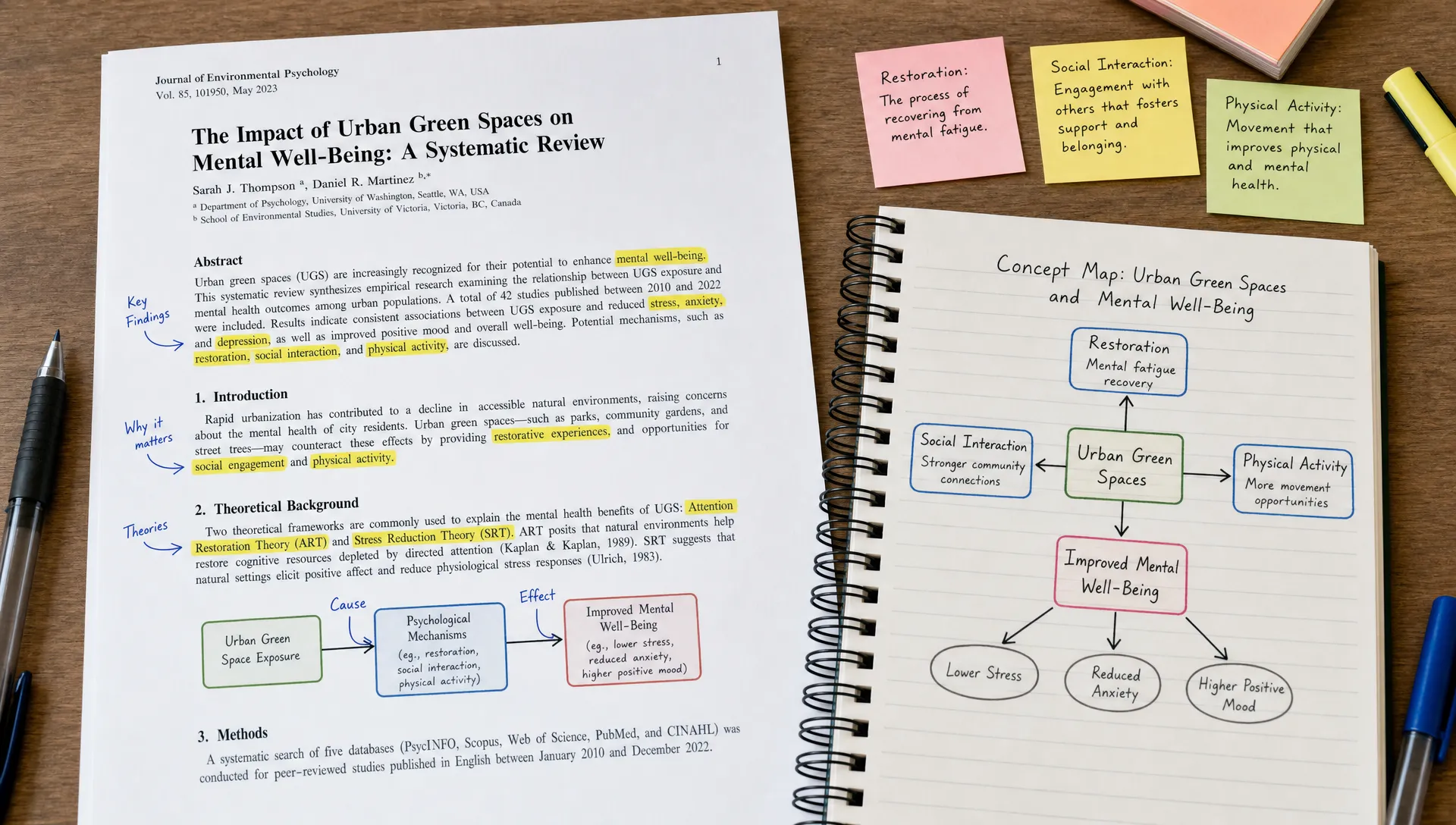
For visual thinkers, mapping those relationships can help. A concept map is useful when the problem is not vocabulary but hidden structure. If you want a practical workflow for this, unrav.io has a guide on using a concept map maker for complex topics and dense reading.
Abstraction needs concrete anchors
Many complex ideas are abstract by nature: democracy, entropy, liquidity, validity, bias, resilience, emergence. These words are useful because they compress large ideas into small packages. But compression has a cost. Readers may recognize the word without being able to explain the mechanism behind it.
Concrete language gives the reader an anchor. It connects the abstract idea to something observable, imaginable or testable.
For instance, “friction” in a business report might mean delays, repeated approvals, unclear ownership or confusing software. If the writer only says “reduce friction,” the reader may agree without knowing what action to take. If the writer says “reduce friction by cutting the approval process from four steps to two,” the idea becomes actionable.
The same principle applies outside academic or business writing. A technical product concept is easier to understand when it is tied to a familiar sensory experience. For example, Air Tea Company explains warm air extraction for herbal wellness by connecting the process to herbs, fragrance and breathing. The concrete language helps readers imagine what the process means instead of leaving them with an abstract mechanism alone.
Examples do not weaken an idea. They test it. If an explanation cannot produce a clear example, the concept may still be too vague.
Metaphors can clarify or mislead
Metaphors are powerful because they let readers borrow an existing mental model. We talk about “information pipelines,” “memory storage,” “market signals,” “feedback loops” and “attention bottlenecks” because these phrases quickly suggest relationships.
The risk is that every metaphor highlights some features and hides others. Calling the brain a computer can help when discussing information processing, but it can mislead if the reader assumes memory works like a hard drive. Calling an economy a machine may clarify inputs and outputs, but it may hide human behavior, uncertainty and adaptation.
A useful metaphor should do two things. First, it should make the target idea easier to grasp. Second, it should have clear boundaries. Good teachers often say, “This analogy works for this part, but not for that part.” That sentence protects the learner from overextending the comparison.
When reading a metaphor in dense material, ask what it is trying to explain. Is it about structure, movement, scale, cause, hierarchy or feedback? Once you know the role of the metaphor, you can use it without being trapped by it.
Language changes confidence as well as comprehension
Language does not only affect whether people understand an idea. It also affects how confident they feel about that understanding.
Overly fluent language can create the illusion of comprehension. A smooth summary may feel satisfying because it removes difficulty, but it can also remove the reasoning that made the original idea meaningful. This is why summaries are helpful for orientation but risky as the final step. If you want to explore that problem in more depth, read how summarizing falls short without real understanding.
On the other side, needlessly dense language can make readers feel less capable than they are. A student may think they are “bad at theory” when the real issue is that the text uses undefined abstractions. A professional may avoid a technical report because the writing assumes too much background knowledge. A creator may hesitate to explain a topic because the source material feels more authoritative than their own grasp of it.
Clear language gives readers a more accurate signal. It shows what is genuinely difficult and what was only hard because of wording.
Different audiences need different language
No single version of an explanation works for everyone. A researcher, first-year student and product manager may all need to understand the same idea, but they need different entry points.
| Audience | What they usually need from language | Example move |
|---|---|---|
| Students | Definitions, examples and exam-ready distinctions | Explain the term, then compare it with a similar term |
| Researchers | Precision, methods, limits and connections to prior work | Keep technical terms but clarify assumptions and scope |
| Professionals | Implications, trade-offs and decisions | Translate findings into risks, actions and constraints |
| Content creators | Core claims, audience-friendly examples and reusable structure | Turn the idea into an outline, script or explainer |
| Educators | Simple explanations without distortion | Use examples, checks for understanding and clear boundaries |
This is why rewriting complex material is not just about shortening it. A shorter version may still be wrong for the audience. A student may need more examples, not fewer words. A researcher may need more precise qualifiers, not a simplified claim. A busy executive may need the decision relevance first, then the evidence.
If you use unrav.io to work through an article, PDF or video, this is where different reading lenses can help. A quick grasp view can orient you, while a teach-it style reframing can expose whether the idea can be explained clearly. The point is not to replace careful reading. It is to create a better path into the material.
A practical method for making complex ideas easier to understand
Whether you are reading, writing or teaching, you can improve understanding by changing how language presents the idea. Use this process when a passage feels dense or when you need to explain something difficult to someone else.
- Find the core claim: Ask what the passage is mainly saying. If it contains several claims, separate them.
- Define the load-bearing terms: Identify the words that carry the most meaning. Translate them into plain language without removing necessary precision.
- Make the action visible: Look for hidden verbs and abstract nouns. Change “the evaluation of outcomes occurred” to “the team evaluated the outcomes.”
- Name the relationships: Add signals for cause, contrast, sequence, evidence and limitation.
- Add one concrete example: Choose an example that shows the idea in motion, not just a decorative illustration.
- Check the boundary: State where the explanation stops applying or what it does not prove.
- Explain it back: Say the idea in your own words, then compare your version with the source.
The final step matters most. Recognition is not the same as understanding. You may recognize the vocabulary of a topic and still be unable to explain how the pieces fit. For a deeper self-check, see this guide on how to tell if you truly understand a topic.
Example: turning dense language into clearer understanding
Take this sentence:
“Epistemic uncertainty in model outputs complicates downstream decision-making under conditions of incomplete observability.”
A reader may understand some words but still struggle with the whole sentence. We can unpack it without losing the point:
“Because the model is unsure about what it predicts, people using its output may make weaker decisions, especially when they cannot see all the relevant facts.”
Now the idea is clearer. The key term “epistemic uncertainty” could still be introduced if the audience needs it:
“Epistemic uncertainty means uncertainty caused by limited knowledge. In this case, the model is unsure because it does not have enough information, and that uncertainty affects the decisions people make from its output.”
Notice what changed. The clearer version names the cause, the affected actor and the condition. It does not simply replace hard words with easy ones. It reveals the logic.
This is the main lesson: language affects understanding most when it changes the visibility of relationships.
Frequently Asked Questions
How does language affect understanding? Language affects understanding by shaping how easily readers can identify key terms, follow relationships, connect examples and build a mental model of the idea. Clear language reduces unnecessary effort without removing meaningful complexity.
Does simplifying language make complex ideas less accurate? Not if it is done carefully. Good simplification preserves the core meaning, keeps necessary technical terms and explains limits. Bad simplification removes important distinctions or makes claims sound more certain than they are.
Why do I understand individual words but not the full idea? This usually happens when the relationships between the words are unclear. You may know the vocabulary but still miss the cause, contrast, sequence, assumption or implication that connects the pieces.
What is the best way to understand dense academic language? Start by identifying the main claim, defining key terms, marking relationship words and rewriting the passage in your own words. Then check your version against the original to see what you preserved or missed.
Can AI help with understanding complex language? AI can help reframe dense material, generate simpler explanations, extract key ideas and create study-friendly versions. It should be used as a reading aid, not as a replacement for judgment, verification or careful engagement with important sources.
The next step is to make the language work for you
Complex ideas do not always need to be simplified. They need to be made understandable. That means choosing words carefully, making sentence logic visible, adding examples and showing how each part connects to the whole.
If you are working through dense articles, PDFs, reports or videos, unrav.io can help you reframe the material for quicker grasping, deeper learning or teaching. Use it as a companion for comprehension, then test your understanding by explaining the idea back in your own words.