
How to Summarize a Scientific Article in Plain English
Scientific articles are often written for specialists, not busy readers who need the point quickly. Even when the topic is interesting, the language can feel dense: long methods sections, cautious wording, statistical details, and terms that assume years of background knowledge.
A good plain-English summary solves a specific problem. It helps someone understand what the article studied, what the researchers found, how they found it, how much confidence to place in the findings, and why the work matters. It should make the science easier to grasp without turning it into a vague or oversimplified takeaway.
If you need to summarize a scientific article for class, research, work, teaching, or content creation, the process below will help you keep the meaning intact while making the language much clearer.
What plain English means in a scientific summary
Plain English does not mean dumbing down the science. It means removing unnecessary friction between the reader and the idea.
A plain-English scientific summary uses familiar words where possible, explains technical terms when they matter, and keeps sentences direct. It also preserves uncertainty. If a study suggests something, your summary should not say it proves it. If the study was done in mice, a small group of patients, or one region, your summary should not imply the finding applies to everyone.
The principles are similar to general plain-language guidance from PlainLanguage.gov: write for the reader, organize information clearly, and use language people can act on. In science, that clarity has to be paired with accuracy.
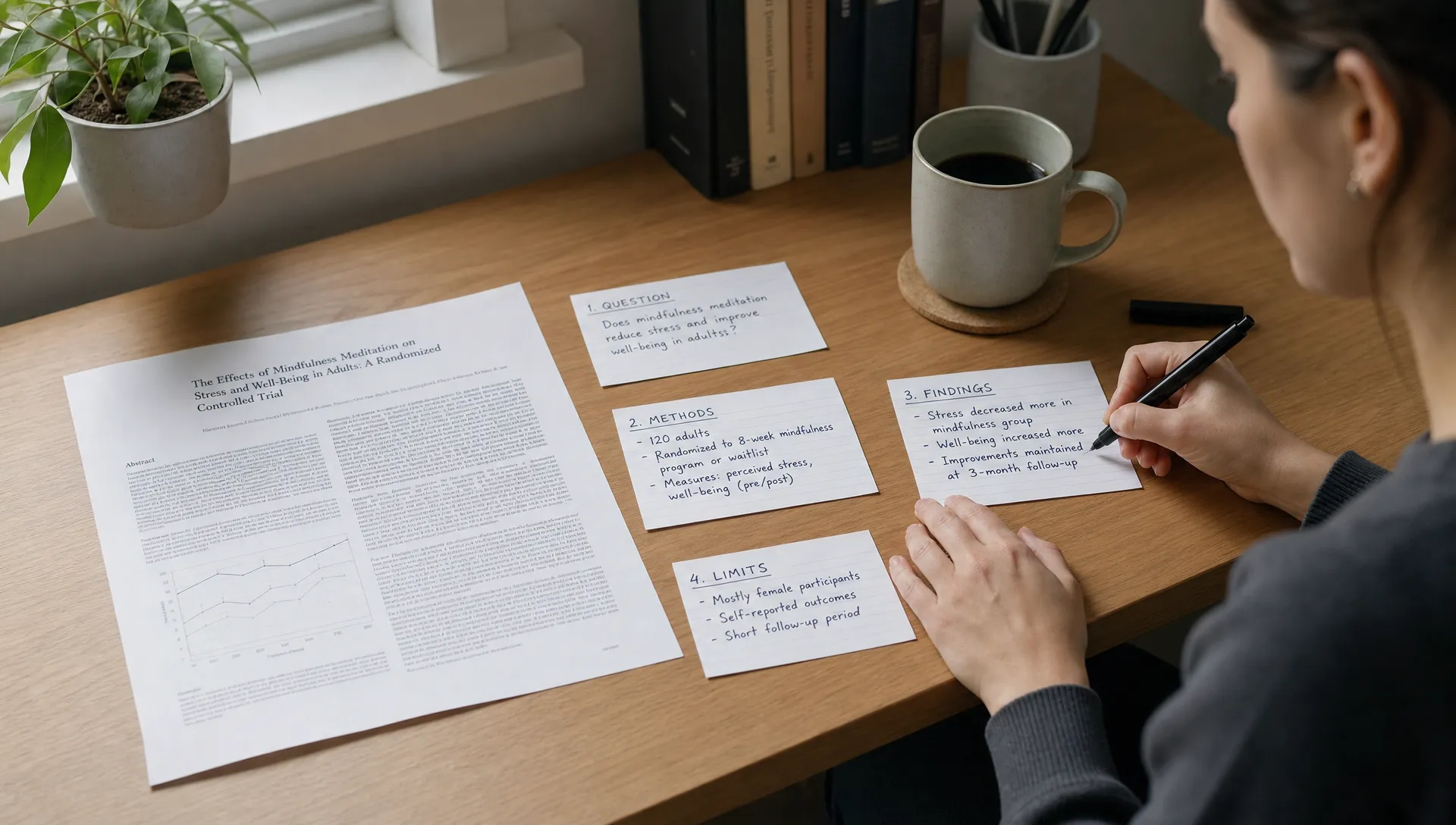
Before writing, make sure your summary answers five basic questions:
- What question did the article try to answer?
- What did the researchers do?
- What did they find?
- How strong or limited is the evidence?
- Why does the finding matter?
If your summary answers those questions in simple language, it is already more useful than a shortened version of the abstract.
First, identify what kind of scientific article you are reading
Not every scientific article should be summarized the same way. A lab experiment, a clinical trial, a review article, and a commentary all have different goals. If you miss the article type, you may summarize the wrong thing.
| Article type | What it usually does | What your summary should emphasize |
|---|---|---|
| Original research study | Reports new data from an experiment, observation, survey, or analysis | Research question, methods, results, limitations |
| Review article | Synthesizes existing studies on a topic | Main themes, areas of agreement, gaps in evidence |
| Systematic review or meta-analysis | Uses a structured method to collect and compare multiple studies | Search criteria, included studies, overall pattern of findings |
| Methods paper | Introduces or tests a research method, model, tool, or protocol | What the method does, why it is useful, when it applies |
| Commentary or perspective | Presents an expert argument or interpretation | Main claim, reasoning, evidence used, possible bias |
This matters because a plain-English summary is not just a translation task. It is a judgment task. You are deciding what information helps the reader understand the article’s purpose and value.
For a deeper workflow focused specifically on academic papers, you may also find it useful to read about how to summarize a research paper without losing the point.
Use the article structure as a map, not as your final summary
Many scientific articles follow the IMRaD structure: Introduction, Methods, Results, and Discussion. Reporting guidelines collected by the EQUATOR Network also reflect how strongly scientific writing depends on transparent structure.
That structure helps you read the article, but your final summary should not simply copy it section by section. Most readers do not need a miniature version of the paper. They need a clear explanation of the study’s logic.
| Article section | Question to ask | Plain-English output |
|---|---|---|
| Introduction | What problem or knowledge gap motivated the study? | The researchers wanted to understand... |
| Methods | What did they actually do? | They compared, measured, surveyed, tested, or analyzed... |
| Results | What changed, differed, increased, decreased, or stayed the same? | They found that... |
| Discussion | What do the authors think the results mean? | The authors argue this may mean... |
| Limitations | What should readers be careful about? | The finding is limited because... |
This map prevents a common problem: writing a summary that sounds fluent but misses the evidence.
How to summarize a scientific article in plain English
1. Skim for the research question before reading every detail
Start with the title, abstract, section headings, figures, tables, and conclusion. Your goal is not to understand every term immediately. Your goal is to locate the article’s central question.
Look for phrases such as the study aimed to, we investigated, we tested whether, or this review examines. These phrases usually point to the article’s purpose.
Then write one rough sentence in your own words:
The study asked whether a specific factor, treatment, behavior, or condition is connected to a specific outcome in a specific group or setting.
That sentence becomes the anchor for the rest of your summary.
2. Translate the research question into everyday language
Scientific questions are often narrow by design. Plain English should make that narrowness visible.
Instead of writing:
The paper evaluates the association between sedentary behavior and cardiometabolic risk markers in adults.
Write:
The researchers studied whether adults who spend more time sitting also show signs linked to higher heart and metabolism risk, such as changes in blood pressure, cholesterol, or blood sugar.
Notice that the second version is longer, but clearer. Plain English is not always shorter. It is easier to understand.
3. Explain the methods as choices the researchers made
The methods section can be intimidating, but its purpose is simple: it tells you how the researchers tried to answer the question.
In a plain-English summary, methods should usually explain four things: who or what was studied, what was measured, what was compared, and over what time period. You do not need to include every instrument, statistical model, or procedural detail unless it changes how the reader should interpret the findings.
For example, instead of writing:
Participants were randomized into intervention and control arms using a double-blind protocol.
Write:
The researchers randomly assigned participants to receive either the treatment or a comparison option, and neither the participants nor the researchers knew who received which option during the study.
This keeps the methodological strength of the study without forcing the reader to already know the terminology.
4. Separate the findings from the authors’ interpretation
Scientific articles often move quickly from results to meaning. Your summary should slow that down.
The findings are what the study observed. The interpretation is what those observations might mean. Both are useful, but they are not the same.
A result might say that one group improved more than another group. An interpretation might say the treatment could be useful in a certain setting. A plain-English summary should make that distinction clear, especially if the study is early, small, observational, or based on indirect evidence.
Use careful verbs:
- Use found, observed, reported, or measured for results.
- Use suggests, may indicate, or could help explain for interpretation.
- Avoid proves, guarantees, or shows once and for all unless the evidence truly supports that level of certainty.
5. Keep the limitations in the summary
Limitations are not optional. They are part of the meaning of the article.
A plain-English summary that deletes limitations can become misleading, even if the rest of the summary is accurate. Readers need to know whether the study was small, short, preliminary, based on self-reported data, limited to one population, or unable to show cause and effect.
You can keep limitations brief:
The study was small and only followed participants for six weeks, so the results may not apply to larger groups or longer-term outcomes.
Or:
Because this was an observational study, it can show a link between the two factors, but it cannot confirm that one caused the other.
This kind of sentence makes your summary more trustworthy.
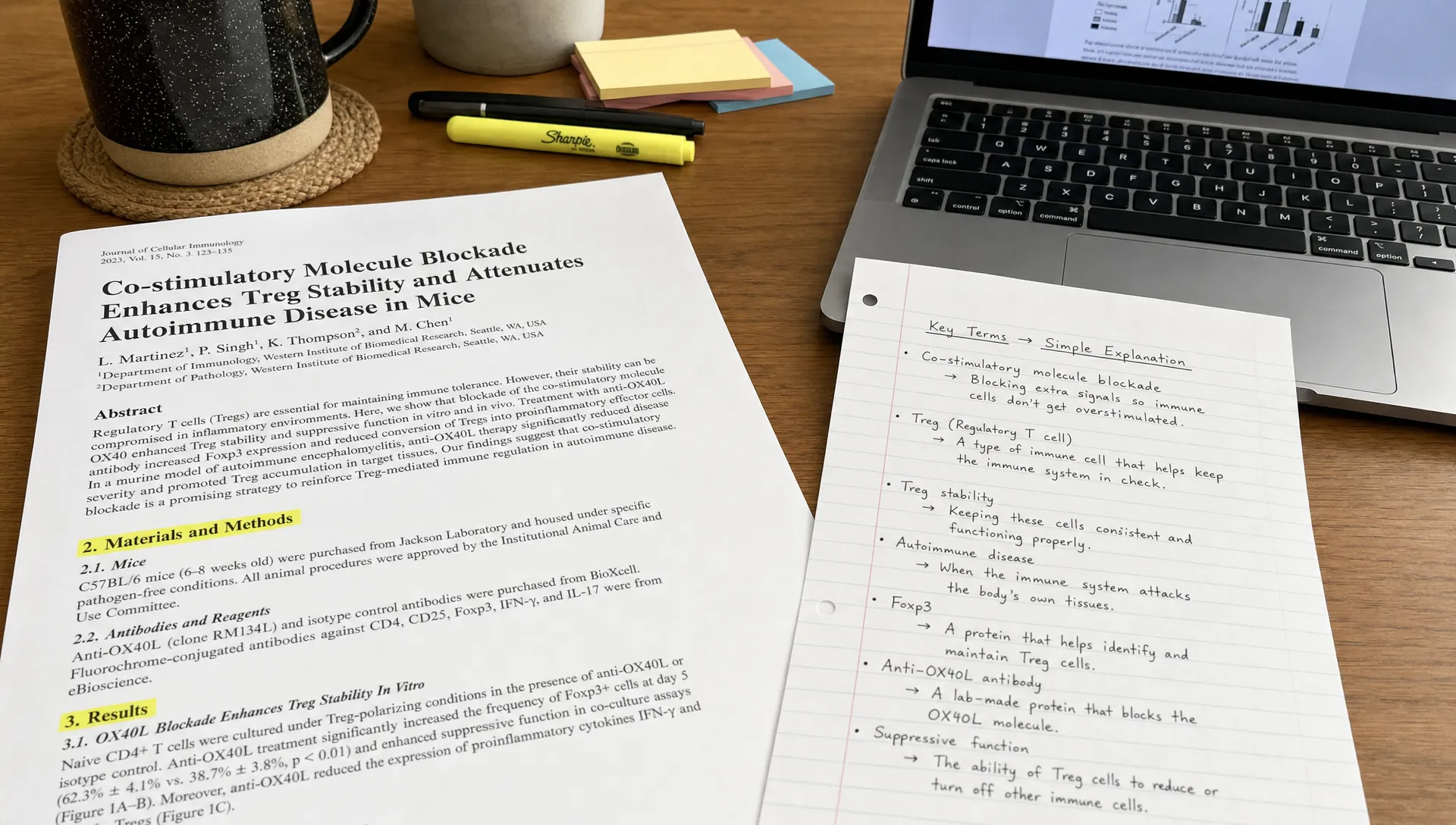
6. Replace technical terms with short explanations
Some technical terms should be kept because they carry specific meaning. But you can define them in simple language the first time they appear.
| Technical phrase | Plain-English version |
|---|---|
| Statistically significant | The result was unlikely to be due to chance, based on the researchers’ test |
| Correlation | Two things changed together, but that does not prove one caused the other |
| Control group | A comparison group used to judge whether the main treatment or condition made a difference |
| In vitro | Studied in cells or lab materials, not in a living person or animal |
| Cohort study | A study that follows a group of people over time |
| Confidence interval | A range that shows where the true result may reasonably fall |
Do not define every word if your audience already understands it. A summary for graduate researchers can use more technical language than a summary for a general audience. Plain English means matching the reader, not removing all scientific vocabulary.
7. End with the so what, but do not exaggerate it
A useful summary finishes by explaining why the article matters. This is where you connect the finding to the reader’s purpose.
For a student, the importance may be how the article supports a course concept. For a researcher, it may be a gap for future work. For a professional, it may be a cautious signal for policy, product, or strategy. For a content creator or educator, it may be a way to explain a complex topic more clearly.
A balanced final sentence might look like this:
Overall, the article suggests that the intervention may help in this specific context, but larger and longer studies are needed before applying the finding broadly.
That sentence gives the reader a takeaway and a boundary.
A plain-English summary template you can copy
Use this template when you need a fast but reliable structure:
Main question: What did the article try to find out?

What the researchers did: Who or what did they study, and how?

Key finding: What was the most important result?

What it means: How should a reader interpret the result?

Limitations: What should make us cautious?

One-sentence summary: What is the clearest version of the article’s point?
This format works especially well for class readings, literature reviews, research notes, workplace briefs, and teaching materials. If you are summarizing journal articles for academic or professional use, this guide to the best ways to summarize a journal article for class or work gives additional approaches for different contexts.
Example: turning a dense scientific result into plain English
Imagine a fictional scientific article about a 12-week sleep education program for first-year college students.
Dense version:
The intervention group demonstrated a statistically significant increase in mean nightly sleep duration relative to controls, with modest improvements in self-reported daytime alertness.
Plain-English version:
Students who took part in the sleep education program slept longer each night than students who did not receive the program. They also reported feeling slightly more alert during the day. The results suggest the program may help some first-year students improve sleep habits, although the study relied partly on self-reported data.
The plain-English version does three things better. It names the people studied, explains the comparison, and keeps the limitation visible.
Common mistakes to avoid
The biggest mistake is copying the abstract and changing a few words. Abstracts are useful, but they are written for readers who already understand the field. A plain-English summary should rebuild the explanation for your audience.
Other common mistakes include:
- Leaving out the study population, which makes the finding sound more general than it is.
- Saying a study proves something when it only suggests or supports it.
- Explaining the topic broadly but forgetting the article’s specific research question.
- Reporting the authors’ conclusion without checking the methods and results.
- Removing all technical terms, even when a term is important for accuracy.
A strong summary is not just shorter. It is clearer, more organized, and more honest about what the article can and cannot tell us.
When to use AI for plain-English scientific summaries
AI can be helpful when you are stuck in dense wording, comparing multiple papers, or trying to turn a technical passage into something easier to explain. It can also help you create different versions of the same summary for different audiences, such as a class discussion, a research note, a presentation slide, or a teaching handout.
With unrav.io, you can work from links, pasted text, PDFs, YouTube videos, and podcasts, then reframe the material using different thinking modes depending on whether you need a quick grasp, deeper understanding, or a teachable explanation.
Still, AI should not replace your judgment. Always compare the output against the original article, especially for methods, numbers, limitations, and causal claims. If the article matters for research, grades, policy, health, legal work, or business decisions, treat the AI summary as a reading aid, not as the final authority.
This is also why simple summaries can fall short if they do not support real comprehension. If you want to think more deeply about that issue, see why summarizing can miss real understanding.
Frequently Asked Questions
What is the easiest way to summarize a scientific article? Start by identifying the research question, then explain what the researchers did, what they found, what the result means, and what limitations affect the finding. Do not begin by rewriting the abstract. Use the article’s structure as a guide, then write for your specific reader.
How long should a plain-English scientific summary be? It depends on the purpose. A quick class or meeting summary may be 150 to 250 words. A research note may need 400 to 700 words. The summary should be long enough to include the question, methods, findings, meaning, and limitations.
Can I use first-person language in a scientific summary? Usually, keep the focus on the article rather than yourself. Phrases like the researchers found or the study suggests are clearer and more objective. First-person language may be fine in reflection assignments, teaching notes, or personal study materials.
Should I include statistics in a plain-English summary? Include statistics when they are central to the finding, but explain what they mean. For a general audience, it is often better to describe the direction, size, and uncertainty of the result than to list every number from the paper.
Can AI summarize a scientific article accurately? AI can help create a first draft, simplify wording, and surface key points, but it can also miss nuance or overstate findings. Always check the summary against the original article, especially the results, methods, and limitations.
Make complex science easier to explain
A plain-English scientific summary should help someone understand the article without distorting it. The best summaries are clear, accurate, and appropriately cautious.
If you are working through dense papers, technical PDFs, lectures, or research-heavy content, unrav.io can help you turn complex material into clearer outputs for learning, teaching, or writing. Use it to get oriented faster, then return to the original source with better questions and a stronger grasp of the article’s meaning.