

How to Turn Articles Into Notes for Work or Study
Turning an article into notes sounds simple until you open a dense report, a research paper, a long essay or a technical post and end up with scattered highlights you never use again.
Good notes are not a shorter copy of the article. They are a working version of the article, shaped around what you need to remember, decide, write or explain later. The goal is to turn reading into something reusable.
This guide walks through a practical workflow you can use to turn articles into notes for work or study, with examples for students, researchers, professionals, educators and content creators.
What good article notes should do
A useful note answers more than “what did the article say?” It helps you understand the article, recall it later and apply it to a real task.
At minimum, your notes should capture:
- The article’s main idea or argument
- The key evidence, examples or data points
- Important terms, frameworks or concepts
- Your own questions and reactions
- How the article connects to your work, class, research or content project
- What you should do next, if anything
This matters because reading and note-taking have different jobs. Reading exposes you to information. Notes turn that information into something you can use.
If you are studying, your notes should help you retrieve ideas without rereading the full article. If you are working, they should help you brief a team, make a decision or support a recommendation. If you are creating content, they should help you find angles, examples and structure.
Choose the right note format before you read
Before reading deeply, decide what kind of output you need. The same article can become a study guide, a research note, a work brief or a content outline. Choosing the format first keeps you from copying too much.
| Your purpose | Best note format | What to capture |
|---|---|---|
| Study for a class | Study note or Q&A sheet | Concepts, definitions, examples, likely exam questions |
| Prepare for work | Briefing note | Main issue, implications, risks, decisions and next steps |
| Review research | Literature note | Research question, method, findings, limitations and relevance |
| Create content | Outline or idea bank | Claims, examples, quotable ideas, counterpoints and audience angles |
| Teach the material | Teaching note | Simple explanation, analogy, sequence and discussion questions |
This one decision changes how you read. A student reading for an exam should look for definitions and relationships between ideas. A manager reading for a meeting should look for implications. A researcher reading a paper should look for method, evidence and limits.
A 7-step workflow to turn articles into notes
You do not need a complicated system. You need a repeatable process that separates understanding from capturing.
1. Start with a reading goal
Before taking notes, write one sentence that explains why you are reading.
For example:
“Understand the main argument so I can discuss it in class.”
“Extract insights for a client briefing.”
“Find examples for a newsletter about AI and education.”
This goal becomes your filter. Without it, every paragraph feels equally important. With it, you can skip details that do not serve the task.
2. Capture the source information first
At the top of every note, record enough information to find the article again. This is especially important for academic work, research projects and workplace reports where you may need to cite or verify the source later.
A simple source block can include the title, author, publication, date, link and your reason for saving it. If the article is long or technical, add a short label such as “background reading,” “method reference,” “argument to compare” or “possible citation.”
This small habit prevents a common problem: useful notes with no context.
3. Skim the structure before reading closely
Do not start by highlighting the first paragraph. First, scan the article to understand its shape.
Look at the title, subheadings, introduction, conclusion, charts, callout boxes and repeated terms. Ask what kind of article it is. Is it making an argument, explaining a concept, reporting research, comparing options or telling a story?
This skim gives you a mental map. It also helps you avoid writing notes in the same order as the article when another structure would be more useful.
If you are dealing with scholarly material, the structure is often more formal. For research papers, it can help to follow a dedicated process for summarizing an academic article step by step, especially when you need to identify the research question, method, findings and limitations.
4. Write the main idea in one sentence
After the skim, pause and write a one-sentence version of the article’s main point.
A strong sentence usually includes the topic and the author’s claim.
Weak note: “This article is about remote work.”
Better note: “The article argues that remote work is most effective when companies redesign communication norms instead of copying office habits online.”
This step is harder than highlighting but far more useful. If you cannot state the main idea, your notes will probably become a pile of fragments.
5. Capture structure, not every sentence
Once you understand the main idea, take notes around the article’s structure. You can use a template like this:
Source:
Why I am reading it:
Main idea:
Key points:
Evidence or examples:
Important terms:
Questions:
Connections:
How I will use this:
The last line is important. “How I will use this” forces you to connect the article to a real outcome. That could be a class discussion, exam review, research project, team memo, presentation, lesson plan or content draft.
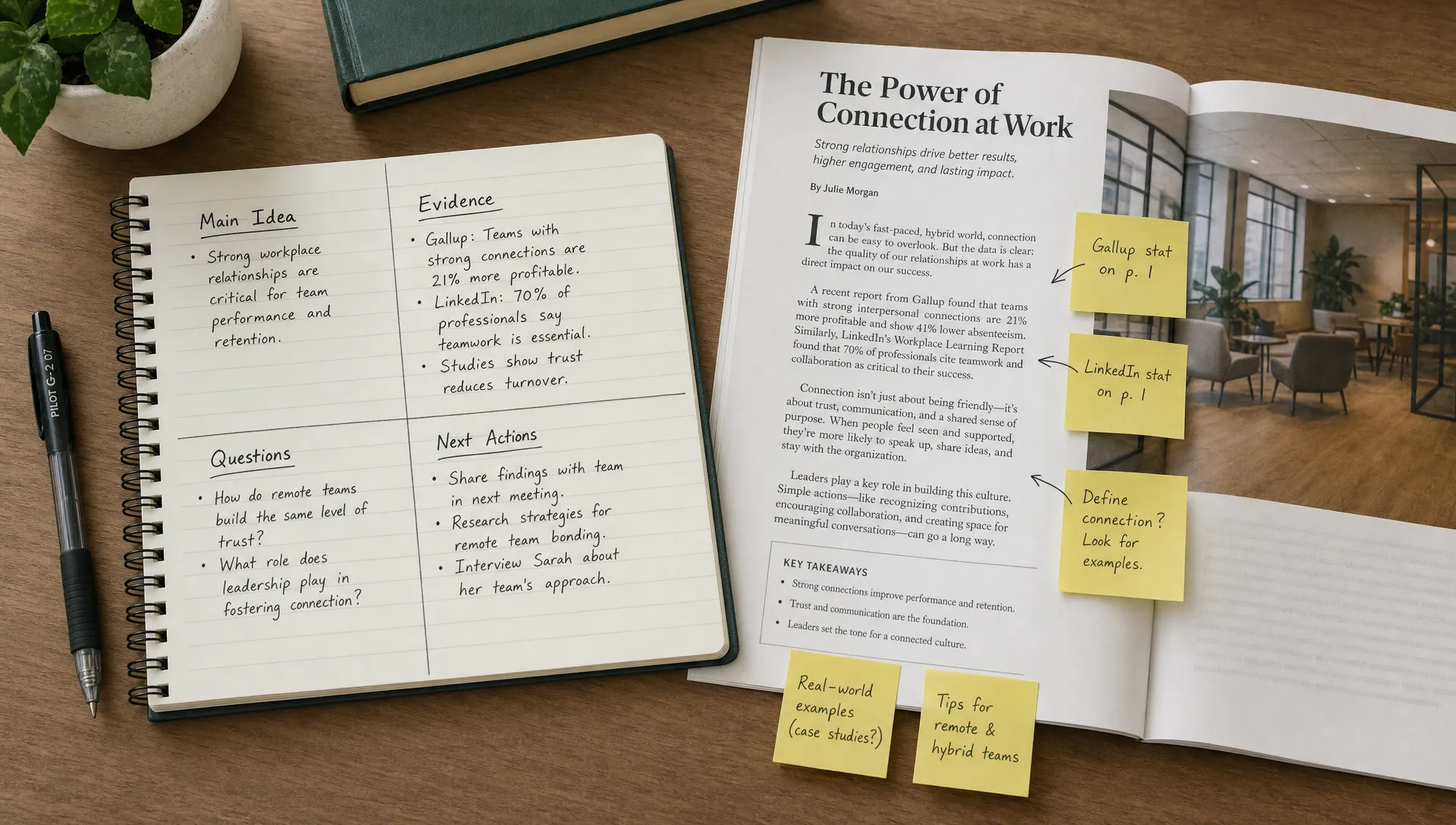
6. Turn highlights into your own words
Highlights are easy to collect but easy to forget. To make them useful, convert each important highlight into a note written in your own language.
Use this pattern:
| Highlight type | Convert it into |
|---|---|
| Definition | A plain-language explanation and one example |
| Claim | The author’s argument plus why it matters |
| Statistic | The number, context and possible implication |
| Example | What the example proves or illustrates |
| Quote | Why the wording is useful and where you might use it |
Here is a simple example.
Original idea: “Teams often confuse speed of response with quality of collaboration.”
Usable note: “Fast replies do not always mean good teamwork. For workplace communication, the more important question is whether people know where decisions live, when input is needed and which messages require action.”
That note is no longer just a copied line. It is something you can use in a meeting, essay or presentation.
7. End with retrieval cues and next actions
A note is more valuable when it helps future you. At the end, add a few cues that make the article easier to review later.
For study notes, write two or three questions you should be able to answer without rereading. For work notes, write the decision, task or person the article relates to. For research notes, add tags for topic, method, theory or debate.
Students may also find the Cornell note-taking system useful because it separates notes, cues and a summary. You do not need to follow the format perfectly. The useful principle is to build review prompts into the note itself.
How to use AI without losing understanding
AI can help you turn articles into notes faster, but it works best when you guide the output. If you only ask for a generic summary, you may get something readable that still does not fit your purpose.
A better approach is to ask for the kind of note you need.
| Goal | Useful AI instruction |
|---|---|
| Quick understanding | “Give me the main claim, supporting points and why this article matters.” |
| Study | “Turn this into study notes with key terms, examples and practice questions.” |
| Work | “Create a briefing note with implications, risks and possible next actions.” |
| Research | “Extract the research question, method, findings, limitations and related questions.” |
| Content creation | “Turn this article into an outline with angles, examples and counterpoints.” |
Tools like unrav.io are useful here because they are built around reframing content for understanding, not just shortening it. You can use links or pasted text, then choose different ways of looking at the same source, such as a quick grasp mode when you need the big picture or a teach-it mode when you want a clearer explanation.
The key is to stay involved. Use AI to create a first structure, then check important details against the original. Add your own judgment, especially when the article affects a grade, a business decision, a client recommendation or a published piece of content.
Examples for work, study and research
The same article can produce very different notes depending on your role. Here are a few practical examples.
Student notes
A student reading an assigned article should focus on the argument, key concepts and how the reading connects to lectures. A good study note might include the main thesis, three supporting ideas, unfamiliar terms, one example from the article and three practice questions.
For example, after reading an article about memory and learning, a student might write:
“Main idea: Repeated retrieval improves long-term learning more than rereading because it forces the brain to reconstruct knowledge. Study use: convert each section into questions instead of only rereading highlights.”
That kind of note is short but useful because it turns the article into exam preparation.
Work notes
A professional reading an industry article, market report or strategy essay usually needs a decision-ready note. The most useful sections are often “What changed?”, “Why does it matter?”, “What should we do?” and “What needs more evidence?”
For example:
“Implication: The article suggests buyers are spending more time comparing tools before contacting sales. Possible action: update our comparison pages and add clearer implementation details. Unclear: the article does not separate enterprise buyers from small teams.”
This is better than a summary because it moves from information to action.
Research notes
Researchers and academics need more precision. A useful research note should distinguish the author’s claim from the evidence supporting it. It should also capture methods, limitations and how the article relates to other work.
If you are reviewing journal literature, you may want a more specialized workflow for summarizing a journal article for class or work. Journal articles require more attention to research design than opinion pieces, essays or industry reports.
A research note should also include your own evaluation. Do the findings apply to your context? Is the method strong enough for your purpose? What questions remain unanswered?
Creator and educator notes
Content creators and educators often read to explain ideas to other people. Their notes should capture examples, simple explanations, strong contrasts and possible teaching sequences.
A creator might turn one article into a newsletter outline, a script section or a list of talking points. An educator might turn the same article into a lesson plan with a warm-up question, a simple explanation, a discussion prompt and an activity.
If the article contains many connected ideas, a visual structure can help. In that case, you may want to build better visual notes with a concept mapping generator instead of forcing everything into a linear outline.
Common mistakes when turning articles into notes
The most common mistake is saving too much. If your note is nearly as long as the article, it will not help you move faster later.
Another mistake is copying sentences without translating them. Copying can be useful for exact quotes, but most notes should be in your own words. Rewriting forces comprehension and makes the note easier to reuse.
A third mistake is mixing summary, reaction and task management in one messy block. It is better to separate what the article says, what you think about it and what you plan to do next.
Also watch for missing context. A note that says “great point about incentives” may make sense today and mean nothing next month. Add enough surrounding detail so the note can stand alone.
Finally, do not treat AI output as finished work. AI can help with structure, extraction and reframing, but you should still verify claims, check important quotes and add your own interpretation.
A simple article note template you can reuse
If you want one flexible template, use this:
Title:
Author/source/date:
Link:
Why I read this:
Main idea in one sentence:
Key points:
Evidence or examples:
Important terms:
Questions or doubts:
Connections to other material:
How I will use this:
Review questions or next actions:
This template works for most articles because it combines summary, comprehension and application. You can shorten it for quick reading or expand it for academic and professional work.
The best note-taking system is the one you can repeat. A simple, consistent format is usually better than a perfect system you abandon after three articles.
Frequently Asked Questions
How long should article notes be? For most articles, aim for 10 to 25 percent of the original length. Shorter is fine if you only need the main idea. Longer may be necessary for research papers, legal material or technical documentation.
What is the difference between a summary and article notes? A summary restates the article’s main points. Notes go further by adding structure, questions, connections, tags and actions. Summary helps you remember what the article said. Notes help you use it.
Can AI turn articles into notes accurately? AI can help extract structure, simplify dense sections and create a first draft of notes. You should still review the output, especially for facts, quotes, citations and nuanced arguments.
What is the fastest way to turn articles into notes for study? Start with the main idea, list the key concepts, then turn each section into practice questions. This makes the note useful for active recall instead of passive rereading.
How do I organize notes from many articles? Use consistent fields such as topic, source, main idea, evidence, questions and use case. Add tags for projects, classes or themes so you can find related notes later.
Turn your next article into a usable note
The next time you read a long article, do not begin by highlighting everything that sounds important. Start with your goal, identify the main idea, capture the structure and write the note in a form you can actually use.
If you want help moving from dense content to clearer understanding, unrav.io can help you reframe articles, links and pasted text into more useful outputs. Use it to get the quick grasp, clarify difficult sections or reshape an article into notes for study, work, teaching or content planning.