Concept Map Maker Tips for Complex Topics and Dense Reading
Dense reading is rarely hard because there are too many words. It is hard because the relationships are hidden. A research paper may connect theory, methods, findings, limitations, and prior work across different sections. A textbook chapter may introduce ten new terms before showing how they fit together. A strategy report may bury the real argument under charts and supporting details.
A concept map maker helps when your goal is not just to shorten a source, but to understand how its ideas depend on each other. Used well, it can turn scattered notes into a visible structure of claims, causes, examples, assumptions, and evidence.
The key phrase is “used well.” A messy concept map can become just another pile of notes. The tips below will help you use concept mapping for complex topics, dense reading, research, study sessions, and content repurposing without losing the point of the material.
What a Concept Map Maker Actually Helps You Do
A concept map is not simply a pretty diagram. It is a way to show how concepts relate to one another.
In the classic approach developed by Joseph Novak and Alberto Cañas, concept maps usually contain concepts, labeled connections, and propositions. A proposition is a meaningful statement created by connecting two concepts with a linking phrase, such as “working memory limits affect reading comprehension” or “sample size influences statistical power.” You can read more about the theory behind concept maps from IHMC’s explanation of concept mapping.
That makes concept maps different from basic summaries. A summary tells you what the source says in fewer words. A concept map shows how the pieces fit.
This matters because dense material often creates a false sense of understanding. You may recognize the terms, highlight key sentences, and still struggle to explain the logic. If that happens often, the issue is not laziness. It is usually a structure problem.
A good concept map maker should help you answer questions like:
- What are the most important concepts in this source?
- Which ideas explain, support, cause, contrast with, or depend on other ideas?
- Where does the author move from evidence to interpretation?
- Which parts of the topic are central, and which are examples or details?
- What do I still not understand well enough to connect?
If you only need a quick overview, a summary may be enough. But if you need to study, teach, write, present, compare sources, or make decisions, mapping relationships is often more useful.
Concept Map vs. Mind Map vs. Summary
People often use “concept map” and “mind map” as if they mean the same thing. They overlap, but they solve different problems.
A mind map usually starts with one central idea and branches outward. It is great for brainstorming, planning, and exploring associations. A concept map is more relationship-focused. It asks you to label the connection between ideas, not just place them near each other.
If your goal is to explore possible directions, a mind map may be enough. If your goal is to understand a dense argument, a theory, a system, or a research paper, a concept map is usually stronger. For a broader comparison, unrav.io has a useful guide on when to use a mind map maker for reading and research.
| Method | Best for | Main limitation |
|---|---|---|
| Summary | Capturing the main point quickly | Can hide relationships between ideas |
| Mind map | Brainstorming and organizing associations | Links may be vague or unlabeled |
| Concept map | Understanding systems, arguments, and dependencies | Takes more careful thinking to build well |
The best method depends on the job. For dense reading, concept mapping shines because it forces you to clarify the meaning of each connection.
Start With a Focus Question
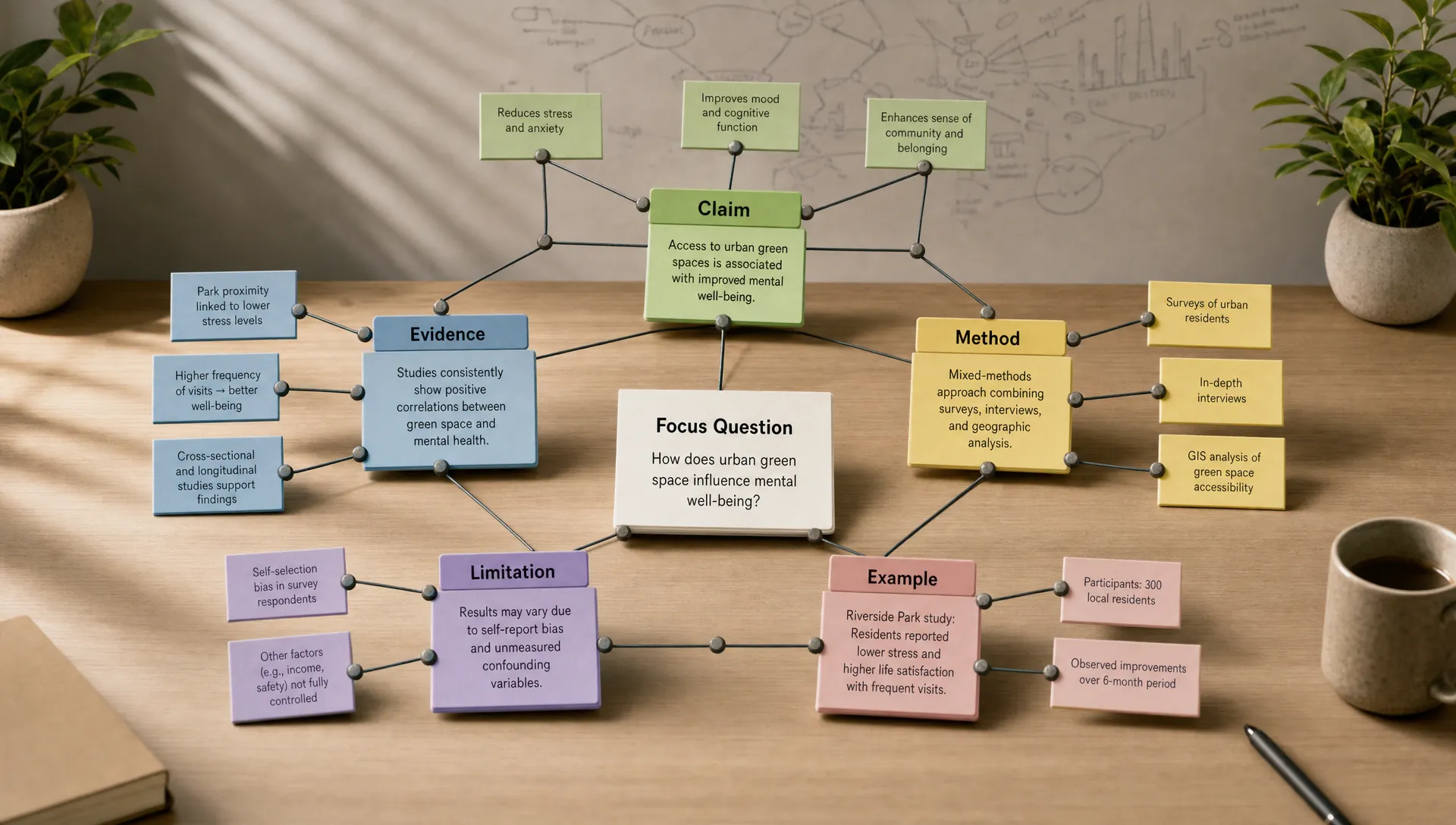
The biggest mistake people make with concept maps is trying to map everything. Dense sources contain too much detail for that. You need a focus question before opening your concept map maker.
A focus question gives your map a job. Instead of asking, “What is this chapter about?”, ask something more specific.
For example:
- How does cognitive load affect learning from multimedia?
- What problem does this research paper address, and how do the authors test it?
- Which factors explain customer churn in this report?
- How do the causes, symptoms, and treatments of this condition relate?
- What does this lecture argue, and what evidence supports it?
The more precise the question, the easier it is to decide what belongs in the map. A concept that helps answer the question should stay. A detail that does not help can be left out or saved for later.
This is especially important for students and researchers. If you are preparing for an exam, your map should reflect what you need to explain or compare. If you are reviewing a paper, your map should show the relationship between the research question, method, results, and limitations.
Build the Map in Passes, Not All at Once
Trying to create a perfect concept map while reading line by line is slow and frustrating. A better approach is to build in passes. Each pass has a different purpose.
Pass 1: Capture the main concepts
Start by collecting the important nouns and noun phrases. These are usually theories, variables, processes, people, groups, methods, findings, or outcomes.
Do not copy full sentences yet. At this stage, you are creating a raw concept list. For a research paper, that list might include “working memory,” “reading comprehension,” “intervention group,” “control group,” “effect size,” and “transfer task.”
If you are working from a long PDF, article, or video, AI can help you create an initial list of candidate concepts. For example, unrav.io can help you process links, PDFs, YouTube videos, podcasts, or pasted text through different reading modes, so you can get a clearer starting point before you build the map yourself.
Pass 2: Separate central ideas from supporting details
Not every concept has the same weight. Dense reading becomes easier when you separate the backbone from the supporting material.
Put the broadest or most central concepts near the top or center of the map. Put examples, measurements, subtypes, or case details farther away. This prevents the map from becoming a wall of equally important boxes.
For a textbook chapter, a central concept might be “cellular respiration.” Supporting concepts might include “glycolysis,” “Krebs cycle,” “electron transport chain,” “ATP,” and “mitochondria.” For a business report, the central concept might be “declining retention,” while supporting concepts include “onboarding friction,” “pricing sensitivity,” and “competitor switching.”
Pass 3: Add linking phrases
This is where a concept map becomes useful. A line without a label is just a visual association. A labeled line becomes a claim.
Instead of connecting “sleep” and “memory” with a blank arrow, write “supports consolidation of.” Now the map says, “Sleep supports consolidation of memory.” That is something you can test, explain, question, or revise.
Useful linking phrases include:
- causes
- depends on
- is measured by
- is an example of
- is limited by
- contrasts with
- supports
- challenges
- leads to
- is explained by
If you cannot write a linking phrase, that is a signal. You may have placed two terms near each other because they appeared in the same paragraph, not because you understand their relationship.
Pass 4: Add cross-links between sections
Cross-links are the connections that turn a basic outline into real understanding. They show how one part of the source relates to another.
For example, a research paper’s limitation section may connect back to the method. A textbook chapter’s example may connect to a general principle introduced earlier. A market report’s recommendation may depend on evidence from two different sections.
Cross-links are especially useful when you are comparing sources. If two papers use different methods to study the same problem, your map can show where they agree, where they differ, and why the difference matters.
Pass 5: Revise after rereading
Your first map is not a final product. It is a thinking draft.
After you reread the source, watch the lecture again, or discuss the topic with someone else, revise the map. Remove weak connections. Rename vague concepts. Add missing assumptions. Move details to better locations.
This revision step is where learning often happens. You are not just storing information. You are testing whether your structure matches the material.
Tips for Mapping Different Types of Dense Content
Different sources need different mapping strategies. A concept map maker can help with all of them, but you should adjust your approach based on the material.
Research papers
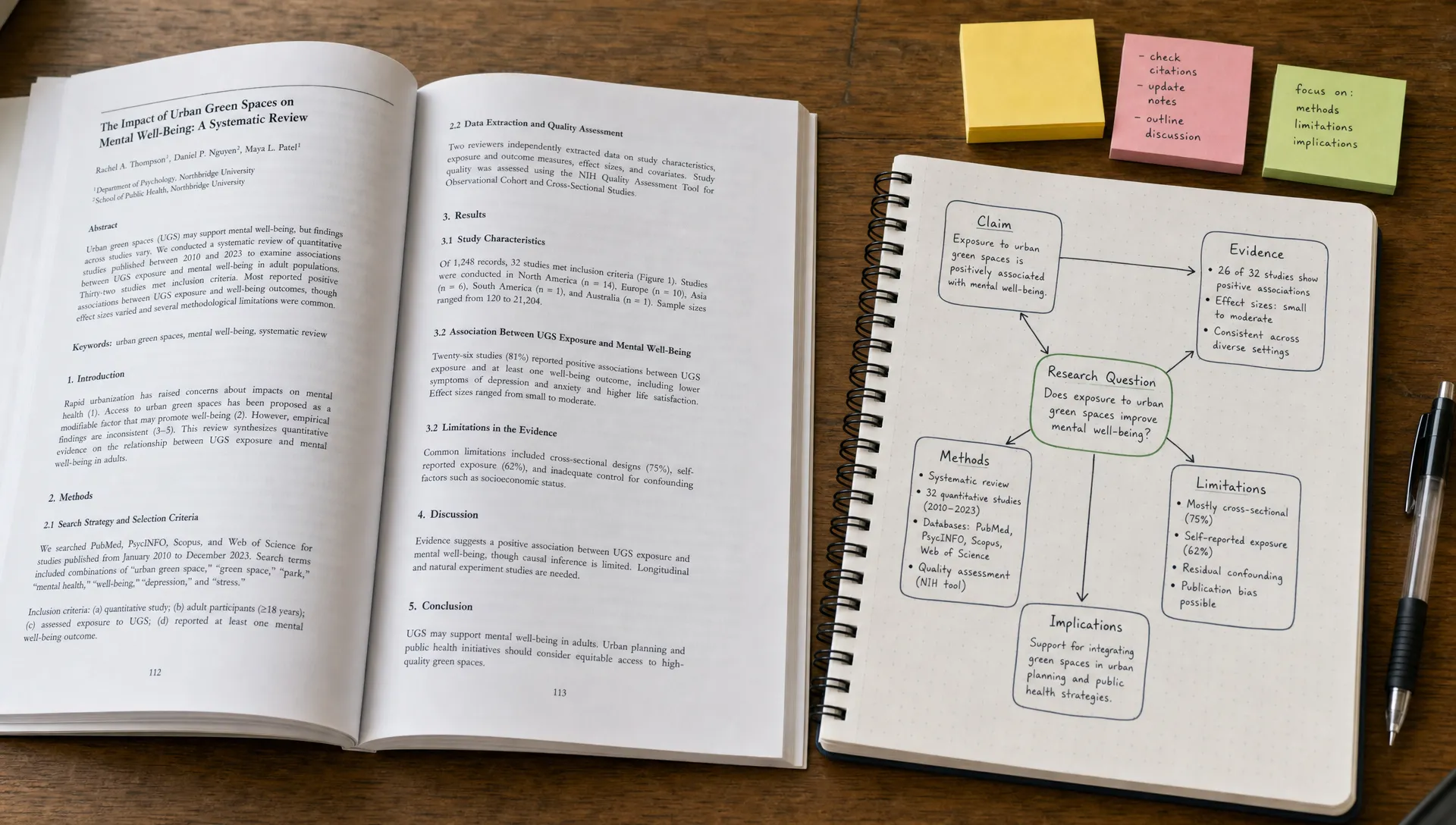
For research papers, map the argument structure first. Do not begin with every statistic or citation. Start with the research problem, hypothesis or question, method, key findings, and limitations.
A useful structure is:
| Paper element | Concept map role | Example linking phrase |
|---|---|---|
| Research question | Starting point | asks whether |
| Literature gap | Motivation | is not explained by |
| Method | Evidence path | tests using |
| Results | Support or challenge | suggests that |
| Limitations | Boundary | may be affected by |
This helps you avoid a common problem: summarizing the abstract and conclusion while missing how the authors got there. If you need a deeper workflow before mapping, this guide on how to summarize a research paper without losing the point pairs well with concept mapping.
Textbook chapters
For textbook chapters, map hierarchy and process. Textbooks often move from broad concepts to definitions, examples, exceptions, and applications.
A strong chapter map might show that “photosynthesis” includes “light-dependent reactions” and “Calvin cycle,” that light-dependent reactions produce ATP and NADPH, and that those products support the Calvin cycle. This is much more useful than rewriting each paragraph in shorter form.
If your textbook notes keep getting too long, you may also find it useful to review how to summarize textbook chapters without rewriting everything.
Reports and briefs
For professional reports, map decision logic. The most important relationships are often between problem, evidence, risk, recommendation, and expected outcome.
For example, a market report might connect “higher acquisition costs” to “reduced paid channel efficiency,” which supports “shift budget toward retention,” which depends on “customer lifetime value.” Mapping this chain makes the recommendation easier to evaluate.
This is useful for analysts, founders, consultants, and knowledge workers who need to explain findings to other people. A concept map can reveal whether a recommendation is actually supported by the evidence or merely placed near it.
Videos, lectures, and podcasts
For videos and podcasts, map the sequence of ideas first, then reorganize it. Spoken content often unfolds linearly, but the ideas may not be best understood in that order.
Start by identifying the main sections: opening problem, background, examples, argument, counterpoint, and takeaway. Then convert those sections into concepts and relationships.
This is where an AI reading companion can save time. For example, unrav.io supports YouTube and podcast understanding, so you can get a clearer grasp of the material before turning it into a concept map for study, teaching, or content creation.
What to Look for in a Concept Map Maker
The best concept map maker depends on your workflow. Some people want a visual whiteboard. Others want AI-assisted extraction before they move into a diagramming tool. Students may care about speed. Researchers may care about source accuracy. Professionals may care about clarity for presentations.
Here are the practical features that matter most:
| Feature | Why it matters for dense reading |
|---|---|
| Easy editing | Your first structure will change as understanding improves |
| Labeled connections | Relationships are the main value of concept maps |
| Support for long inputs | Dense sources often come from PDFs, reports, articles, and transcripts |
| Flexible layout | Complex topics rarely fit into a simple linear outline |
| Source-aware thinking | You need to check claims against the original material |
| Multiple views or modes | Sometimes you need a quick grasp first, then deeper analysis |
If you are choosing between tools, ask one simple question: does this help me think more clearly, or does it just make a diagram faster?
Speed is useful, but a fast map full of vague connections will not help much. The goal is not to generate a perfect visual in one click. The goal is to create a structure you can explain, question, and remember.
Common Concept Mapping Mistakes to Avoid
A concept map should reduce confusion, not decorate it. Watch for these common mistakes.
- Using single words without relationships: A map full of isolated terms may look organized, but it does not show understanding.
- Copying too much text: Long pasted sentences make the map hard to scan and defeat the purpose of visual structure.
- Mapping the source in page order only: Page order is not always logic order. Reorganize ideas by relationship.
- Treating AI output as final: AI can suggest structure, but you still need to verify claims, fix weak links, and check nuance.
- Skipping uncertainty: If a relationship is unclear, mark it. A question mark is better than a false connection.
This last point matters. Good concept mapping is not about pretending you understand everything. It is about making your current understanding visible enough to improve it.
A Simple Before-and-After Example
Imagine you are reading about misinformation online. Your notes might look like this:
“Misinformation spreads quickly on social media. Algorithms prioritize engagement. Emotional content gets shared more. Media literacy can help. Fact-checking has limits. Trust in institutions matters.”
Those notes are useful, but the relationships are still vague. A concept map would turn them into propositions:
| Concept relationship | What it clarifies |
|---|---|
| Algorithms prioritize engagement | Platform design affects visibility |
| Emotional content increases sharing | User behavior affects spread |
| Fact-checking corrects some claims | Intervention has partial effect |
| Low institutional trust reduces correction impact | Social context limits interventions |
| Media literacy supports evaluation | Education can improve individual judgment |
Now you can see the structure. The topic is not just “misinformation.” It is a system involving platform incentives, user psychology, social trust, and intervention limits.
That is the value of concept mapping. It turns a list of ideas into a model of how the topic works.
How to Use AI Without Becoming Passive
AI can help you start faster, especially when the source is long or unfamiliar. But the learning comes from checking, editing, and explaining the map.
A good workflow is to use AI for the first layer of structure, then use your own judgment for refinement. Ask for the main concepts, possible relationships, counterarguments, assumptions, or teaching explanations. Then compare those suggestions with the original source.
This matters because summarization alone can create a shortcut that feels productive but leaves understanding shallow. If you want to go deeper on that problem, unrav.io has a helpful piece on why summarizing falls short without real understanding.
For students, this means using AI to prepare better study materials, not to avoid studying. For researchers, it means accelerating orientation, not outsourcing interpretation. For creators, it means finding structure and angles, not copying generated outputs. For educators, it means simplifying complex material while still checking accuracy and nuance.
Frequently Asked Questions
What is a concept map maker? A concept map maker is a tool or workflow that helps you organize concepts and show how they relate through labeled connections. It is especially useful for dense reading, complex topics, research papers, textbook chapters, reports, and lectures.
How is a concept map different from a mind map? A mind map usually branches from one central idea and is useful for brainstorming. A concept map focuses more on relationships between ideas, especially labeled links such as “causes,” “depends on,” “supports,” or “contrasts with.”
Can AI create a concept map for me? AI can help extract concepts, suggest relationships, and reframe dense material, but you should still review the output. Concept mapping is most useful when you actively check whether the connections are accurate and meaningful.
What should I map first in a research paper? Start with the research question, the problem or gap, the method, the main findings, and the limitations. Add details like variables, measurements, and prior studies after the core argument is clear.
Are concept maps good for studying? Yes. Concept maps help you move beyond memorizing definitions by showing how ideas connect. They are especially useful for exam preparation, teaching yourself a chapter, and identifying gaps in understanding.
Turn Dense Reading Into Clearer Structure
A concept map maker is most valuable when you use it as a thinking tool, not just a drawing tool. Start with a focus question, capture the main concepts, label the relationships, add cross-links, and revise as your understanding improves.
If you are starting from a long article, PDF, research paper, video, or podcast, unrav.io can help you get a clearer grasp of the material before you map it. Use it to reframe dense content, identify the ideas that matter, and move from passive reading toward active understanding.