
How to Summarize Textbook Chapters Without Rewriting Everything
Textbook chapters can be long, dense, and packed with details that all look important. If you try to summarize them by rewriting every paragraph in shorter words, you can spend hours creating notes that are almost as hard to review as the original chapter.
A good textbook chapter summary is not a smaller textbook. It is a learning tool. It helps you see the structure of the chapter, remember the main ideas, understand key terms, and prepare for class, exams, or discussion without copying everything into your notebook.
The goal is simple: summarize textbook chapters by deciding what matters, not by rewriting everything sentence by sentence.
Why rewriting the chapter is the wrong goal
Rewriting feels productive because it keeps you busy. You are reading, typing, highlighting, and filling pages. But busy work is not the same as understanding.
When you rewrite too much, three things usually happen.
First, your notes become too long to review. If a 35-page chapter turns into 12 pages of notes, you have not really reduced the workload.
Second, you may copy the textbook’s structure without understanding it. You can paraphrase a sentence and still miss why that idea matters.
Third, you leave no time for recall. Research on learning strategies has consistently found that techniques like practice testing and distributed review are more effective than passive rereading or highlighting alone. A widely cited review by Dunlosky and colleagues ranked practice testing as one of the most useful study techniques.
Your summary should make recall easier. It should give you something compact enough to review, question, and explain later.
Start with the chapter map before reading closely
Do not begin by summarizing page one. Begin by mapping the chapter.
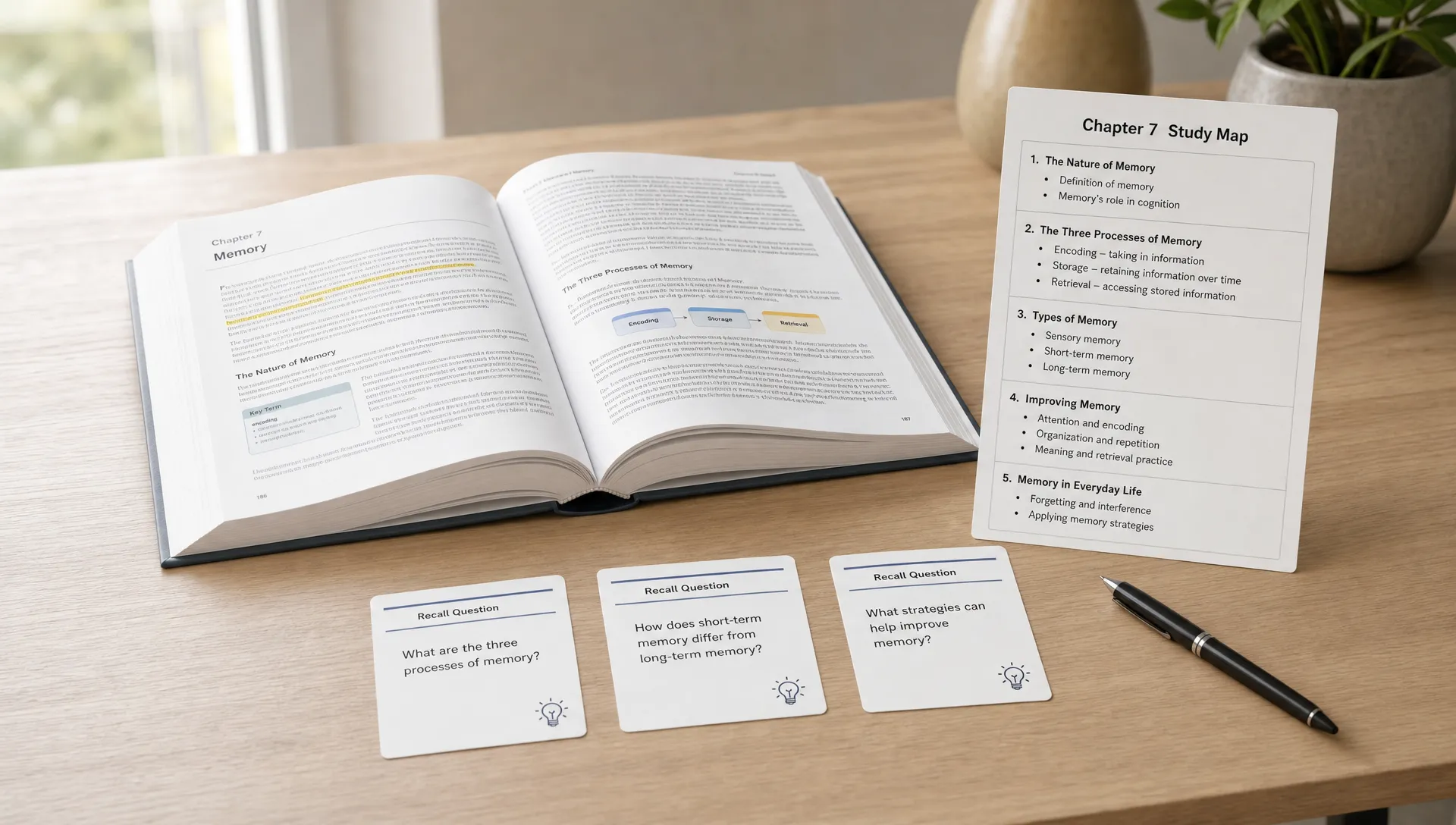
Most textbook chapters already give you clues about what matters. Look at the title, section headings, subheadings, learning objectives, bold terms, figures, tables, chapter summary, and review questions. These are not decorations. They show the author’s intended structure.
Before you write any detailed notes, create a simple skeleton:
- Chapter title and main topic
- Major sections
- Key terms listed in the chapter
- Figures, tables, or models that seem central
- End-of-chapter questions or learning objectives
This first pass should take five to ten minutes. It prevents you from treating every paragraph equally. If you want a broader study-focused method, this guide on how to summarize a chapter for better studying goes deeper into building summaries that support exam preparation.
Choose the right summary depth
Not every chapter deserves the same kind of summary. A chapter you need for tomorrow’s quiz requires different notes than one you are reading for background knowledge.
Use your purpose to decide how much detail to keep.
| Your purpose | What to capture | Ideal summary length |
|---|---|---|
| Exam preparation | Key terms, processes, comparisons, formulas, likely questions | 1 to 3 pages |
| Class discussion | Main argument, important examples, confusing points, discussion questions | Half a page to 1 page |
| Research background | Concepts, frameworks, cited studies to follow up on, page references | 1 to 2 pages |
| Professional learning | Frameworks, decisions, implications, action points | 1 page or less |
| Quick review | Main idea, section takeaways, 5 to 10 recall questions | Half a page |
This step matters because it gives you permission to leave things out. A summary for understanding does not need every date, example, and supporting paragraph. It needs the material you will actually use.
Use the four-part filter: claim, concept, evidence, connection
When reading a section, ask four questions. These questions help you decide what belongs in the summary.
What is the main claim? This is the point the section is making. It may be stated in the first paragraph, repeated in the conclusion, or implied through examples.
Which concepts must I know? These are bold terms, definitions, theories, formulas, models, or categories that the rest of the chapter depends on.
What evidence or example makes it clear? Textbooks often include stories, case studies, experiments, charts, or historical examples. You do not need to copy all of them, but you may need one short example that helps you remember the concept.
How does this connect to the rest of the chapter? A good summary shows relationships. It explains how one idea causes, contrasts with, depends on, or supports another idea.
If a sentence does not help with one of those four things, it probably does not belong in your summary.
Write one sentence per section first
The fastest way to avoid rewriting everything is to limit yourself at the start. For each section, write one sentence only.
This sentence should answer: What is this section really saying?
For example, imagine a biology chapter section about photosynthesis. A rewriting approach might produce a long paragraph about chloroplasts, light energy, carbon dioxide, glucose, oxygen, and plant cells. A useful section summary would be shorter:
Photosynthesis is the process by which plants use light energy to convert carbon dioxide and water into glucose, storing energy while releasing oxygen.
That sentence is not enough for full exam prep, but it gives you the anchor. After that, you can add only the details that matter: the equation, the role of chlorophyll, the light-dependent reactions, and the Calvin cycle.
This method keeps you from turning every paragraph into a note. You summarize the section first, then add details only when they support the section’s main idea.
Treat definitions as learning tools, not copied glossary entries
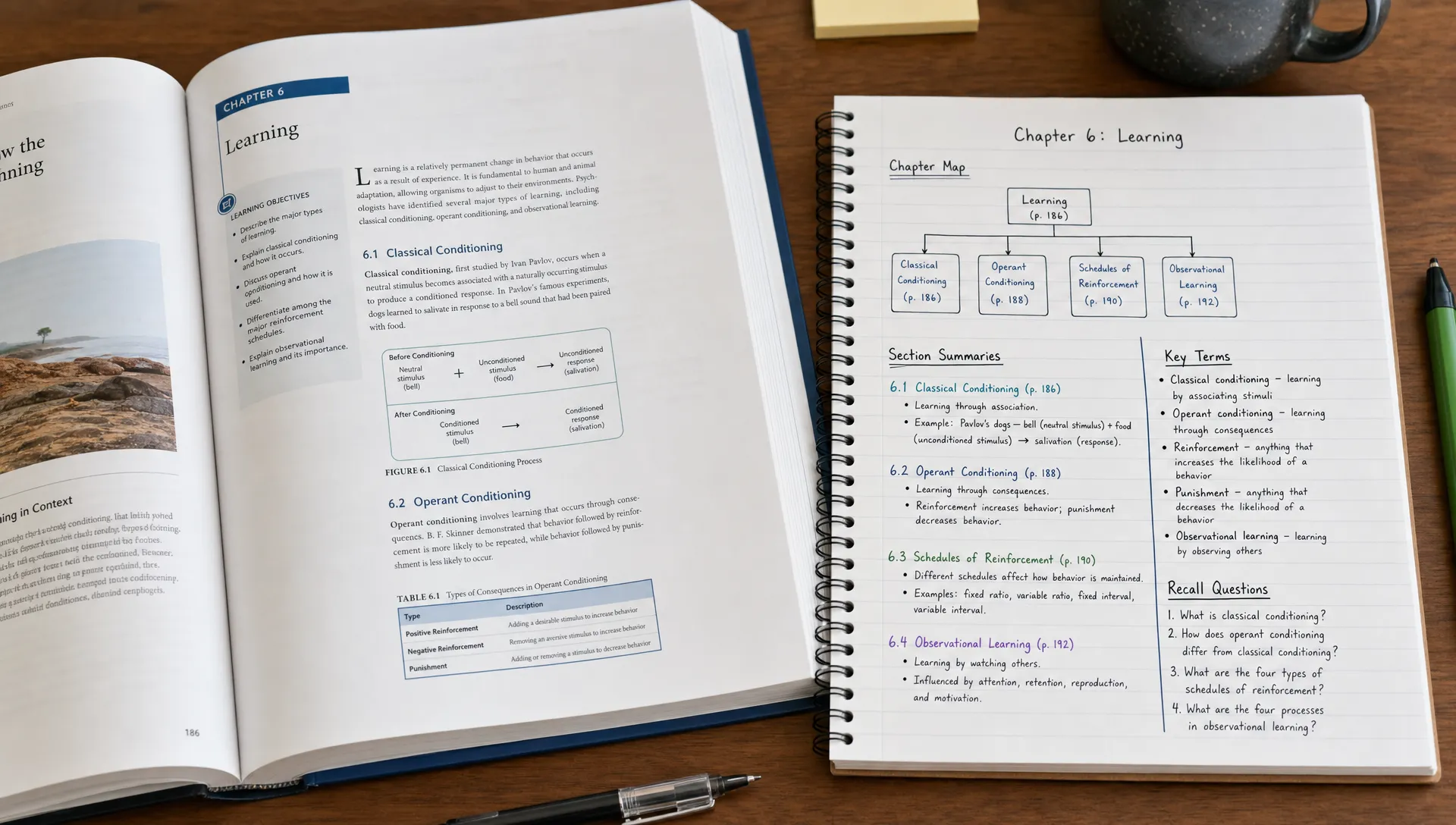
Textbook chapters often include many terms. Copying definitions word for word can feel safe, but it is not always useful. A better definition note has three parts: the term, the plain-English meaning, and a quick example.
| Term note element | What to write | Why it helps |
|---|---|---|
| Term | The exact vocabulary word | Keeps your notes aligned with the textbook |
| Plain-English meaning | Your own simple explanation | Shows whether you understand it |
| Example | A short case, situation, or application | Makes the idea easier to remember |
For example, instead of writing a long textbook definition of “opportunity cost,” you might write:
Opportunity cost: The value of the next-best option you give up when making a choice. Example: If I spend two hours studying economics instead of working a paid shift, the lost wages are part of my opportunity cost.
That note is short, testable, and easier to recall than a copied definition.
Compress examples instead of deleting them
Many students remove all examples to make summaries shorter. That can backfire. Examples often explain the concept more clearly than the definition.
The trick is not to delete examples. It is to compress them.
A textbook might spend a full page describing a historical event, business case, legal decision, or scientific experiment. Your summary may only need one line:
Example: The Stanford prison experiment is used to show how social roles and environments can influence behavior, although its methods and interpretation remain heavily criticized.
This gives you the function of the example without rewriting the full story.
Ask yourself: Why did the author include this example? If you can answer that, you can usually summarize it in one sentence.
Convert diagrams, tables, and figures into takeaways
Textbook visuals are often high-value material. They simplify complex information, compare categories, or show processes. But students often skip them or copy captions without thinking.
Instead, turn each important visual into a takeaway.
For a process diagram, write the sequence in a few steps. For a comparison table, write the key contrast. For a graph, write the trend and what it means.
You do not need to redraw everything unless the visual itself is something you must reproduce on an exam. In most cases, one concise takeaway is enough:
Figure takeaway: As price increases, quantity demanded usually decreases, showing the basic inverse relationship in the demand curve.
This kind of note saves time and captures the point of the visual.
Add recall questions to make the summary useful
A summary should not only store information. It should help you retrieve it.
After each major section, add one or two questions you can answer later without looking. These questions turn your notes into a study tool.
Good recall questions sound like this:
- What problem does this theory try to explain?
- How are these two concepts different?
- What are the steps in this process?
- Why does this example matter?
- What would be a real-world application of this idea?
If you can answer your own questions from memory, your summary is doing its job. If you cannot, you know exactly which part of the chapter needs another look.
This is also where simple summarizing can fall short. Shortening a chapter is useful, but it does not guarantee understanding. If you want to think more about that distinction, read this piece on why summarizing falls short without real understanding.
Use AI to reframe the chapter, not replace your reading
AI can help you summarize textbook chapters faster, especially when the material is dense or unfamiliar. But it works best when you use it as a reading companion, not as a shortcut that removes your judgment.
For example, with unrav.io, you can work with PDFs, links, pasted text, videos, or podcasts and reframe the material depending on your goal. If you need a quick grasp, you can use a shorter explanation. If you need to teach the topic, you can use a mode that helps explain ideas more clearly.
The key is to ask for useful outputs, not just “summarize this.” Try prompts like:
- Summarize this textbook section in five sentences, focusing only on the main concepts.
- Turn this chapter section into key terms, plain-English definitions, and examples.
- Explain this section as if I need to teach it to a classmate.
- Create ten recall questions from this chapter section.
- Identify which details are essential and which are supporting examples.
Always compare the AI output with the original chapter. Textbooks contain nuance, definitions, diagrams, and instructor-specific emphasis that may matter. AI can help you get oriented and organize ideas, but you should verify anything important before using it for an exam, paper, or presentation.
A simple 30-minute workflow for one chapter
If you are short on time, use a fixed workflow. Time limits prevent over-notetaking.
| Time | Task | Output |
|---|---|---|
| 0 to 5 minutes | Scan headings, objectives, visuals, and review questions | Chapter skeleton |
| 5 to 15 minutes | Read the most important sections closely | Marked key ideas |
| 15 to 22 minutes | Write one sentence per major section | Section summary |
| 22 to 27 minutes | Add key terms, examples, and figure takeaways | Compact notes |
| 27 to 30 minutes | Write recall questions | Study-ready summary |
This will not cover every detail in a difficult chapter. That is the point. It gives you a usable first summary quickly. You can expand only the parts that matter later.
Common mistakes to avoid
The biggest mistake is summarizing too early. If you write notes before you understand the section’s purpose, you will copy details instead of capturing meaning.
Another mistake is treating all details equally. Textbooks include definitions, transitions, examples, review material, sidebars, and optional context. Your job is to separate core ideas from support.
A third mistake is making your notes look neat but not testable. Beautiful notes are not automatically useful. If your summary has no questions, examples, contrasts, or plain-language explanations, it may not help you remember the material.
Finally, do not skip confusion. If something does not make sense, mark it clearly. A good summary can include a short “still unclear” note. That tells you what to ask in class, review with a study group, or investigate further.
Frequently Asked Questions
How long should a textbook chapter summary be? A useful summary is usually 5 to 15 percent of the original chapter length, depending on your purpose. For most student use, 1 to 3 pages is enough for a long chapter.
Should I summarize while reading or after reading? Do both, but in different ways. While reading, mark key ideas and write short section sentences. After reading, combine those notes into a cleaner summary and add recall questions.
Is it okay to use AI to summarize textbook chapters? Yes, if you use it carefully. AI can help you simplify, organize, and question the material, but you should check the output against the textbook and your course expectations.
What should I leave out of a chapter summary? Leave out repeated explanations, minor transitions, long examples that do not add new meaning, and details that are unlikely to matter for your goal. Keep core concepts, relationships, definitions, and important examples.
How do I know if my summary is good? Cover the original chapter and try to explain the topic from your summary alone. If you can explain the main ideas, define key terms, and answer likely questions, your summary is working.
The bottom line
To summarize textbook chapters without rewriting everything, stop thinking of summary as sentence-by-sentence compression. Think of it as building a study tool.
Map the chapter first. Decide your purpose. Capture claims, concepts, evidence, and connections. Write one sentence per section, add only the most useful details, and finish with recall questions.
If you want help reframing dense chapters into clearer explanations, questions, or teaching notes, try using unrav.io alongside your reading. You will still need to think, verify, and study, but you will spend less time copying and more time understanding.