When to Use a Mind Map Maker for Reading and Research
A mind map maker is most useful when your problem is not that a text is long, but that the ideas are tangled.
That happens often in reading and research. A paper has a strong conclusion, but the method, assumptions, and limitations are scattered across sections. A textbook chapter introduces ten terms before explaining how they fit together. A report has recommendations, evidence, risks, and stakeholder concerns all competing for attention.
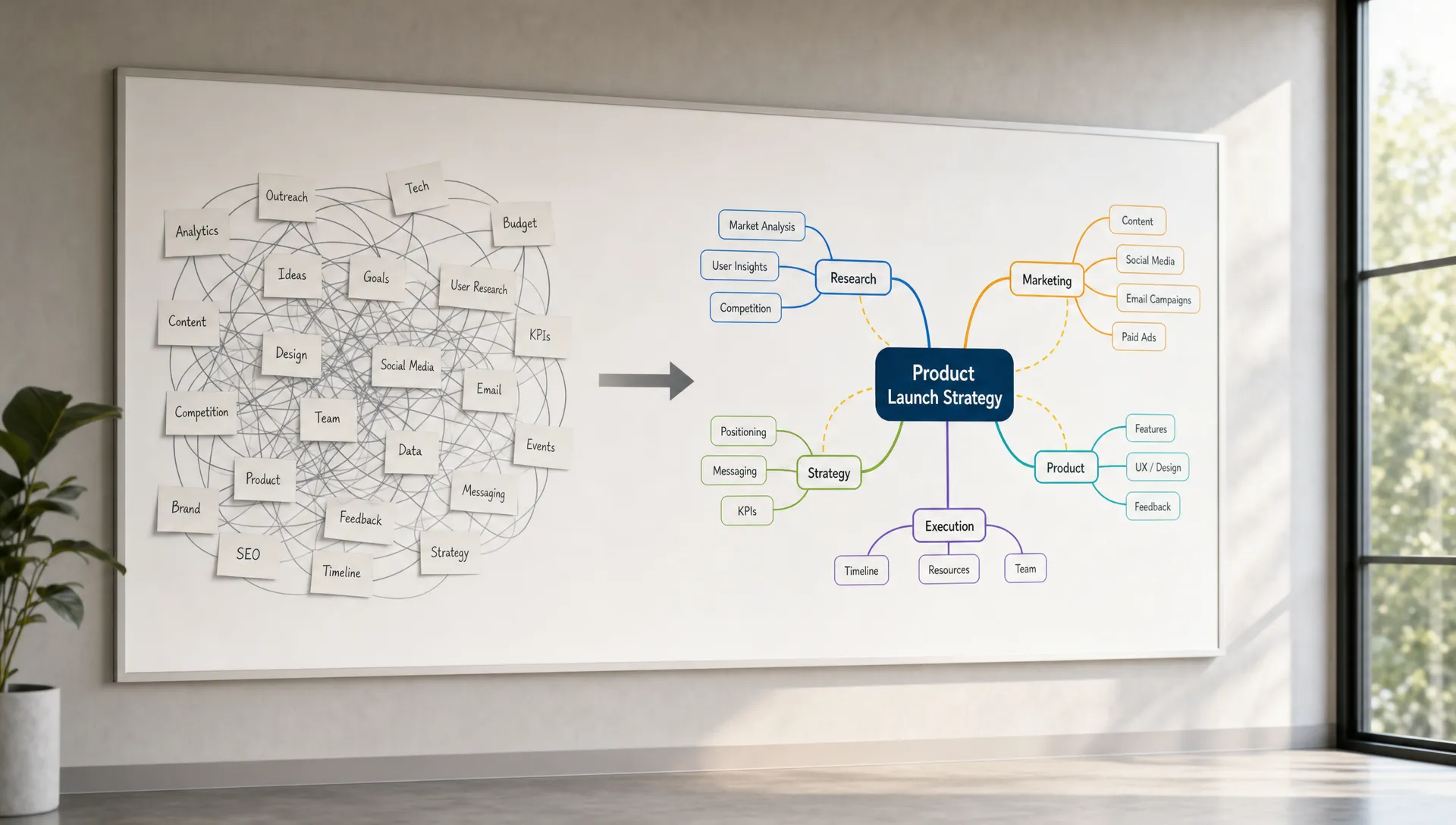
A summary can help you move faster, but it usually compresses information into a straight line. A mind map helps you see structure: what the main idea is, what supports it, what branches from it, and where the gaps or questions are.
The key is knowing when a mind map is the right tool. Use it too early or for the wrong material, and it becomes a pretty diagram with little value. Use it at the right moment, and it can make complex reading easier to understand, remember, discuss, and reuse.
What a mind map maker helps you see
A mind map maker turns information into a visual network of topics, subtopics, and relationships. Instead of reading from top to bottom, you can zoom out and ask: What is this really about? Which ideas are central? Which details are supporting evidence? Which branches deserve closer reading?
This matters because comprehension is not only about collecting facts. It is also about organizing them. Research on concept maps, a related visual learning method, emphasizes that externalizing relationships between ideas can support meaningful learning. The IHMC overview of concept mapping is a useful reference if you want the learning theory behind visual knowledge structures.
Mind maps and concept maps are not identical. Mind maps usually radiate from a central topic and are often easier for quick reading workflows. Concept maps tend to show more explicit labeled relationships. But both are useful because they force you to move beyond isolated notes.
A good mind map can help you answer questions like:
- What are the main themes in this material?
- Which points are examples, evidence, causes, effects, or objections?
- Where does the author repeat an idea in different words?
- What should I read more carefully?
- What can I turn into notes, questions, an outline, or a presentation?
This is why a mind map maker is especially helpful for readers who work with dense or unfamiliar material: students, researchers, analysts, educators, founders, and content creators.
Use a mind map maker when the material is dense but structured
Mind maps work best when the source has multiple ideas that relate to each other. That often includes research papers, reports, textbook chapters, long essays, white papers, technical documentation, lecture transcripts, and educational videos.
The tool is less useful when the material is already very short, purely narrative, or mostly a list of unrelated facts. For example, a one-page announcement may only need a quick summary. A 40-page market report with definitions, trends, risks, and recommendations is a much better candidate.
Use a mind map maker when you notice one of these signs:
- You understand individual sentences, but not the overall argument.
- You keep rereading because you lose track of where the author is going.
- You need to compare sections, claims, examples, or findings.
- You want to study from the material later, not just finish reading it.
- You need to explain the content to someone else.
For this kind of material, an AI-assisted map can give you a first-pass structure. For example, unrav.io can turn articles, PDFs, and videos into interactive mind maps, which is useful when you want to inspect the shape of a source before committing to detailed notes.
The important habit is to treat the map as a guide, not a final authority. AI can surface structure quickly, but you should still verify important claims, especially in academic, legal, medical, financial, or technical material.
Use it before detailed note-taking to avoid copying everything
One of the most common reading mistakes is starting notes too soon. You open a chapter or paper, highlight the first interesting sentence, then the next, then the next. By the end, your notes are almost as long as the original source.
A mind map can prevent that by giving you a preview of the structure before you start writing. Instead of asking, What should I copy?, you ask, What role does this section play?
For students, this can make textbook reading more efficient. Before summarizing a chapter, create or review a map of the major sections. Then decide which branches are definitions, which are processes, which are examples, and which are likely to appear on an exam.
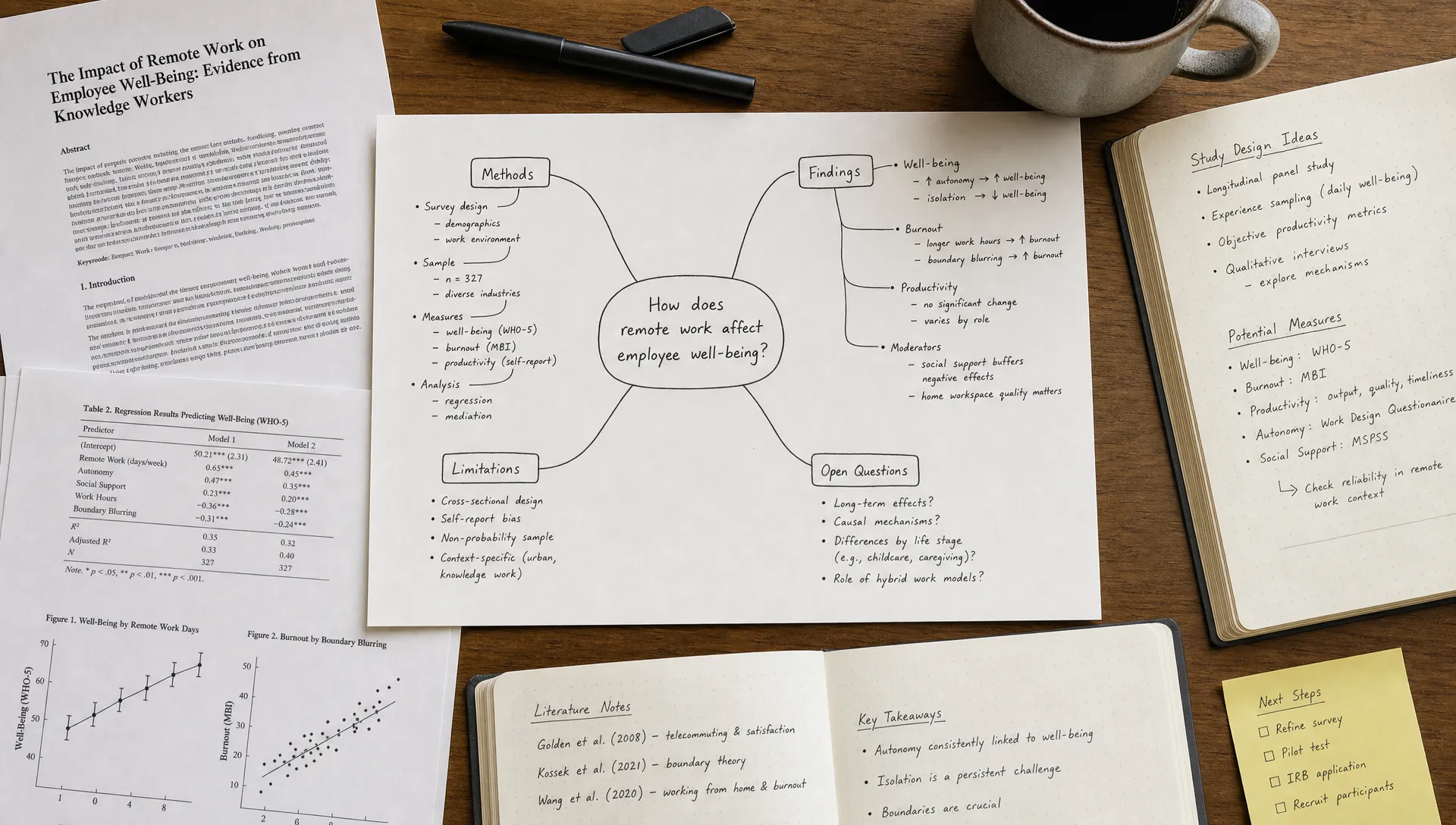
For researchers, this helps separate the paper's purpose from its details. You can identify the research question, theoretical framing, method, results, limitations, and future work before writing a formal summary.
For professionals, it can turn a long report into a navigable structure. Instead of reading every section with the same intensity, you can scan the map and decide where to focus: market context, risk analysis, recommendations, assumptions, or implementation steps.
| Reading stage | How a mind map helps | Best next step |
|---|---|---|
| Before reading | Shows the main structure and likely key ideas | Decide what deserves close attention |
| During reading | Helps you place details under larger themes | Add questions, evidence, and objections |
| After reading | Reveals whether you understood the relationships | Convert the map into notes, a summary, or study prompts |
| Before sharing | Turns complex material into an explainable outline | Prepare a briefing, lesson, presentation, or article |
This workflow is especially useful if you struggle with over-highlighting. The map gives you a reason to be selective.
Use it after reading to test your understanding
A mind map is not only a pre-reading tool. It can also work as a self-test after you finish a source.
Try creating a map from memory before looking back at the article, paper, or chapter. Start with the central topic, then add the major branches you remember. After that, compare your map with the original source.
This reveals three things quickly. First, it shows what you understood well. Second, it shows what you forgot. Third, it shows whether you remember isolated details but missed the actual structure.
A classic study published in Medical Education found that mind mapping showed benefits for long-term recall compared with a self-selected study technique, although the effect depended on how students used the method and how motivated they felt. You can view the abstract on PubMed. The practical lesson is not that mind maps magically improve learning. It is that visual organization can support memory when paired with active recall.
For studying, do not stop at looking at a polished map. Use it actively. Cover branches and try to rebuild them. Turn branch labels into questions. Explain the map out loud. If a branch feels vague, go back to the source and refine it.
This is where mind mapping becomes more than organization. It becomes a way to check comprehension.
Use it for research synthesis, not just single-source reading
A mind map maker becomes even more useful when you are working across multiple sources. Research rarely involves one article in isolation. You might be comparing papers, collecting evidence for a literature review, preparing a thesis chapter, or building a briefing from several reports.
In that situation, linear notes can become hard to manage. You may have five papers that all discuss the same concept, but each one uses different terms, methods, or assumptions. A mind map helps you cluster ideas across sources.
For example, if you are reviewing research on remote work and productivity, your central topic might be remote work outcomes. Your branches could include employee productivity, collaboration, management practices, well-being, measurement methods, and limitations. Under each branch, you can place findings from different papers.
That structure helps you see patterns:
- Which findings are repeated across sources?
- Which studies disagree?
- Which methods are common?
- Which populations or contexts are missing?
- Which claims are strong, weak, or still uncertain?
This is especially valuable before writing. A literature review, research memo, or strategic brief needs more than a pile of summaries. It needs synthesis. If your current notes are a collection of separate source summaries, a map can help you move toward an argument.
If your main task is still to produce a concise paper summary, use a more focused process like summarizing a research paper without losing the point. If your task is to understand how several papers connect, use a mind map.
Use it when you need to teach or explain the material
Teaching is one of the best tests of understanding. If you cannot explain how the parts of a topic fit together, you probably do not understand it yet.
A mind map maker helps educators, tutors, managers, and creators turn complex content into a teachable structure. The central topic becomes the lesson focus. The first-level branches become sections. The lower-level branches become examples, definitions, activities, or discussion questions.
For educators, this can help simplify dense readings without flattening them. A map can show students the relationship between a theory, its assumptions, evidence, criticisms, and applications.
For content creators, a map can become the basis for a newsletter, video script, podcast outline, carousel, or article. Instead of repurposing by copying paragraphs, you can repurpose by structure. The map helps you choose a path through the material that fits your audience.
For managers and analysts, it can turn a long internal document into a briefing. You can move from a complex report to a clear explanation of what changed, why it matters, what evidence supports it, and what decisions are needed.
This is one of the biggest advantages of mind maps over basic summaries. A summary tells people the main points. A map helps you decide how to explain those points.
Use it when a summary feels too flat
Summaries are useful, but they have limits. A good summary compresses. A good mind map organizes.
If you only need the gist of a news article, a summary may be enough. But if the source contains competing ideas, layered arguments, evidence chains, or multiple stakeholders, a summary can hide the complexity you actually need to understand.
This is why many readers get frustrated with summaries of academic or technical material. The summary may be accurate, but it does not show how the conclusion depends on the method, how the author handles objections, or where the limitations sit.
A mind map is a better choice when the relationship between ideas matters as much as the ideas themselves.
| Goal | Better tool | Why |
|---|---|---|
| Get the basic gist quickly | Summary | It compresses the source into the main points |
| Understand structure | Mind map | It shows hierarchy, branches, and relationships |
| Prepare for an exam | Mind map plus recall questions | It supports organization and self-testing |
| Write an executive brief | Summary plus outline | It gives a concise message and a clear sequence |
| Compare several sources | Mind map or synthesis matrix | It reveals patterns across materials |
| Quote exact wording | Original source notes | Precision matters more than structure |
If you want a deeper look at this distinction, the guide on why summarizing falls short without real understanding explains why compression alone is often not enough.
When not to use a mind map maker
A mind map maker is not always the best choice. Sometimes a different format is clearer, faster, or more accurate.
Do not rely on a mind map when you need exact wording. Legal clauses, policy language, definitions, and quotations should be checked directly in the source. A map can point you to the relevant section, but it should not replace careful reading.
Avoid using a mind map as your only tool for step-by-step procedures. If the material is a protocol, recipe, mathematical proof, coding tutorial, or technical setup guide, a checklist or sequential outline may work better. A map can show components, but it may obscure order.
Be careful with highly argumentative essays. Some arguments depend on sequence: premise, objection, response, qualification, conclusion. A map can help after reading, but an outline may preserve the logic more faithfully.
Also avoid mapping everything. If every article, chapter, or video becomes a map, the method loses its value. Use it when the structure is hard to hold in your head, when you need to compare ideas, or when the material will matter later.
A simple workflow for reading and research
You do not need a complicated system. A practical mind map workflow can be short and repeatable.
- Start with a purpose: Decide whether you are mapping to understand, study, compare, teach, or create. The same source may need a different map depending on your goal.
- Create a first-pass map: Use a mind map maker or build one manually from headings, abstracts, section titles, transcripts, or your own notes.
- Check the major branches: Look for missing context, unclear relationships, repeated ideas, and branches that are too broad.
- Return to the source: Verify important claims, definitions, data, and conclusions. Do not assume the map captured everything correctly.
- Turn the map into an output: Convert it into study questions, a research summary, an outline, a lesson plan, a briefing, or a content draft.
The last step is important. A mind map is most valuable when it leads to action. If the map just sits there, it may feel productive without improving understanding.
Examples by audience
Students can use a mind map maker before summarizing textbook chapters or preparing for exams. The map helps separate core concepts from examples and gives them a structure for active recall.
Researchers can use mind maps to break down papers, compare methods, and identify gaps across a reading list. This is especially helpful before writing a literature review or research proposal.
Knowledge workers can use mind maps to understand long reports, industry analysis, meeting transcripts, and policy documents. The map can become a briefing structure for colleagues who do not have time to read the full source.
Content creators can use mind maps to repurpose long-form material. A single podcast, article, or research report can become multiple content angles when the main themes and supporting branches are visible.
Educators can use mind maps to prepare lessons from complex readings. The map can show what students need to know first, what examples will help, and where misconceptions might appear.
Across all of these cases, the principle is the same: use a mind map when understanding depends on structure.
Frequently Asked Questions
What is a mind map maker best used for? A mind map maker is best used for organizing complex information into a visual structure. It is especially helpful for dense readings, research papers, reports, textbook chapters, and videos where the relationships between ideas matter.
Is a mind map better than a summary? Not always. A summary is better when you need the main points quickly. A mind map is better when you need to see how ideas connect, compare sections, study actively, or turn material into an explanation.
Can I use a mind map maker for research papers? Yes. It can help you identify the research question, methods, findings, limitations, and connections to other papers. However, you should still check the original paper for exact claims, data, and methodological details.
Should I make a mind map before or after reading? Both can work. Before reading, a map gives you a preview of the structure. After reading, it helps test whether you understood and remembered the relationships between ideas.
Can AI-generated mind maps be wrong? Yes. AI-generated maps can miss nuance, overstate relationships, or omit important caveats. Use them as a starting point for comprehension, then verify important points against the original source.
Take the next step
Use a mind map maker when your reading problem is structural: too many ideas, unclear relationships, scattered evidence, or a need to explain the material later.
If you only need the gist, start with a summary. If you need to understand how the parts fit together, map it. If the material matters, combine both: use a map to see the structure, then create a concise summary or set of notes from the map.
To try this workflow on a real article, PDF, or video, you can use unrav.io as a reading companion. Start with one complex source, generate a visual structure, check it against the original, and turn it into the next thing you need: notes, questions, an outline, or a clearer explanation.