
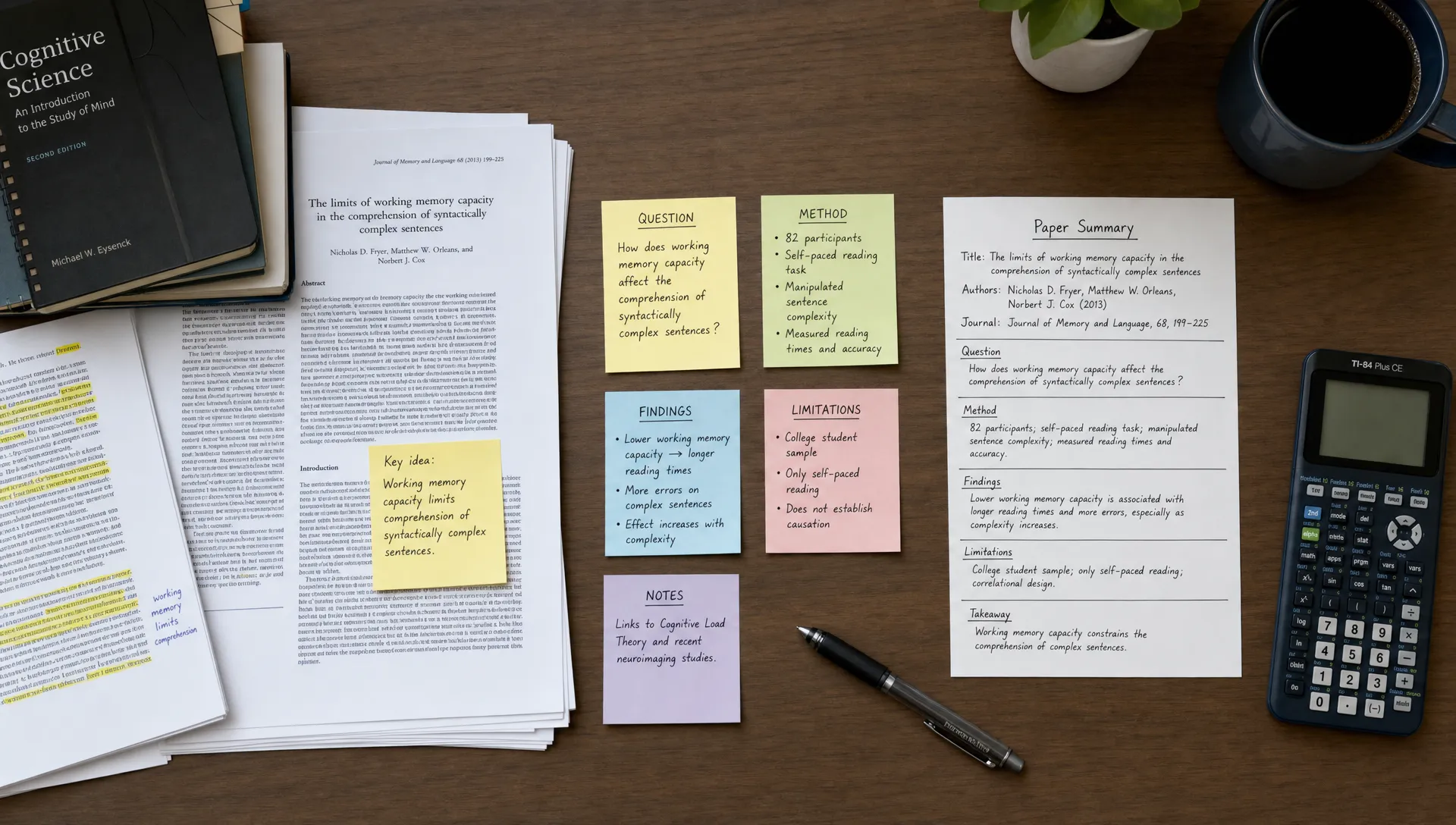
How to Summarize a Research Paper Without Losing the Point
A research paper is dense by design. It may contain a literature review, technical methods, statistical results, caveats, and discipline-specific language, all packed into a format that assumes the reader already knows the field.
That is why summarizing a research paper is not just about making it shorter. A useful summary preserves the paper’s point: what question it answers, how it answers it, what the evidence shows, and what the findings do or do not mean.
If you only compress the abstract, you can easily miss the logic of the paper. If you copy too many details, you end up with notes instead of a summary. The goal is to create a version that is brief, accurate, and useful for your next task, whether that is writing a literature review, preparing for class, briefing a team, or deciding whether the paper is worth reading in full.
Below is a practical method you can use to summarize a research paper without flattening the argument.
Start by defining what the summary is for
Before reading, decide why you are summarizing the paper. The right summary for an exam is not the same as the right summary for a literature review or a business report.
A student may need the central concept, key evidence, and likely exam relevance. A researcher may need methods, variables, datasets, limitations, and how the paper relates to prior work. A professional may only need the business implication, confidence level, and practical constraints.
This one decision helps you avoid the most common mistake: summarizing everything equally.
Ask yourself one question first: What decision, task, or understanding should this summary support?
For example, if you are summarizing a paper to compare it with three others, you should capture the research question, method, findings, and limitations in a consistent format. If you are summarizing it to teach the concept, you should spend more space on the intuition and less on every statistical detail.
Know the structure before you read closely
Most research papers follow a predictable structure, even when the section names vary. Learning that structure makes summarizing faster because you know where to look for each kind of information.
| Paper section | What to look for | Summary value |
|---|---|---|
| Abstract | Claimed problem, method, main finding | Quick orientation, not enough by itself |
| Introduction | Research gap, question, motivation | Explains why the paper exists |
| Literature review | Prior work and disagreement | Shows how the paper fits the field |
| Methods | Data, design, procedure, assumptions | Tells you how the claim was tested |
| Results | Main findings and evidence | Shows what the paper actually found |
| Discussion | Interpretation, implications, limits | Helps you avoid overstating the result |
| Conclusion | Final claim and future direction | Useful for the final summary sentence |
A classic guide by S. Keshav, How to Read a Paper, recommends reading papers in passes rather than trying to understand everything at once. That approach is especially useful when your end goal is a strong summary.
Use a three-pass reading method
Trying to summarize while reading line by line often leads to bloated notes. A better approach is to read in passes, with a different goal each time.
First pass: understand the paper’s shape
Start with the title, abstract, headings, figures, tables, and conclusion. Do not worry about understanding every method detail yet.
At the end of this pass, you should be able to answer:
- What is the paper about?
- What problem or gap does it address?
- What type of paper is it: experimental, theoretical, review, qualitative, computational, or methodological?
- Does it seem relevant enough to read more closely?
This pass prevents you from getting stuck in technical details before you know what role those details play.
Second pass: identify the argument
Now read the introduction, results, and discussion more carefully. Your goal is to understand the chain of reasoning.
A research paper usually makes a move like this: previous work leaves a gap, this study investigates that gap using a specific method, the results support a claim, and the authors explain what the claim changes.
Write that chain in plain language. If you cannot explain the paper’s argument without quoting it, you probably do not understand it well enough to summarize it yet.
Third pass: check the evidence and boundaries
Finally, inspect the methods, data, figures, tables, and limitations. This is where you protect your summary from becoming too vague or too confident.
Look for the details that affect how much weight the conclusion should carry: sample size, dataset, population, study design, assumptions, measurement choices, statistical uncertainty, comparison groups, or scope limits.
You do not need to include every technical detail in the final summary. But you do need to understand which details change the meaning of the result.
Capture the paper in five core elements
A reliable research paper summary should include five things. If one is missing, the summary may still sound polished, but it will likely lose the point.
| Element | Question to answer | Example phrasing |
|---|---|---|
| Research question | What is the paper trying to find out? | “The paper asks whether...” |
| Context or gap | Why does this question matter? | “Prior work has not clearly shown...” |
| Method | How did the authors investigate it? | “Using survey data from...” |
| Main finding | What did they find? | “The authors find that...” |
| Boundary | What should readers be careful about? | “However, the result is limited by...” |
This structure works across many fields because it follows the logic of research itself. It also keeps your summary from becoming just a shorter version of the abstract.
Separate the finding from the interpretation
One of the easiest ways to lose the point of a paper is to merge what the authors found with what they think it means.
A finding is the result produced by the study. An interpretation is the meaning the authors assign to that result.
For example, a paper might find that students who used a certain study technique scored higher on a test. The authors may interpret this as evidence that the technique improves retention. But your summary should also notice whether the study design supports that conclusion. Was it randomized? Was the sample small? Were prior ability levels controlled? Was the test short term or long term?
A careful summary uses language that matches the strength of the evidence. “Suggests,” “is associated with,” “finds,” “estimates,” and “demonstrates” do not mean the same thing.
This is especially important when summarizing research papers with AI. AI tools can compress text quickly, but you still need to check whether causal claims, statistical claims, and limitations are represented accurately. For a broader explanation of this problem, see unrav.io’s guide to why summarizing can fall short without real understanding.
Write the summary in layers
A strong way to summarize a research paper is to create multiple layers of detail. This lets you use the same understanding in different situations.
Start with a one-sentence summary:
This paper asks [research question], uses [method or data], and finds [main result], with [key limitation or context].
Then write a short paragraph:
The authors investigate [problem/gap] because [reason it matters]. They use [method, sample, dataset, or framework] to examine [specific relationship or mechanism]. The main finding is [result], which suggests [interpretation]. However, the paper’s conclusions are limited by [scope, design, assumptions, or unanswered question].
Then, if needed, create a longer structured summary with headings for question, method, findings, limitations, and relevance.
This layered method is useful because it forces clarity. If you cannot write the one-sentence version, the longer version will probably be unfocused too.
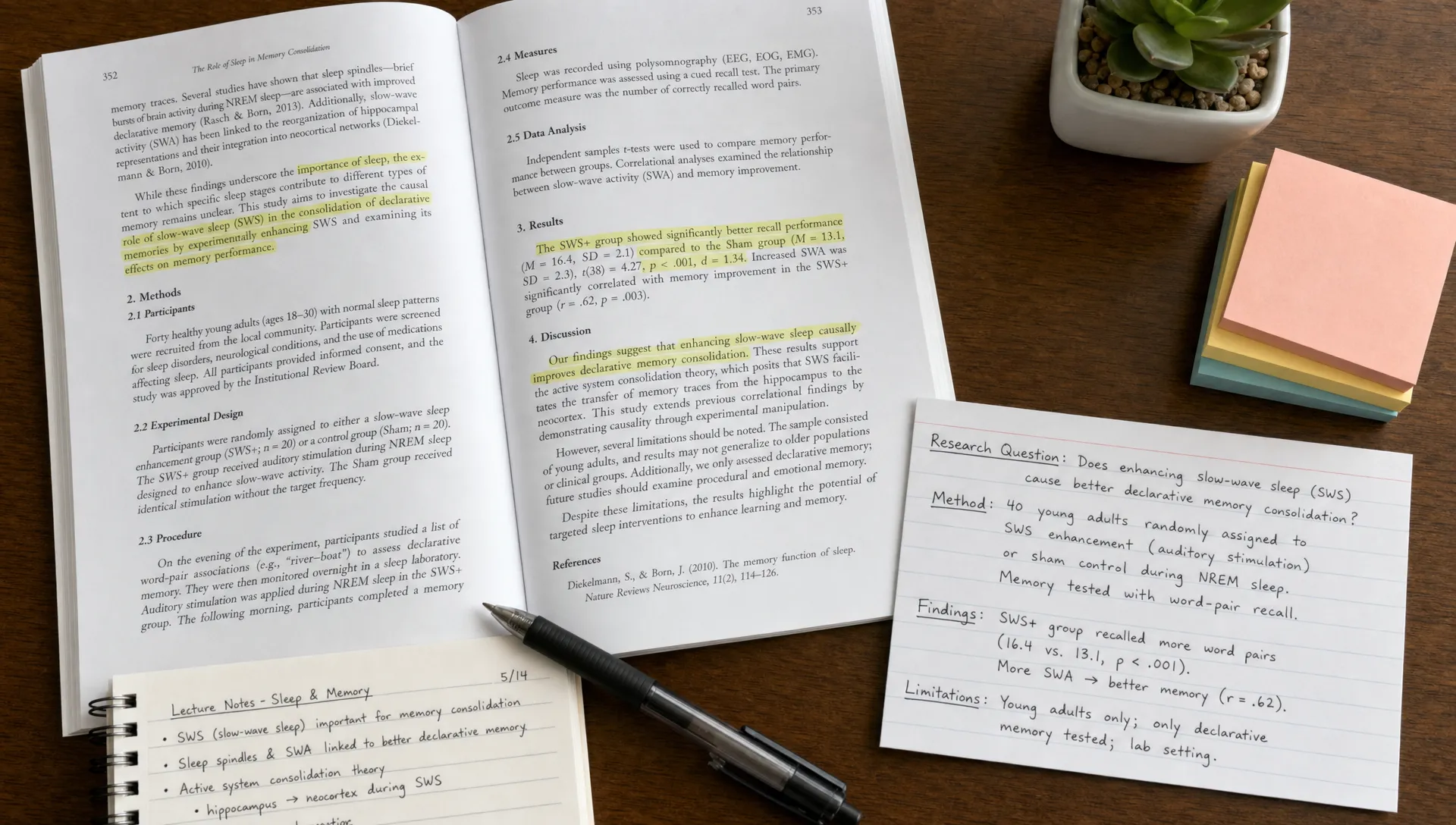
Example: weak summary vs. useful summary
Imagine a fictional paper about sleep and memory in university students.
A weak summary might say:
This paper is about sleep and memory. It discusses how sleep affects students and shows that sleep is important for learning.
That summary is short, but it loses the point. It does not say what the paper tested, how it tested it, what it found, or how far the conclusion can go.
A better summary would be:
The paper examines whether sleep duration is associated with short-term memory performance in university students. Using self-reported sleep logs and a word-recall task, the authors find that students who reported longer sleep performed better on the memory test. The result supports a link between sleep and memory performance, but because the study is observational and relies on self-reported sleep, it cannot prove that longer sleep directly caused the improvement.
The second summary is not much longer, but it preserves the paper’s meaning. It includes the question, method, finding, implication, and limitation.
Use AI to summarize, but give it the right job
AI can be very helpful when you need to summarize a research paper, especially if the paper is long, technical, or outside your main field. But the best results come when you ask for understanding, not just compression.
Instead of asking, “Summarize this paper,” ask for a specific structure.
Try a prompt like this:
Summarize this research paper for a careful reader. Include:
1. The research question
2. The gap or problem the paper addresses
3. The method or data used
4. The main findings
5. The authors' interpretation
6. Key limitations or assumptions
7. Why the paper matters
Use plain language and avoid overstating the conclusions.
If you are using an AI reading companion such as unrav.io, you can work from links, pasted text, PDFs, YouTube videos, and other content formats, then reframe the material depending on your goal. For a paper, you might first use a quick grasp mode to understand the basic claim, then use a teaching-oriented view to explain the concept in simpler language.
The key is to treat AI as a reading partner, not as a replacement for judgment. For important academic, legal, medical, financial, or technical work, always verify the summary against the original paper.
Check the summary against the original paper
After drafting your summary, go back to the paper and check for accuracy. This step is where many summaries improve from “sounds right” to “is reliable.”
Use this checklist:
- Does the summary name the actual research question, not just the topic?
- Does it describe the method at the right level of detail?
- Does it state the main result without exaggeration?
- Does it distinguish correlation from causation?
- Does it include at least one important limitation?
- Does it avoid copying the abstract too closely?
- Does it explain why the paper matters for your purpose?
If the answer to any of these is no, revise before you save or share the summary.
A good summary should also make uncertainty visible. If the authors themselves are cautious, your summary should be cautious. If the paper only studies one population, setting, time period, or dataset, your summary should not imply that the result applies everywhere.
Adapt your summary to the task
The same paper can be summarized in different ways depending on what you need. This is not a flaw. It is part of good reading.
| Use case | What to emphasize | What to reduce |
|---|---|---|
| Class notes | Main concept, definitions, examples | Excessive methodological detail |
| Literature review | Gap, contribution, method, limits | Broad background explanation |
| Lab meeting | Design, data, results, validity | Introductory material everyone knows |
| Professional brief | Practical implication and confidence level | Discipline-specific terminology |
| Teaching material | Intuition, analogy, sequence of ideas | Dense citations and side debates |
| Content creation | Core insight, examples, audience relevance | Technical details not needed by readers |
This is why “the best summary” is not always the shortest one. The best summary is the one that preserves what matters for the reader’s purpose.
Common mistakes to avoid
The first mistake is summarizing only the abstract. Abstracts are useful, but they often compress the paper so tightly that limitations, assumptions, and nuance disappear.
The second mistake is treating all details as equally important. A paper may contain many variables, citations, and secondary analyses. Your job is to identify which details support the central claim.
The third mistake is ignoring figures and tables. In many papers, the clearest evidence is not in the prose. A results paragraph may describe a pattern, but a table or figure often shows the size, direction, and reliability of that pattern.
The fourth mistake is removing uncertainty. Research papers are rarely final answers. They are contributions to a larger conversation. A summary that sounds more certain than the paper itself is misleading.
The fifth mistake is failing to connect the paper to your own knowledge. After summarizing, add one final note for yourself: “How does this change what I think, know, or need to investigate next?” That note turns a summary into learning.
A simple template you can reuse
Use this template whenever you need a fast but careful research paper summary:
Citation:
Research question:
Why it matters:
Method or data:
Main finding:
Interpretation:
Limitations:
Useful quote or detail:
How I might use this:
Open questions:
The “How I might use this” line is especially valuable. It helps students connect papers to essays, researchers connect papers to projects, professionals connect findings to decisions, and creators connect research to future content.
You can keep this template in a notes app, a spreadsheet, or a research manager. The format matters less than the habit of capturing the same elements consistently.
Frequently Asked Questions
How long should a research paper summary be? It depends on the purpose. A quick reference summary may be 100 to 200 words. A literature review note may be 300 to 600 words. A detailed research memo may be longer, especially if you need to compare methods or evidence across papers.
Can I summarize a research paper using only the abstract? You can use the abstract for a first impression, but it is usually not enough for a reliable summary. Read at least the introduction, results, discussion, conclusion, and any limitations before using the summary for serious work.
What is the most important part of a research paper to summarize? The most important part is the relationship between the research question, method, finding, and limitation. A summary that includes all four will usually be more useful than one that only repeats the conclusion.
How do I summarize a paper I do not fully understand? Start with the abstract, headings, figures, and conclusion. Define unfamiliar terms, then write what you do understand as questions. AI tools, textbooks, review articles, and teaching-focused explanations can help, but you should mark uncertain points rather than pretending they are clear.
Is it okay to use AI for academic summaries? In many settings, yes, but follow your institution’s rules. Use AI to support comprehension, structure notes, or generate a first draft. Do not submit AI-generated work as your own if that violates your guidelines, and always verify important claims against the original paper.
Take the next step
To summarize a research paper without losing the point, do not start by cutting words. Start by finding the paper’s logic.
Identify the question, understand the method, capture the main finding, preserve the limitation, and adapt the summary to your purpose. That process takes a little more care than copying the abstract, but it gives you something far more useful: a summary you can trust, explain, and reuse.
If you are working through dense papers, reports, PDFs, or lectures, unrav.io can help you move from “I read it” to “I understand what matters.” Use it to reframe complex content, then bring your own judgment back to the original source before you rely on the summary.