
How Summarizing Falls Short Without Real Understanding
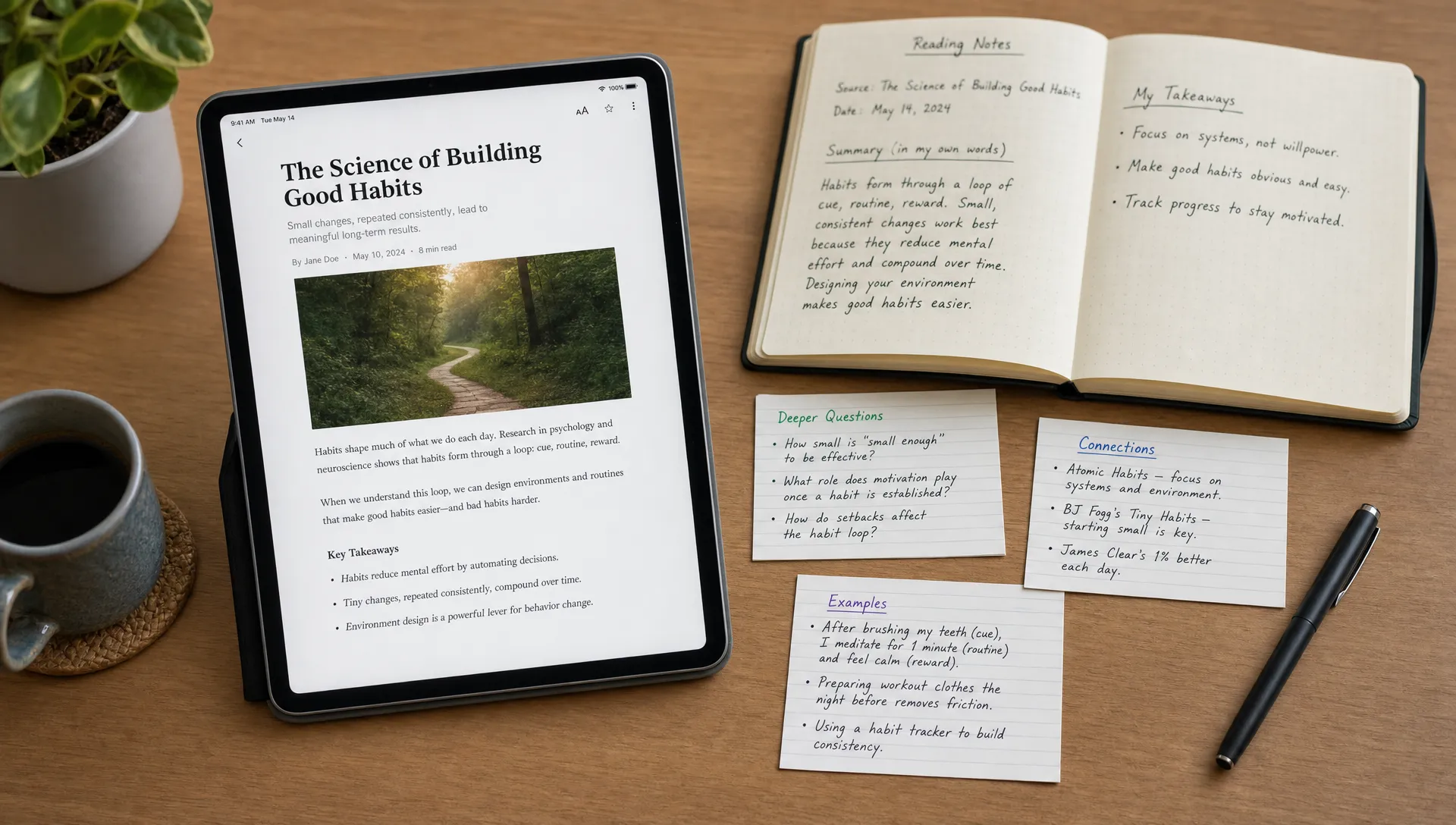
Summarizing is useful. It helps you move through information faster, decide what deserves attention, and recover the main point of a long article, paper, video, or podcast. In a world where every tab leads to five more tabs, that matters.
But there is a problem: a summary can feel like understanding even when understanding has not happened yet.
You may know the headline claim, the three key points, and the conclusion. Still, you may not be able to explain why the argument works, where it is weak, what assumptions it depends on, or how to apply it in a different context. That gap is where summarizing falls short.
The issue is not that summaries are bad. The issue is treating summarizing as the final step instead of the first step toward comprehension.
What summarizing does well
A good summary compresses information. It removes examples, side paths, anecdotes, and supporting details so the main structure becomes easier to see. This is especially valuable when you are trying to triage what to read, review something you already know, or extract a quick orientation from dense material.
Summarizing helps with:
- Getting the gist before committing more time
- Remembering the broad outline of a piece
- Comparing multiple sources quickly
- Returning to content later without rereading everything
- Reducing cognitive overload when the original is long or complex
For example, a concise 5-point summary can quickly orient you to a philosophical essay like this summary of “The Relativity of Wrong”, but the summary alone cannot fully recreate the reasoning, nuance, or intellectual tension of the original argument.
That is the central tradeoff. A summary gives you speed by leaving things out. Real understanding often depends on noticing exactly what was left out.
Where summarizing starts to fail
Summaries are designed to be smaller than the original. That means they must simplify. Sometimes that simplification is harmless. Other times, it removes the very material you need to understand the idea properly.
A summary can hide the reasoning
Many summaries tell you what the author concluded without showing how they got there. That can be enough if your goal is quick awareness, but it is not enough if you need to evaluate the argument.
Consider the difference between these two statements:
| Summary-level knowledge | Understanding-level knowledge |
|---|---|
| “The author argues that remote work can improve productivity.” | “The author argues productivity improves when deep work time increases, but the claim depends on role type, management quality, and how productivity is measured.” |
| “The study found a relationship between sleep and memory.” | “The study suggests sleep supports memory consolidation, but the design, sample size, and type of memory task affect how broadly the finding applies.” |
| “The book says incentives shape behavior.” | “The book shows incentives shape behavior differently depending on feedback loops, social norms, and unintended consequences.” |
The first column is useful. The second column is usable.
A summary can flatten uncertainty
Original content often contains hedging, debate, exceptions, and unresolved questions. A summary tends to smooth those edges into clean statements. That makes the output easier to read, but it can also make uncertain ideas look settled.
This is especially risky with scientific, financial, legal, medical, or technical material. A careful author may say “early evidence suggests,” “under these conditions,” or “this remains contested.” A weak summary may turn that into “X causes Y.”
Once uncertainty disappears, your confidence can rise faster than your understanding.
A summary can remove the context that gives an idea meaning
Ideas rarely stand alone. They respond to prior arguments, solve specific problems, or depend on shared definitions. When a summary extracts the “main point,” it can detach that point from the context that makes it true.
For instance, “less is more” means different things in product design, architecture, writing, exercise, and investing. Without context, the phrase is memorable but vague. Understanding requires knowing when it applies, when it does not, and what tradeoffs it implies.
A summary can create an illusion of fluency
When a summary is clear, you may feel fluent. The content seems familiar. The concepts sound straightforward. You nod along.
But fluency is not the same as mastery. Cognitive psychology has repeatedly shown that easier-feeling study methods can produce weaker long-term learning than more effortful ones. In their well-known review of learning techniques, Dunlosky and colleagues found that summarization has limited general utility compared with methods like practice testing and distributed practice, especially when learners are not already skilled at identifying the most important ideas.
In other words, the fact that a summary feels easy to understand may be a warning sign, not proof of comprehension.
The difference between summarizing and understanding
Summarizing answers the question, “What was this about?” Understanding goes further. It answers, “How does this work, why does it matter, and what can I do with it?”
You probably understand an idea when you can explain it in your own words without copying the original structure, give a concrete example, identify what would make it false, connect it to something else you know, and use it to make a decision or solve a problem.
This is why teaching is such a strong test of comprehension. When you teach an idea, you quickly discover where your knowledge is vague. You may know the phrase but not the mechanism. You may remember the conclusion but not the evidence. You may understand the example from the article but fail to transfer the idea to a new situation.
That failure is not a bad thing. It is the moment learning becomes visible.
Why AI summaries make this more important
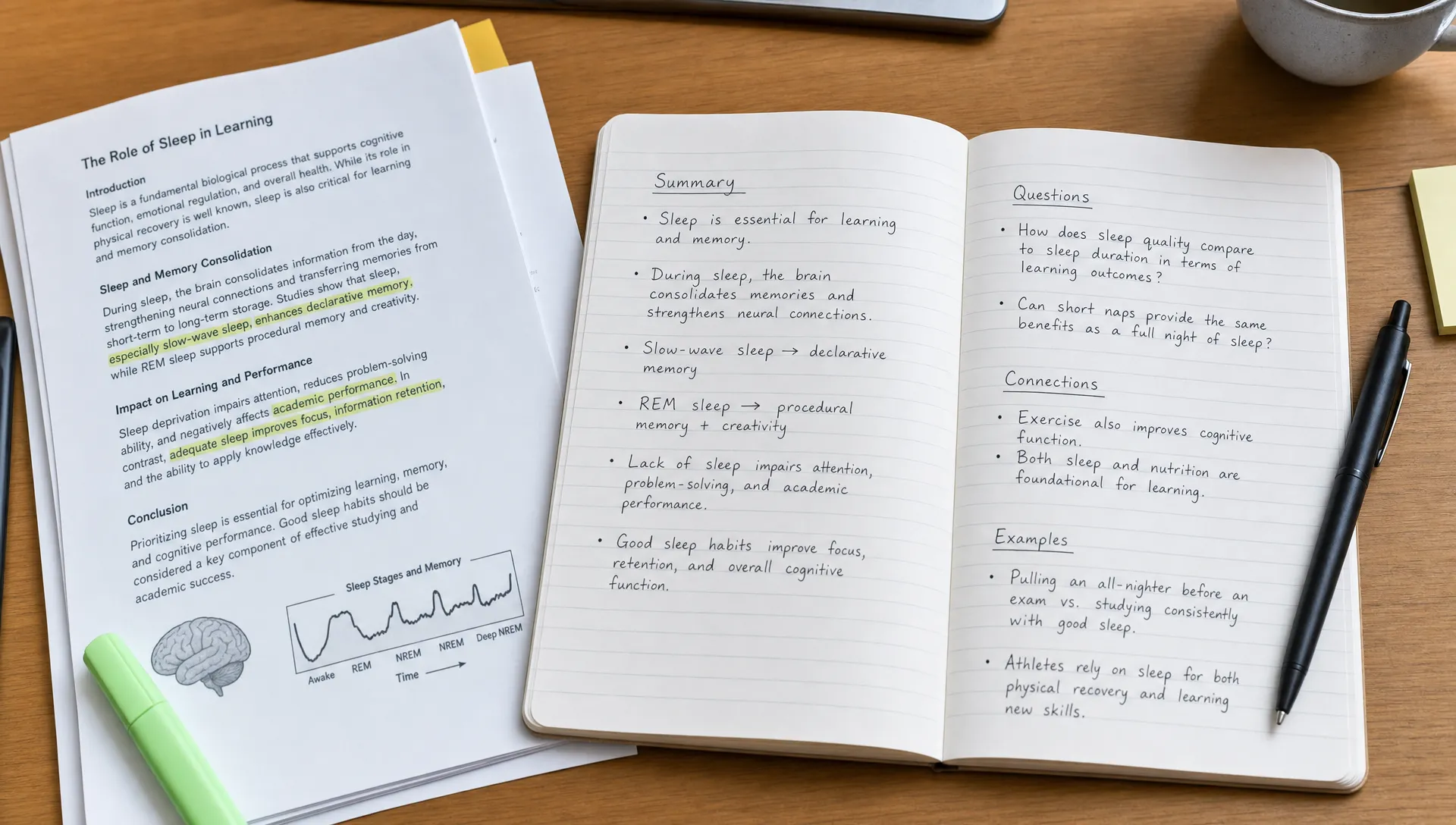
AI has made summarizing dramatically easier. You can paste text, submit a link, process a PDF, or ask for the main points of a long video in seconds. That is powerful, but it also changes the risk profile.
When summarizing was slow, the act of writing a summary forced you to process the material. You had to choose what mattered, decide how ideas related, and restate them. With AI, you can receive a polished summary without doing that mental work yourself.
That does not make AI summaries useless. It means the best use of AI is not to replace thinking, but to support it.
A summary can become a starting lens. It can help you ask better questions, identify confusing areas, and choose where to dig deeper. But if you stop at the summary, you may collect compressed information without building durable knowledge.
This is the difference between an AI tool that merely shortens content and an AI reading companion that helps reframe content around your goal. If you want a quick grasp, a short summary may be right. If you want deeper insight or need to teach the idea to someone else, you need a different mode of engagement.
How to move from summary to real understanding
The goal is not to abandon summarizing. The goal is to combine it with practices that make your mind do something active with the material.
Start with the summary, then interrogate it
After reading a summary, ask what it leaves unclear. A strong summary should make you curious, not finished.
Useful follow-up questions include:
- What problem is the author trying to solve?
- What assumptions does the argument depend on?
- What evidence supports the main claim?
- What examples were removed from the summary?
- Where might this idea fail or stop applying?
- What would I need to know before acting on this?
These questions turn summarizing into inquiry. Instead of accepting the compressed version as complete, you use it as a map for deeper reading.
Rebuild the argument, not just the outline
Many summaries preserve structure without preserving logic. They tell you the first point, second point, and third point, but not why those points support the conclusion.
A better exercise is to rebuild the argument as a chain:
| Step | Question to answer |
|---|---|
| Claim | What is the main thing the author wants me to believe? |
| Reason | Why does the author think this is true? |
| Evidence | What examples, data, or observations support it? |
| Assumption | What must be true for the argument to work? |
| Limitation | Where does the argument become weaker? |
| Application | What changes if I accept this idea? |
If you cannot fill in the middle rows, you may have summarized the content without understanding it.
Explain it without using the original words
Copying phrases can disguise weak comprehension. If you can only explain an idea using the author’s language, you may be remembering wording rather than meaning.
Try explaining the idea to a smart friend who has no background in the topic. Use plain language. Add a simple example. Then explain why the example fits.
This is where tools that offer a “teach-it” style of reframing can be especially helpful. Instead of producing only a condensed version, they push the content into a form that exposes gaps in your understanding.
Test yourself after the summary
Retrieval is one of the clearest ways to separate recognition from understanding. Reading a summary lets you recognize information. Testing yourself forces you to retrieve and reconstruct it.
Research on the testing effect, including work by Roediger and Karpicke, shows that retrieving information can improve long-term retention more than simply restudying it. For practical purposes, this means you should close the summary and ask yourself what you remember, how the ideas connect, and what examples you can generate.
A simple test is to write five sentences from memory:
- One sentence for the main claim
- One sentence for the mechanism
- One sentence for the strongest evidence
- One sentence for a limitation
- One sentence for how you might use the idea
If you struggle, reread selectively. The struggle tells you where to focus.
When a summary is enough
Not every piece of content deserves deep understanding. Sometimes summarizing is exactly the right tool.
A summary may be enough when you are screening sources, checking whether a document is relevant, reviewing familiar material, or trying to capture basic takeaways from low-stakes content. In those cases, speed matters more than depth.
But summarizing is not enough when the material affects a decision, challenges your beliefs, teaches a skill, introduces a complex concept, or needs to be shared with others. The more you plan to rely on an idea, the more you need to understand its structure.
A useful rule is this: summarize for awareness, interrogate for understanding, retrieve for retention, and apply for mastery.
A better workflow for complex content
For articles, videos, PDFs, podcasts, and long essays, a layered workflow works better than a single summary.
First, get oriented. Ask for the core idea, the structure, and the main terms. This reduces overwhelm and gives you a path through the material.
Next, deepen the frame. Ask how the argument works, what context matters, what examples were used, and what the author might be assuming. This is where the content starts becoming knowledge rather than text.
Then, transform it. Ask for an explanation for a beginner, a skeptical critique, a teaching outline, or a set of application scenarios. Different frames reveal different parts of the idea.
Finally, retrieve and connect. Write what you remember, connect it to other ideas, and decide what you will do differently because of it.
This is the kind of reading process that turns content into clearer understanding. Summaries help you enter the material. Reframing helps you work with it.
Frequently Asked Questions
Is summarizing bad for learning? No. Summarizing is useful for orientation and review. It becomes a problem only when you treat the summary as proof that you understand the material.
Why do AI summaries sometimes feel more useful than they are? AI summaries are often fluent, organized, and confident-sounding. That polish can create the feeling of comprehension even if you have not examined the reasoning, evidence, assumptions, or limitations.
How can I tell if I truly understand something after reading a summary? Try explaining it without looking, giving your own example, identifying a limitation, and applying the idea to a new situation. If you cannot do those things, you likely need deeper engagement.
What should I do after reading a summary? Ask follow-up questions, rebuild the argument, check unclear terms, test yourself from memory, and connect the idea to something you already know.
When is a quick summary enough? A quick summary is enough when the stakes are low, the topic is familiar, or you are deciding whether the full content deserves attention. It is not enough when you need to make decisions, teach, critique, or apply the material.
Make summarizing the start of understanding
Summarizing helps you move faster, but real understanding helps you think better. The best reading workflow uses both: quick compression when you need orientation, and deeper reframing when you need insight, retention, or action.
unrav.io is built around that distinction. It helps turn articles, videos, PDFs, podcasts, links, and pasted text into clearer understanding through different thinking modes, from quick grasping to deeper exploration and teachable explanations.
If you are tired of collecting summaries that fade by tomorrow, use summarizing as the doorway, not the destination. The real value begins when you start asking what the summary cannot show you yet.