What an Academic Reading Tool Should Do for Researchers
Researchers rarely lose time only because a paper is long. They lose time because the paper asks them to hold too many things in working memory at once: the research question, assumptions, method, evidence, limitations, prior literature and whether any of it matters for their own project.
A useful academic reading tool should not simply make papers shorter. It should help researchers understand dense material faster, keep track of what they have learned and return to the source when precision matters.
That distinction matters. A short summary can be helpful for triage, but research work depends on nuance. You need to know what the authors actually tested, what they did not test, how strong the evidence is and how the paper connects to other work. The right tool supports that process without pretending to replace expert judgment.
Researchers need more than a PDF reader
PDF readers are good at displaying documents. Reference managers are good at storing citations. Note-taking apps are good at capturing ideas. But academic reading sits between all three.
When researchers open a paper, they are usually trying to answer practical questions:
- Is this paper relevant enough to read closely?
- What problem does it address?
- What method did the authors use?
- What are the main findings?
- What assumptions or limitations should I remember?
- How does this connect to other papers in my project?
A strong academic reading tool helps with those questions directly. It turns reading from a passive activity into an active workflow: inspect, question, verify, connect and reuse.
If you are comparing software options more broadly, this guide on how to choose the best app for reading academic papers covers selection criteria in more detail. Here, the focus is on what the tool should actually do once you are inside the paper.
It should preserve the source, not hide it
The first requirement is source fidelity. Researchers need to trust where an interpretation came from.
An academic reading tool should keep the original document close to every generated output. If it summarizes a method, the researcher should be able to return to the relevant section. If it explains a claim, the claim should be easy to verify against the paper. If it simplifies technical language, it should not blur uncertainty or make cautious findings sound stronger than they are.
This matters because academic writing often uses careful qualifiers. Words like “may,” “associated with,” “in this sample” and “under these conditions” carry real meaning. A weak tool flattens those details. A better one helps you notice them.
For research reading, the tool should encourage habits like:
- Checking generated summaries against the abstract, method and results sections
- Keeping page numbers, section names or source passages visible when possible
- Separating what the paper says from what the reader infers
- Flagging uncertainty instead of smoothing it away
AI can support comprehension, but the researcher remains responsible for interpretation.
It should help you triage papers before deep reading
Not every paper deserves a full read. Researchers often scan dozens of papers to decide which ones belong in a literature review, project folder or annotated bibliography.
A good tool should make this triage faster. It should help you quickly identify the paper’s topic, research question, contribution, population or dataset, method and relevance to your goal. That does not mean relying on a one-paragraph summary alone. It means getting a structured first pass that helps you decide what to do next.
For example, when triaging a paper, a researcher might ask:
- What is the central research question?
- What gap in the literature does the paper claim to address?
- What evidence does it use?
- Is this empirical, theoretical, computational, historical or review-based?
- Does it relate directly to my project or only indirectly?
The answer may be “save for later,” “read the method,” “extract for literature review” or “skip.” The tool’s job is to help you make that decision with less friction.
It should extract research structure, not just produce summaries
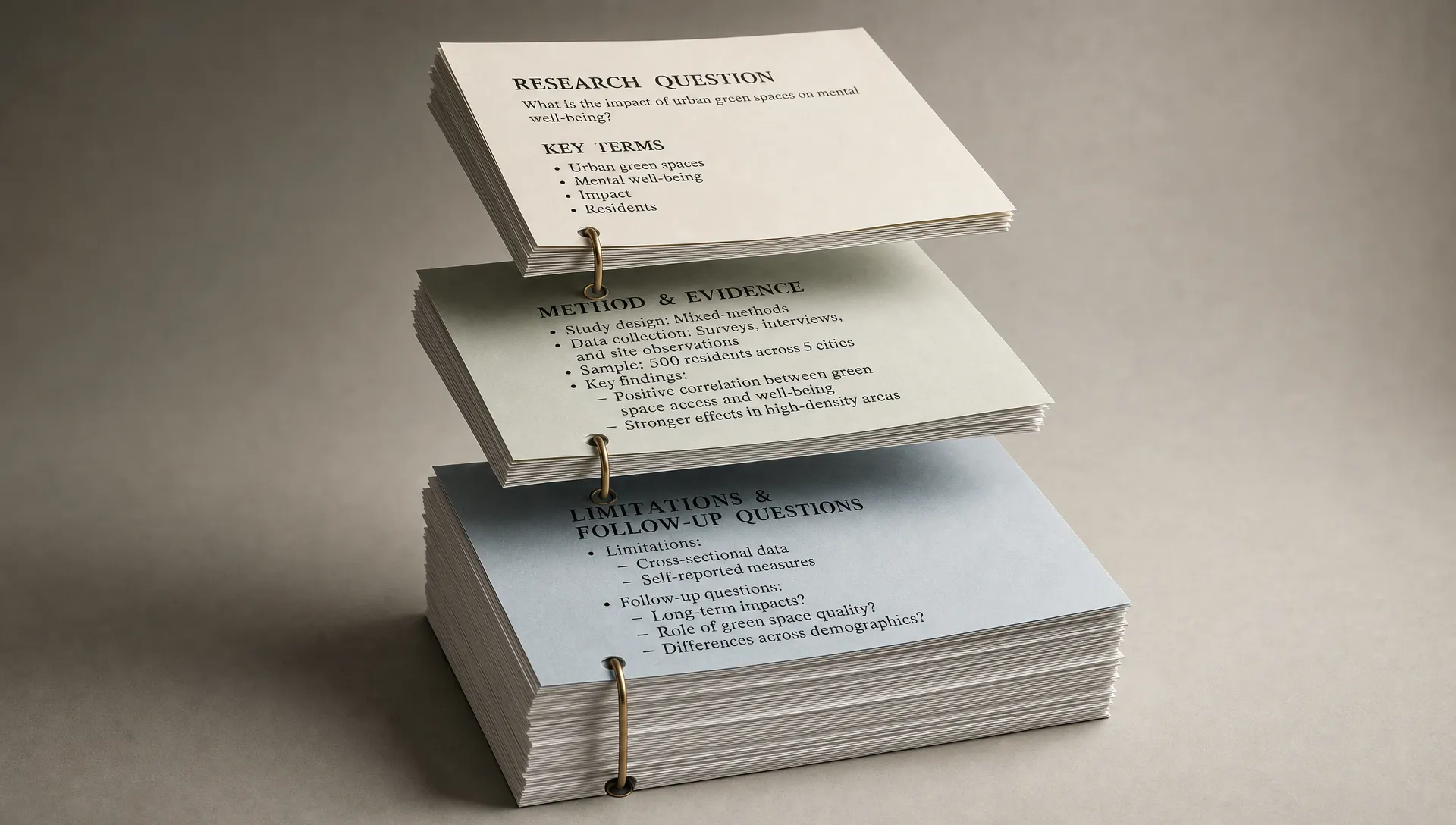
A summary tells you what a paper is about. A research structure tells you how the paper works.
That difference is especially important for academic reading. Two papers can be about the same topic but differ completely in method, evidence quality and contribution. A useful academic reading tool should identify the core components of a paper so the researcher can evaluate it properly.
| Research element | What the tool should help identify | Why it matters |
|---|---|---|
| Research question | The problem or question the paper investigates | Helps you judge relevance |
| Contribution | What the paper adds to the field | Helps with literature review positioning |
| Method | How the authors collected, modeled or analyzed evidence | Helps you evaluate credibility |
| Findings | The main results or arguments | Helps you capture the paper’s point |
| Limitations | Boundaries, weaknesses or unanswered questions | Helps prevent overclaiming |
| Key terms | Definitions and technical concepts | Helps with comprehension and teaching |
This structure is useful because it turns a dense article into a map. You can still read the full paper, but you no longer have to hold the entire thing in your head at once.
For a more detailed workflow, this guide to summarizing a research paper without losing the point explains how to capture the core elements without reducing the paper to a vague abstract.
It should support different reading modes
Researchers do not read every document the same way. Sometimes you need a fast overview. Sometimes you need to inspect the statistical model, trace an argument or teach the concept to someone else.
An academic reading tool should support different reading modes rather than forcing every document into the same summary format.
A quick grasp mode is useful when you want to know whether a paper matters. A deep dive mode is better when the paper is central to your work and you need to understand the reasoning. A teach-it mode can help when you need to explain a concept to students, teammates or a non-specialist audience. A comparison mode is useful when several papers address similar questions but disagree on methods or conclusions.
The best mode depends on your purpose. A doctoral student preparing for a comprehensive exam may need recall and synthesis. A policy analyst may need implications and caveats. A lab researcher may care most about methods and reproducibility. A creator may want to turn a paper into a clear article outline.
The point is not to read less. The point is to read at the right level for the task. If this distinction is useful, the article on choosing between quick grasp and deep dive reading modes gives a practical way to decide which mode fits the material.
It should turn reading into reusable notes
Academic reading creates value only when you can use it later. Highlights are not enough if they sit inside a PDF and never become part of your thinking.
A strong academic reading tool should help convert reading into reusable notes. Those notes should be structured enough to support writing, teaching, presentations, grant proposals, literature reviews or future study.
For researchers, useful notes often include the citation, research question, method, findings, limitations, relevant quotations, key terms and personal comments. The tool should make it easier to create this structure, but it should also leave space for your own judgment. A generated note is a starting point, not a finished interpretation.
Good notes also distinguish between three kinds of content: what the authors say, what the evidence supports and what you think about it. Mixing those together can create problems later when you start writing.
It should help researchers ask better questions
Reading is not only extraction. It is interrogation.
An effective academic reading tool should let researchers ask questions of the material. Not just “summarize this,” but questions that match real scholarly work:
- What assumptions does this argument rely on?
- How does the method affect the conclusion?
- What would weaken this finding?
- Which terms are defined differently from related papers?
- What follow-up studies would this paper suggest?
This kind of interaction is valuable because it turns the tool into a reading companion rather than a summary machine. You are not asking it to decide what is true. You are using it to surface parts of the text that deserve attention.
Tools like unrav.io are built around this idea of reframing content for different goals. Instead of treating every article, PDF, video or pasted text as something to compress, unrav.io helps readers approach material through different thinking modes, such as quick grasping, deeper understanding or teaching the idea back. That is closer to how researchers actually work.
It should connect ideas across sources
Most research questions are not answered by one paper. They emerge from patterns across many sources.
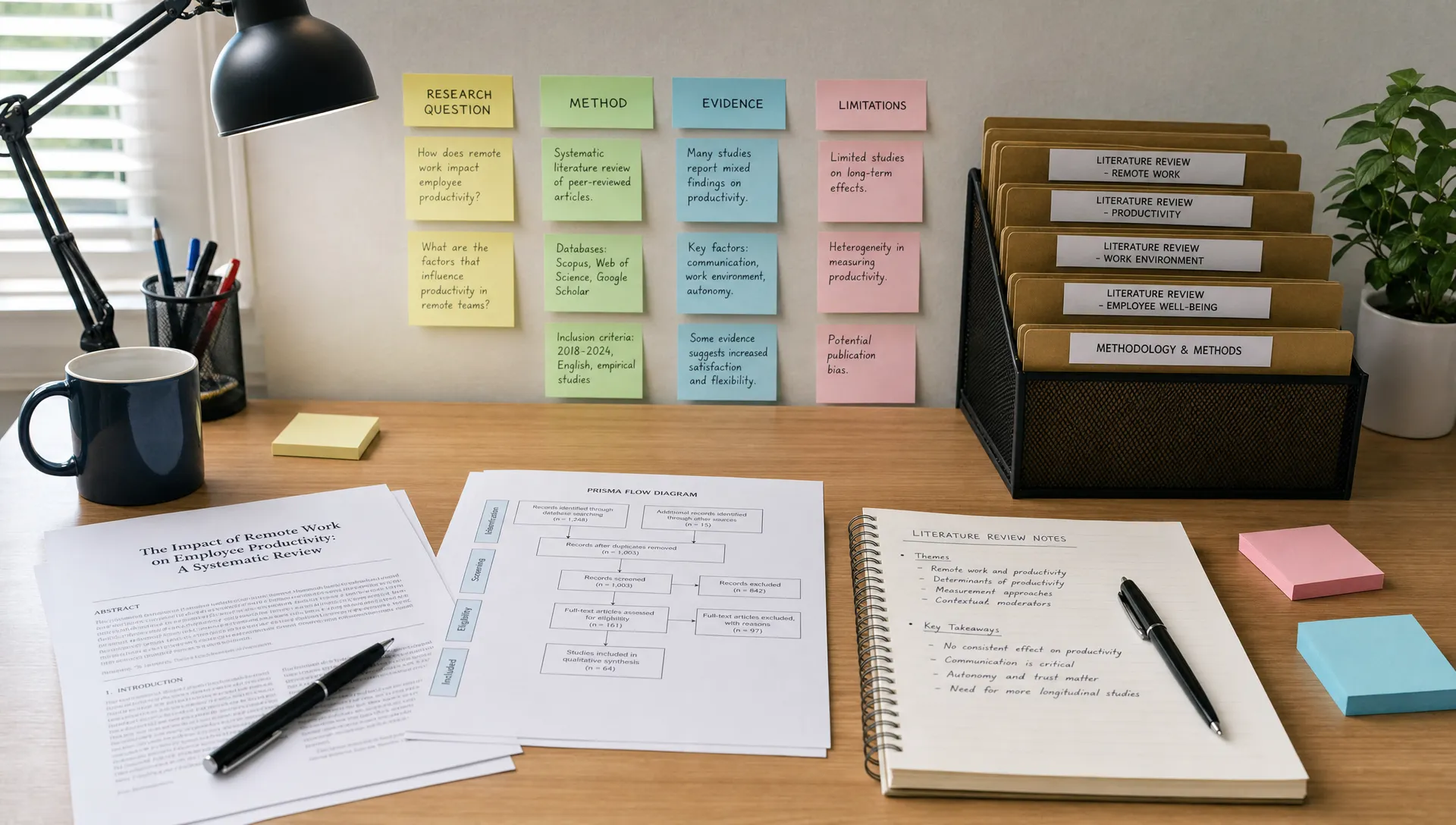
A useful academic reading tool should help researchers notice connections: shared concepts, conflicting findings, recurring limitations, methodological differences and gaps in the literature. This is especially helpful during literature reviews, where the challenge is not just understanding individual papers but seeing how the conversation develops.
For formal evidence synthesis, researchers still need rigorous methods. Standards such as PRISMA 2020 exist to support transparent reporting in systematic reviews. An academic reading tool should not replace those standards, but it can support earlier stages of the process by helping you inspect, tag and compare sources more efficiently.
For example, if three papers study the same intervention but use different populations, the tool should help you see that distinction. If several papers share the same limitation, it should help you capture that pattern. If one paper defines a key concept differently from another, it should help you notice before you write a misleading synthesis.
It should reduce cognitive load without reducing critical thinking
The danger of any reading tool is that it can make weak understanding feel like strong understanding. A polished summary can create confidence before the reader has checked the evidence.
A good academic reading tool should reduce cognitive load while still encouraging critical thinking. It should make the paper easier to enter, not make the researcher passive.
That means the tool should help with comprehension tasks like defining terms, outlining arguments, simplifying dense paragraphs and locating key sections. But it should also support verification: returning to the source, comparing interpretations and asking follow-up questions.
Researchers should be especially careful when using AI with:
- Statistical results or mathematical reasoning
- Medical, legal or safety-critical material
- Highly technical methods
- Controversial claims
- Papers outside their area of expertise
In those cases, the tool can still help, but closer human review is non-negotiable.
It should work across the formats researchers actually use
Academic work is no longer limited to journal PDFs. Researchers learn from preprints, technical reports, recorded lectures, conference talks, podcasts, datasets, policy documents and long web articles.
An academic reading tool should handle more than one format when possible. A researcher may want to understand a PDF paper in the morning, extract the argument from a recorded lecture in the afternoon and turn a long article into notes later. Switching tools for every format creates friction.
This is where support for links, PDFs, YouTube videos, podcasts and pasted text becomes useful. The core need is the same across formats: understand the content, preserve the point, extract what matters and make it easier to use later.
For students, this might mean turning a lecture recording and assigned paper into a study guide. For researchers, it might mean comparing a paper with a conference talk by the same author. For professionals, it might mean extracting the implications of a technical report before a meeting.
It should fit into a real research workflow
The best academic reading tool is not necessarily the one with the longest feature list. It is the one that fits the way researchers already work.
That means low friction. Researchers should be able to open a paper, ask useful questions, save useful outputs and move on without spending more time managing the tool than reading the source. Browser support, PDF support and the ability to work with copied text all help because they meet the researcher where the material already is.
It also means the tool should support different levels of commitment. Sometimes you want a fast scan with no setup. Sometimes you want deeper work on a central paper. A no-signup option can be useful for quick exploration, especially when you simply want to understand whether a tool fits your reading process.
A practical academic reading workflow might look like this:
- Use a quick pass to decide whether the paper is relevant.
- Extract the research question, method, findings and limitations.
- Ask targeted questions about unclear sections.
- Check important claims against the original text.
- Convert the output into structured notes for later use.
- Compare the paper with related sources when writing or teaching.
This workflow keeps the researcher in control while using AI to remove unnecessary friction.
What to avoid in an academic reading tool
Some tools look useful at first but create problems for serious research.
Be careful with tools that produce confident summaries without showing how they reached them. Be cautious if the tool ignores document structure, loses tables or treats a methods section like general background. Also be skeptical of tools that make every paper sound equally clear, equally important or equally certain.
Academic reading requires discrimination. A good tool should help you see what matters, but also what is missing, weak, tentative or unresolved.
A simple checklist for researchers
Before making an academic reading tool part of your routine, test it on a paper you already understand. This gives you a baseline. If the tool misses the point, overstates the findings or confuses the method, you will notice quickly.
Use this checklist during evaluation:
| Question | What a good answer looks like |
|---|---|
| Does it preserve the original source? | You can verify claims against the document |
| Does it identify research structure? | It separates question, method, findings and limitations |
| Does it support different reading goals? | You can skim, study, explain or compare |
| Does it help create reusable notes? | Outputs can support writing, teaching or review work |
| Does it handle your formats? | It works with PDFs, links, text and other materials you use |
| Does it encourage verification? | It does not ask you to trust summaries blindly |
A tool that performs well on these points is more likely to support real scholarship instead of adding another layer of noise.
Frequently Asked Questions
What is an academic reading tool? An academic reading tool helps researchers, students and technical readers understand scholarly material. It may support tasks like summarizing papers, explaining dense sections, extracting methods, organizing notes and comparing sources.
Should researchers use AI to read academic papers? AI can help with triage, comprehension and note organization, but it should not replace careful reading or expert judgment. Researchers should verify important claims against the original paper.
What is the most important feature in an academic reading tool? Source grounding is one of the most important features. Researchers need to know where a summary, explanation or extracted claim comes from so they can check it before relying on it.
Is a summary enough for academic research? Usually not. A summary is useful for a first pass, but research work often requires the method, evidence, assumptions, limitations and relationship to other literature.
Can an academic reading tool help with literature reviews? Yes, especially during early reading, paper triage, note creation and comparison across sources. For systematic reviews, researchers still need to follow formal review protocols and reporting standards.
Take the next step
A good academic reading tool should make complex material easier to work with without removing the need to think. For researchers, that means faster triage, clearer structure, better questions, reusable notes and a reliable path back to the source.
If your reading workflow includes papers, PDFs, long articles, videos or pasted text, unrav.io can help you approach the same material through different thinking modes. Use it to get a quick grasp, dig deeper into difficult sections or reframe content so you can explain it clearly to someone else.