

The Meaning of Understanding Beyond Memorizing Facts
Memorizing facts can be useful. It helps you recall formulas, definitions, dates, vocabulary, names, steps, and rules. But if you have ever passed a quiz and then struggled to explain the topic a week later, you have felt the gap between remembering and understanding.
The meaning of understanding goes beyond having information stored in your head. To understand something is to see how its parts fit together, why it matters, when it applies, where it breaks down, and how it connects to what you already know.
That distinction matters for students preparing for exams, researchers reading papers, professionals interpreting reports, educators explaining difficult ideas, and creators repurposing complex material. In all of those situations, facts are not the final goal. They are building blocks for insight.
What understanding actually means
Understanding is the ability to make sense of information, not just repeat it. When you understand an idea, you can explain it in your own words, use it in a new situation, connect it to related concepts, and notice when someone is applying it incorrectly.
A useful way to think about understanding is that it has three parts:
- Relationship: You know how the pieces connect, not just what each piece is called.
- Transfer: You can use the idea outside the exact example where you first learned it.
- Judgment: You can tell what the idea does and does not explain.
For example, memorizing that correlation does not imply causation is helpful. Understanding it means you can look at a headline like “people who drink more coffee are more productive” and ask better questions. Were other variables controlled? Is productivity causing coffee consumption, or is coffee consumption causing productivity? Could both be influenced by job type, sleep, or income?
This is why understanding is often described as organized knowledge. The National Academies book How People Learn explains that experts do not simply know more facts. They organize knowledge around important concepts, which helps them retrieve and apply it more effectively.
Why memorizing feels like understanding
Memorization often feels satisfying because it produces quick evidence of progress. You reread a paragraph and it seems familiar. You highlight a definition and feel like you have captured it. You repeat a term enough times that it becomes easy to recognize.
The problem is that familiarity can masquerade as learning. Recognition is easier than explanation. Seeing the correct answer on a page is easier than producing it from memory. Following someone else’s argument is easier than rebuilding the argument yourself.
This is one reason rereading and highlighting can be limited study strategies when used alone. A widely cited review by Dunlosky and colleagues in Psychological Science in the Public Interest found stronger evidence for practice testing and distributed practice than for passive techniques like rereading and highlighting.
That does not mean memorization is bad. You cannot reason well about a topic if you have no facts available. A medical student needs anatomical terms. A language learner needs vocabulary. A programmer needs syntax. A historian needs dates and actors. But facts become powerful when they are connected, questioned, and used.
Memorizing vs understanding: the practical difference
The difference becomes clearer when you look at what each one allows you to do.
| If you memorize | If you understand |
|---|---|
| You can repeat a definition. | You can explain the idea in your own words. |
| You recognize examples you have already seen. | You can create new examples and non-examples. |
| You remember individual facts. | You see how facts relate to a larger structure. |
| You may struggle when the wording changes. | You can handle unfamiliar wording or contexts. |
| You know the answer. | You know why the answer makes sense. |
Consider a physics student learning Newton’s laws. Memorizing the laws may help on a simple quiz. Understanding them means the student can reason through a new problem, draw a force diagram, explain why a heavier object does not necessarily fall faster in a vacuum, and identify when friction or air resistance changes the situation.
The same pattern appears in professional work. An analyst can memorize that a metric increased by 12 percent. But understanding means knowing what drove the increase, whether the measurement is reliable, how it compares with a baseline, and what decision it should inform.
Signs that you understand something deeply
A good test of understanding is not “Have I seen this before?” It is “Can I work with this idea?”
You are moving beyond memorization when you can explain the concept without copying the original wording. You can answer “why” and “how” questions. You can simplify the idea without distorting it. You can teach it to someone with less background. You can apply it to a new case. You can identify weak evidence, hidden assumptions, or missing context.
This is also where confusion becomes useful. If you try to explain an idea and get stuck, that is not failure. It is feedback. It shows exactly where your knowledge is still disconnected.
If you want a more detailed self-check, the guide on how to tell if you truly understand a topic breaks down practical ways to test your comprehension before an exam, presentation, or important decision.
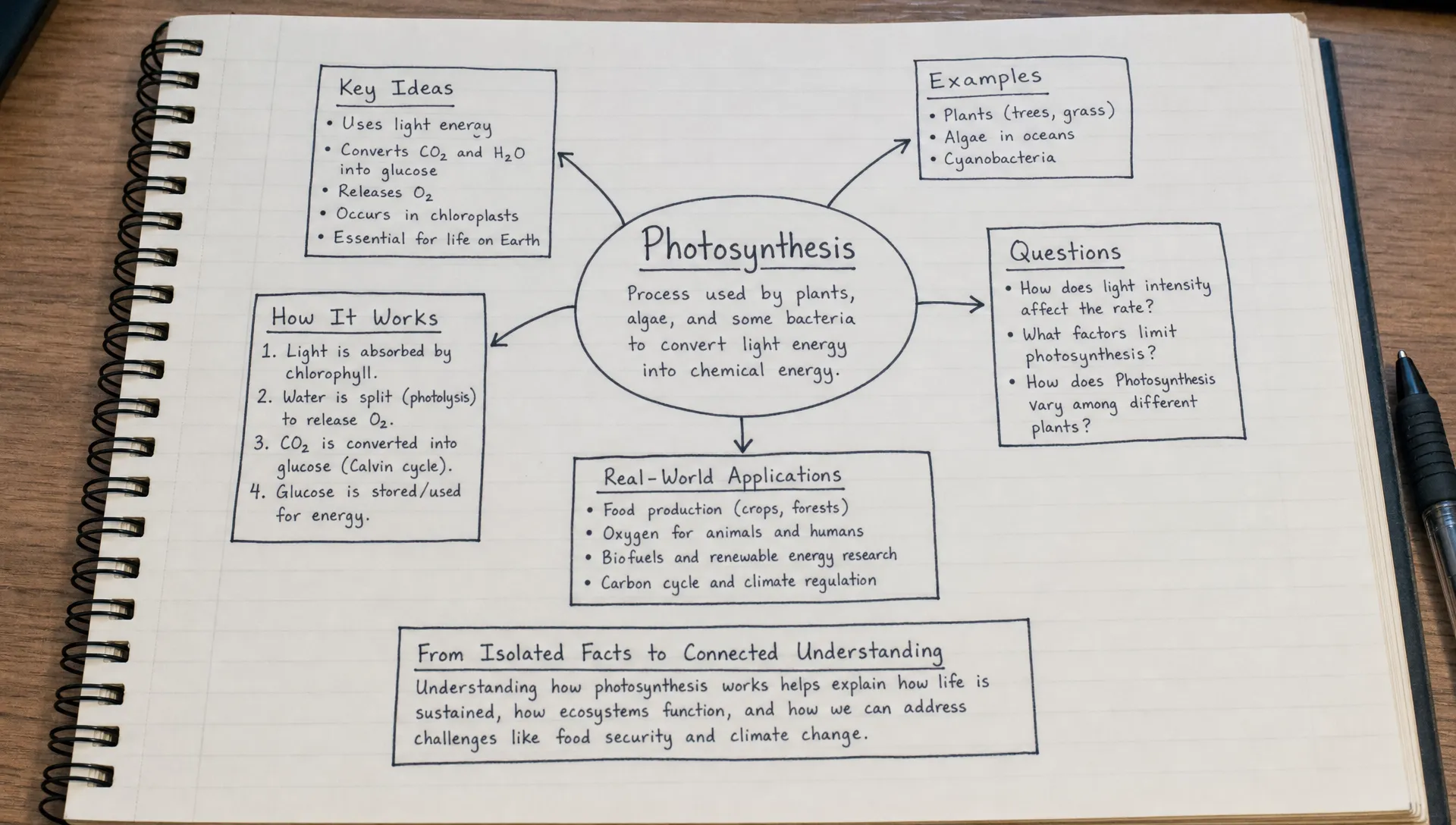
How to move from memorizing facts to real understanding
Understanding is not a personality trait. It is a process. You can build it deliberately by changing what you do after you first encounter information.
Start with the structure, not every detail
When reading a dense article, research paper, textbook chapter, or report, begin by asking what the material is trying to do. Is it explaining a concept, defending an argument, comparing options, reporting evidence, or teaching a process?
Then look for the main parts. In a research paper, that might be the question, method, findings, limitations, and implications. In a business report, it might be the problem, evidence, recommendation, risks, and next steps. In a lecture, it might be the core idea, supporting examples, and applications.
This prevents you from treating every sentence as equally important.
Explain the idea in plain language
A strong understanding can usually survive simplification. Try explaining the topic as if you were teaching a smart beginner.
For example, instead of repeating “photosynthesis converts light energy into chemical energy,” you might say, “Plants use sunlight to help turn carbon dioxide and water into sugar they can store and use, releasing oxygen as a byproduct.”
Plain language reveals gaps. If you cannot simplify an idea, you may only recognize the words, not the meaning.
Create examples and non-examples
Examples show how an idea works. Non-examples show where it does not apply.
If you are learning about opportunity cost, an example might be choosing to spend two hours studying instead of working a paid shift. A non-example might be choosing between two identical free samples when there is no meaningful tradeoff.
This method is especially useful for abstract topics such as bias, inference, entropy, justice, liquidity, validity, or recursion. A definition alone can remain slippery. Examples give the idea shape.
Ask what would change your mind
Understanding includes knowing the limits of a claim. When you read an argument, ask what evidence would weaken it. When you study a theory, ask where it fails. When you summarize a report, ask what assumptions the conclusion depends on.
This habit matters in research, strategy, and public communication because confident summaries can hide uncertainty. That is why summarizing can fall short without real understanding, especially when a summary removes caveats, methods, or competing explanations.
Use retrieval instead of only review
Review means looking again. Retrieval means trying to bring the idea back from memory.
After reading, close the source and write what you remember. Then check what you missed. Ask yourself questions before looking at the answer. Explain a diagram without labels. Rebuild an argument from its conclusion back to its evidence.
Retrieval feels harder than rereading, but that difficulty is part of why it works. It forces your brain to organize and access knowledge, not merely recognize it.
How AI can support understanding without replacing your thinking
AI tools are useful when they help you interact with material more actively. They are less useful when they simply compress a long source into a short answer and invite you to stop thinking.
For example, if you are reading a long PDF, watching a technical YouTube lecture, or reviewing a podcast interview, an AI reading companion can help you reframe the content for different goals. You might first ask for a quick orientation, then a deeper explanation of the argument, then a teaching version with examples, then a list of unclear assumptions to inspect yourself.
That is the kind of workflow unrav.io is designed around. It helps turn articles, videos, PDFs, podcasts, links, or pasted text into clearer outputs using different thinking modes, so you can move from “I saw the content” to “I can work with the ideas.”
The key is to use AI as a comprehension partner, not an authority you accept without question. Ask it to reveal structure, compare ideas, define terms, generate questions, or translate dense sections into clearer language. Then return to the source, verify important claims, and make your own judgment.
For some material, you only need a quick grasp. For other material, you need a careful deep dive. Choosing the right level of attention is part of understanding, and this guide on quick grasp versus deep dive reading can help you decide which mode fits the task.
A simple workflow for deeper understanding
The next time you face a dense source, try this sequence.
First, skim for purpose. Identify what the source is trying to explain, prove, compare, or solve. Second, extract the main structure. Do not chase every detail yet. Third, explain the core idea in your own words. Fourth, create one example and one non-example. Fifth, ask what evidence, assumption, or context matters most. Finally, retrieve the idea later without looking.
This workflow works for many contexts. Students can use it for exam prep. Researchers can use it to evaluate papers. Professionals can use it to interpret reports. Creators can use it to turn long material into useful outlines or scripts. Educators can use it to prepare lessons that make difficult ideas easier to teach.
The goal is not to avoid memorization. The goal is to put memorization in its proper place. Facts are ingredients. Understanding is the ability to cook with them.
Frequently Asked Questions
What is the meaning of understanding in learning? Understanding means being able to make sense of information, explain it in your own words, connect it to other ideas, apply it in new situations, and recognize its limits. It includes memory, but it goes beyond recall.
Is memorization still important? Yes. Memorization gives you the raw material for thinking. The problem is relying on memorization alone. Deep learning happens when facts are organized, connected, questioned, and applied.
How do I know if I truly understand a topic? Try explaining it without looking, creating your own example, teaching it to someone else, solving a new problem, or identifying what would make the idea false or incomplete. If you can only repeat the original wording, your understanding may still be shallow.
Can AI help me understand complex content? Yes, if you use it actively. AI can help simplify dense passages, reveal structure, generate questions, compare ideas, and reframe material for studying or teaching. You should still verify important details and think critically about the source.
Is a summary the same as understanding? No. A summary can help you orient quickly, but it may hide reasoning, uncertainty, and important relationships. Understanding requires working with the ideas, not just reading a shorter version of them.
Build a better understanding habit
The meaning of understanding is not limited to knowing more facts. It is about seeing connections, using ideas well, and knowing when your knowledge is incomplete.
If you are working through a difficult article, PDF, lecture, podcast, or research paper, try using unrav.io to reframe the material into clearer forms. Start with orientation, move into deeper questions, and use the output as a guide for your own thinking. That is where memorized facts can turn into real understanding.