How to Tell if You Truly Understand a Topic
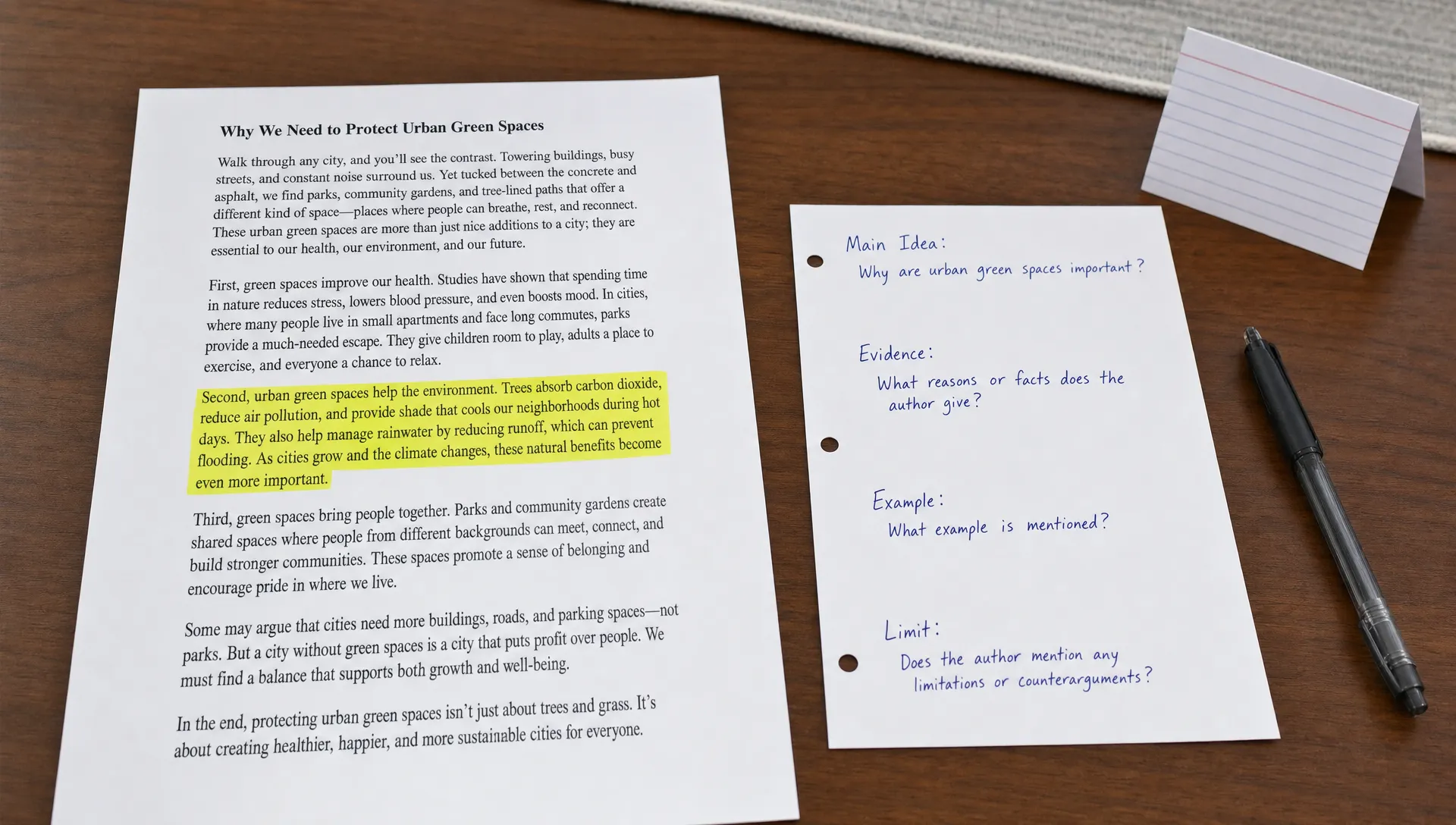
You can read an entire chapter, watch a clear lecture, highlight a report, and still freeze when someone asks you to explain the topic from memory. That gap is common. Exposure feels like learning, but real understanding shows up only when you can use an idea without leaning on the original source.
The useful question is not simply, Did I read this? It is, Can I explain it, apply it, connect it to other ideas, and notice where my knowledge breaks down?
This guide gives you practical ways to tell if you truly understand a topic, whether you are studying for an exam, reading research papers, preparing a client brief, learning a technical concept, or turning complex material into content for others.
Why feeling familiar is not the same as understanding
Reading creates familiarity. After seeing the same terms several times, your brain starts to recognize them quickly. That recognition can feel like comprehension, especially if the source is well written or the summary is clean.
But familiarity often fails under pressure. You may recognize the right answer in a multiple choice question but struggle to define the concept. You may nod through a video but be unable to solve a related problem. You may repeat a conclusion without knowing what evidence supports it.
Summaries can help you orient yourself, but they can also hide the reasoning that makes a topic meaningful. If you often feel like you understand something after reading a short recap, then lose confidence when asked follow-up questions, it is worth reading more about how summarizing falls short without real understanding.
The goal is not to distrust every summary or explanation. The goal is to treat them as starting points, not proof that the topic is now yours.
What true understanding looks like
True understanding is flexible knowledge. You are not just storing words. You can move around the idea, look at it from different angles, and use it in situations that do not look exactly like the original example.
| Ability | What it means in practice |
|---|---|
| Explain | You can describe the idea in your own words without copying the source. |
| Reconstruct | You can show how the claim, evidence, assumptions, and conclusion fit together. |
| Apply | You can use the idea in a new example, problem, or decision. |
| Connect | You can relate the topic to other concepts, cases, or frameworks. |
| Critique | You can name limits, uncertainties, exceptions, or weak points. |
You do not need perfect mastery to say you understand something. But if you can only repeat the wording from a source, your understanding is probably still shallow.
1. Explain it without copying the original wording
The first test is simple: close the source and explain the topic out loud in plain language.
Do not aim for a polished lecture. Aim for clarity. If you are studying photosynthesis, you should be able to explain what plants are doing, why sunlight matters, and how the process relates to energy. If you are reading about machine learning, you should be able to say what the model is learning from, what it is trying to predict, and why the training data matters.
A clear explanation usually includes:
- The core idea in one plain sentence
- The problem the idea helps solve
- The main parts, steps, or causes
- One concrete example
- One sentence about when the idea might not apply
If you keep reaching for the original wording, that is a useful signal. It means you may have memorized phrasing rather than built your own mental model.
2. Rebuild the logic, not just the conclusion
Many people remember conclusions better than reasoning. That is a problem because conclusions are easy to misapply when you forget how they were reached.
For a research paper, ask yourself: What question did the authors investigate? What method did they use? What evidence did they present? What assumptions did they rely on? What conclusion follows from the evidence, and what does not follow?
For a business report, ask: What data supports the recommendation? What tradeoffs are being made? What would change the decision? What is uncertain?
If you can rebuild the path from question to conclusion, your understanding is stronger. If you only remember the final claim, you may be carrying a headline instead of an argument.
3. Produce examples and non-examples
A good sign of understanding is the ability to create your own examples. An even better sign is the ability to create non-examples.
Suppose you are learning the concept of correlation. An example might be that two variables move together, such as study time and test scores. A non-example would be assuming that one variable caused the other just because they appear together. That contrast matters because it shows you understand the boundary of the concept.
Try this format: This is an example because... This is not an example because...
If the because part is vague, your understanding needs more work. If you can explain the boundary clearly, you are closer to real comprehension.
4. Answer why, how, and what if questions
Surface knowledge often answers what. Deeper understanding can answer why and how.
After learning a topic, ask yourself questions like these: Why does this step matter? How does this process work? What if one assumption changes? Why is this method better in one case but worse in another? How would the result change if the inputs were different?
For students, this helps prepare for exams that test reasoning rather than recall. For researchers, it exposes whether you understand the method or only the abstract. For professionals, it reveals whether you can defend a recommendation when someone challenges it.
If your answers become circular, for example, it works because that is how it works, you have found the next place to study.
5. Apply it to a new situation
Application is one of the strongest tests of understanding. It shows that you can transfer the idea beyond the original context.
If you are learning supply and demand, can you use it to explain ticket prices, housing markets, or freelance rates? If you are learning a statistical method, can you decide whether it fits a new dataset? If you are learning a legal or business concept, can you trace how it would work in a real workflow?
For example, suppose a content creator is trying to understand music rights on social platforms. A shallow answer is that rights holders can make money when their music is used. A deeper answer traces the workflow: identify where the content appears, verify the use, preserve evidence, contact the right party, then decide whether to enforce, license, or partner. Looking at an actual IP monitoring and licensing workflow can make the abstract topic concrete because it shows how monitoring, enforcement, and licensing fit together.
You do not need to become an expert in every related field. The point is to test whether the topic still makes sense when the example changes.
6. Connect it to neighboring ideas
Understanding improves when a topic is not isolated. You should be able to say what it resembles, what it conflicts with, what it depends on, and what it helps explain.
A concept map is useful here because it forces you to show relationships, not just collect notes. Put the topic in the center, then connect it to causes, effects, examples, evidence, methods, objections, and related concepts. If all your lines mean related to, the map is probably too vague. Stronger maps use specific relationships such as causes, supports, contradicts, depends on, includes, or limits.
If you work with dense papers, technical chapters, or long reports, these concept map maker tips for complex topics can help you turn scattered information into a clearer structure.
7. Name the limits of what you know
Real understanding includes humility. If you truly understand a topic, you can usually say where your knowledge stops.
Try finishing these sentences: This idea works best when... This idea might fail if... The evidence is strongest for... I am still unsure about... A reasonable critic might ask...
This is especially important for academic and professional work. Strong readers do not treat every claim as equally certain. They notice sample size, context, assumptions, definitions, and missing evidence. They can explain what a source shows and what it does not show.
Being able to say I do not know yet is not a weakness. It is often a sign that you understand the shape of the problem.
8. Teach it and listen to the questions
Teaching is one of the fastest ways to reveal gaps. Explain the topic to a classmate, colleague, friend, or imaginary beginner. Then pay attention to the questions that interrupt your flow.
If someone asks a basic question and you cannot answer without rereading, that is useful feedback. If they misunderstand your explanation, ask whether the problem is your wording or your own mental model. If you can adjust your explanation for a beginner, then for a technical audience, then for a decision-maker, your understanding is becoming more flexible.
You can also use a tool like unrav.io to reframe a source in a teach-it style, then close the output and teach the topic from memory. The key is to use the clearer explanation as training, not as a substitute for your own recall.

A quick rubric for checking your level of understanding
Use this rubric after reading, watching, or listening to something complex. It helps you decide whether you are ready to move on or need another pass.
| Level | What you can do | What to do next |
|---|---|---|
| 1. Recognition | You recognize terms and remember where you saw them. | Review definitions and identify the main question. |
| 2. Basic explanation | You can summarize the topic in familiar wording. | Explain it without notes and rebuild the logic. |
| 3. Usable understanding | You can apply the idea to similar examples. | Try unfamiliar examples and answer what if questions. |
| 4. Flexible understanding | You can teach, critique, connect, and transfer the idea. | Compare it with other sources and refine your mental model. |
Most learning tasks do not require level 4 for every topic. A busy professional may only need level 2 for background reading. A researcher evaluating methods may need level 4. A student preparing for an exam may need level 3 or 4 depending on the course.
The mistake is using the same standard for every source. Match your depth of understanding to the decision, assignment, or task in front of you.
Common false signs of understanding
It is easy to mistake smoothness for mastery. Watch for these false signals:
- You can repeat the exact sentence from the source but cannot rephrase it.
- The explanation felt clear while you were reading, but you cannot recall it later.
- You highlighted many passages but cannot say which ideas matter most.
- You recognize the answer when you see it but cannot generate it yourself.
- You agree with the conclusion but cannot explain the evidence behind it.
None of these mean you failed. They simply mean you are still in the early stage of learning. The fix is not always to read more. Often, the fix is to test yourself differently.
How to use AI to check understanding without fooling yourself
AI can make difficult material easier to approach, but it cannot automatically prove that you understand it. The safest workflow is to use AI for orientation, reframing, and question generation, then test your own recall and reasoning.
Tools like unrav.io can help you work with articles, PDFs, videos, podcasts, links, or pasted text in different modes. For example, you might start with a quick grasp of a long source, switch to a deeper explanation, then use a teaching-style reframe to see the structure more clearly.
A useful AI-assisted understanding workflow looks like this:
- Use AI to get oriented to the source and identify the main ideas.
- Ask for a simpler explanation, a technical explanation, or a teaching version depending on your goal.
- Close the AI output and explain the topic from memory.
- Compare your explanation with the original source, not just the AI summary.
- Ask for practice questions that require application, not only recall.
- Write down the gaps you found and revisit only those sections.
This approach saves time because you are not rereading everything blindly. You are turning confusion into specific questions.
What to do when you do not understand yet
If you fail one of these tests, do not restart from the beginning immediately. First, identify the type of gap.
If you cannot define key terms, return to the basic vocabulary. If you cannot explain the logic, trace the argument step by step. If you cannot apply the idea, look for more examples. If you cannot connect it to anything else, create a small concept map. If you cannot name the limits, look for critiques, exceptions, or alternative explanations.
A simple recovery plan is:
- Write the exact question you cannot answer.
- Find the smallest section of the source that addresses that question.
- Rephrase that section in your own words.
- Create one example and one non-example.
- Test yourself again later without looking.
Understanding often improves in layers. The first pass gives you orientation. The second pass gives you structure. The third pass helps you transfer and critique.
Examples of understanding tests for different readers
Different people need different kinds of understanding. Use the test that matches your goal.
| Reader | Topic type | Best test of understanding |
|---|---|---|
| Student | Textbook chapter or lecture | Explain the concept without notes and solve a new practice problem. |
| Researcher | Journal article | Rebuild the research question, method, evidence, limitations, and contribution. |
| Knowledge worker | Industry report or strategy memo | Turn the findings into decisions, risks, and next steps. |
| Content creator | Long article, interview, or video | Reframe the ideas into an outline, script, newsletter, or teaching example. |
| Educator | Complex material for a class | Simplify the topic without removing the key distinctions. |
The shared pattern is the same: do something with the information. If you can only consume it, your understanding is still fragile. If you can transform it accurately, your understanding is getting stronger.
Frequently Asked Questions
How do I know if I understand a topic or just memorized it? You probably understand it if you can explain it in your own words, create new examples, answer why and how questions, and apply it to a situation you have not seen before. If you can only repeat the original wording, you are closer to memorization.
What is the fastest way to test understanding? Close the source and give a two-minute explanation out loud. Then write one example, one non-example, and one question you still cannot answer. This quickly reveals whether your knowledge is usable or only familiar.
Is being able to summarize a topic enough? A summary is useful, but it is not always enough. You also need to understand the reasoning, evidence, assumptions, and limits behind the summary, especially for research, exams, technical work, or important decisions.
Can AI tell me whether I understand a topic? AI can help by asking questions, simplifying explanations, and showing different framings. But you still need to test yourself through recall, application, and critique. Your ability to use the idea is the real evidence.
What should I do if I understand a topic while reading but forget it later? Practice retrieval. Close the source, explain the idea from memory, and revisit the parts you missed. Then test yourself again after some time has passed. Forgetting often shows that you need active recall, not just another passive reread.
Take the next step
To tell if you truly understand a topic, do not ask only whether it feels clear. Ask what you can do with it.
Can you explain it plainly? Can you rebuild the logic? Can you apply it to a new case? Can you connect it to other ideas? Can you name its limits? Can you teach it and handle questions?
Pick one topic you are working on today and run three tests: explain it without notes, create a new example, and identify one limit. If you are working from a dense article, PDF, video, podcast, or pasted text, unrav.io can help you reframe the material so you can move from quick orientation to deeper understanding.