
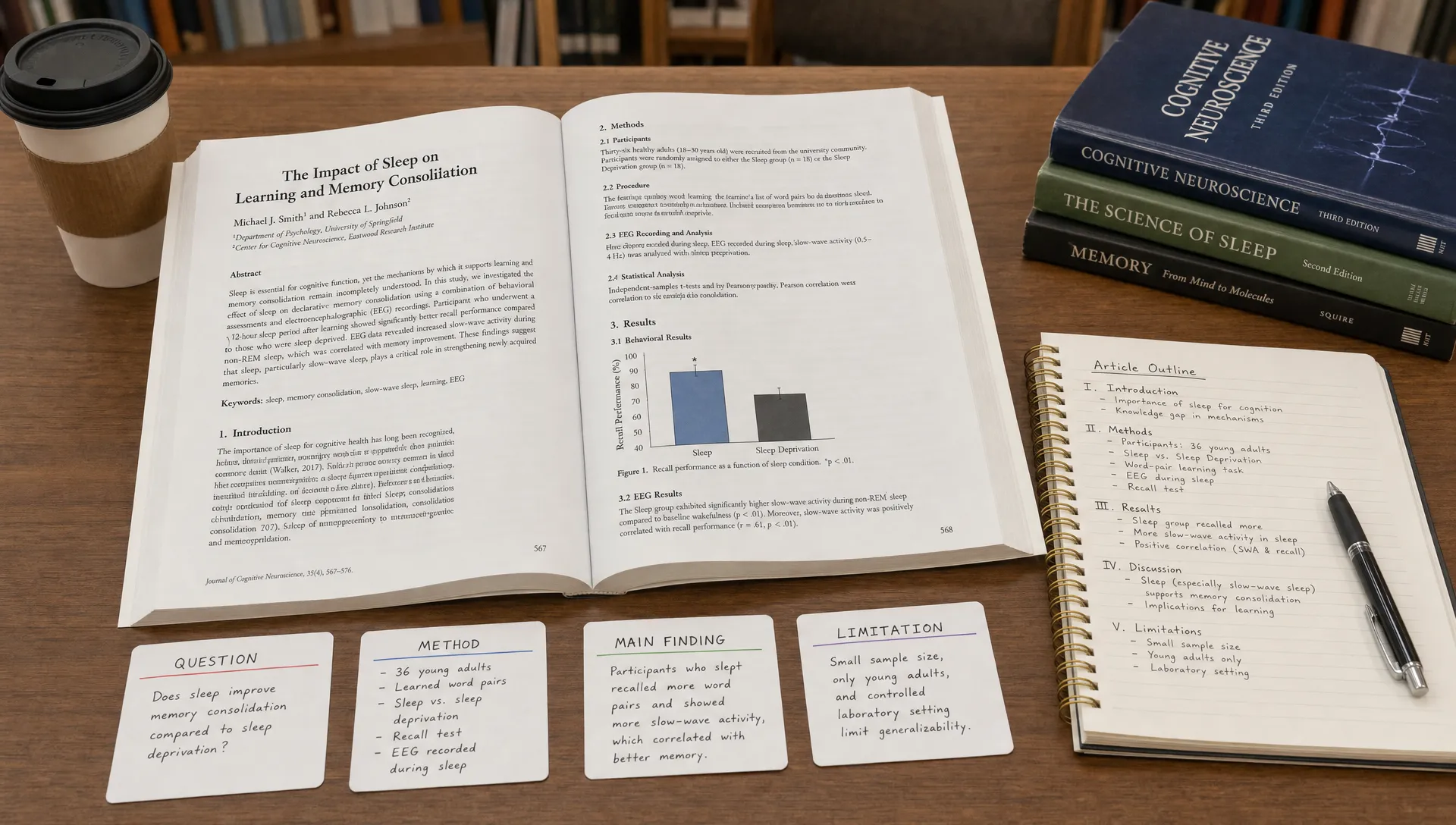
Summarizing a Research Article Without Going Too Shallow
When you are summarizing a research article, the easiest mistake is to make it shorter by making it vaguer. A thin summary may name the topic and repeat the conclusion, but it does not help you understand the study, discuss it in class, cite it in a literature review, or decide whether its findings are useful.
A better summary is concise without becoming shallow. It preserves the article's logic: what question the authors asked, how they investigated it, what they found, how they interpreted the finding, and where the limits are.
This guide shows how to keep that depth while still producing a clean, readable summary.
The goal is compression, not flattening
A research article is not just a container of information. It is an evidence trail. The authors usually start with a problem or gap, narrow it into a research question, explain how they studied it, present results, and then argue what those results mean.
If your summary only says the article is about a topic, it has flattened that evidence trail. If it only repeats the conclusion, it has removed the reason a reader should trust or question that conclusion.
You do not need to include every citation, statistical test, paragraph, or technical detail. But you do need to keep enough structure for the reader to understand the claim in context. For a broader paper-level workflow, this guide on how to summarize a research paper without losing the point pairs well with the deeper method below.
What too shallow looks like
Here is a quick test: if someone could replace your summary with the opposite finding and it would still sound plausible, your summary is probably too vague.
For example, this is shallow:
Too shallow: The article discusses remote work and productivity. It finds that remote work can affect employees and has important implications for organizations.
That summary tells us almost nothing. What kind of workers? What kind of productivity? Compared with what? Did productivity increase, decrease, or vary by context? Was this a survey, experiment, interview study, or analysis of company records?
A stronger summary does not need to be long. It just needs to carry more meaning.
| Summary area | Too shallow | Stronger |
|---|---|---|
| Research question | Says the article is about a topic | States the relationship or problem being investigated |
| Method | Says researchers studied or analyzed something | Names the design, data source, sample, or evidence type |
| Results | Says the findings were significant or important | Explains the direction and nature of the main finding |
| Interpretation | Repeats the authors' broad conclusion | Connects the finding to the question and context |
| Limits | Leaves out caveats | Names the main boundary on what the study can prove |
A summary becomes useful when it gives the reader enough to understand what was learned and how confidently they should treat it.
Five details that protect depth
Most research article summaries can stay concise if they preserve five details. These are the pieces that stop a summary from becoming a vague topic statement.
- The research question or central claim: Do not just name the subject. State what the article is trying to find out, test, explain, or argue.
- The material studied: Include the population, texts, cases, dataset, experiments, interviews, or sources when they affect interpretation.
- The method or evidence type: A randomized experiment, literature review, ethnographic study, survey, simulation, and historical analysis support different kinds of claims.
- The main finding: Capture the direction of the result and, when available, the size or pattern that matters most.
- The boundary of the finding: Mention key limitations, uncertainty, scope, or conditions that prevent overgeneralizing.
This is not just academic neatness. Research reporting standards exist because methods and context affect how evidence should be interpreted. The EQUATOR Network collects reporting guidelines across health and scientific research, and many of them emphasize clear reporting of study design, participants, interventions, outcomes, and limitations. Even when you are writing a short summary, those same categories help you avoid oversimplification.
A depth-preserving workflow for summarizing a research article
The best way to avoid going too shallow is to delay compression until you understand the article's structure. Do not start by rewriting the abstract. Start by mapping the article.
Map the article before you write
First, identify the article's path. Read the abstract, introduction, section headings, tables or figures, and discussion. Then write one rough sentence for yourself:
The article is trying to show that: [research question or claim] by using [method or evidence] and finds [main result].
This sentence is not your final summary. It is your spine. Once you have it, every other detail either supports the spine or can probably be left out.
Separate background from evidence
Research articles often spend a lot of space explaining prior work. That background matters, but your summary usually does not need to reproduce the whole literature review.
Ask yourself which background details are necessary for understanding the study's contribution. A previous debate, theory, or gap may be worth one sentence. A long list of citations usually is not.
The evidence deserves more attention. A study of 30 interviews supports a different type of conclusion than an analysis of millions of administrative records. A lab experiment means something different from a field study. A single-country sample has different limits than a multi-country comparison.
Compress in layers
Many shallow summaries happen because the writer tries to go directly from a dense article to a short paragraph. A better approach is to compress in stages.
Start with a rough analytical summary of 250 to 400 words. Include the research question, method, finding, interpretation, and limitations. Then reduce it to the length you need by removing repetition and secondary details, not by removing the article's logic.
If your final summary must be only 100 words, it can still include depth. It just needs careful choices.
Check every general statement against specific evidence
If you write that an intervention worked, ask: worked for whom, compared with what, measured how, and over what time period?
If you write that the authors challenge existing research, ask: which assumption, theory, or prior finding do they challenge?
If you write that the study has implications, ask: implications for teaching, policy, product design, clinical practice, future research, or something else?
These questions force specificity without making the summary unnecessarily long.
Use a three-layer summary when depth matters
For class, research, or professional work, one flat paragraph is often not enough. A three-layer summary helps you stay concise while keeping the important distinctions clear.
| Layer | Length | Purpose | What to include |
|---|---|---|---|
| Gist | 1 sentence | Fast orientation | Question, method, and main finding |
| Analytical summary | 1 paragraph | Usable understanding | Research problem, method, key result, meaning, and limit |
| Evidence notes | 3 to 6 short notes | Study, citation, or review | Definitions, variables, sample, measures, caveats, useful quotes |
Students can use the three layers to prepare for discussion or exams. Researchers can use them to compare papers across a literature review. Professionals can use them to brief a team without hiding uncertainty. Creators and educators can use them to turn a dense article into an outline, lesson, or explainer.
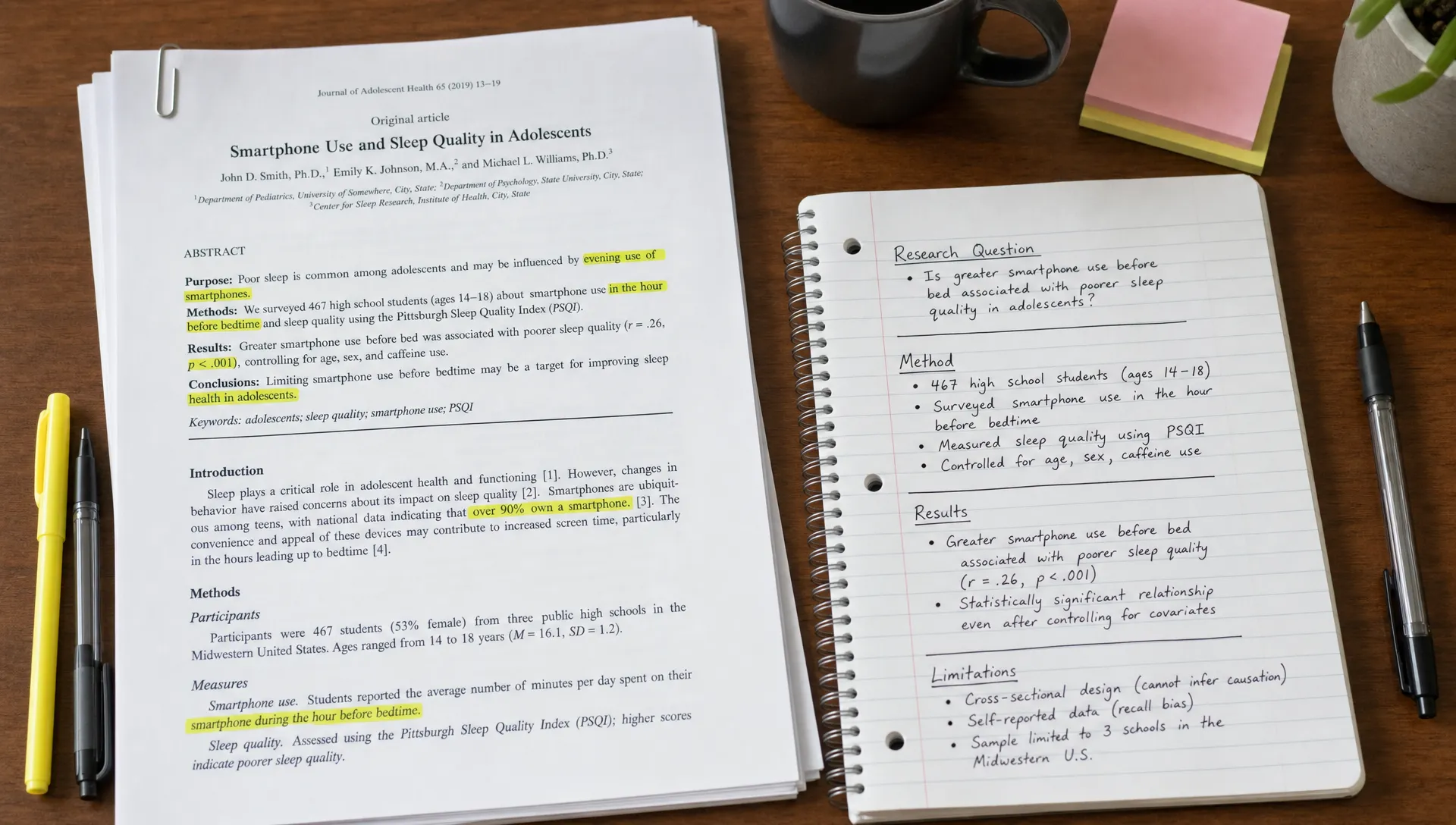
Example: from thin summary to useful summary
Suppose you are summarizing a fictional education article about retrieval practice in an online biology course.
Too shallow: The article examines retrieval practice and finds that quizzes improve learning. It shows that active learning is useful for students.
Depth-preserving: In a semester-long study of undergraduate students in an online introductory biology course, the authors compared frequent low-stakes retrieval quizzes with review activities based mainly on rereading. Students in the quiz condition performed better on delayed unit assessments, suggesting that repeated recall supported retention more effectively than passive review. The finding supports using retrieval-based study design in online courses, but the authors limit the conclusion to the course context, assessment format, and student population studied.
The second version is not much longer, but it is far more useful. It names the setting, comparison, outcome, interpretation, and limitation. A reader can now understand the finding and avoid overgeneralizing it.
If you want to see a fuller model, this research article summary example you can follow shows how a structured summary works in practice.
How to use AI without losing depth
AI tools can help you get through dense material faster, especially when you are dealing with long PDFs, technical language, or unfamiliar fields. But a generic prompt like summarize this can produce a generic result. It may remove exactly the details that make the article meaningful.
Use prompts that ask for structure, not just brevity:
- Summarize this article by preserving the research question, method, key evidence, conclusion, and limitations.
- List the details that would change the interpretation if removed.
- Explain the authors' conclusion in plain English, then identify what evidence supports it.
- Create a study note that separates background, method, results, and critique.
- Give me a short version and a deeper version so I can compare what gets lost.
This is also why summarizing can fall short without real understanding. A summary should help you see the structure of the article, not replace your judgment.
With unrav.io, you can move from a quick grasp of a PDF, article, pasted text, video, or podcast to a deeper teaching-style reframing. That is useful when your first summary feels too thin and you need to see the article through a different lens. Treat the output as a map for closer reading, then verify important claims against the original article.
Common mistakes that make research summaries shallow
A shallow summary is usually not caused by bad writing. It is caused by leaving out the wrong things. Watch for these common mistakes.
- Replacing the research question with a broad topic: The topic tells readers what the article is about. The question tells them what the article contributes.
- Omitting the method: Without method, a reader cannot judge what kind of evidence supports the claim.
- Reporting significance without direction: Saying a result was significant is less useful than explaining what increased, decreased, differed, or failed to change.
- Treating speculation as a result: Authors may discuss possible implications. Keep those separate from what the data actually showed.
- Ignoring limitations: Leaving out limits can make a careful study sound stronger or broader than it is.
The fix is simple: when you remove details, remove decorative details first. Keep details that affect interpretation.
Quick checklist before you call the summary finished
Use this checklist after drafting. If you answer no to several questions, your summary may be too shallow.
| Question | Why it matters |
|---|---|
| Does the summary name the exact research question or claim? | Prevents a topic-only summary |
| Does it say what evidence or method was used? | Helps readers judge the strength of the claim |
| Does it include the main result with direction or pattern? | Avoids vague statements about importance |
| Does it distinguish findings from interpretation? | Keeps evidence separate from explanation |
| Does it mention a major limitation or scope condition? | Prevents overgeneralization |
| Does it remove unnecessary background? | Keeps the summary concise without becoming thin |
A strong summary does not need to answer every possible question. It should answer the questions that make the article understandable.
Frequently Asked Questions
How long should a research article summary be? It depends on the use case. For class or quick reference, 150 to 300 words is often enough. For a literature review or research memo, you may need 400 to 800 words plus notes on methods, findings, and limitations.
What is the most important part of summarizing a research article? The most important part is preserving the relationship between the research question, method, result, and conclusion. If those pieces stay connected, the summary can be short without becoming shallow.
Should I include statistics in a research article summary? Include statistics when they are central to the finding or help the reader understand the size, direction, or certainty of the result. You do not need to include every number unless your assignment or field requires it.
Can I use AI to summarize a research article? Yes, but use AI as a reading assistant, not as a substitute for judgment. Ask it to preserve methods, evidence, and limitations, then check important details against the original article.
How do I summarize a research article if I do not understand the methods section? Start by identifying the broad method type, such as experiment, survey, interview study, model, review, or dataset analysis. Then note what was measured or compared. If the technical details remain unclear, say so in your notes rather than pretending the method is fully understood.
Is an abstract the same as a summary? No. An abstract is written by the authors to preview the article. Your summary should reflect your understanding of the article and may emphasize different details depending on whether you are studying, teaching, reviewing literature, or briefing a team.
Make dense research easier to work with
Summarizing a research article without going too shallow is a balance. You are not trying to shrink the article until only a conclusion remains. You are trying to preserve the article's reasoning in a smaller, clearer form.
Keep the question, method, evidence, interpretation, and limits. Remove repetition, excessive background, and details that do not change the meaning. If you use AI, ask for structured understanding rather than a generic short summary.
When you need help moving from dense content to clearer understanding, unrav.io can help you reframe articles, PDFs, videos, podcasts, and pasted text through different reading lenses. Start with the quick grasp, then go deeper where the evidence matters most.