
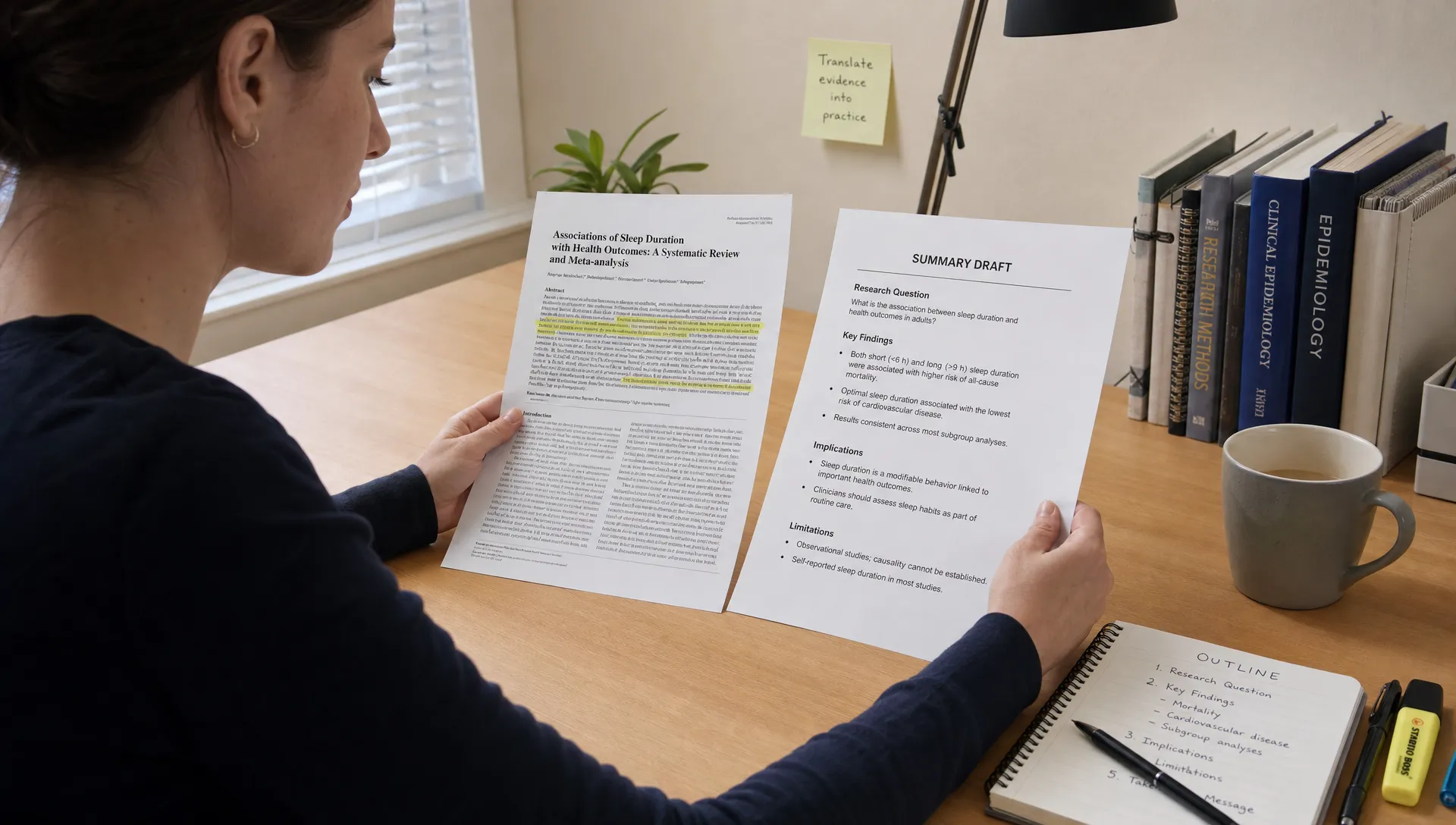
Research Article Summary Example You Can Follow
If you have ever opened a research article and thought, “I understand some of this, but I have no idea how to summarize it,” you are not alone. Research papers are written to document evidence carefully, not to make the main point instantly obvious.
A good research article summary does more than shorten the paper. It explains the study’s purpose, method, main findings, and meaning in a way someone else can understand without reading every section first.
Below, you will find a complete research article summary example you can follow, plus a reusable structure, a copy-and-adapt template, and practical tips for making your summary useful for class, work, research, or content creation.
What a research article summary should include
A research article summary should answer six basic questions:
- What problem or topic did the article study?
- What research question or hypothesis guided the study?
- How did the researchers investigate it?
- What did they find?
- Why do the findings matter?
- What limitations or cautions should the reader remember?
That may sound like a lot, but each answer can be short. The goal is not to rewrite the article section by section. The goal is to capture the article’s logic.
Think of a summary as a compressed version of the paper’s argument:
| Paper section | What you are looking for | What belongs in the summary |
|---|---|---|
| Abstract | Overall purpose and result | A quick orientation, not a sentence to copy |
| Introduction | Problem, background, research gap | Why the study was done |
| Methods | Participants, data, procedure, analysis | How the evidence was collected |
| Results | Main findings | The most important outcomes, not every statistic |
| Discussion | Interpretation and implications | What the findings mean and where they are limited |
If you need a deeper process before using the example below, this guide on how to summarize a research paper without losing the point walks through the reading workflow in more detail.
Research article summary example you can follow
The example below uses a realistic mock research article. It is not presented as a real published source. The point is to show you exactly how a strong summary is built without requiring you to read a full paper first.
Mock research article details
Article topic: Low-stakes quizzes and student retention in undergraduate biology courses
| Element | Example article information |
|---|---|
| Research problem | Students often forget course material after exams, even when they perform well on short-term assessments. |
| Research question | Do weekly low-stakes quizzes improve long-term retention compared with rereading assignments? |
| Participants | 186 undergraduate students in an introductory biology course. |
| Method | Students were assigned to weekly quiz practice, guided rereading, or regular study conditions during a four-week unit. |
| Measures | Immediate unit test, delayed test two weeks later, and student confidence ratings. |
| Main finding | Students in the quiz practice group performed better on delayed retention questions than students in the rereading and regular study groups. |
| Limitation | The study used one course at one university, so the findings may not apply equally across subjects or student populations. |
Example summary paragraph
The article examines whether weekly low-stakes quizzes help undergraduate biology students retain course material better than rereading or regular study habits. The researchers studied 186 students in an introductory biology course over a four-week unit and compared three learning conditions: quiz practice, guided rereading, and normal study. Student learning was measured through an immediate unit test, a delayed test two weeks later, and confidence ratings about the material. The main finding was that students who completed weekly low-stakes quizzes remembered more information on the delayed test, especially for questions that required applying concepts rather than simply recognizing terms. The study suggests that retrieval practice may support longer-term learning by encouraging students to recall information before they forget it. However, because the research was conducted in a single course at one university, the results should be applied carefully to other subjects, institutions, or learning contexts.
Example structured summary
If your teacher, supervisor, or research group expects a more formal format, you can turn the same information into a structured summary.
Purpose: The study investigated whether weekly low-stakes quizzes improve long-term retention in an undergraduate biology course.
Method: The researchers compared 186 students across three study conditions: quiz practice, guided rereading, and regular study. Learning was assessed using an immediate test, a delayed test two weeks later, and confidence ratings.
Findings: Students who practiced with weekly quizzes performed better on delayed retention questions than students who reread material or studied normally. The benefit was strongest for questions that required applying concepts.
Significance: The findings support the idea that retrieval practice can help students remember and use course material beyond the initial exam.
Limitations: The study took place in one course at one university, which limits how confidently the results can be generalized.
Why this example works
The summary works because it is specific without becoming overloaded. It does not try to include every detail from the methods section or every result. Instead, it keeps the focus on the article’s central contribution.
A useful research article summary usually has five qualities.
First, it starts with the purpose of the study. The reader immediately knows what the article is about.
Second, it identifies the research design in plain language. You do not need to repeat every technical procedure, but you should explain how the authors gathered or analyzed evidence.
Third, it names the main finding. A summary that says “the article discusses learning strategies” is too vague. A better summary says what the study found about a specific learning strategy.
Fourth, it explains why the finding matters. This is where many weak summaries fall short. They report the result but do not explain its value.
Fifth, it includes at least one limitation. Research findings are rarely universal. A short limitation shows that you understand the scope of the evidence.
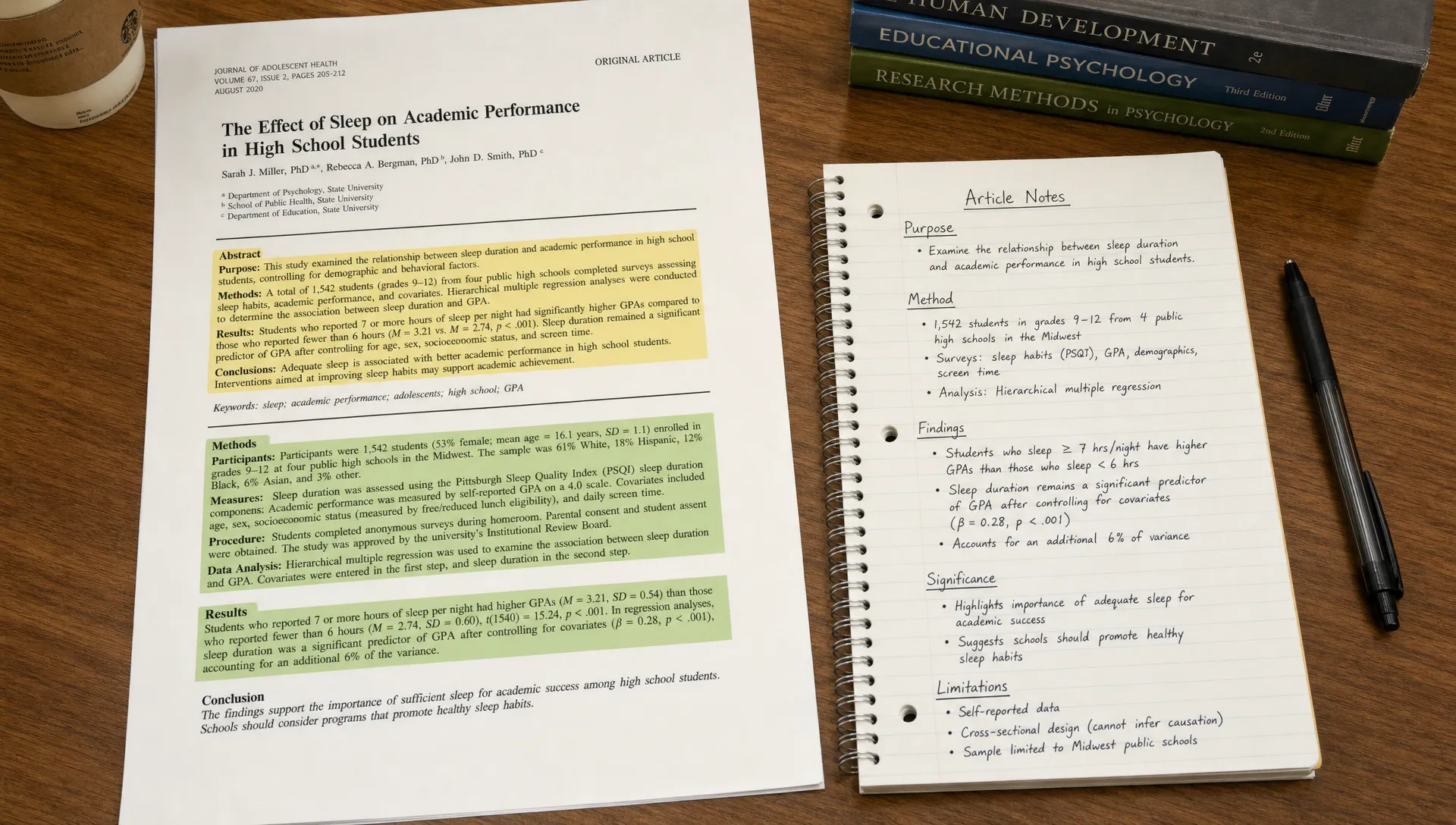
A simple formula for summarizing any research article
You can follow this five-part formula for most research articles, whether you are reading for class, literature review, workplace analysis, or content planning.
- Name the topic and purpose: State what the article investigates and why the topic matters.
- Identify the research question: Explain the specific question, hypothesis, or problem the authors address.
- Describe the method briefly: Mention the participants, data, materials, or analysis approach only as much as needed.
- Report the main findings: Focus on the most important result, not every number or subfinding.
- Explain meaning and limits: Say why the finding matters and what should be interpreted cautiously.
Here is the formula as a sentence pattern:
The article examines [topic/problem] by asking whether/how [research question]. The researchers used [method or data] to study [participants, cases, texts, or materials]. They found that [main finding]. This matters because [significance or implication]. However, the findings are limited by [limitation], so they should be interpreted in relation to [context].
You can adapt this template for most academic fields. A psychology paper may require more detail about participants and measures. A history article may require more attention to sources and interpretation. A computer science paper may need a short explanation of datasets, benchmarks, or system design. The same basic logic still applies: purpose, method, finding, meaning, limitation.
How to write your own research article summary step by step
Start by reading strategically, not linearly. Many readers try to summarize a paper by reading from the first sentence to the last and highlighting as they go. That can work, but it often creates too many notes and no clear hierarchy.
A better approach is to scan the article first. Read the abstract, introduction, section headings, tables, figures, and conclusion before taking detailed notes. This gives you a mental map of the paper.
Then reread with a small set of questions in mind. What is the study trying to prove, test, describe, or explain? What evidence does it use? What conclusion do the authors want readers to accept?
As you read, separate essential information from supporting detail. A useful summary does not need every literature review citation, statistical test, or paragraph-level claim. It needs the pieces that help someone understand the article’s main contribution.
If you are using AI to speed this up, treat it as a reading assistant rather than a replacement for judgment. For example, you can use unrav.io to turn a dense article, PDF, video, or pasted text into clearer outputs using different thinking modes, then check the result against the original article. This can help you get a quick grasp, reframe confusing sections, or explain the paper in simpler language before writing your own final version.
For journal articles specifically, you may also find it helpful to compare different formats in this guide to the best ways to summarize a journal article for class or work.
Short, medium, and detailed summary examples
The right length depends on why you are summarizing. A class discussion post, annotated bibliography entry, research memo, and literature review note will not all need the same amount of detail.
Here is how the same mock article could be summarized at three different lengths.
| Summary type | Best for | Example |
|---|---|---|
| One-sentence summary | Quick notes or article triage | The article finds that weekly low-stakes quizzes helped undergraduate biology students retain course material better than rereading or normal study. |
| Short paragraph | Class posts, reading logs, or study notes | The article investigates whether weekly low-stakes quizzes improve long-term retention in an undergraduate biology course. In a comparison of quiz practice, guided rereading, and regular study, students who completed quizzes performed better on a delayed test two weeks later. The study suggests that retrieval practice can support longer-term learning, although the findings are limited to one course setting. |
| Detailed summary | Literature reviews, research notes, or workplace briefs | The article examines the effect of weekly low-stakes quizzes on retention among 186 students in an introductory biology course. Over a four-week unit, students participated in quiz practice, guided rereading, or regular study conditions. The researchers measured learning through an immediate unit test, a delayed test two weeks later, and confidence ratings. Students in the quiz practice condition performed better on delayed retention questions, especially those requiring concept application. The findings suggest that retrieval practice may improve durable learning, but the single-course design limits generalization. |
Notice that the longer version is not padded. It adds useful context: participants, timeframe, comparison groups, measures, and limitation.
Common mistakes to avoid
Many research summaries fail because they are either too vague or too close to the original text. Your job is to translate the article’s logic into clear language, not to rearrange sentences from the abstract.
Avoid these common problems:
- Copying the abstract: The abstract is already a summary, but your assignment or workflow usually requires your own understanding.
- Ignoring the method: Without the method, the reader cannot judge the strength or relevance of the findings.
- Listing details without hierarchy: Not every variable, citation, or table deserves space in the summary.
- Overstating the findings: If the study finds an association, do not describe it as proof of causation unless the design supports that claim.
- Leaving out limitations: A good summary shows what the study does and does not establish.
This is also why summarizing should not stop at compression. If you want to understand the difference between shortening content and actually making sense of it, read this explanation of how summarizing falls short without real understanding.
How different readers can adapt the same summary
A research article summary is not one-size-fits-all. The best version depends on what you need to do next.
Students should focus on the research question, key concepts, findings, and exam relevance. If the article supports a lecture topic, connect the summary to course vocabulary.
Researchers should capture the study design, data, theoretical contribution, and limitations. If the summary is for a literature review, include how the article relates to other studies.
Professionals should emphasize decisions, risks, and practical implications. For example, an analyst summarizing a labor market study may care most about what the findings suggest for hiring, retention, or policy.
Content creators and educators may need to turn the research into an outline, lesson, newsletter, script, or explainer. In that case, the summary should highlight the core idea, audience relevance, and examples that make the concept easier to teach. For ecommerce or marketing teams that turn research insights into campaigns, tools like AI-made ads, emails, and videos can support the next step after the research has been understood and translated into a clear message.
The key is to summarize for a purpose. Before you write, ask: “Who will use this summary, and what do they need to do with it?”
Research article summary template
Use this template when you need a clean starting point.
[Article title or author] examines [main topic] in order to understand [research problem or gap]. The study asks [research question or hypothesis]. To answer this question, the authors used [method, data, participants, or materials]. The main finding is that [key result]. This finding matters because [significance for the field, class topic, workplace issue, or audience]. However, the article is limited by [limitation], which means [caution about interpretation or application]. Overall, the article contributes to [larger conversation or practical problem].
Here is a shorter version for quick assignments:
The article studies [topic] and asks [research question]. Using [method], the authors found that [main finding]. The study is important because [meaning], but its conclusions are limited by [limitation].
If you are summarizing several articles, keep the same template for each one. Consistency makes it easier to compare studies later.
Frequently Asked Questions
How long should a research article summary be? It depends on the purpose. A short class summary may be 150 to 250 words. A detailed literature review note may be 300 to 600 words. The summary should be long enough to explain the article’s purpose, method, finding, meaning, and limitation without repeating unnecessary details.
Is a research article summary the same as an abstract? No. An abstract is written by the article’s authors and usually appears at the beginning of the paper. A summary is written by you for a specific purpose, such as studying, briefing a team, preparing a literature review, or explaining the article to another audience.
Should I include statistics in my summary? Include statistics only when they are central to the finding or required by your assignment. In many summaries, it is enough to explain the direction and meaning of the result in plain language. If the exact effect size, confidence interval, or p-value matters, include it accurately.
Can I use AI to summarize a research article? Yes, but you should review the output carefully. AI can help you get oriented, simplify dense passages, and create a first draft. You still need to verify the summary against the original article, especially methods, findings, limitations, and technical terms.
What if I do not understand the methods section? Start with the basics: who or what was studied, what was measured, and how the authors compared or analyzed the data. You do not need to master every technical detail to write a useful summary, but you should avoid making claims about evidence you do not understand.
Make your next research summary easier
A strong research article summary is not just shorter than the original paper. It is clearer. It helps you understand what the article studied, how the evidence worked, what the authors found, and why the findings matter.
Use the example above as a model, then adapt the template to your own article. If the paper is dense, start with the abstract and conclusion, map the structure, identify the central finding, and write in your own words.
When you need help moving from dense material to clearer understanding, unrav.io can help you reframe articles, PDFs, videos, podcasts, and pasted text into outputs that match your goal, from quick grasping to deeper explanation. Use it to support your reading process, then bring your own judgment to the final summary.