
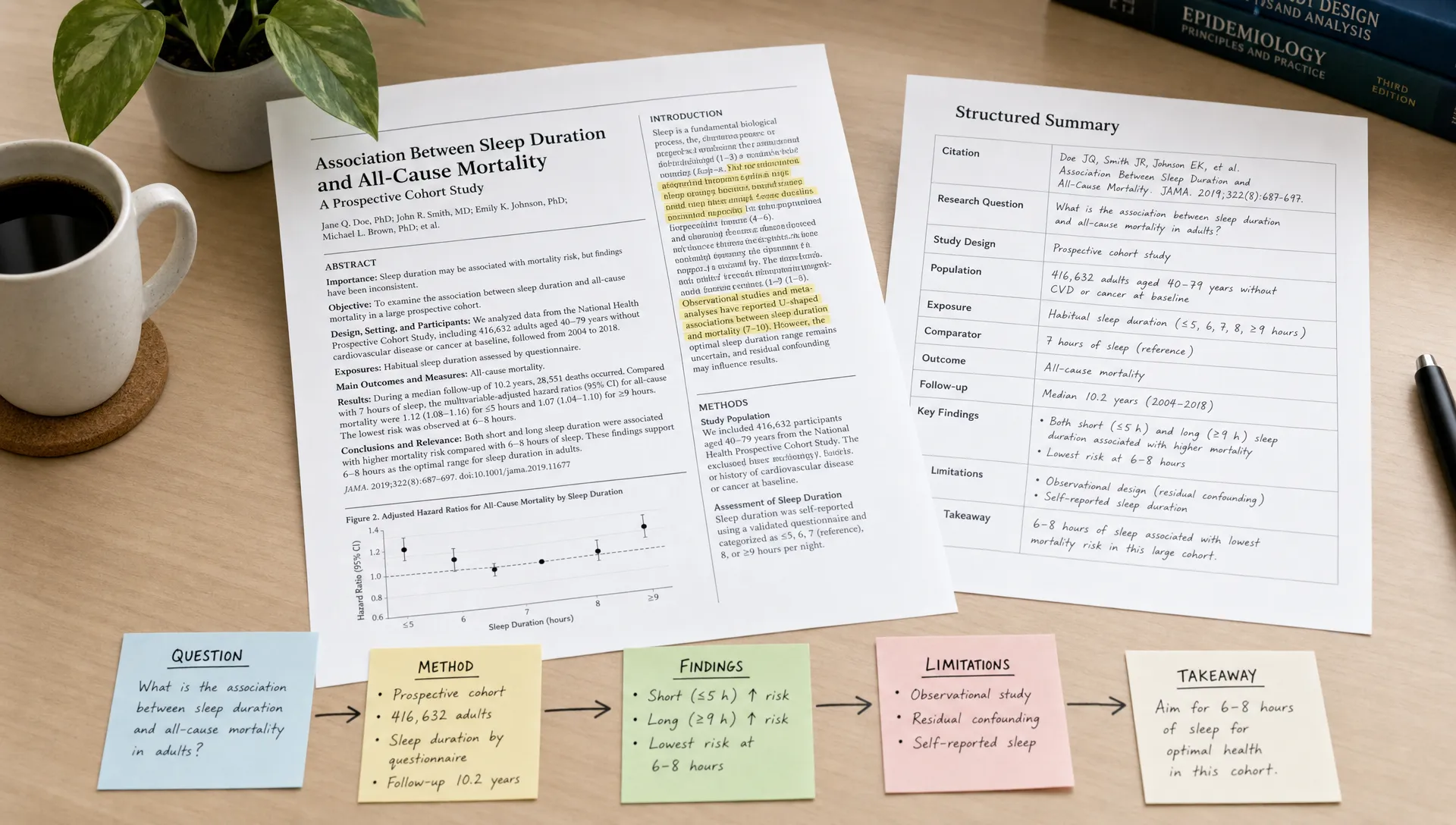
Scientific Paper Summary Guide for Faster Reading
Scientific papers are not written for speed. They are written to document evidence, methods, uncertainty, and prior work. That makes them valuable, but it also makes them slow to read, especially when you are facing a stack of PDFs for class, a literature review, a technical decision, or a content project.
A good scientific paper summary helps you move faster without pretending the paper is simpler than it is. It gives you a structured way to capture the research question, method, main findings, limitations, and relevance, so you can decide what deserves deeper reading and what can be safely skimmed.
This guide shows you how to build a scientific paper summary that supports faster reading, better recall, and more useful notes. It is not about replacing the paper. It is about reading with a map.
What a useful scientific paper summary actually captures
A weak summary only repeats the abstract in shorter words. A useful summary explains what the paper contributes and how much confidence you should place in it.
For faster reading, your summary should answer six practical questions:
- What problem is the paper trying to solve?
- What question or hypothesis does it test?
- What did the authors do to investigate it?
- What did they find?
- What are the limits, assumptions, or uncertainties?
- What should you do with this information next?
This matters because scientific papers often separate important information across sections. The abstract may sound clear, the methods may reveal constraints, the results may be narrower than expected, and the discussion may include interpretations that go beyond the data. Your summary should connect those pieces.
If you are new to this process, it can help to start with a more detailed walkthrough of how to summarize a research paper without losing the point, then adapt the workflow below for faster reading.
| Summary type | Best for | Typical length | Main goal |
|---|---|---|---|
| Triage summary | Deciding whether to read deeply | 3 to 5 sentences | Identify relevance quickly |
| Structured summary | Class notes, research notes, work briefs | 150 to 300 words | Capture question, method, evidence, limits |
| Deep reading summary | Literature reviews, exam prep, technical decisions | 500+ words | Explain reasoning, compare evidence, preserve caveats |
The key is to match the summary depth to your goal. Not every paper deserves a deep summary. Some only need a quick relevance check.
Start with triage before you read line by line
Most people read scientific papers too linearly. They start at the introduction, push through the literature review, slow down in the methods, and lose energy before the results become clear.
A faster approach is to triage first. Triage means scanning the paper to decide how much attention it deserves and which sections matter most for your purpose.
Start by identifying the paper type. An empirical study, systematic review, meta-analysis, methods paper, theoretical paper, and case study all need different summary expectations. For example, an empirical study needs careful attention to sample, design, and results. A review paper needs attention to scope, inclusion criteria, and how the authors weigh evidence.
Then scan in this order:
- Title and keywords to understand the domain and main variables
- Abstract to get the claimed contribution
- Figures, tables, and captions to see what evidence is central
- Conclusion and limitations to understand the authors' final interpretation
- Methods section to check how the evidence was produced
- Introduction only after you know what the paper is actually trying to prove or explain
This order prevents you from getting trapped in background information before you know whether the paper is useful. It also helps you detect mismatch early. Sometimes a paper title sounds relevant, but the population, dataset, context, or outcome measure does not fit your question.
Use a 7-field scientific paper summary template
The fastest summaries come from a repeatable structure. Instead of deciding from scratch what to write each time, use the same seven fields for every paper.
| Field | What to capture | Why it helps |
|---|---|---|
| Citation and context | Author, year, topic, field, and paper type | Helps you locate and compare the paper later |
| Research question | The specific question the study addresses | Keeps the summary focused |
| Background problem | Why the question matters | Prevents isolated facts from losing meaning |
| Method | Study design, data, sample, materials, or procedure | Shows how the authors produced the evidence |
| Key findings | The main results, not every result | Separates signal from detail |
| Limitations | Constraints, uncertainty, assumptions, or missing evidence | Protects you from overclaiming |
| Takeaway | What the paper changes for your understanding or decision | Turns reading into usable knowledge |
You can use this template in a notes app, spreadsheet, reference manager, or AI reading tool. The format matters less than consistency. When every paper is summarized in the same structure, comparing papers becomes much easier.
A faster reading workflow you can repeat
Use this workflow when you need to understand a paper quickly but still responsibly.
Define your reading purpose first: Before opening the PDF, write one sentence about why you are reading it. Are you preparing for class, checking evidence for a claim, building a literature review, creating a presentation, or making a work decision? Your purpose determines which details matter.
Write a first-pass prediction from the abstract: After reading the abstract, write what you think the paper will show. This gives you something to test as you read. If the results or limitations contradict your first impression, update the summary.
Inspect figures and tables early: In many scientific papers, the central story is visible in the visuals. Captions often reveal variables, comparisons, outcomes, and relationships faster than paragraphs do.
Read the methods for trust, not for memorization: Unless your goal is replication or technical critique, you usually do not need every procedural detail on the first pass. Focus on whether the design fits the question, whether the sample or data source is appropriate, and whether the analysis supports the claim.
Separate results from interpretation: Results describe what the study found. The discussion explains what the authors think those findings mean. Your summary should keep both, but not blend them into one unsupported claim.
Write the summary from memory, then verify: After reading, close the paper and draft the summary. Then reopen it to check accuracy. This small retrieval step improves recall and reveals what you did not actually understand.
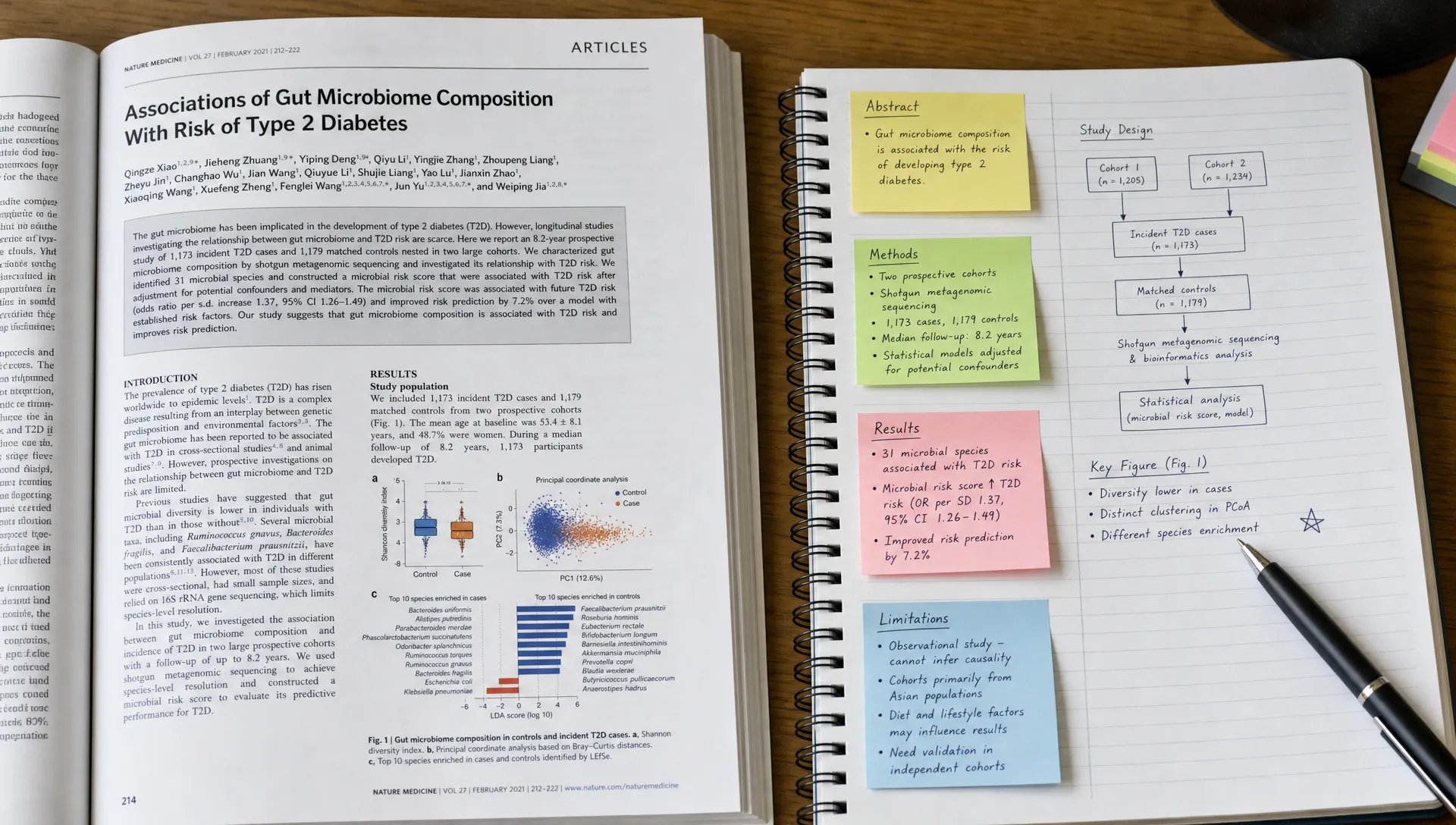
Example: turning a dense paper into a fast summary
Here is an illustrative example. This is not a real paper citation. It shows how to structure a fast summary without copying the abstract.
Imagine a paper studying whether spaced retrieval practice helps undergraduate biology students retain concepts better than rereading notes.
| Summary field | Example summary |
|---|---|
| Research question | Does spaced retrieval practice improve long-term retention in an undergraduate biology course compared with rereading? |
| Background problem | Students often feel fluent after rereading, but that fluency may not translate into durable recall. |
| Method | The study compares students using scheduled practice questions with students using repeated reading over the same course content. |
| Key findings | Students using retrieval practice show stronger delayed recall than students who mainly reread. |
| Limitations | The findings may depend on course design, student motivation, question quality, and how retention was measured. |
| Takeaway | For studying, active recall may be more useful than passive review, but the result should be applied with attention to context. |
Notice what this summary does not do. It does not include every statistic, every literature reference, or every procedural detail. It preserves the central logic: question, method, evidence, caveat, and use.
For a deeper note, you could add exact sample size, study duration, assessment type, effect sizes, and comparison conditions. For faster triage, the six rows above may be enough.
Where AI helps, and where it does not
AI can make scientific reading faster, especially when the paper is long, technical, or outside your main field. But it works best as a reading companion, not as a substitute for judgment.
For example, unrav.io can help you bring in a PDF, link, YouTube lecture, podcast, or pasted text and reframe it through different modes depending on your goal. You might use a quick grasp mode to decide whether a paper is relevant, then use a teach-it style explanation to understand the method or explain the paper to someone else.
AI is especially useful for:
- Converting dense passages into plain English
- Extracting the research question and contribution
- Identifying methods, results, and limitations
- Creating study questions from a paper
- Turning a paper into notes, an outline, or a teaching explanation
Still, you should verify important details. Check numbers, causal claims, definitions, quoted phrases, and anything you plan to cite. AI can help you see structure faster, but the responsibility for accuracy remains with you.
If your main challenge is technical language, a focused guide on summarizing a scientific article in plain English can help you turn specialist wording into clearer explanations without flattening the meaning.
Common mistakes that make summaries slower or less reliable
A scientific paper summary should reduce confusion, not create a second document that is almost as hard to read as the original. Watch for these common problems.
| Mistake | Why it hurts | Better approach |
|---|---|---|
| Copying the abstract | You repeat the authors' framing without checking the paper | Rewrite from the paper's question, method, evidence, and limits |
| Summarizing every section equally | You waste time on background that may not matter | Prioritize the parts that answer your reading purpose |
| Ignoring methods | You may accept claims without knowing how evidence was produced | Capture design, data, sample, and key constraints |
| Treating correlation as causation | You may overstate what the paper proves | Use cautious language that matches the study design |
| Skipping limitations | Your notes become too confident | Include at least one caveat in every summary |
| Keeping isolated facts only | Your notes become hard to reuse | Add a final takeaway that explains why the paper matters |
The best summaries are concise, but not careless. They keep enough detail to support the claim and enough uncertainty to stay honest.
Choose the right summary format for your use case
Different readers need different outputs. A student preparing for an exam does not need the same summary as a researcher building a literature review or a creator turning a paper into a newsletter.
| Reader | Best summary format | What to emphasize |
|---|---|---|
| Student | Study summary with key terms and practice questions | Concepts, definitions, findings, likely exam angles |
| Researcher | Structured literature note | Research gap, method, findings, limitations, relationship to other papers |
| Professional | Decision brief | Practical implication, confidence level, risks, next action |
| Content creator | Explanation outline | Main idea, audience relevance, examples, caveats |
| Educator | Teaching summary | Simplified explanation, discussion questions, misconceptions |
A summary can also become the raw material for professional communication. For example, if you are using research to support a cover letter, formal request, complaint, recommendation, or outreach message, your paper summary provides the substance while a professional letter generator can help shape the final letter format.
The important point is to avoid one-size-fits-all summaries. The same paper can become a study guide, a slide outline, a literature note, or a decision memo. The reading goal should shape the output.
Turn summaries into a reusable reading system
A single summary helps today. A consistent summary system helps for months or years.
If you read scientific papers regularly, store summaries in a way that makes retrieval easy. Use a predictable title format such as Author-Year-Topic. Add tags for methods, populations, concepts, and use cases. Include one sentence that explains why the paper matters to your project or course.
You can also add a short connection note after each summary. This is where you link the paper to other ideas, related studies, or open questions. For example: supports retrieval practice, conflicts with small-sample classroom study, useful for exam-prep workshop, or needs comparison with meta-analysis.
This step is important because summarizing alone can create the illusion of understanding. You may have a neat paragraph, but still miss how the paper connects to the broader problem. If you want to go deeper, this piece on why summarizing falls short without real understanding explains how to move from compressed notes to connected knowledge.
A simple scientific paper summary checklist
Before you consider your summary finished, check whether it passes these tests:
- Can someone understand the paper's purpose without reading the original?
- Does the summary identify the method or evidence source?
- Does it separate findings from interpretation?
- Does it include at least one limitation or uncertainty?
- Does it explain why the paper matters for your goal?
- Can you find the paper again from your citation or note title?
If the answer is yes, your summary is probably useful. If not, the missing piece will usually be method, limitation, or takeaway.
Frequently Asked Questions
What is a scientific paper summary? A scientific paper summary is a concise explanation of a paper's research question, method, main findings, limitations, and relevance. It is more than a shorter abstract because it should help the reader understand how the evidence supports the claim.
How long should a scientific paper summary be? For quick triage, 3 to 5 sentences may be enough. For class, work, or literature review notes, 150 to 300 words is often more useful. For deep research, you may need a longer structured note with methods, evidence, caveats, and connections to other papers.
Can AI summarize scientific papers accurately? AI can help identify structure, simplify language, and produce a first draft, but it can also miss nuance or overstate claims. Always verify important details in the original paper, especially numbers, methods, limitations, and anything you plan to cite.
Should I read the whole paper before summarizing it? Not always. Start with triage to decide whether the paper deserves deep reading. If the paper is central to your work, read it more carefully before finalizing the summary. If it is only background, a structured quick summary may be enough.
What should I do if I do not understand the methods section? Focus first on the basics: what data or sample was used, what was compared, what outcome was measured, and whether the design fits the research question. Then translate unfamiliar terms into plain language and mark anything you need to verify later.
Next step: read faster without flattening the science
A good scientific paper summary is not just a shortcut. It is a thinking tool. It helps you decide what to read deeply, remember what matters, and reuse research in notes, presentations, literature reviews, lessons, or professional decisions.
If you want help turning dense papers, PDFs, articles, or videos into clearer understanding, try unrav.io. Use it to get a quick grasp, reframe complex sections, and build summaries that support real comprehension rather than surface-level skimming.