
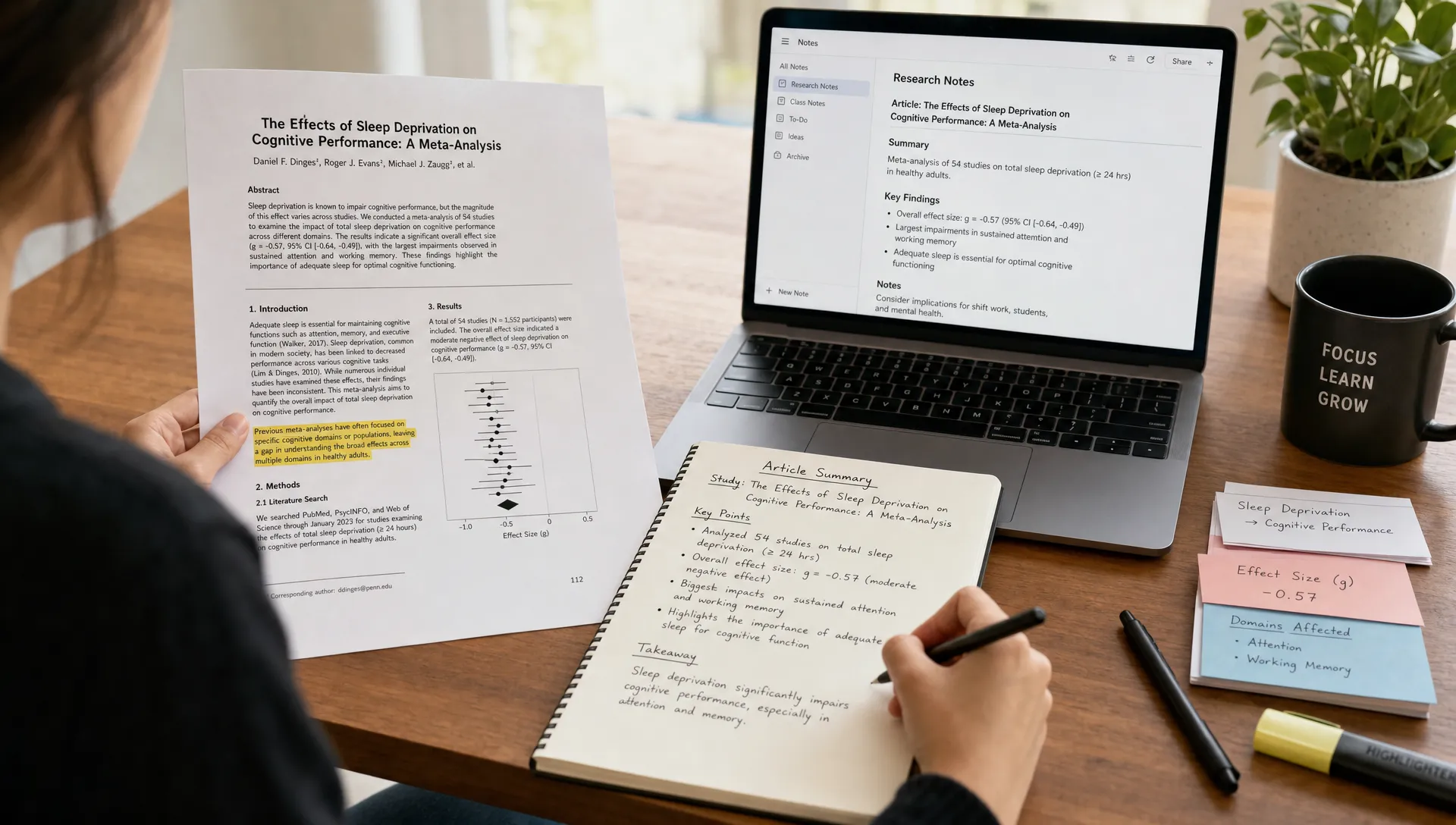
Best Ways to Summarize a Journal Article for Class or Work
A journal article can be difficult to summarize because it is not written like a textbook chapter or blog post. It usually has a narrow research question, a dense literature review, technical methods, statistical results, and cautious language. If you are summarizing it for class, you may need to show that you understood the argument. If you are summarizing it for work, you may need to extract practical implications without losing the limits of the evidence.
The best way to summarize a journal article is not to shorten every section equally. It is to identify the article’s purpose, methods, findings, and significance, then rewrite those points for your specific audience.
Below are practical ways to summarize a journal article for class assignments, research notes, presentations, workplace briefs, or content planning.
Start by knowing what kind of summary you need
Before you read closely, decide what the summary is supposed to do. A summary for a professor is different from a summary for a manager, team, client, or newsletter audience.
For class, your summary usually needs to prove comprehension. You may need to capture the author’s thesis, explain the research design, define key terms, and evaluate the evidence. Your instructor may also expect you to connect the article to a course theme or reading.
For work, your summary usually needs to support a decision. A manager may not need every statistical detail, but they do need to know what the study found, whether the evidence is credible, and how much confidence to place in it.
A useful journal article summary usually answers five questions:
- What problem or question is the article addressing?
- What did the authors study, analyze, or argue?
- How did they reach their findings?
- What are the most important results or claims?
- Why does this matter, and what are the limitations?
This framing keeps you from writing a summary that is either too vague or too overloaded with details.
Use the article structure to your advantage
Most empirical journal articles follow a predictable structure. Not every field uses the same format, but many research papers include some version of abstract, introduction, literature review, methods, results, discussion, and conclusion.
You do not need to summarize each section with equal weight. Instead, use each section to find a different type of information.
| Article section | What to look for | What to include in your summary |
|---|---|---|
| Abstract | Research question, method, headline findings | A quick orientation, not your only source |
| Introduction | Problem, context, gap in knowledge | Why the article exists |
| Literature review | Prior research and debate | Only the background needed to understand the article |
| Methods | Data, participants, materials, procedure, analysis | How the authors produced the evidence |
| Results | Main findings, patterns, statistics | The most important outcomes, not every number |
| Discussion | Interpretation, implications, limitations | What the findings mean and where caution is needed |
| Conclusion | Final claim or contribution | A concise closing point |
The abstract is useful, but do not rely on it alone. Abstracts often compress nuance, skip important limitations, or present findings in the most favorable light. Use it as a map, then verify the details in the article.
If the article is especially technical, read the introduction and discussion before the methods. This gives you the “why” before you wrestle with the “how.”
Try the three-pass reading method
A common mistake is trying to understand everything on the first read. That often leads to slow reading, excessive highlighting, and a summary that repeats the article instead of explaining it.
A better approach is to read in passes.
First, skim the article for structure. Read the title, abstract, headings, tables, figures, and conclusion. Write down the article’s general topic and what you think the authors are trying to prove or investigate.
Second, read for the core argument. Focus on the introduction, research question, hypotheses, key results, and discussion. Mark only the sentences that reveal the article’s main claim, evidence, or limitation.
Third, read for summary details. Return to the methods and results to confirm what was studied and how strong the findings are. This pass is where you collect the details you actually need for class notes, a literature review, or a workplace brief.
This method is especially helpful when you need to summarize several journal articles in one sitting. It gives you a consistent process instead of treating every paper like a blank page.
Write a one-sentence summary before the full version
Before writing a paragraph or page-long summary, force yourself to write one sentence. This reveals whether you actually understand the article.
A strong one-sentence summary should include the topic, method or evidence, main finding, and significance.
For example:
This article examines how remote work affects employee collaboration by analyzing survey data from hybrid teams, finding that communication quality depends less on location and more on team norms, meeting design, and managerial clarity.
That sentence is not perfect for every field, but it shows the basic structure. It names the subject, explains the evidence, states the finding, and hints at why it matters.
If you cannot write a one-sentence version, you probably need to revisit the research question, results, or discussion before drafting the full summary.
Use a summary template for class or work
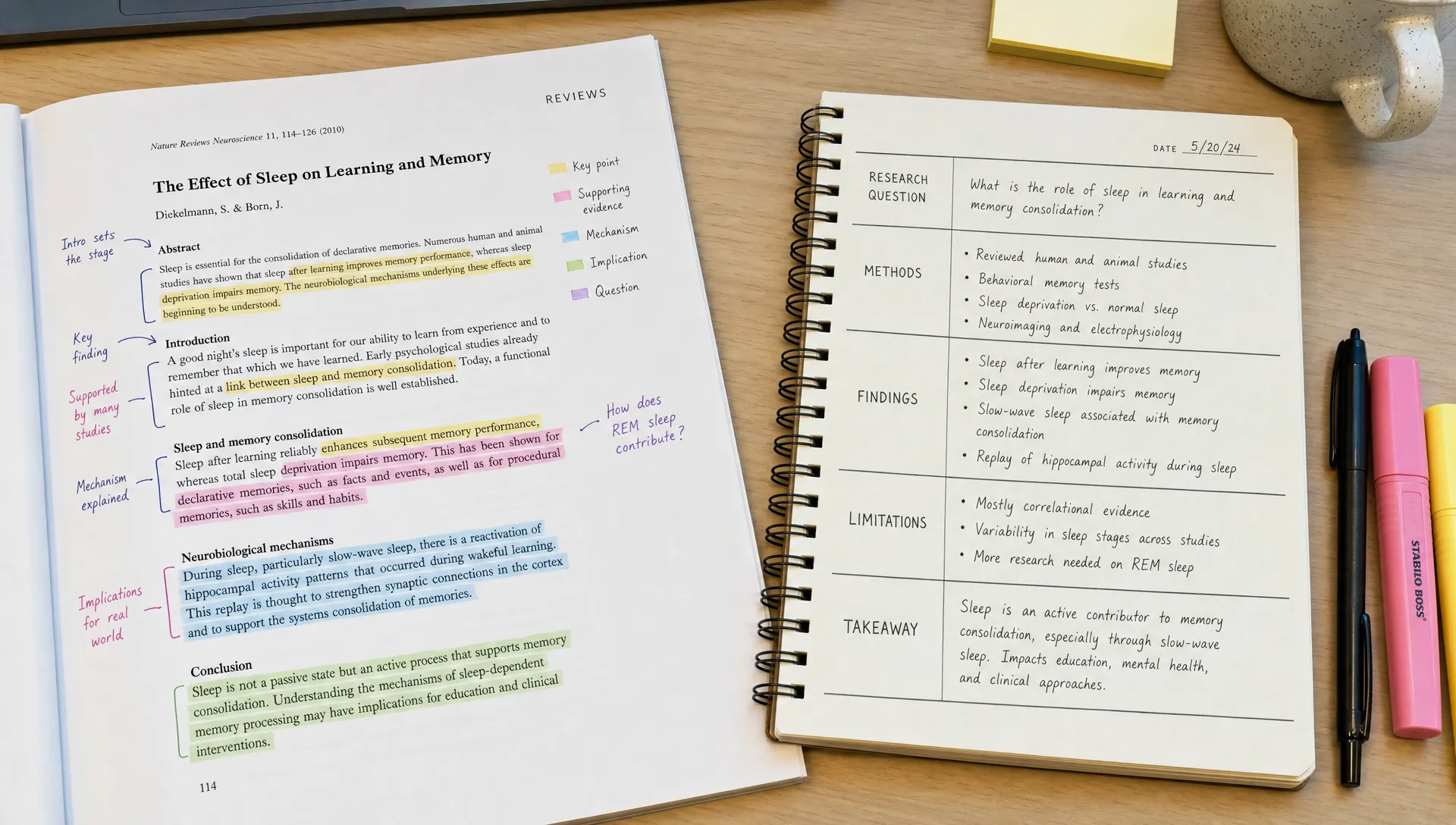
Templates help you avoid both extremes: writing too little or copying too much. They also make it easier to compare articles across a course, project, or research topic.
Here is a simple template you can adapt:
| Summary element | Prompt to answer |
|---|---|
| Citation | Who wrote the article, when, and where was it published? |
| Topic | What issue, question, or debate does the article address? |
| Purpose | What are the authors trying to find out or argue? |
| Method | What data, sources, experiment, or analysis did they use? |
| Findings | What are the main results or claims? |
| Significance | Why do the findings matter for the field, class, or workplace? |
| Limitations | What should readers be careful about? |
| Your takeaway | How will you use this article in your assignment, decision, or project? |
For a class assignment, your “your takeaway” section might connect the article to a lecture theme. For work, it might translate the finding into a recommendation, risk, or next question.
If you are summarizing multiple articles, use the same template for each one. Consistency makes it easier to synthesize later.
Separate summary from critique
A journal article summary should explain what the authors did and found. A critique evaluates whether the article is convincing. Both are useful, but mixing them too early can make your writing unclear.
In class, professors often expect both summary and analysis. Still, it helps to write the summary first in neutral language. After that, add your evaluation.
For example, a summary sentence might say:
The authors found that students who used retrieval practice performed better on delayed tests than students who only reread the material.
A critique sentence might say:
However, the sample was limited to one introductory course, so the findings may not apply to advanced students or other disciplines.
For work, this distinction matters even more. A team needs to know what the article says before hearing what you think the organization should do about it.
A practical format is: “What the article says,” followed by “What to do with it.” This keeps evidence and interpretation separate.
Focus on findings, not every detail
A summary is not a compressed version of the entire article. Your job is to choose what matters.
Include details when they affect interpretation. For example, the sample size, population, time period, research design, and measurement approach may all change how much confidence readers should have in the findings.
Skip details that do not change the main point. Long literature review tangents, secondary statistics, and minor robustness checks usually do not belong in a short summary unless your assignment or project depends on them.
A good rule is to include a detail only if it helps answer one of these questions:
- What exactly did the authors study?
- How reliable or limited is the evidence?
- What is the main finding?
- Why does the article matter for this reader?
This helps you summarize journal articles faster without flattening the argument.
Translate technical language into plain English
Many journal articles use field-specific language. Some of it is necessary. Some of it can be translated.
If you are writing for a professor or research team, you may need to keep key terms. If you are writing for a general workplace audience, you should explain technical ideas in plain language.
For example, instead of writing:
The study found a statistically significant positive association between intervention exposure and outcome attainment.
You might write:
People who received the intervention were more likely to reach the target outcome, and the result was unlikely to be due to random chance.
Do not oversimplify results, especially if the article includes uncertainty, confidence intervals, or limitations. Plain English should make the meaning clearer, not stronger than the evidence supports.
This is also where AI can help. Tools like unrav.io can reframe dense articles into clearer explanations, including quick-grasp or teach-it style views. That can be useful when you need a first pass through a difficult PDF, but you should still check the original article before citing or submitting your summary.
Use AI carefully when summarizing journal articles
AI can speed up the process, especially when you are dealing with long PDFs or unfamiliar terminology. But it should support your understanding, not replace it.
A safe AI-assisted workflow looks like this:
- Upload or paste the article into your tool.
- Ask for the research question, method, findings, and limitations separately.
- Compare the AI output against the abstract, results, and discussion.
- Rewrite the summary in your own words.
- Add citations and page references if your assignment or workplace requires them.
The key is to ask for structured understanding, not just “summarize this.” A generic summary may miss the methods, exaggerate conclusions, or hide uncertainty. If you want a deeper explanation of this risk, unrav.io has a useful guide on why summarizing can fall short without real understanding.
For students, AI can help turn a difficult article into study notes or discussion questions. For researchers, it can help identify whether a paper is worth reading closely. For professionals, it can convert a dense academic article into a short brief for a meeting.
But for high-stakes work, always verify claims in the original source. AI can help you move faster, but it cannot take responsibility for your interpretation.
Adapt the format to the setting
The best way to summarize a journal article depends on where the summary will be used. A class discussion post, annotated bibliography, executive brief, and literature review all require different levels of detail.
For a class discussion, aim for a clear paragraph that identifies the argument and raises one thoughtful question. For an annotated bibliography, include the citation, scope, method, findings, and relevance to your research topic. For a workplace brief, lead with the takeaway, then explain the evidence and limitations. For a literature review, focus on how the article relates to other studies.
Here are a few practical formats:
| Use case | Best format | Ideal length |
|---|---|---|
| Class discussion | Main claim, evidence, response question | 150 to 300 words |
| Annotated bibliography | Citation, summary, relevance, evaluation | 150 to 250 words |
| Research notes | Structured template with methods and findings | 300 to 600 words |
| Workplace brief | Key takeaway, evidence, implication, caution | 1 page or less |
| Presentation prep | 3 to 5 talking points with one key figure | Slide-ready bullets |
If you are summarizing a journal article for class, follow the assignment first. If the prompt asks for critique, include critique. If it asks for a neutral summary, save your opinion for a separate section.
Example of a concise journal article summary
Here is a simplified example using a fictional article.
In “Feedback Timing and Student Retention,” Lee and Martinez examine whether immediate or delayed feedback improves learning outcomes in undergraduate biology courses. Using a quasi-experimental design across four course sections, the authors compare quiz performance and final exam retention between students who received instant feedback and students who received feedback after a short delay. The study finds that delayed feedback slightly improved long-term retention, while immediate feedback helped students correct mistakes more quickly during weekly quizzes. The authors argue that feedback timing should match the learning goal: immediate feedback may support practice, while delayed feedback may support durable memory. However, the study is limited by its single-institution sample and lack of random assignment.
Notice what this summary does. It does not repeat the entire article. It identifies the research question, method, findings, significance, and limitation. It also avoids overstating the result.
For a workplace version, you might shorten it further:
A study on feedback timing suggests that immediate feedback helps learners correct mistakes quickly, while delayed feedback may improve longer-term retention. For training programs, this means instant feedback may be best during practice, but delayed review may be useful before final assessments. The evidence is limited, so the finding should guide experimentation rather than dictate policy.
Same article, different audience.
Common mistakes to avoid
Many weak summaries fail for predictable reasons. Avoiding these mistakes will improve your work quickly.
Do not copy the abstract and lightly rewrite it. Your summary should reflect your reading of the article, not only the authors’ compressed version of it.
Do not include every statistic. Use numbers when they are central to the finding, surprising, or necessary for credibility.
Do not ignore limitations. Journal articles often make narrow claims. If you leave out the limitations, your summary may sound more certain than the article actually is.
Do not summarize the topic instead of the article. For example, if the article is about sleep and memory, your summary should explain that specific study, not write a general paragraph about why sleep matters.
Do not treat critique as a replacement for summary. Even if you disagree with the article, show that you understood it first.
If you are working with research papers specifically, you may also find this guide on how to summarize a research paper without losing the point helpful, especially for longer or more technical papers.
A simple workflow you can reuse
When you need to summarize journal articles regularly, use a repeatable workflow. It reduces friction and makes your summaries more consistent.
- Identify the required output: class paragraph, annotated bibliography, workplace brief, notes, or presentation.
- Skim the article structure: title, abstract, headings, figures, tables, and conclusion.
- Write the research question in your own words.
- Capture the method in one or two sentences.
- List the two or three most important findings.
- Add one sentence on significance.
- Add one sentence on limitations or uncertainty.
- Rewrite the summary for your audience.
- Check the original article before submitting, citing, or sharing.
This process works whether you are reading one article for a seminar or scanning ten articles for a project.
Frequently Asked Questions
What is the best way to summarize a journal article? The best way is to identify the article’s research question, method, main findings, significance, and limitations, then rewrite those points for your specific audience. Avoid summarizing every section equally.
How long should a journal article summary be? It depends on the purpose. A class discussion summary may be 150 to 300 words, an annotated bibliography entry may be 150 to 250 words, and a workplace brief is often one page or less.
Can I use AI to summarize a journal article? Yes, but use it as a reading aid. Ask for structured outputs such as research question, methods, findings, and limitations. Then verify the result against the original article and rewrite it in your own words.
Should a summary include my opinion? Not always. If the assignment or work task asks for a neutral summary, keep your opinion separate. If it asks for critique, first summarize the article fairly, then evaluate its strengths, weaknesses, and relevance.
What should I do if I do not understand the methods section? Start with the introduction and discussion to understand the purpose and meaning of the study. Then return to the methods and focus on the basics: data source, sample, procedure, and analysis approach. You do not always need to explain every technical detail in a short summary.
Make the article easier to use
A strong journal article summary is not just shorter. It is clearer, more selective, and more useful for the task in front of you.
For class, that means showing you understand the article’s argument and evidence. For work, it means helping others grasp what the research suggests, what it does not prove, and how it might inform a decision.
If you are staring at a dense PDF and do not know where to start, try breaking it into the same core pieces every time: question, method, findings, significance, and limitations. And if you want help getting from dense content to clearer understanding, unrav.io can help you reframe articles, PDFs, links, and text into more usable forms without turning reading into a black box.