
How to Understand Other Words Through Context Clues
When you meet an unfamiliar word in a sentence, your first instinct might be to stop and look it up. That works sometimes, but it also breaks your reading flow, especially when you are working through a dense textbook chapter, research paper, report or PDF.
Context clues help you infer meaning from the words, examples and logic around the unknown term. Instead of treating every difficult word as a separate problem, you learn to use the sentence and paragraph as evidence. This is one of the most useful habits for understanding other words without constantly switching to a dictionary.
The goal is not to guess carelessly. The goal is to make a reasonable interpretation, test it against the surrounding text and revise it when needed.
What are context clues?
Context clues are hints in nearby text that help you figure out what a word means. They can appear in the same sentence, the sentence before, the sentence after or the larger paragraph.
For example:
The committee reached a consensus, meaning everyone agreed on the final recommendation.
You do not need a dictionary here because the phrase “meaning everyone agreed” defines the word directly. In other cases, the clue is less obvious:
Unlike her usually candid feedback, this comment was vague and carefully worded.
The word “unlike” creates a contrast. If the comment was vague and carefully worded, then “candid” likely means direct, honest or open.
Context clues are especially helpful because real reading rarely gives you isolated vocabulary words. You meet words inside arguments, stories, instructions and explanations. Meaning comes from how the word is being used.
Why context matters more than memorizing definitions
Memorizing definitions can help with exams or language learning, but it has limits. Many words change meaning depending on the field, tone or sentence structure.
Take the word “model.” In everyday conversation, it might refer to a person, a small version of something or an example to imitate. In research, it might mean a theoretical framework. In machine learning, it may refer to a trained system that makes predictions.
If you only memorize one definition, you may misread the sentence. Context helps you choose the meaning that fits the situation.
This is also why vocabulary learning is connected to deeper comprehension. If you want to go beyond memorizing isolated facts, it helps to think about the meaning of understanding beyond memorizing facts. A word is not fully understood until you can use it correctly in relation to the idea around it.
The main types of context clues
Most context clues fall into a few common patterns. Once you learn to recognize them, unfamiliar words become easier to handle.
| Type of context clue | What to look for | Example | Likely meaning |
|---|---|---|---|
| Definition | A direct explanation near the word | The process is iterative, meaning it repeats in cycles. | Repeated in cycles |
| Synonym | A similar word or phrase nearby | The instructions were ambiguous, unclear to several students. | Unclear |
| Antonym or contrast | Words such as unlike, but, however or instead | The first draft was concise, but the final version was long and repetitive. | Brief |
| Example | Specific cases that explain the word | Arboreal animals, such as monkeys and sloths, live mainly in trees. | Tree-dwelling |
| Inference | A logical clue from the whole sentence or paragraph | After weeks without rain, the soil became arid and cracked. | Dry |
These categories are not strict boxes. A paragraph can give you more than one clue at once. A definition might be followed by an example. A contrast might also include a synonym. Strong readers combine clues rather than relying on only one.
A simple method for understanding other words through context clues
When you run into an unfamiliar word, use a repeatable process. This keeps you from guessing too quickly or getting stuck for too long.
First, reread the full sentence without stopping at the unknown word. Many readers freeze at the difficult term and miss the rest of the sentence, even though the clue often comes after it.
Next, look at the surrounding sentence. Ask what the writer is trying to explain, compare, prove or describe. If the sentence has signal words such as “because,” “although,” “such as,” “in contrast” or “which means,” pay close attention. These words often point to the relationship between the unknown term and the clue.
Then, replace the unfamiliar word with a simple guess. The guess does not need to be perfect. It only needs to fit the sentence well enough to continue. For example, if you read “The results were anomalous and did not match the expected pattern,” you might replace “anomalous” with “unusual.”
After that, test your guess against the paragraph. If the next few sentences support your interpretation, keep reading. If the meaning stops making sense, revise it.
Finally, look up the word if it is central to the topic, repeated many times or likely to appear on an exam or in your own writing. Context clues are powerful, but they are not a replacement for careful verification when precision matters.
Context clue examples in real reading situations
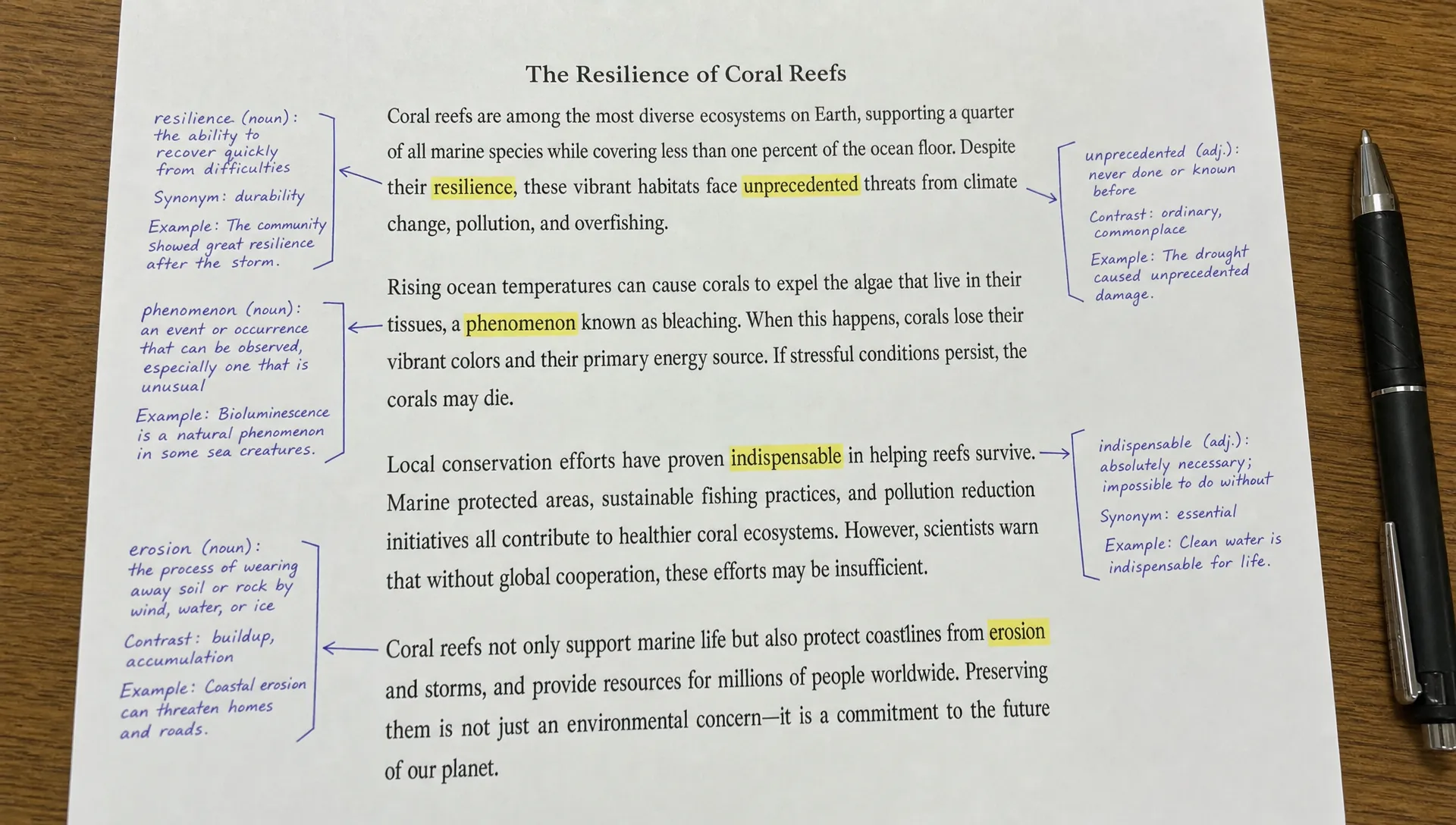
Context clues show up differently depending on what you read. A novel, a technical manual and an academic article each give different kinds of hints.
In academic reading
Academic writing often defines terms because authors need precision. You may see phrases like “refers to,” “is defined as,” “can be understood as” or “in this context.”
Example:
Metacognition refers to awareness of one’s own thinking processes, including the ability to monitor comprehension and adjust study strategies.
The definition comes immediately after the term. A good note would not simply copy the word. It would capture the meaning in your own language, such as “thinking about how I think and learn.”
Academic texts also use contrast. For example:
The study did not measure long-term retention. Instead, it focused on immediate recall after a single reading session.
The contrast tells you that “immediate recall” means remembering something right away, not after a delay.
In technical content
Technical content often uses examples, categories and cause-and-effect clues. A term may seem difficult because the sentence assumes background knowledge.
Example:
The system uses redundancy, storing copies of the data on multiple servers so that one failure does not make the information unavailable.
The phrase after the comma explains how redundancy works. You can infer that the word means backup, duplication or extra support to prevent failure.
If technical content feels overloaded with specialized terms, context clues can help you slow down and preserve meaning. For more strategies, see this guide on how to simplify technical content without losing meaning.
In literature and essays
Literary writing may not define words directly. Instead, it gives tone, action and description.
Example:
He gave a furtive glance toward the door, then slipped the envelope into his coat before anyone noticed.
The actions suggest secrecy. “Furtive” likely means secretive or sneaky.
This kind of clue requires inference. You are not just decoding vocabulary. You are reading behavior, mood and implication.
In reports and business writing
Reports often use context clues through charts, examples and surrounding claims.
Example:
Customer churn increased in the third quarter, with more subscribers canceling their plans after the introductory discount ended.
The second part of the sentence explains the term. “Churn” means customers leaving or canceling.
For professionals, this skill is useful when reading market reports, policy briefs, strategy documents and industry analysis. You can often understand the key term well enough to continue before checking the exact definition later.
Common signal words that reveal meaning
Signal words are small phrases that tell you how ideas relate. They often reveal whether the unknown word is being defined, contrasted or illustrated.
Useful signal words include:
- Definition: means, refers to, is called, is defined as
- Example: such as, including, for example, for instance
- Contrast: but, however, unlike, instead, although
- Cause and effect: because, therefore, as a result, due to
- Restatement: in other words, that is, or, also known as
Do not rely on signal words mechanically. “However” may show contrast, but you still need to identify what is being contrasted. “Such as” often introduces examples, but you still need to find the broader category those examples share.
Mistakes to avoid when using context clues
The biggest mistake is grabbing the first meaning that seems familiar. If a word has several meanings, your everyday definition may not fit the sentence.
For example:
The researchers controlled for age, income and prior education.
Here, “controlled” does not mean commanded or managed in the ordinary sense. In a research context, it means the researchers accounted for these variables so they would not distort the result.
Another mistake is using too little context. Sometimes the sentence itself is not enough. You may need the previous paragraph, a figure caption or the section heading.
A third mistake is treating your guess as certain. Context clues give you a working meaning, not always a final one. If the word is important to the argument, verify it. This is especially true in law, medicine, statistics, philosophy and other fields where one word can carry a specific technical meaning.
How to practice context clues effectively
The best way to practice is not to memorize long vocabulary lists. Instead, build a habit while reading real material.
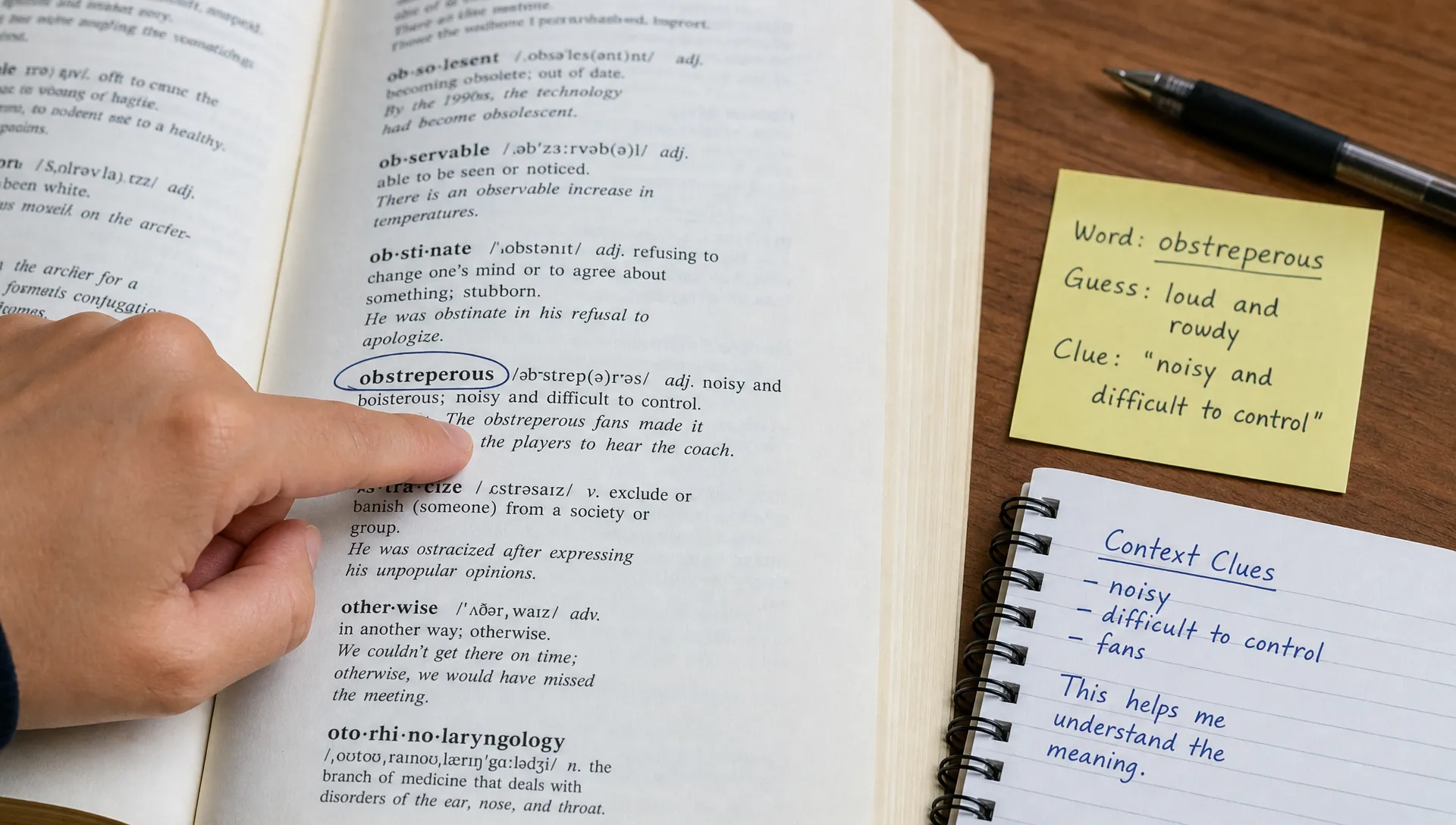
Choose a paragraph from a textbook, article or report. Circle two or three unfamiliar words. For each word, write a short guess based only on the surrounding text. Then underline the clue that led you to that guess. Afterward, check a dictionary or glossary and compare.
Your goal is not to be right every time. Your goal is to improve the reasoning process. Over time, you will notice patterns: academic authors often define key terms, journalists often explain through examples and technical writers often rely on cause-and-effect relationships.
You can also practice with a simple note format:
| Word | My context-based guess | Clue I used | Checked meaning |
|---|---|---|---|
| empirical | Based on observation or evidence | The sentence mentioned data from experiments | Based on observation or experience |
| mitigate | Reduce | The policy was meant to lower risk | Make less severe |
| opaque | Hard to understand | The report said the process lacked transparency | Not transparent or difficult to understand |
This kind of practice helps you see whether you truly understood the word or only recognized it. If you want a broader self-check, this article on how to tell if you truly understand a topic gives useful tests you can apply beyond vocabulary.
Using AI without skipping the thinking
AI tools can help when context is long, dense or spread across several sections. For example, if you are reading a PDF or article and a term appears in multiple places, an AI reading companion can help you compare how the term is used across the document.
The key is to use AI as a support for comprehension, not as a shortcut that replaces reading. A good prompt might be:
Explain what “epistemic uncertainty” means in this paragraph, using only clues from the surrounding text. Then show which phrases support that interpretation.
This forces the answer to stay connected to the original passage. You can also ask for a simpler explanation, an example or a teach-it version after you have tried to infer the meaning yourself.
With unrav.io, you can work with links, pasted text, PDFs, YouTube videos and podcasts, then reframe the material depending on your goal. For context clues, that might mean asking for a quick grasp of a paragraph, a deeper explanation of a technical term or a teaching-style breakdown that shows how the surrounding text points to the meaning.
When to use a dictionary instead
Context clues are often enough for basic comprehension, but there are times when you should confirm the exact definition.
Use a dictionary, glossary or field-specific source when the word is central to the main argument, appears repeatedly, affects a decision or belongs to a technical domain. You should also verify the word if you plan to use it in your own essay, report, presentation or teaching material.
A practical rule is simple: infer first, verify when it matters. This keeps you moving through the text without sacrificing accuracy.
Frequently Asked Questions
What are context clues in reading? Context clues are hints in the surrounding sentence, paragraph or section that help you infer the meaning of an unfamiliar word. They may appear as definitions, examples, contrasts, synonyms or logical clues.
How can I understand unknown words without a dictionary? Reread the full sentence, look for signal words, identify examples or contrasts, make a simple guess and test that guess against the paragraph. If the word is important, check a dictionary afterward.
What is the most common type of context clue? Definitions and examples are among the easiest to spot because writers often explain new terms directly. In more advanced texts, inference and contrast clues are also common.
Can context clues be wrong? Context clues are not wrong, but your interpretation can be incomplete. Some words have multiple meanings, and technical terms may require a glossary or expert source for full accuracy.
How do context clues help students? They help students read faster, build vocabulary, understand assignments and stay engaged with difficult material. They also support exam preparation because students learn how words function inside real passages.
The next step
Understanding other words through context clues is a practical reading skill, not a trick. It helps you stay with the text, notice relationships and build vocabulary in a way that connects to meaning.
Start with one unfamiliar word in your next reading. Do not look it up immediately. Read around it, identify the clue, make a careful guess and then verify if needed. The more you practice, the less often difficult vocabulary will stop your reading flow.
If you are working through a long article, PDF, lecture transcript or video, unrav.io can help you reframe the material so the clues are easier to see. Use it to support your own thinking, then return to the original text with a clearer sense of what the words are doing.