
How to Simplify Technical Content Without Losing Meaning
Technical material is often difficult for the wrong reason. The ideas may be precise, useful, and important, but they are buried under specialist language, long sentences, dense structure, and assumptions about what the reader already knows.
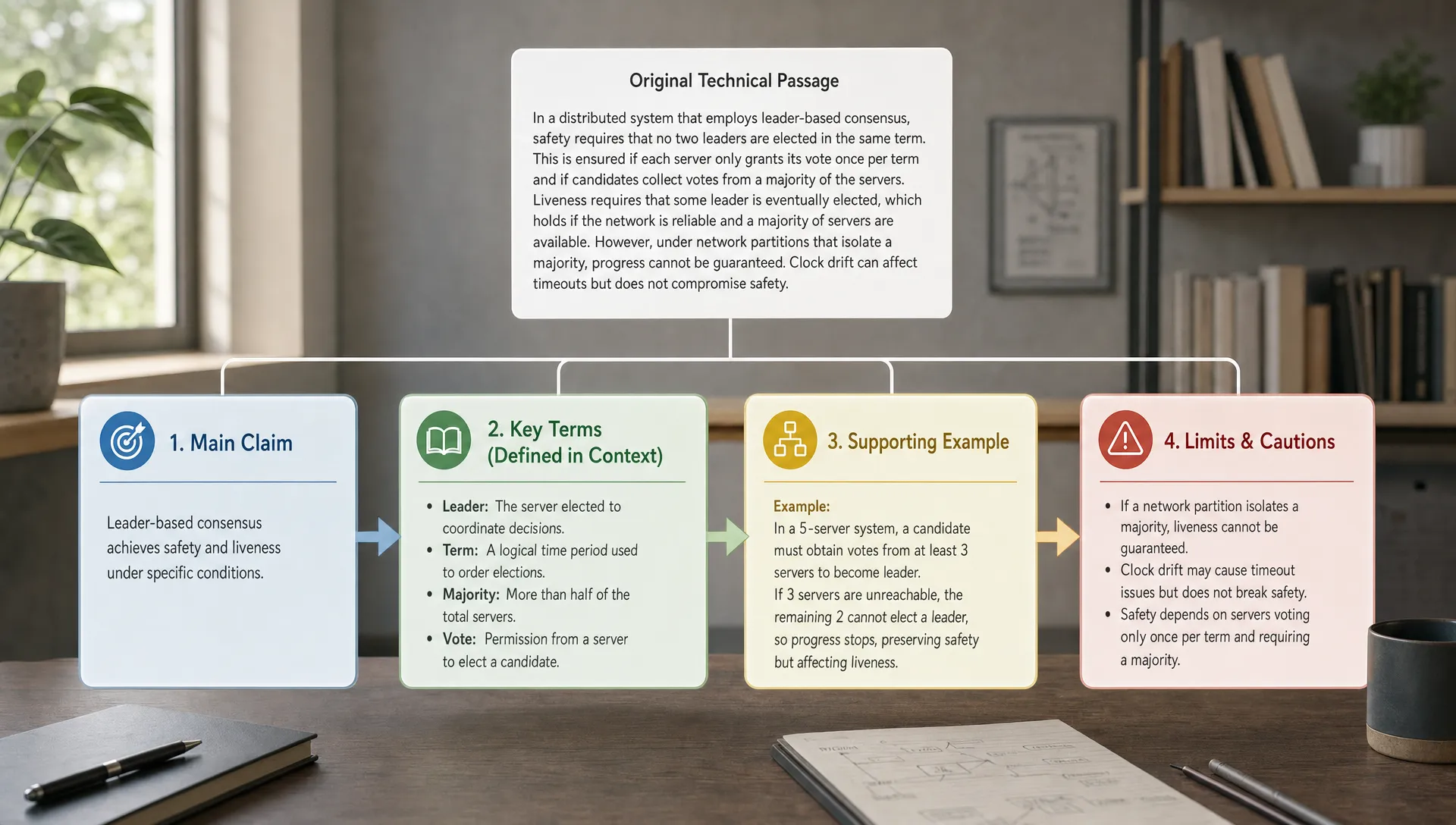
Simplifying technical content is not the same as “dumbing it down.” The goal is to make the meaning easier to access while keeping the logic, evidence, limitations, and important terms intact. This matters whether you are explaining a research paper to classmates, turning a product spec into a stakeholder update, adapting a report for executives, or teaching a complex concept to beginners.
The challenge is balance. If you simplify too little, readers stay lost. If you simplify too much, you remove the details that make the content accurate. The method below helps you find the middle ground.
What “simpler” should mean in technical communication
Simple technical content is not vague. It is content where the reader can understand what is being said, why it matters, and what to do with it.
A strong simplified version usually has four qualities:
- It keeps the main claim intact: The simplified version should say the same thing as the original, not a more dramatic or more convenient version.
- It explains necessary terms: Important technical words can stay, but they should be defined in context.
- It shows relationships clearly: Readers should see causes, conditions, tradeoffs, steps, and consequences.
- It preserves uncertainty: If the source says “may,” “in some cases,” or “based on limited evidence,” the simplified version should not turn that into a guarantee.
This is where many summaries fail. They shorten the content, but they also remove the reasoning. If you want a deeper look at that problem, unrav.io has a useful guide on why summarizing falls short without real understanding.
Start with the reader, not the source
Before rewriting anything, define who the simplified version is for. A beginner, a busy executive, a subject-matter expert from another field, and a student preparing for an exam all need different levels of detail.
Ask three questions before you simplify:
- What does this reader already know? This helps you decide which terms need explanation and which can remain untouched.
- What does this reader need to do next? They may need to make a decision, remember the concept, teach it, critique it, or apply it.
- What would be risky to omit? This protects you from removing limitations, assumptions, or conditions that change the meaning.
For example, if you are simplifying a medical research paper for patients, you might explain the condition, the treatment, the results, and the limitations in plain language. If you are simplifying the same paper for clinicians, you may keep the technical terminology but make the study design, sample size, outcomes, and caveats easier to scan.
The same source can produce multiple valid simplified versions. The right version depends on the reader’s purpose.
Identify the “irreducible core” before you rewrite
The irreducible core is the meaning that must survive simplification. If this core is missing or distorted, the simplified version is no longer trustworthy.
For most technical content, the core includes:
- The central claim or question
- The method or basis for the claim
- The key evidence or reasoning
- The conditions where the claim applies
- The limitations, uncertainty, or exceptions
- The practical implication
If you are working with a research paper, the core might be the research question, method, findings, significance, and limitations. For more detail on that kind of source, see this guide on how to summarize a scientific article in plain English.
For a technical product document, the core might be the problem, proposed solution, system behavior, constraints, dependencies, risks, and open questions. For a policy report, it may be the finding, evidence base, affected groups, tradeoffs, and recommendation.
Do not begin by replacing words. Begin by identifying what cannot be lost.
Separate what to simplify from what to preserve
A useful way to simplify technical content without losing meaning is to separate surface complexity from meaning-critical complexity.
Some complexity comes from presentation. Long sentences, undefined acronyms, passive voice, crowded paragraphs, and poor structure can usually be simplified safely. Other complexity comes from the subject itself. Statistical uncertainty, causal limits, technical thresholds, and methodological constraints may be difficult, but they often need to remain.
| Element | Usually safe to simplify | Usually important to preserve |
|---|---|---|
| Sentence structure | Break long sentences into shorter ones | Keep causal links and conditions clear |
| Vocabulary | Replace jargon when it is not essential | Keep key technical terms when precision matters |
| Acronyms | Spell them out on first use | Keep standard acronyms if the audience expects them |
| Data | Round or group numbers when exact values are not needed | Keep exact numbers when they affect interpretation |
| Methods | Explain the method in plain language | Preserve the design, sample, inputs, or assumptions |
| Caveats | Make them easier to read | Do not remove uncertainty or exceptions |
| Examples | Add concrete scenarios | Avoid examples that change the scope of the claim |
This distinction is crucial. The goal is not to remove all difficulty. The goal is to remove unnecessary difficulty.
Use a layered explanation
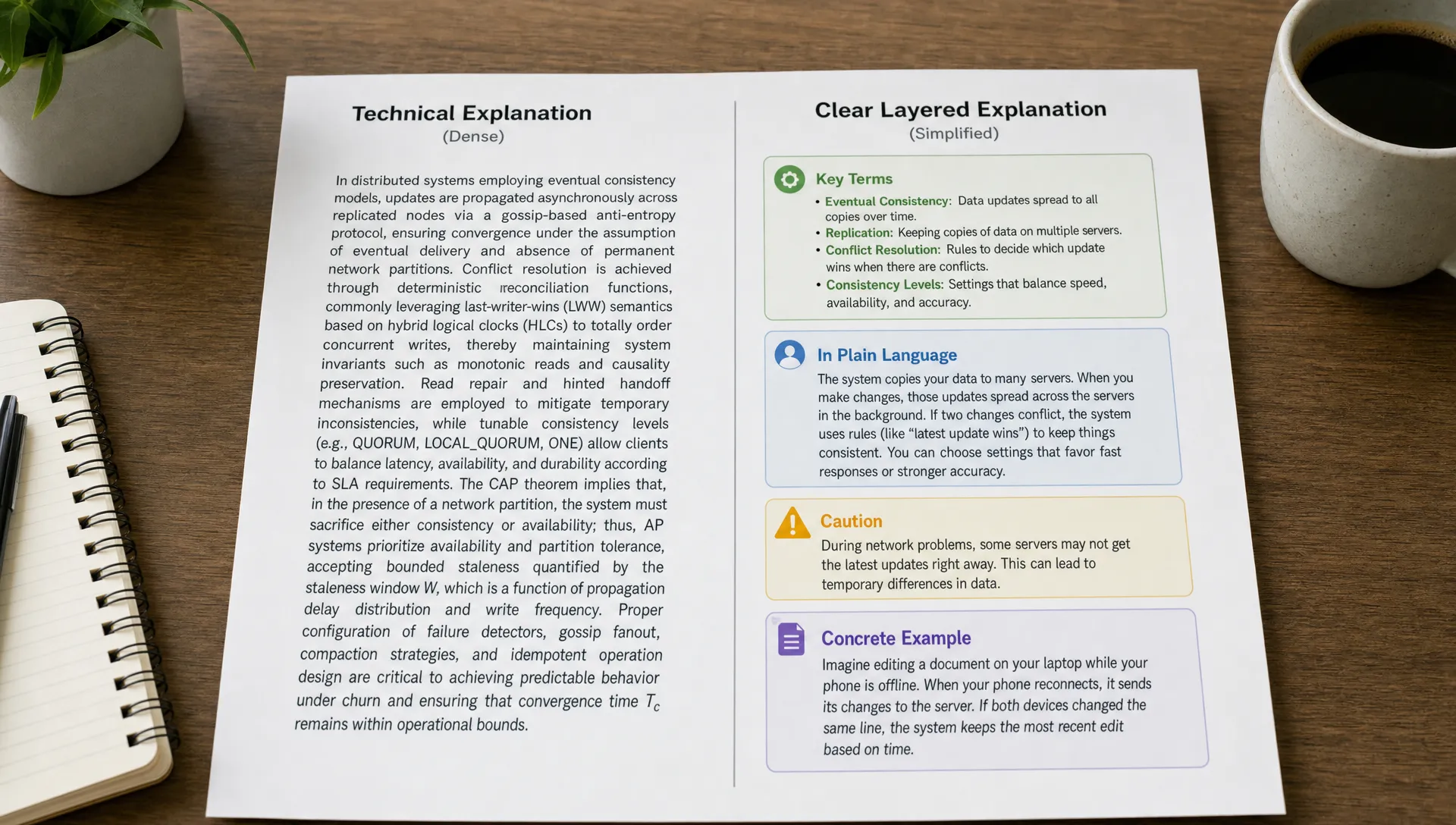
A layered explanation gives readers the right amount of detail at the right time. Instead of forcing every detail into one dense paragraph, you build from simple to specific.
A practical structure looks like this:
- One-sentence plain answer: State the point in direct language.
- Short explanation: Explain how or why the point works.
- Technical detail: Add the key terms, data, method, or mechanism.
- Caveat: Explain what the statement does not mean or where it may not apply.
- Example: Show the idea in a concrete situation.
Here is a simple example.
Original:
The model demonstrates improved performance under low-resource conditions, although generalizability remains constrained by domain-specific training data and limited external validation.
Simplified version:
The model worked better when there was not much training data available. However, the results may not apply everywhere because the model was trained on data from a specific domain and has not been tested widely outside that setting.
The simplified version is easier to read, but it keeps the important meaning: improved performance, low-resource conditions, domain limits, and limited validation.
Replace jargon carefully, not automatically
Jargon is not always bad. In technical work, specialized terms can be efficient and precise. The problem is unexplained jargon, unnecessary jargon, or jargon used when a plain word would do.
A good rule is to divide terms into three groups.
| Term type | What to do | Example |
|---|---|---|
| Essential technical term | Keep it and define it | “Latency, the delay before a system responds…” |
| Replaceable jargon | Use a simpler word | “Utilize” becomes “use” |
| Audience-specific term | Keep or replace based on reader knowledge | “Regression” may need explanation for non-statisticians |
For example, do not replace “confidence interval” with “certainty range.” That can be misleading, because a confidence interval has a specific statistical meaning. Instead, keep the term and explain it: “A confidence interval is a range that estimates where the true value is likely to fall, based on the data and method used.”
Plain language guidance from plainlanguage.gov recommends writing for the user, organizing information clearly, and using familiar words when possible. Those principles work well for technical content too, as long as you do not remove necessary precision.
Turn hidden structure into visible structure
Technical content often feels hard because the structure is hidden. The writer may know how the pieces connect, but the reader has to infer the logic.
You can simplify by making the structure visible. Use headings, signposts, transition sentences, and short labels that tell the reader what each part is doing.
For example, a dense technical explanation might contain all of these elements in one paragraph:
- Background
- Problem
- Method
- Finding
- Limitation
- Implication
Instead of leaving the reader to untangle them, separate the ideas:
Problem: Current tools struggle when data is sparse.
Method: The researchers tested a model on smaller training datasets.
Finding: The model performed better than the baseline in these low-data settings.
Limitation: The tests used data from a narrow domain, so the results may not generalize.
Implication: The approach may be useful in specialized settings, but it needs broader testing.
This does not oversimplify the content. It simply reveals the structure that was already there.
Preserve uncertainty and limits
One of the most common mistakes in simplifying technical content is turning cautious claims into confident claims.
Technical sources often use careful language for a reason. Words like “suggests,” “associated with,” “may reduce,” “under specific conditions,” and “requires further study” are not filler. They tell the reader how strong the claim is.
Here are examples of meaning loss:
| Original wording | Oversimplified wording | Better simplified wording |
|---|---|---|
| “The intervention was associated with improved outcomes.” | “The intervention caused better outcomes.” | “People who received the intervention had better outcomes, but the study does not prove it was the cause.” |
| “The model may improve accuracy in low-noise environments.” | “The model improves accuracy.” | “The model may improve accuracy when the data is relatively clean.” |
| “Findings are preliminary.” | “The findings show…” | “The early findings suggest…” |
This matters in research, health, finance, engineering, policy, and any field where decisions depend on the strength of evidence. A simplified explanation should make uncertainty easier to understand, not erase it.
Use examples, analogies, and comparisons with discipline
Examples are one of the best ways to simplify technical content. They give readers something concrete to hold onto. But they can also distort the idea if they are too loose.
A good example should match the original concept in the ways that matter. If you use an analogy, clarify where it works and where it stops.
For example, when explaining an API to a non-technical stakeholder, you might say:
An API is like a menu in a restaurant. It tells another system what it can request and what it will receive back.
That analogy is useful, but incomplete. A menu does not fully explain authentication, rate limits, error handling, or data formats. If those details matter, add a second layer:
The menu analogy explains the request and response idea, but real APIs also include rules about who can access them, how often requests can be made, and what format the data must use.
This keeps the benefit of the analogy without letting it replace the technical truth.
Simplify at the sentence level
Once the meaning is clear, improve the writing itself. Sentence-level simplification can make a big difference.
Use these edits:
- Replace long noun phrases with verbs when possible.
- Break sentences that contain multiple conditions.
- Put the main point near the beginning.
- Use active voice unless passive voice is clearer.
- Define terms when they first appear.
- Remove filler phrases that do not add meaning.
For example:
Original:
The implementation of the proposed protocol resulted in the reduction of synchronization failures across distributed nodes.
Simplified:
The proposed protocol reduced synchronization failures across distributed nodes.
This version is shorter, clearer, and still accurate. Not every sentence can become that simple, but many technical sentences contain avoidable friction.
Simplify by format, not just wording
Sometimes the best simplification is not a rewritten paragraph. It may be a table, comparison, checklist, diagram, study guide, teaching script, or executive brief.
Different readers need different output formats.
| Use case | Better format | Why it helps |
|---|---|---|
| Studying for an exam | Key concepts and question prompts | Helps recall and self-testing |
| Reviewing a research paper | Structured summary with methods and limitations | Keeps evidence visible |
| Explaining findings to stakeholders | Short brief with implications and risks | Supports decisions |
| Teaching a complex topic | Step-by-step explanation with examples | Builds understanding gradually |
| Repurposing a report | Outline, talking points, or newsletter draft | Converts dense material into usable content |
This is where AI tools can help, if used carefully. An AI reading companion like unrav.io can reframe articles, PDFs, YouTube videos, podcasts, links, or pasted text into different modes depending on whether you need a quick grasp, deeper understanding, or a teachable explanation. The important habit is to compare the output with the source, especially when the material is technical, legal, medical, scientific, or high-stakes.
AI can speed up the first pass, reveal structure, and suggest clearer wording. It should not replace your judgment about accuracy.
A practical workflow for simplifying technical content
Use this workflow when you need to turn dense material into something clearer.
- Read for purpose first: Before rewriting, identify what the document is trying to do. Is it explaining, proving, comparing, warning, instructing, or recommending?
- Highlight the core meaning: Mark the claim, method, evidence, limitations, and implication. Do not worry about wording yet.
- Define the audience: Decide what the reader knows, what they need, and what would be dangerous to omit.
- Create a rough plain-language version: Rewrite the main point in direct language, even if it feels imperfect.
- Add back necessary precision: Restore technical terms, conditions, numbers, and caveats that matter.
- Choose the right format: Decide whether the content works best as a paragraph, table, outline, FAQ, example, or teaching explanation.
- Check against the original: Compare the simplified version with the source and ask, “Did I change the meaning?”
This process is slower than simply shortening the text, but it produces a much better result. It is especially useful for researchers, students, analysts, educators, and creators who need to make complex material usable for other people.
Before and after example
Here is a short example of technical content simplified without losing the main idea.
Original:
Due to heterogeneity in participant demographics and variability in intervention adherence, the observed effects should be interpreted cautiously and may not be generalizable to populations outside the study sample.
Too shallow:
The results may not apply to everyone.
Better simplified version:
The results should be interpreted carefully. The participants were not all the same, and some followed the intervention more closely than others. Because of this, the findings may not apply to people who are very different from those in the study.
The shallow version is not wrong, but it loses useful detail. The better version explains why the results may not generalize. That “why” is often what readers need in order to understand the meaning.
Common mistakes to avoid
The biggest mistakes usually happen when simplification becomes compression without reasoning.
Avoid these habits:
- Removing the method and keeping only the conclusion
- Replacing precise terms with vague everyday words
- Dropping caveats because they feel inconvenient
- Turning probabilities into certainties
- Using analogies without explaining their limits
- Shortening every sentence but leaving the structure confusing
- Writing for “everyone” instead of a defined audience
If you are simplifying your own findings for a presentation, report, or stakeholder update, this guide on summarizing findings so people actually understand offers a useful companion approach.
A quick quality check before publishing or sharing
Before you send, post, teach, or publish simplified technical content, run a final review.
Ask yourself:
- Can the reader identify the main point quickly? If not, move it earlier.
- Did I explain the terms that matter? If not, define them where they first appear.
- Did I preserve the evidence or reasoning? If not, add a short method, basis, or example.
- Did I keep the limitations? If not, restore the caveats.
- Would an expert say this is still accurate? If not, revise before sharing.
For high-stakes material, ask a subject-matter expert to review the simplified version. Clarity is valuable, but accuracy comes first.
Frequently Asked Questions
What is the best way to simplify technical content? Start by identifying the audience and the core meaning, then rewrite the content in layers: plain answer, explanation, technical detail, caveat, and example. This keeps the content clear without stripping out important context.
How do I simplify jargon without losing precision? Keep essential technical terms and define them in plain language. Replace only the jargon that does not carry special meaning. If a term has a specific definition in the field, do not swap it for a looser everyday phrase.
Is simplifying technical content the same as summarizing it? Not exactly. Summarizing reduces length. Simplifying improves understanding. A good simplified version may still include details, examples, and caveats if they help the reader understand the meaning accurately.
Can AI help simplify technical content? Yes, AI can help produce a first-pass explanation, reorganize dense material, define terms, and generate examples. However, you should verify the result against the source, especially when accuracy, evidence, or safety matters.
How do I know if I have oversimplified something? You have probably oversimplified if the method disappears, uncertainty becomes certainty, key terms become vague, or the reader can no longer see when and where the claim applies.
Make the complex easier to work with
The best simplified technical content does not remove intelligence from the source. It removes unnecessary friction between the source and the reader.
Start with the reader’s goal. Protect the core meaning. Keep the terms, evidence, and caveats that matter. Then use clearer structure, shorter sentences, examples, and the right format to make the content easier to understand.
If you regularly work with dense articles, PDFs, research papers, reports, videos, or podcasts, tools like unrav.io can help you reframe material for quick understanding, deeper insight, or teaching. Use it as a reading companion, then bring your own judgment to the final version.