
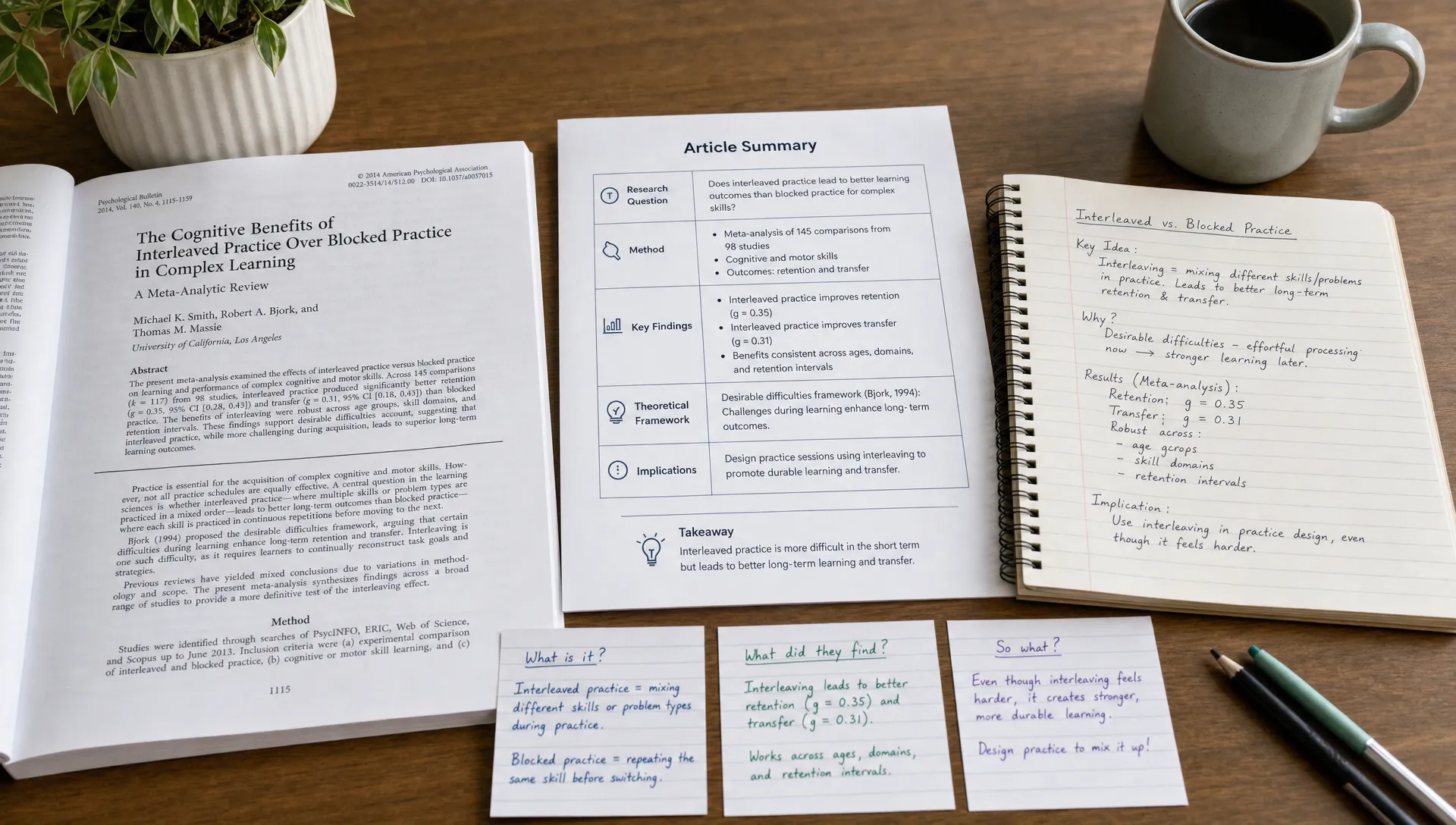
How to Summarize an Academic Article Step by Step
If you have ever opened an academic article and felt buried under theory, citations, methods, and cautious language, you are not alone. Academic writing is designed to document evidence carefully, not to give busy readers a quick takeaway.
To summarize an academic article well, you need more than a shorter version of the abstract. You need to identify the article's purpose, explain how the authors support their point, and preserve the limits of what the article actually shows.
This guide gives you a practical step-by-step process you can use for class readings, literature reviews, research notes, workplace briefs, or teaching materials.
What a good academic article summary should do
A strong academic article summary answers five basic questions: What is the article about? What question or problem does it address? How did the author or researchers investigate it? What did they find or argue? Why does it matter?
That sounds simple, but it is easy to get lost in background information or copy language from the paper. A summary should be faithful, selective, and written in your own words. It should not include every citation, every statistical detail, or every example unless those details are essential to understanding the article.
For empirical research, organizations such as the American Psychological Association provide Journal Article Reporting Standards that show how research articles are commonly structured. You do not need to memorize those standards, but it helps to recognize the usual parts of an academic article: introduction, literature review, methods, results, discussion, and conclusion.
If you are working with a full research paper rather than a shorter assigned article, you may also find this guide on summarizing a research paper without losing the point useful.
Before you start, know why you are summarizing
The right summary depends on the task. A 150-word class summary is not the same as a literature review note, and a workplace brief is not the same as a study guide.
Before reading closely, write one sentence that names your purpose: I am summarizing this article to understand the main argument for class, compare it with other studies, brief my team, prepare a lesson, or decide whether it is relevant to my project.
| Purpose | What to emphasize | Best summary format |
|---|---|---|
| Class reading | Main argument, key evidence, conclusion | Short paragraph or half-page summary |
| Literature review | Research question, method, findings, limitations | Structured notes with citation details |
| Workplace brief | Practical implications and reliability | Bullet summary with key takeaways |
| Teaching | Concepts, examples, and simplified explanation | Plain-English explanation or lesson outline |
| Content creation | Core idea, supporting points, and reusable angles | Outline, script notes, or newsletter draft |
Knowing your purpose keeps the summary focused. Otherwise, you may spend too much time summarizing background sections that are not central to the article's contribution.
Step 1: Capture the citation and context first
Start with the basics before you read deeply. Record the article title, author or authors, publication year, journal or source, and DOI or stable link if available. This prevents a common problem: writing good notes but later forgetting where they came from.
Then add one short context sentence. For example: This article is a 2022 education study about retrieval practice in university science courses. Or: This article is a theoretical paper about how digital platforms shape public discourse.
This context sentence is not your final summary. It is a quick anchor that helps you interpret the rest of the article.
Step 2: Skim the structure before reading line by line
Do not start by reading every sentence from the introduction to the references. Academic articles are easier to understand when you first map the structure.
Read the abstract, introduction, headings, tables, figures, discussion, and conclusion. This gives you a rough sense of the article's path before you slow down.
| Article section | What to look for | What not to overfocus on at first |
|---|---|---|
| Abstract | Topic, method, main finding, conclusion | Treating it as the full article |
| Introduction | Problem, research gap, purpose | Every citation in the literature review |
| Methods | Data, participants, sources, approach | Minor technical details you do not need |
| Results | Main findings or patterns | Every number or sub-result |
| Discussion | Interpretation and significance | Broad claims not supported by results |
| Conclusion | Final takeaway and implications | Repeated background material |
At this stage, your goal is orientation. You are asking: What kind of article is this, and where will I find the information I need?
Step 3: Identify the research question or central claim
Most summaries fail when they skip the article's main question. Look for phrases such as this study examines, we investigate, this article argues, the purpose of this paper is, or we ask whether.
For an empirical study, turn the purpose into a question. For example: Does a specific teaching strategy improve student retention? How do remote teams coordinate complex work? What relationship exists between a policy and an outcome?
For a theoretical or humanities article, look for the central claim instead. The article may not test a hypothesis. It may interpret a text, challenge an assumption, build a framework, or connect ideas across previous scholarship.
Your summary should make this question or claim visible early, usually in the first or second sentence.
Step 4: Read the methods for design, not every detail
The methods section explains how the author or researchers produced their evidence. You do not need to summarize every procedure, but you do need to understand the design well enough to judge the findings.
For a research study, note the population, data source, sample size if important, time period, measures, and analysis method. For a humanities article, note the primary texts, archive, case studies, theoretical lens, or interpretive approach.
A useful methods sentence often looks like this: The authors analyzed interview data from 42 participants to understand how early-career teachers adapt to classroom technology. Or: The article uses close reading and historical context to reinterpret a recurring theme in the novel.
If you cannot explain the method simply, slow down. You do not need to become an expert in the method, but you should know what kind of evidence the article relies on.
Step 5: Separate findings from interpretation
Findings are what the article reports. Interpretation is what the authors say those findings mean. Good summaries keep both, but they do not mix them up.
In a quantitative article, findings may involve differences between groups, correlations, model results, or statistically significant effects. In a qualitative article, findings may appear as themes, patterns, categories, or recurring participant experiences. In a theoretical article, findings may be argument moves, conceptual distinctions, or reinterpretations of existing evidence.
Be careful with claim strength. If the article says a result is associated with an outcome, do not summarize it as proving that one thing causes another. If the authors say the evidence suggests something, do not rewrite it as the evidence confirms it.
A precise summary preserves uncertainty. Academic articles often include cautious language because evidence has limits. Your summary should keep that caution when it matters.
Step 6: Note the limitations and scope
Limitations are not flaws to hide. They are part of the article's meaning. They tell you how far the findings can reasonably travel.
Look near the discussion or conclusion for comments about sample size, context, measurement, data availability, generalizability, missing variables, or future research. For theoretical work, limitations might involve scope, selected texts, assumptions, or alternative interpretations.
You usually need only one limitation sentence. For example: The authors note that the study is limited by its small sample and single-institution setting. Or: The article's argument is strongest for the selected case studies and may not apply to all digital communities.
Step 7: Build a simple summary outline
Before drafting, organize your notes into a reusable structure. This prevents your summary from becoming a collection of disconnected facts.
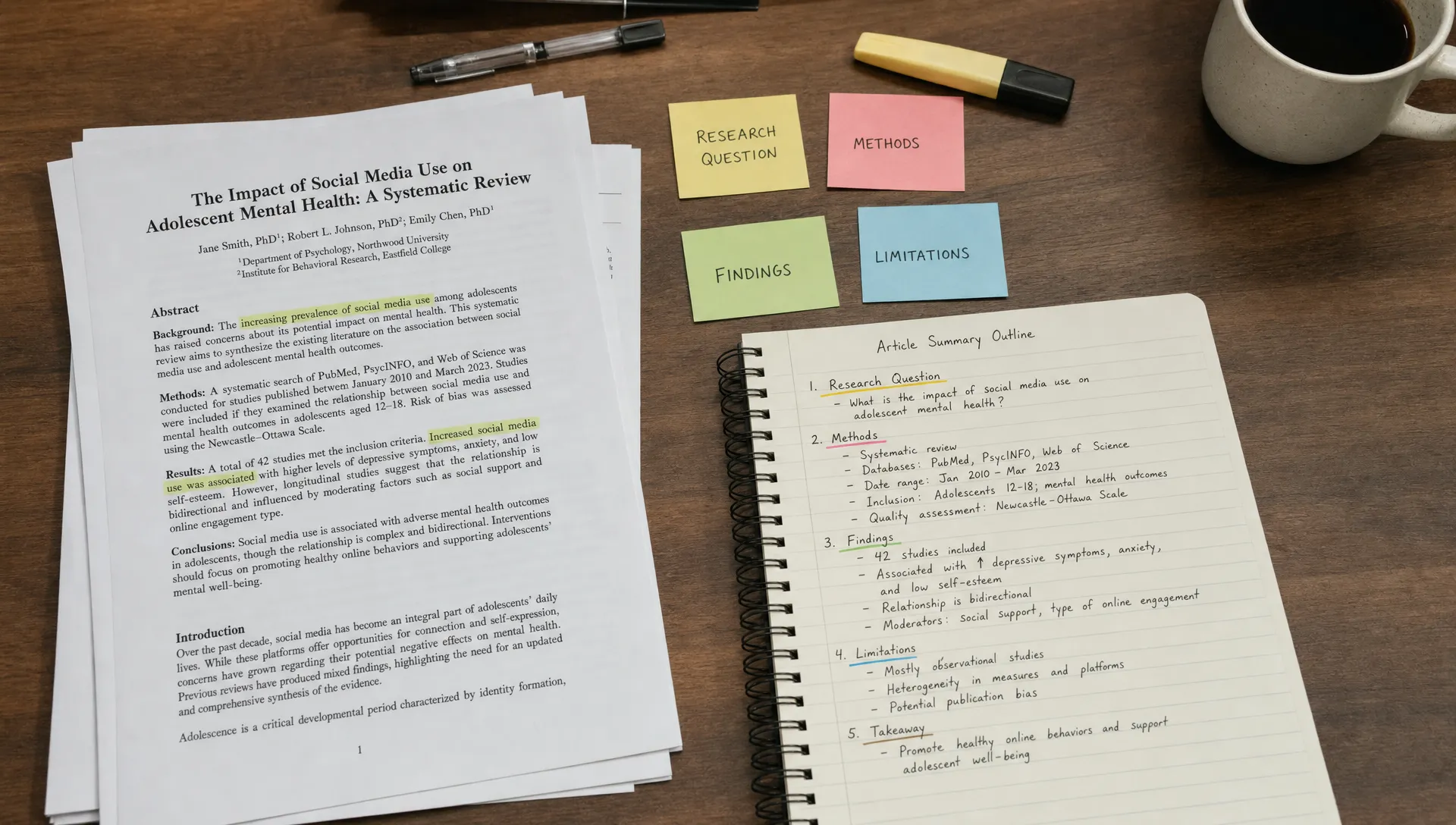
Use this academic article summary outline:
- Citation and context: Who wrote the article, when, and what topic does it address?
- Research question or claim: What problem, question, or argument drives the article?
- Method or evidence: How do the authors support the claim?
- Main findings or argument: What are the most important results or points?
- Significance: Why does the article matter for the field, class, or project?
- Limitations: What boundaries or cautions should readers remember?
If you want to see how this structure looks in practice, this research article summary example walks through a model you can adapt.
Step 8: Write the first draft in your own words
Once your outline is clear, close the article for a moment and draft from your notes. This helps you avoid patchwriting, which happens when your summary follows the source wording too closely.
A simple formula works for many summaries:
- The article examines a specific question or problem in a defined context.
- The authors use a particular method, source, dataset, or line of reasoning.
- The article finds or argues the main point.
- The article matters because it contributes a specific insight.
- The authors or the evidence leave a specific limitation or open question.
Here is a flexible paragraph template:
In this article, the author examines [topic or question] in order to understand [larger issue]. Using [method, evidence, or source type], the article shows that [main finding or argument]. The author argues that [interpretation or significance]. This matters because [contribution to the field, course theme, or practical problem]. However, the article is limited by [scope, method, evidence, or context].
Do not fill this template mechanically. Use it as scaffolding, then revise so the summary sounds natural.
Step 9: Check the draft against the article
After drafting, return to the article and verify accuracy. This step is especially important if you are summarizing for academic work, research synthesis, or professional decisions.
Ask yourself these questions:
- Did I correctly identify the article's main question or claim?
- Did I include the method or evidence, not just the conclusion?
- Did I keep the author's level of certainty?
- Did I leave out minor details that do not affect the main point?
- Did I avoid adding my own opinion unless the task asks for critique?
- Did I cite the article according to the required style?
If your summary sounds more confident than the article itself, revise it. If your summary could apply to dozens of articles on the same topic, make it more specific.
Step 10: Shorten without making the summary vague
A good summary is concise, but concision should not remove meaning. The goal is to cut repetition, not substance.
Use stronger verbs instead of vague phrases. Instead of saying an article talks about technology in schools, say it examines how teachers use classroom technology during formative assessment. Instead of saying the article is about climate policy, say it compares the effects of two emissions policies across urban regions.
| Vague wording | Clearer wording |
|---|---|
| The article talks about student learning. | The article examines how retrieval practice affects student retention. |
| The authors use research to show their point. | The authors analyze survey and interview data to support their argument. |
| The article says the method works. | The study finds that the method improved short-term performance in the tested group. |
| The article has some problems. | The authors note that the findings are limited by sample size and study context. |
You can usually shorten by removing long background explanations, extra examples, and repeated definitions. Keep the research question, method, main finding, significance, and limitation.
How to use AI to summarize an academic article responsibly
AI tools can help you move through dense academic material faster, but they should not replace your judgment. Use AI for orientation, reframing, and note organization, then verify important claims against the original article.
For example, unrav.io can help you work with articles, PDFs, links, pasted text, videos, and podcasts. For an academic article, you might use it to get a quick grasp of the paper, reframe a dense section in plain English, or turn the article into teaching notes. Because unrav.io focuses on understanding and reframing rather than only shortening, it can be useful when you need to learn the material, not just produce a paragraph.
Good prompts or requests include:
- Identify the research question, method, main findings, and limitations.
- Explain the article in plain English for a first-year student.
- Turn this article into structured notes for a literature review.
- List the claims I should verify before citing this article.
- Create a short summary and a deeper explanation of the same article.
The most important rule is simple: cite the original article, not the AI output. If a detail matters for your assignment, literature review, or decision, check it in the source. For more on why this matters, read about how summarizing falls short without real understanding.
Common mistakes to avoid
One common mistake is summarizing only the abstract. Abstracts are useful, but they are compressed and sometimes leave out important limitations, methods details, or nuance from the discussion.
Another mistake is turning the summary into a critique too early. Unless your task asks for evaluation, first explain the article fairly. You can add critique after the summary in a separate section.
Avoid copying long phrases from the article. Academic language can be dense, and copying it often makes your summary harder to read. If a term is essential, keep it, but explain the surrounding idea in your own words.
Also avoid ignoring the methods. A summary that says what the article concludes without saying how the authors got there is incomplete, especially for empirical research.
Example: turning article notes into a short summary
Imagine you are summarizing a fictional study about online discussion boards in college courses. Your notes might look like this:
| Summary element | Notes |
|---|---|
| Topic | Online discussion boards in undergraduate courses |
| Research question | How do structured prompts affect student participation? |
| Method | Analysis of discussion posts and student survey responses across several course sections |
| Main finding | More specific prompts were linked with longer, more focused responses |
| Significance | Course design affects the quality of online participation |
| Limitation | Results come from one institution and may not apply to all courses |
A short summary could look like this:
The article examines how structured discussion prompts shape student participation in undergraduate online course discussions. Using discussion post analysis and student survey responses from several course sections, the study finds that more specific prompts are linked with longer and more focused student responses. The article suggests that small design choices can affect the quality of online participation, although its findings are limited by the single-institution setting.
Notice what the summary does not include. It does not list every survey question, every citation, or every minor result. It keeps the article's purpose, evidence, finding, significance, and limitation.
Frequently Asked Questions
How long should an academic article summary be? It depends on the assignment or use case. A class summary may be 150 to 300 words, while literature review notes may be longer and more structured. If no length is given, aim for the shortest version that still includes the research question, method, main finding, significance, and limitation.
Can I summarize an academic article from the abstract only? You can use the abstract for orientation, but you should not rely on it alone for an accurate summary. The methods, results, and discussion often contain important details that change how the article should be understood.
What is the difference between a summary and a critique? A summary explains what the article says and how it supports its point. A critique evaluates the article's strengths, weaknesses, assumptions, or usefulness. In academic writing, it is usually best to summarize first and critique second.
Should I include citations in an academic article summary? Yes, if the summary is for school, research, publication, or professional documentation. Follow the citation style required by your instructor, journal, or organization, such as APA, MLA, Chicago, or another field-specific style.
Can AI help me summarize academic articles? Yes, AI can help you identify structure, simplify dense passages, and draft notes. However, you should verify important claims, check the original wording when needed, and make sure the final summary reflects your own understanding.
Next step: turn the article into usable knowledge
Summarizing an academic article gets easier when you stop treating the paper as one long block of text. Break it into parts: context, question, method, findings, significance, and limits. Then write a short version that preserves the article's meaning without carrying over unnecessary detail.
If you want help making dense articles, PDFs, or pasted text easier to understand, unrav.io can support the reading process with AI-powered lenses such as quick grasp and teach-it modes. Use it as a companion for comprehension, then return to the source for verification and final judgment.