
How to Take Notes From Podcasts With AI
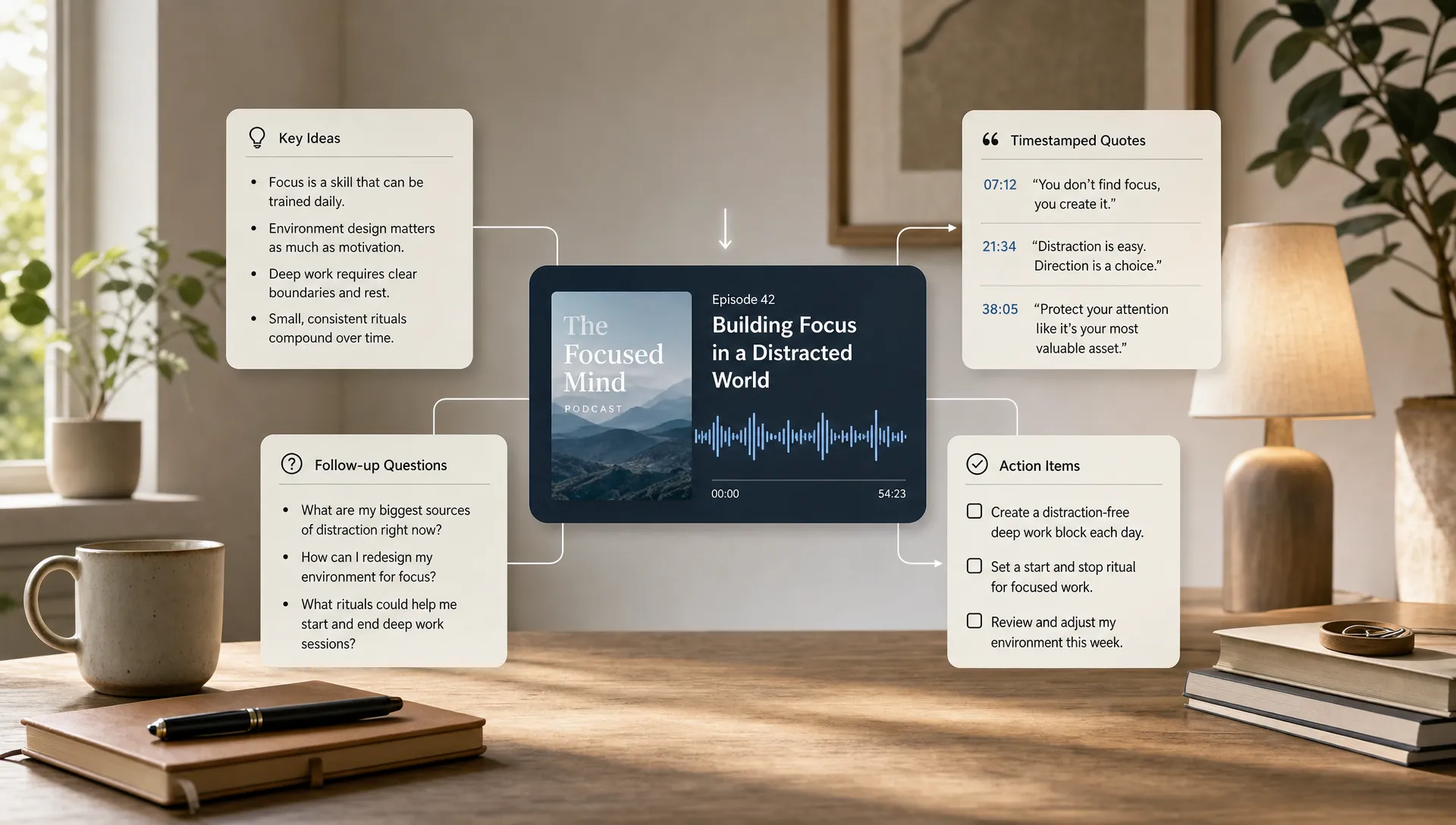
If you listen to podcasts for learning, research, work, or content ideas, you have probably had this problem: an episode feels valuable while you are listening, but a day later you remember only a few scattered points.
Podcasts are full of useful thinking, expert interviews, case studies, personal stories, and practical advice. They are also hard to take notes from because they move in real time. You might be walking, commuting, cooking, or working out. By the time you pause to capture one idea, the conversation has already moved on.
AI can help, but only if you use it for more than a generic summary. Good podcast notes should help you understand the episode, find the important moments again, connect the ideas to your own work, and turn listening into something you can reuse. That might mean study notes, research questions, article outlines, teaching material, or a list of next actions.
This guide walks through a practical workflow for taking notes from podcasts with AI without losing nuance, context, or your own judgment.
Why podcast notes are different from article notes
Taking notes from a podcast is not the same as taking notes from an article or PDF. Written content usually has headings, paragraphs, citations, and a visible structure. A podcast unfolds through speech. Ideas can be repeated, interrupted, clarified later, or hidden inside stories.
That makes podcast notes tricky in several ways.
First, spoken content is often nonlinear. A guest might introduce an idea early, explain it 20 minutes later, and return to it near the end. If you only capture the first mention, you may miss the complete point.
Second, tone matters. A host may challenge a guest, joke, express uncertainty, or distinguish between evidence and opinion. A flat AI summary can remove those signals, which makes the notes sound more certain than the conversation actually was.
Third, podcasts often contain examples rather than neat claims. The most useful part of an episode may not be the main topic. It may be a case study, a method, a warning, or an analogy you want to use later.
This is why your goal should not be to turn a 60-minute episode into 10 bullets. The goal is to turn it into a useful learning object. If you want a deeper look at this distinction, unrav.io has a helpful article on why summarizing falls short without real understanding.
Decide what kind of podcast notes you need
Before you ask AI to summarize an episode, decide what you want the notes to do. Different listeners need different outputs.
A student listening to a psychology episode before an exam needs definitions, theories, examples, and review questions. A founder listening to an interview with an operator may want strategic insights, mistakes to avoid, and action items. A researcher may care about claims, evidence, methods, and references to follow up on. A creator may want angles, quotes, and ideas to repurpose.
Here is a simple way to match your goal to the right type of AI-generated notes.
| Listener goal | Best note format | What to ask AI for |
|---|---|---|
| Study faster | Concept notes and review questions | Key concepts, definitions, examples, and quiz questions |
| Research a topic | Evidence-focused notes | Claims, sources mentioned, assumptions, and open questions |
| Prepare for work | Briefing notes | Main takeaways, risks, decisions, and next steps |
| Create content | Repurposing notes | Hooks, angles, quotes, stories, and outline ideas |
| Teach the topic | Explanation notes | Simple explanation, analogies, examples, and discussion prompts |
This one decision improves the quality of your AI notes immediately. Instead of asking for a summary, you are asking for a specific output that fits your purpose.
How to take notes from podcasts with AI: a practical workflow
The best workflow has three phases: capture the episode, structure the ideas, then refine the notes yourself. AI is useful in each phase, but it should not be the only layer of thinking.
1. Start with the episode source or transcript
AI needs access to the podcast content. Depending on the tool and platform, that may come from a podcast link, a YouTube version of the episode, an RSS page, an audio transcript, or copied text from show notes.
If you have a transcript, use it. Transcripts make it easier to extract accurate claims, quotes, and timestamps. If the podcast is on YouTube, some tools can work from the video or transcript directly. If you often learn from long video interviews, this related guide on a YouTube video to notes workflow covers that use case in more depth.
If you do not have a transcript, you can still use AI, but be more careful. Automatically generated transcripts can contain errors, especially with names, technical terms, accents, and overlapping speech. Treat the notes as a first pass, not a final source.
2. Ask for a big-picture map before detailed notes
Many people make the mistake of asking AI for detailed notes immediately. For a long conversation, it is better to ask for the structure first.
A big-picture map helps you see the main themes, how the conversation develops, and which sections deserve closer attention. This is especially useful for dense interviews, technical discussions, or episodes with multiple guests.
Try a prompt like this:
Create a big-picture map of this podcast episode. Identify the main themes, the order in which they appear, the most important turning points in the conversation, and any sections that seem especially useful for deeper note-taking.
This gives you a navigational layer. You can then decide which parts to expand, ignore, question, or revisit.
3. Extract key ideas with context
Once you have the map, ask AI to pull out the important ideas. The key word is context. A note like The guest says remote work is better is too vague. A better note explains when, why, and under what conditions the guest makes that claim.
A strong AI note should usually include:
- The idea or claim
- The reasoning behind it
- The example used to support it
- Any caveats or uncertainty
- The timestamp or section, if available
A useful prompt is:
Extract the key ideas from this episode, but keep the context. For each idea, include the speaker if known, the reasoning, any example mentioned, and any caveat or disagreement.
This prompt reduces the risk of oversimplified notes. It also makes your notes easier to trust later.
4. Separate claims, stories, quotes, and actions
Podcast conversations mix different types of information. If AI turns everything into the same bullet style, your notes become harder to use. Instead, ask it to separate the material by function.
| Note type | What it captures | Why it matters |
|---|---|---|
| Claims | Arguments, opinions, conclusions | Helps you evaluate what the episode is saying |
| Stories | Personal examples or case studies | Makes ideas easier to remember and reuse |
| Quotes | Memorable phrasing | Useful for articles, presentations, or citations after verification |
| Actions | Practical steps or recommendations | Turns listening into behavior change |
| Questions | Unresolved issues or follow-ups | Supports research, study, or discussion |
For example, if a podcast guest says they changed their writing process after realizing readers skim first, that could become a story, a claim, and an action. Separating those layers makes your notes more useful.
5. Turn the notes into your preferred format
Raw AI notes are only the beginning. The next step is to convert them into the format you actually use.
If you are a student, ask for study notes with definitions, examples, and practice questions. Retrieval practice is one of the most reliable study techniques, and resources like The Learning Scientists explain why testing yourself is often more useful than rereading.
If you are a researcher, ask for a claims-and-evidence table. Include what the guest asserts, what evidence they mention, what is missing, and what you should verify separately.
If you are a professional, turn the episode into a brief. Ask for the decision-relevant points, risks, assumptions, and possible next steps.
If you are a creator, ask AI to convert the episode into content assets. This could include newsletter angles, short post ideas, a script outline, or questions for your own audience.
Here is a prompt you can adapt:
Convert these podcast notes into study notes for a graduate-level seminar. Include key concepts, examples, discussion questions, and points that need verification before citing.
The same source episode can produce very different notes depending on the lens you apply.
6. Verify important details before using them
AI-generated podcast notes can be very useful, but they are not a substitute for checking the source. This matters most when you are using the notes for research, teaching, client work, journalism, or public content.
Always verify:
- Direct quotes
- Names, dates, and statistics
- Scientific or legal claims
- Medical, financial, or safety advice
- Claims you plan to publish or cite
For direct quotes, go back to the timestamp and listen again. For statistics, look for the original report or study. For expert claims, check whether the guest is speaking from evidence, experience, speculation, or personal opinion.
This step may feel slower, but it protects the value of your notes. AI should help you find what deserves attention faster. It should not make unverified information look finished.
7. Add your own layer of thinking
The most valuable notes are not just extracted from the podcast. They include your interpretation.
After AI produces a structured note set, add a short reflection section. Ask yourself what changed in your understanding, what you disagree with, what you want to test, and how the episode connects to something else you are learning.
You can also ask AI to help with this stage:
Based on these notes, generate five reflection questions that would help me connect the episode to my current work on [topic]. Do not answer the questions for me.
This is a small but important distinction. You are using AI to support thinking, not outsource it.
Useful AI prompts for podcast notes
The quality of your notes depends heavily on the quality of your request. A vague prompt produces vague notes. A clear prompt tells the AI what to preserve, what to ignore, and how you plan to use the output.
| Use case | Prompt to try |
|---|---|
| Quick understanding | Give me a quick grasp of this podcast episode, including the main topic, the core argument, and the three most useful ideas. |
| Deep learning | Explain the episode as if I am studying the topic seriously. Include concepts, examples, assumptions, and follow-up questions. |
| Research review | Extract the claims made in this episode and separate them from evidence, anecdotes, speculation, and recommended sources. |
| Content creation | Turn this episode into a content brief with hooks, key angles, memorable examples, and possible article outlines. |
| Teaching | Reframe this episode for teaching. Include a simple explanation, classroom discussion questions, and common misunderstandings. |
| Action planning | Identify practical actions from this episode, who they apply to, and what conditions would make them more or less useful. |
If you use an AI reading assistant like unrav.io, the same idea applies through different thinking modes. For a first pass, a quick grasp mode can help you understand what the episode is about. For deeper learning, a teaching-oriented mode can reframe the material so it is easier to explain, remember, and connect to other ideas.
Common mistakes when using AI for podcast notes
AI can make podcast note-taking faster, but it can also create a false sense of understanding. Watch out for these mistakes.
The first mistake is accepting a summary that is too smooth. Podcast conversations are messy because real thinking is messy. If the AI output removes all disagreement, uncertainty, and detail, it may be easier to read but less accurate.
The second mistake is ignoring timestamps. If you plan to reuse a quote, check a claim, or revisit a section, timestamps save time. Ask for them whenever the source supports it.
The third mistake is mixing notes with conclusions. A guest may describe what worked for their company, but that does not automatically mean it will work for yours. Keep the original point separate from your decision.
The fourth mistake is keeping too many notes. More notes do not always mean better understanding. A useful note set should make the episode easier to return to. If the AI produces pages of bullets, ask it to compress the notes around themes, decisions, or questions.
The fifth mistake is not adapting the output to your goal. A creator, researcher, and student should not all use the same podcast notes. The source is the same, but the job of the notes is different.
If you are still choosing a tool, this guide on what to look for in an AI note taking app can help you compare features without getting distracted by surface-level summaries.
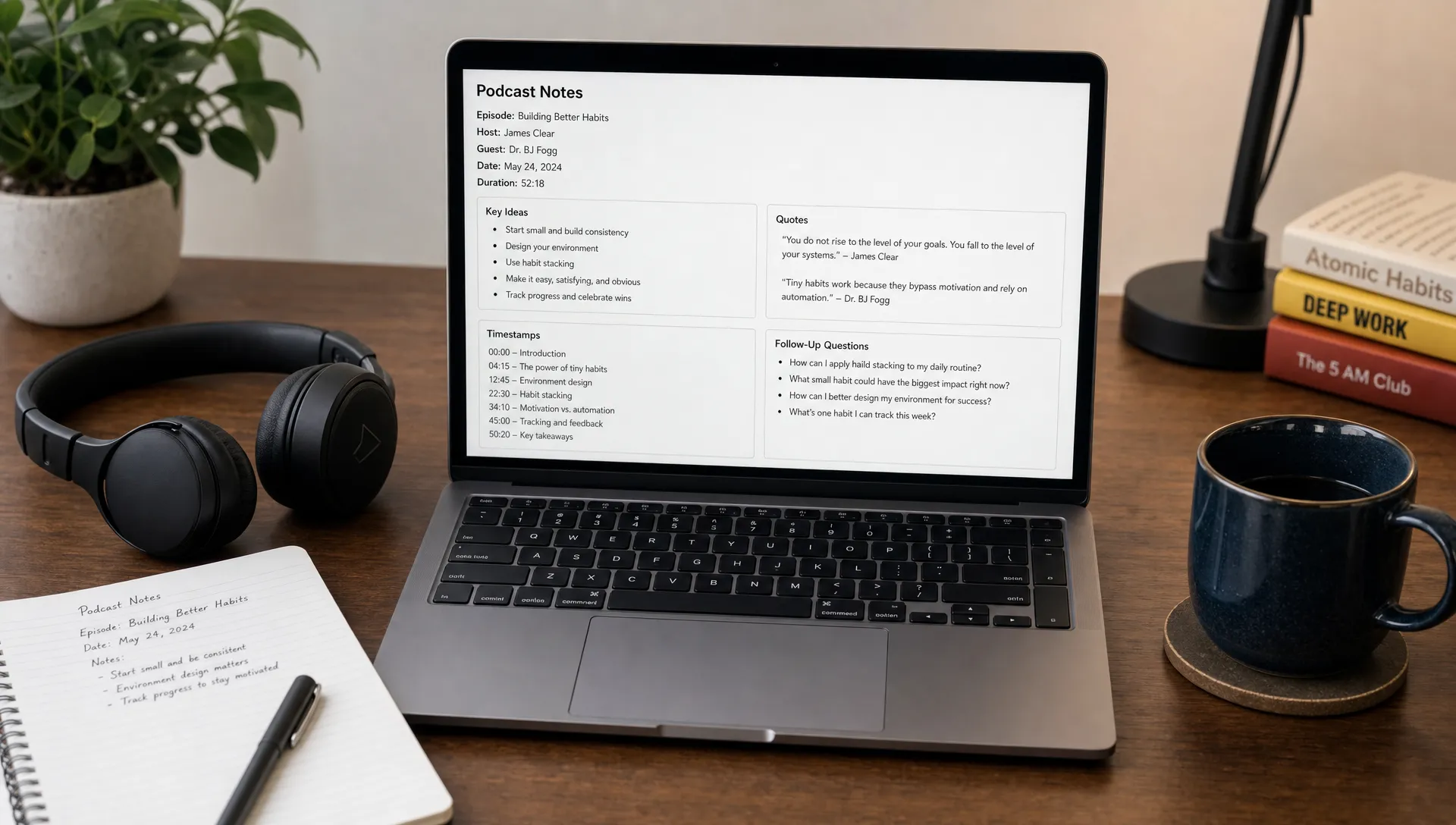
A simple podcast note template you can reuse
Here is a practical template you can copy into your notes app and use with any AI tool.
Episode:
Guest or host:
Date listened:
Purpose for listening:

Big picture:

Key ideas:

Important examples or stories:

Useful quotes to verify:

Claims that need checking:

Questions I still have:

Connections to other things I am learning:

Actions or next steps:
This template works because it keeps different types of information separate. It also leaves room for your own thinking, which is where long-term learning happens.
For students, the most important sections may be key ideas, questions, and connections. For researchers, claims that need checking may be the most valuable section. For professionals, actions and next steps may matter most. For creators, examples, stories, and quotes may become the seed of future content.
When should you use AI, and when should you take manual notes?
You do not have to choose between AI notes and manual notes. The strongest workflow often combines both.
Use AI when the episode is long, when you need a transcript-based overview, when you want to compare multiple episodes, or when you need to reformat notes for a specific purpose. AI is especially helpful for finding patterns across a dense conversation.
Use manual notes when you are listening for personal insight, when the topic is sensitive, when you need exact interpretation, or when the episode is central to your work. Manual notes force attention. They also capture your reaction in the moment, which AI cannot know unless you add it.
A good hybrid approach is simple: let AI create the first structure, then add your own highlights, corrections, and reflections. That gives you speed without losing judgment.
Frequently Asked Questions
Can AI take notes from any podcast? It depends on the tool and the available source. Some tools work from links, transcripts, YouTube versions, or pasted text. If there is no transcript or accessible audio source, you may need to create or find a transcript first.
Are AI podcast notes accurate? They can be useful, but they are not always fully accurate. Transcription errors, missing context, and overconfident summaries can happen. Verify important claims, quotes, names, and numbers before using them in serious work.
What is the best prompt for podcast notes? A strong prompt includes your goal. For example: Extract the key ideas from this episode for a research brief, including claims, evidence, examples, caveats, and follow-up questions.
Can AI turn podcast notes into study materials? Yes. You can ask AI to convert podcast notes into definitions, flashcard-style questions, discussion prompts, or a study guide. For better learning, review the notes actively instead of only rereading them.
How do I keep podcast notes from becoming too long? Ask AI to organize notes by themes, remove repetition, and separate essential ideas from supporting examples. You can also request a short version first, then expand only the sections that matter.
Turn your next podcast into usable notes
The easiest way to take notes from podcasts with AI is not to ask for a summary and stop there. Start with your goal, create a big-picture map, extract ideas with context, separate claims from stories and actions, then add your own thinking.
This workflow helps you move from passive listening to active understanding. Whether you are studying, researching, writing, teaching, or preparing for work, your podcast notes become easier to review, trust, and reuse.
If you want a faster way to reframe long content into clearer understanding, try using unrav.io with a podcast, transcript, video, article, or PDF. Use a quick grasp when you need the overview, then shift into deeper thinking when the episode deserves more attention.