
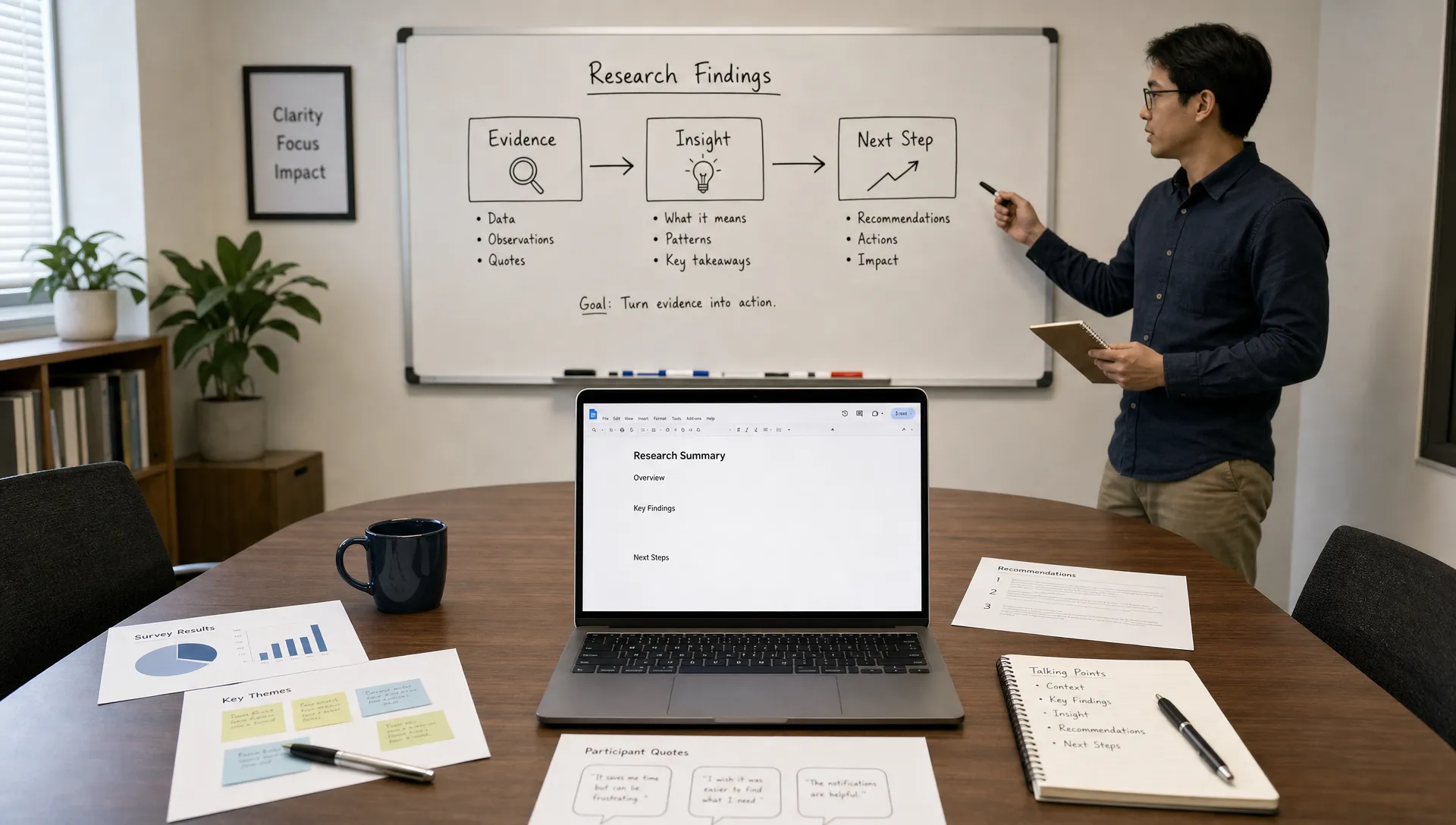
How to Summarize Your Findings So People Actually Understand
You can do solid research, analyze the right material, and still lose your audience if your findings are hard to follow. This happens in class presentations, research updates, strategy documents, stakeholder reports, client emails, and content briefs. The problem is rarely that the findings are bad. More often, the summary asks people to do too much work.
To summarize your findings clearly, you need more than a shorter version of your notes. You need to help people understand what you looked at, what you found, why it matters, and what should happen next.
This guide walks through a practical way to turn messy findings into a clear summary people can actually use.
Start by separating findings from everything else
A common reason summaries become confusing is that they mix observations, evidence, interpretation, and recommendations into one dense block. Before you write, separate those pieces.
A finding is not every detail you collected. It is a meaningful pattern, result, or insight that answers the question you were investigating.
For example, if you interviewed 12 users, “three users mentioned onboarding” is a data point. “New users struggle to understand the first setup step because the product language does not match their goal” is closer to a finding. It connects evidence to meaning.
The same applies to academic work. A statistical result is not automatically a finding until you explain what it suggests in relation to the research question. If you are working from papers, it helps to first understand the argument before condensing it. The unrav.io guide on summarizing a research paper without losing the point is useful if your findings come from scholarly sources.
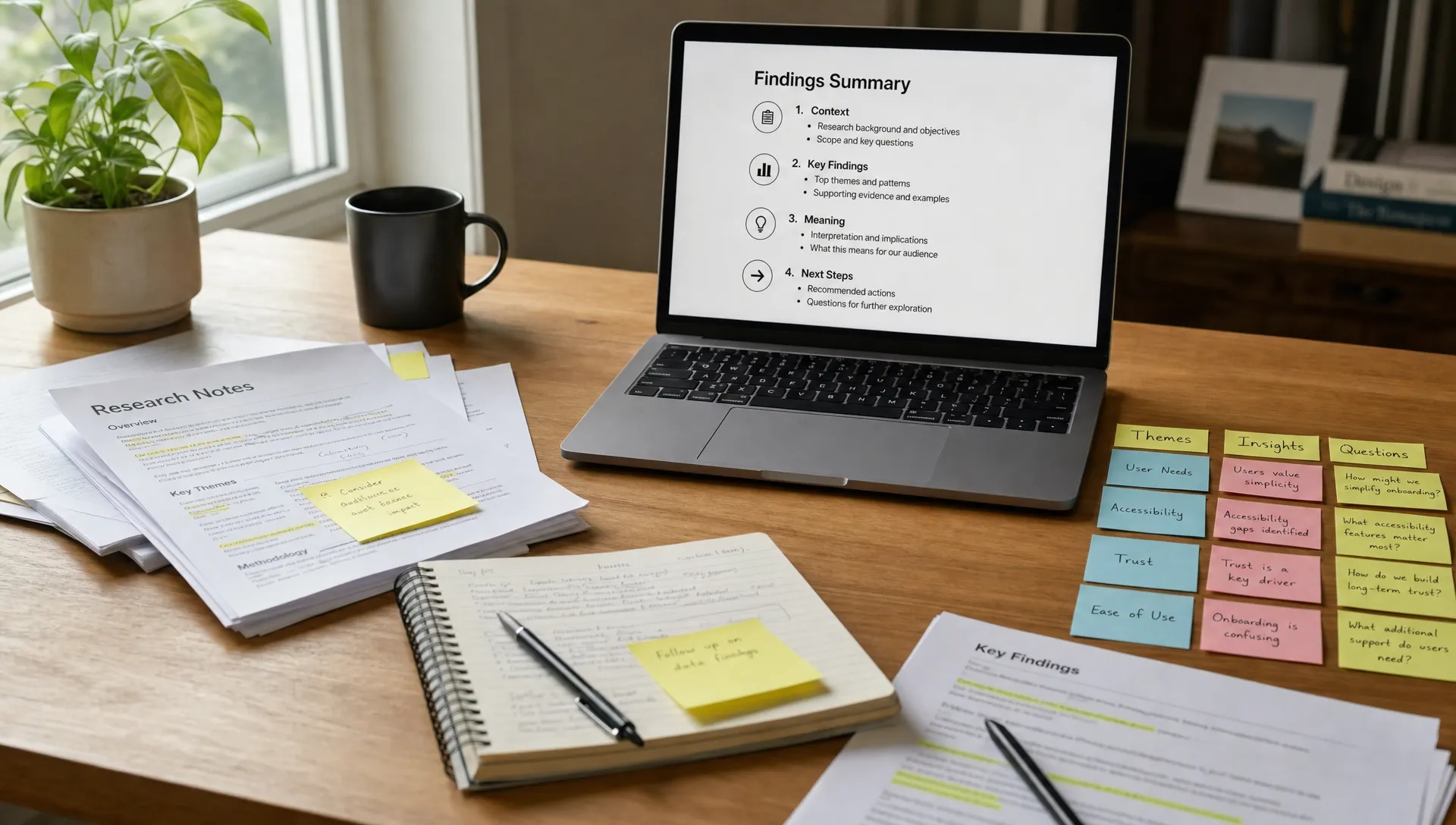
A clear findings summary usually answers four questions:
| Question | What the reader needs |
|---|---|
| What did you examine? | Scope, source material, sample, or context |
| What did you find? | The main patterns, results, or conclusions |
| Why does it matter? | Implications for the reader’s goal or decision |
| What should happen next? | Action, follow-up question, or recommendation |
If your summary does not answer these, it may be accurate but still hard to use.
Know who needs to understand the findings
The same findings should be summarized differently for different audiences. A professor, executive, product manager, client, student, or general reader will not all need the same level of detail.
Before writing, define the reader’s job. Are they trying to make a decision, study for an exam, approve a project, understand a trend, teach the topic, or create content from the material?
A researcher may need methods, limitations, and confidence levels. A manager may need risks, tradeoffs, and next steps. A student may need the core argument and how each finding supports it. A content creator may need the most interesting angles, examples, and takeaways.
This is where many summaries fail: they are written from the writer’s point of view rather than the reader’s. The writer thinks, “What did I do?” The reader thinks, “What do I need to understand or act on?”
A useful test is to finish this sentence before drafting: “After reading this summary, my audience should be able to...” Then write the summary to support that outcome.
Use a simple structure for findings summaries
You do not need a complex template. In most cases, a clear findings summary follows a simple order: context, question, findings, meaning, and next step.
Here is a reusable structure:
- Context: Briefly explain what you reviewed, studied, analyzed, or observed.
- Purpose: State the question or goal behind the work.
- Main finding: Lead with the most important result or pattern.
- Supporting findings: Add two to four secondary findings that clarify the main point.
- Evidence: Include enough proof to make the findings credible.
- Implication: Explain what the findings mean for the reader.
- Next step: Recommend an action, decision, or follow-up question.
This order works because it reduces cognitive load. Readers do not have to guess why the information exists, how the pieces connect, or what they are supposed to do with it.
For short updates, this can be one paragraph. For reports, it can become an executive summary. For academic work, it can become a discussion section summary. For content work, it can become a brief or outline.
Lead with the point, not the process
Many people summarize findings in the order they did the work. They begin with background, then methods, then all the details, and finally the insight. That may be how the work happened, but it is not always how readers understand best.
Instead, lead with the most important point. Then explain how you got there.
Weak version:
We reviewed 48 customer support tickets, grouped them by topic, compared them against onboarding analytics, and noticed several issues related to the setup flow.
Clearer version:
The main finding is that new users are getting stuck during setup because the instructions do not explain what information they need before starting.
The second version gives the reader a mental anchor. Now the evidence has somewhere to attach.
This does not mean you should hide methods or uncertainty. It means you should not make the audience wait too long to understand the point. If your work is technical, include methods after the finding, not before, unless the method is the main thing your audience needs to evaluate.
Turn “what happened” into “what it means”
A summary of findings becomes valuable when it moves from description to interpretation. Description tells people what you saw. Interpretation tells them why it matters.
Here is the difference:
| Raw observation | Clear finding |
|---|---|
| 62% of respondents skipped the help section. | Most users are not relying on help content during setup, which suggests the product needs clearer in-flow guidance. |
| Three papers mentioned inconsistent terminology. | The field lacks shared definitions, making it difficult to compare results across studies. |
| Viewers dropped off after minute six. | The video likely delays its strongest value too long, reducing retention before the main lesson appears. |
| Students scored lower on application questions. | Learners may understand definitions but struggle to transfer the concept to new examples. |
The pattern is simple: observation plus meaning. This is also where AI tools can help, as long as you review the output critically. For example, unrav.io can reframe articles, PDFs, videos, and pasted text through different thinking modes, which can help you move from “what does this say?” to “what does this mean?” If you want a deeper explanation of why short summaries are not always enough, see how summarizing falls short without real understanding.
Choose the right level of detail
A findings summary should be short enough to read, but complete enough to trust. The right length depends on the reader and the stakes.
For a quick team update, you may only need three findings and one recommendation. For a thesis, research report, or client deliverable, you may need to include context, evidence, limitations, and alternative interpretations.
Use this rule: include details that change understanding, confidence, or action. Remove details that only prove you did a lot of work.
Details usually belong in the summary if they affect:
- Scale: How common or significant the finding is.
- Confidence: How strong the evidence is.
- Relevance: Which audience, segment, case, or condition the finding applies to.
- Limitations: What the finding does not prove.
- Action: What someone should do differently because of the finding.
For example, “participants preferred shorter lessons” is useful but vague. “Beginner participants preferred lessons under 10 minutes because longer lessons introduced too many new terms at once” is more actionable. It tells the reader who the finding applies to and why.
Use plain language without oversimplifying
Plain language does not mean removing complexity. It means making the relationship between ideas easier to follow.
If your findings come from academic, scientific, or technical material, keep the important nuance but translate specialized terms when needed. Replace abstract nouns with concrete wording. Break long sentences. Define terms the first time you use them.
For example:
| Harder to understand | Easier to understand |
|---|---|
| The intervention demonstrated variable efficacy across cohorts. | The intervention worked for some groups but not others. |
| Respondents exhibited low awareness of available support pathways. | Most respondents did not know where to get help. |
| The data indicates a potential misalignment between user expectations and onboarding copy. | Users expected one thing from the setup process, but the instructions described something else. |
This is especially important when summarizing findings for mixed audiences. A technical reader can handle detail, but a non-specialist still needs a clear path through the argument.
If you are summarizing scientific material, the guide on summarizing a scientific article in plain English offers a more focused approach.
Show the evidence, but do not bury the reader in it
People understand findings better when they can see where they came from. But too much evidence can turn a summary back into a report.
A good pattern is: finding, evidence, meaning.
Example:
Finding: Students understood the definition of opportunity cost but struggled to apply it in unfamiliar scenarios. Evidence: In the quiz results, 81% answered definition questions correctly, while only 46% answered scenario questions correctly. Meaning: Future lessons should include more applied examples, not just terminology review.
This format works because each sentence has a job. The first states the insight. The second supports it. The third explains the implication.
For qualitative findings, evidence may be a recurring theme, a representative quote, or a pattern across interviews. For quantitative findings, it may be a percentage, comparison, trend, or statistical result. For content analysis, it may be repeated claims, missing context, source quality, or audience response.
Avoid dumping all evidence into the main summary. If needed, put detailed notes, transcripts, tables, or source excerpts in an appendix or separate document.
Make relationships between findings visible
A list of findings is not always enough. Readers also need to understand how the findings connect.
Sometimes one finding explains another. Sometimes two findings conflict. Sometimes a finding is only important because it appears across multiple sources. If you leave those relationships unstated, the reader may miss the real insight.
Use connective phrases such as:
- “This helps explain why...”
- “This matters because...”
- “A related pattern appears in...”
- “However, this finding is limited by...”
- “Taken together, these findings suggest...”
These phrases may look simple, but they do important work. They guide the reader through your reasoning.
For example, instead of writing, “Users disliked the setup flow. Users also ignored the help docs,” connect the findings: “Users disliked the setup flow, and the help docs did not solve the problem because most users never opened them during setup.”
Now the reader understands the relationship: the support content exists, but it is not available at the moment of need.
Adapt the format to the situation
The best way to summarize your findings depends on where the summary will be used.
| Situation | Best format | What to emphasize |
|---|---|---|
| Class assignment | Structured paragraph or short report | Main argument, evidence, relevance to course concepts |
| Research update | Findings memo | Research question, methods, findings, limitations |
| Workplace report | Executive summary | Decision, risk, impact, recommendation |
| Client presentation | Slide-friendly summary | Key insights, proof points, next steps |
| Content planning | Creative brief | Audience insight, angles, examples, reusable ideas |
| Teaching material | Plain-language explanation | Core concept, examples, misconceptions |
For slide decks, keep each finding to one sentence and use speaker notes for evidence. For reports, use headings and short paragraphs. For emails, put the main finding in the first few lines. For study notes, include definitions and examples alongside the findings.
Avoid the most common mistakes
Even strong findings can become hard to understand if the summary has poor structure. Watch for these issues:
- Starting too broad: Do not spend half the summary on background before stating the point.
- Listing facts without meaning: A fact becomes useful when you explain why it matters.
- Using vague claims: Words like “interesting,” “significant,” and “important” need evidence or explanation.
- Ignoring limitations: Clear summaries explain what the findings do and do not show.
- Including every detail: More information can reduce clarity if it hides the main message.
- Writing for yourself: Use the reader’s goal to decide what belongs in the summary.
A good summary is selective. It does not include everything you found. It includes what the audience needs in order to understand the situation and take the next step.
A quick before-and-after example
Here is a rough findings summary:
We analyzed user feedback from the onboarding survey and support tickets. A lot of users mentioned confusion around the setup process. Some users also said they were not sure which option to choose. The help center has articles about setup, but users still had problems. We should improve onboarding.
This is not terrible, but it is too general. It does not explain the main issue clearly enough.
Here is a clearer version:
The main finding is that new users are getting stuck during setup because they do not understand which configuration option matches their goal. This appeared in both onboarding survey responses and support tickets. Although help center articles exist, users often need guidance inside the setup flow before they know what to search for. The next step is to rewrite the option labels and add short examples directly where users make the choice.
The improved version works because it identifies the cause, names the evidence, explains why the current solution is not enough, and gives a practical next step.
Frequently Asked Questions
How long should a findings summary be? It depends on the audience and purpose. A short update may be 150 to 300 words, while a formal report summary may be one to two pages. The key is to include enough context, evidence, and meaning for the reader to trust the findings.
What is the difference between findings and conclusions? Findings are the main results or patterns from your analysis. Conclusions explain what those findings mean overall. A conclusion often combines several findings into a broader interpretation or recommendation.
Should I include limitations when I summarize my findings? Yes, especially for research, analysis, or decisions with real consequences. Limitations help readers understand how much confidence to place in the findings and where more work may be needed.
Can AI help summarize findings? Yes, AI can help organize notes, identify patterns, rephrase dense material, and create first drafts. But you should still verify the summary, check the evidence, and make sure the interpretation matches your actual source material.
How do I make findings easier for non-experts to understand? Start with the main point, define specialized terms, use concrete examples, and explain why the finding matters. Do not remove important nuance, but avoid making readers decode unnecessary jargon.
Make your findings easier to understand
Summarizing findings is not just a writing task. It is a thinking task. You are deciding what matters, how ideas connect, what evidence is needed, and what the reader should understand next.
A strong findings summary gives people a clear path: here is what we looked at, here is what we found, here is why it matters, and here is what to do with it.
If your findings are buried across articles, PDFs, YouTube videos, podcasts, research papers, or pasted notes, unrav.io can help you reframe the material into clearer forms for quick understanding, deeper insight, or teaching. Use it as a companion for comprehension, then apply your own judgment to shape the final summary for your audience.