
How to Shorten a Paragraph Without Losing the Main Idea
If you need to shorten a paragraph, the goal is not to delete words randomly. The goal is to keep the paragraph’s central meaning while making it easier to read, quote, study, publish, or reuse.
This matters in many everyday situations. A student may need to reduce a long reading response. A researcher may need to condense a dense paragraph from a paper into a note. A professional may need to shorten a report paragraph for an executive brief. A content creator may need to turn a long explanation into a caption, slide, or script.
The hard part is deciding what can go. Cut too little and the paragraph still feels heavy. Cut too much and the main idea becomes vague or misleading. The method below helps you shorten a paragraph without losing the point.
What it means to shorten a paragraph well
A shortened paragraph is not always a summary. A summary can restate the overall meaning in a new form, often from a larger source. Shortening a paragraph is more specific: you are reducing one paragraph while preserving its main idea, tone, and necessary context.
A good shortened paragraph should do three things:
- Keep the main claim or message.
- Keep only the details needed to understand that claim.
- Remove repetition, filler, and low-value examples.
The best version usually feels clearer, not thinner. It should still answer the reader’s natural question: what is this paragraph really saying?
Start by finding the main idea
Before you cut anything, identify the main idea in one sentence. If you cannot state the main idea clearly, shortening will become guesswork.
Ask yourself: if the reader remembered only one thing from this paragraph, what should it be?
In many paragraphs, the main idea appears in the first or last sentence. But that is not always true. Some writers build toward the point slowly. Others bury the main idea in the middle between examples and qualifications.
Here is a simple test: remove each sentence mentally and ask whether the paragraph’s meaning changes. The sentence that carries the central claim is usually the one you must protect.
For example, consider this paragraph:
Many students highlight large sections of a textbook because it feels productive and gives them a sense of progress. However, highlighting alone does not always help students remember or apply what they read. Without stopping to identify the main idea, connect it to prior knowledge, or turn it into a question, students may end up with colorful pages but weak understanding. A better approach is to highlight selectively and then create a short note that explains the point in their own words.
The main idea is not simply that students highlight textbooks. The main idea is that highlighting is useful only when paired with active processing, such as identifying the point and restating it.
Once you know that, shortening becomes much easier.
Use a three-part cutting rule: keep, compress, remove
Most long paragraphs contain three types of content. Some parts must stay. Some can be compressed. Some should be removed.
| Paragraph element | What to do | Example |
|---|---|---|
| Main idea | Keep it | The central claim, conclusion, or answer |
| Essential context | Keep or compress it | Who, what, why, or when, if needed for accuracy |
| Supporting detail | Compress it | One example instead of three, or a shorter phrase |
| Repetition | Remove it | Restating the same idea in different words |
| Filler | Remove it | Phrases like it is important to note that |
| Tangent | Remove it | Interesting but nonessential side information |
This rule is useful because it stops you from treating every sentence equally. Not all details have the same job. Some explain the main idea. Others only decorate it.
Step-by-step method to shorten a paragraph
Use this process when you need a reliable result, especially for academic, professional, or technical writing.
1. Read the paragraph once without editing
Do not start cutting during the first read. First, understand the paragraph as a whole. Editing too early can make you delete context before you know why it is there.
After reading, write a rough note in plain language: this paragraph says that...
That note becomes your compass.
2. Underline the main sentence
Find the sentence that carries the central idea. If the main idea is spread across multiple sentences, combine it in your own words.
For instance, a paragraph might include one sentence explaining the problem and another explaining the solution. In the shortened version, those can often become one sentence.
3. Mark details that are required for accuracy
Some details are not optional. In research, technical writing, legal writing, and policy writing, removing the wrong qualifier can change the meaning.
Words like may, usually, in this sample, early evidence, under these conditions, and for this audience can be important. They may look small, but they prevent overstatement.
If you are working with technical content, be especially careful. Shortening should not flatten important distinctions. For more on this problem, see this guide on simplifying technical content without losing meaning.
4. Remove repetition first
Repetition is the safest place to cut. Writers often repeat an idea to build emphasis, clarify a point, or transition between thoughts. That may be useful in a first draft, but it makes the paragraph longer than needed.
Look for sentences that say nearly the same thing with different wording. Keep the clearest version and remove or merge the other.
For example:
The new policy reduced delays in the approval process. As a result, approvals happened faster and teams spent less time waiting for decisions.
Shortened version:
The new policy reduced approval delays, helping teams get decisions faster.
The meaning stays intact, but the repeated idea is compressed.
5. Replace wordy phrases with direct ones
Many paragraphs are long because they use phrases that can be replaced by one or two words.
| Wordy phrase | Shorter alternative |
|---|---|
| Due to the fact that | Because |
| In order to | To |
| At this point in time | Now |
| It is possible that | May |
| A large number of | Many |
| In the event that | If |
| Has the ability to | Can |
This kind of editing does not usually affect the main idea. It simply removes friction.
6. Combine related sentences
If two sentences share the same subject or explain the same action, you can often combine them.
Original:
The team reviewed the customer interviews. They found that users were confused by the onboarding process. This confusion caused many users to abandon the product before reaching the dashboard.
Shortened:
After reviewing customer interviews, the team found that onboarding confusion caused many users to abandon the product before reaching the dashboard.
The shortened version keeps the sequence, finding, and consequence.
7. Check the shortened version against the original
This final step is where many people skip too quickly. Read both versions and ask three questions:
- Does the shortened paragraph make the same main point?
- Did I remove any necessary condition, limitation, or cause?
- Would a reader misunderstand the original after reading only the shorter version?
If the answer to any of these is yes, restore the missing detail.
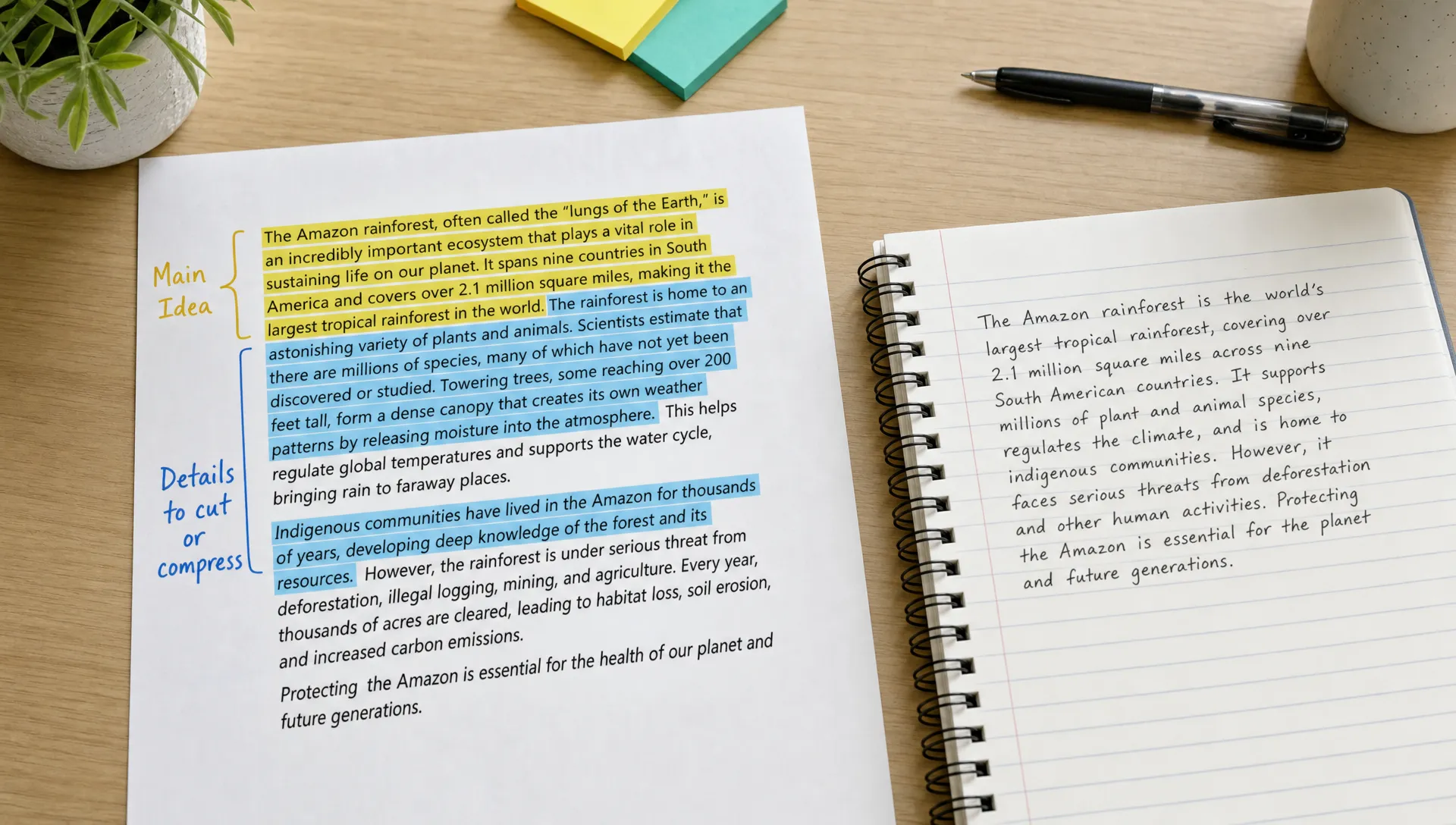
Example: shortening a paragraph without losing the point
Here is a practical before and after example.
Original paragraph:
Remote work has become more common across many industries, especially for roles that rely heavily on digital tools and independent tasks. While remote work can give employees more flexibility and reduce commuting time, it can also create communication challenges when teams do not have clear expectations. Without agreed norms around response times, meeting schedules, documentation, and decision-making, remote teams may experience confusion, duplicated work, or slower progress. For this reason, successful remote work depends less on location and more on deliberate communication habits.
Shortened paragraph:
Remote work can increase flexibility and reduce commuting, but it also requires clear communication norms. Without expectations for response times, meetings, documentation, and decisions, teams may face confusion or slower progress. Successful remote work depends less on location than on deliberate communication habits.
What changed?
The shortened version removes broad setup, compresses examples, and keeps the main idea: remote work succeeds when communication habits are intentional. It does not simply say remote work is good or bad, which would lose the point.
How much should you shorten a paragraph?
There is no universal ideal length. The right length depends on purpose.
A paragraph for a social post may need to be very short. A paragraph in a literature review may need more context. A paragraph in a business brief may need the conclusion first, followed by just enough evidence.
Use this guide:
| Use case | Good target | What to prioritize |
|---|---|---|
| Study notes | 1 to 3 sentences | Main idea and key terms |
| Executive brief | 2 to 4 sentences | Decision, result, implication |
| Research notes | 3 to 5 sentences | Claim, method, finding, limitation |
| Social post | 1 to 2 sentences | Clear takeaway |
| Slide text | 1 sentence or short fragment | One message per slide |
If you are shortening textbook material for studying, the goal is not to preserve every supporting detail. It is to make review easier. This is similar to the process explained in summarizing textbook chapters without rewriting everything, where the key is to capture structure and meaning instead of copying the source.
Common mistakes when shortening a paragraph
Shortening sounds simple, but a few mistakes can quietly weaken the result.
Mistake 1: Cutting the example that explains the idea
Examples can be unnecessary, but sometimes they make an abstract idea understandable. If the paragraph becomes vague after removing an example, keep a shorter version of it.
Original:
Cognitive load increases when learners must process too much information at once, such as reading dense text while also interpreting a complex diagram.
Weak shortened version:
Cognitive load increases when learners process too much information.
Better shortened version:
Cognitive load increases when learners process too much at once, such as dense text and a complex diagram together.
The better version keeps the example because it clarifies the concept.
Mistake 2: Removing qualifiers
Qualifiers protect accuracy. If a paragraph says a treatment may improve outcomes in some patients, do not shorten it to the treatment improves outcomes. That changes the claim.
This is especially important in research writing. If you often work with papers, it helps to use a structure that preserves the research question, method, findings, and limitations. This guide on summarizing a research article without going too shallow explains that balance in more detail.
Mistake 3: Keeping the first sentence automatically
The first sentence is not always the main sentence. Sometimes it is only a warm-up. If the paragraph begins with background and ends with the actual point, the shortened version should lead with the point.
Mistake 4: Making the paragraph shorter but harder to read
A shorter paragraph is not automatically clearer. If you compress too many ideas into one packed sentence, you may create a dense sentence that is technically shorter but mentally heavier.
Aim for clarity, not just word count.
How to shorten a paragraph with AI
AI tools can help you shorten paragraphs quickly, but the quality depends on your instructions and your review. If you simply paste a paragraph and say make it shorter, the result may remove context you needed or smooth over an important distinction.
A better prompt gives the tool a purpose, length, and preservation rule.
Try this prompt:
Shorten this paragraph to about 60 words. Keep the main idea, preserve important qualifiers, and remove repetition. Do not add new information. After the shortened version, list any details you removed.
For academic or technical writing, add:
Keep key terms, methods, limitations, and cause-and-effect relationships if they are necessary for accuracy.
For content repurposing, add:
Make it suitable for a newsletter intro while keeping the original meaning and tone.
This is where a reading companion such as unrav.io can be useful. You can paste text or open supported content like links, PDFs, YouTube videos, or podcasts, then reframe it depending on your goal, such as getting a quick grasp or turning the idea into a teachable explanation. That can help you understand the paragraph before deciding what to cut.
Still, do not treat AI output as final without checking it. AI can be helpful for compression and rewording, but you are responsible for whether the shortened version is accurate.
A simple formula you can use
When you are stuck, use this sentence formula:
Main idea + essential reason or evidence + important limitation or implication.
Example:
Original paragraph:
The city’s bike lane expansion was designed to reduce traffic congestion and make commuting safer for cyclists. Early transportation data suggests that bicycle use increased in neighborhoods where protected lanes were added, although the effect was smaller in areas with limited connections to major routes. The results indicate that bike lanes can support safer and more sustainable commuting, but their impact depends on how well they connect to the broader transportation network.
Shortened with the formula:
The bike lane expansion increased cycling in areas with protected lanes, suggesting it can support safer, more sustainable commuting. However, its impact was smaller where lanes did not connect well to major routes.
This version keeps the main idea, evidence, and limitation.
Quick checklist before you finalize
Before you use your shortened paragraph, run through this checklist:
- The main idea is still clear.
- The shortened version does not add new claims.
- Important qualifiers are still present.
- Repetition and filler are removed.
- Examples are kept only if they clarify the point.
- The tone still matches the original purpose.
- The paragraph is easier to read, not just shorter.
If the paragraph is part of an assignment, report, article, or research note, compare it with the surrounding text too. A paragraph can be strong on its own but awkward in context if it removes a needed transition.
Frequently Asked Questions
What is the fastest way to shorten a paragraph? Identify the main idea, remove repeated points, replace wordy phrases, and compress examples. Then compare the shorter version with the original to make sure the meaning has not changed.
How do I shorten a paragraph without making it vague? Keep the central claim plus the details that explain why it is true. Do not remove key terms, causes, limitations, or examples that make the idea understandable.
Can AI shorten a paragraph accurately? AI can help produce a shorter draft, but you should review it against the original. Give clear instructions about length, tone, and what must be preserved.
Should I rewrite the paragraph or just delete sentences? Usually, you should do both. Delete low-value content, then rewrite the remaining ideas so the shortened paragraph still flows naturally.
How short should a shortened paragraph be? It depends on the use case. Study notes may need 1 to 3 sentences, while research or business summaries may need more context. Short enough to be useful, but long enough to stay accurate.
The next step
To shorten a paragraph well, first understand it. Then cut with intention. Preserve the main idea, protect necessary context, and remove anything that does not help the reader grasp the point.
If you are shortening many paragraphs from articles, PDFs, research papers, or videos, it can help to use a tool that supports understanding before compression. unrav.io is built for that kind of workflow: turning complex material into clearer forms based on how you want to learn, study, explain, or reuse it.