
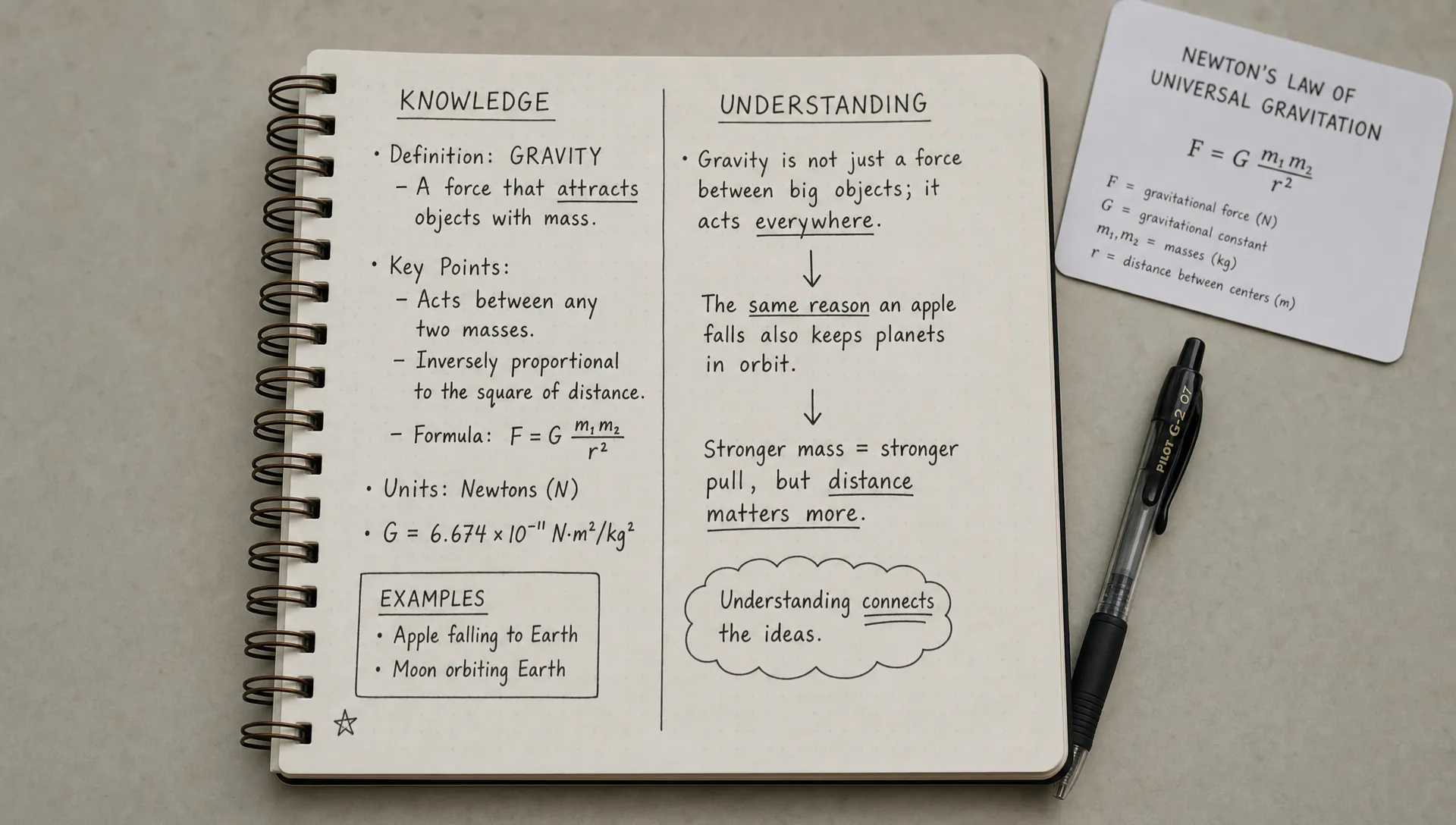
How Knowledge and Understanding Work Together
Knowledge and understanding are often used as if they mean the same thing. They do not.
You can know a definition, formula, date, framework or process without understanding what it really means. You can also feel that you understand a topic but lack enough knowledge to explain it accurately. Real learning happens when the two support each other: knowledge gives you the material to think with, and understanding helps you organize that material into meaning.
This distinction matters when you are reading research papers, studying for exams, analyzing reports, preparing lessons or turning dense content into notes. If you only collect facts, you may remember fragments but struggle to apply them. If you only chase “big picture” understanding, you may miss the details that keep your interpretation grounded.
The short version: knowledge gives you pieces, understanding shows how they fit
Knowledge is the information you can recall or recognize. It includes facts, terms, examples, methods, rules and evidence. Understanding is your ability to explain relationships, causes, limits and implications.
For example, in biology, knowledge might mean knowing that mitochondria produce ATP. Understanding means being able to explain why ATP matters, how cellular respiration works, what happens when energy production fails and how the idea connects to metabolism.
In academic reading, knowledge might mean knowing the author’s claim, the sample size and the method used. Understanding means being able to explain why the method was chosen, what the findings do and do not support, and how the paper fits into a wider debate.
The two are not competitors. Knowledge without understanding is brittle. Understanding without knowledge is vague.
What knowledge does in learning
Knowledge gives you the raw material for thought. You cannot compare theories, question evidence or build arguments if you do not know the basic terms, facts and examples in the field.
Background knowledge also makes new material easier to process. The National Academies report How People Learn II explains that learners interpret new information through what they already know. If your prior knowledge is thin, every sentence carries more burden. If your prior knowledge is stronger, you can focus less on decoding and more on meaning.
This is why beginners often need definitions, examples and summaries before they can think deeply about a topic. A student reading political theory may first need to know terms like sovereignty, legitimacy and social contract. A product manager reading a machine learning report may first need the meanings of precision, recall, training data and model drift.
Knowledge helps you:
- Recognize key terms and concepts
- Follow an argument without stopping every sentence
- Notice when something is missing or inconsistent
- Compare new material with what you already know
- Ask better questions because you have more reference points
Still, knowledge by itself can create a false sense of competence. You may recognize a concept in a textbook but fail to use it in a new problem. You may remember a quote but misunderstand the argument around it. That is where understanding takes over.
What understanding adds
Understanding turns information into a usable mental model. It helps you answer questions like “why does this matter?”, “how does this work?”, “when does this apply?” and “what would change if one part changed?”
If knowledge is a set of pieces on a table, understanding is the structure that makes the pieces meaningful. But the structure is not decorative. It helps you use what you know in situations that do not look exactly like the examples you studied.
A person who understands a topic can usually do several things:
- Explain it in their own words without copying the source
- Give an example and a non-example
- Identify assumptions or conditions
- Connect it to related ideas
- Apply it to a new case
- Notice where their explanation becomes uncertain
This is why summarizing alone is not always enough. A summary can tell you what a source says, but it may hide the reasoning that makes the source worth understanding. If that problem feels familiar, the article on how summarizing falls short without real understanding explains why a neat summary can still leave gaps in comprehension.
How knowledge and understanding reinforce each other
Knowledge and understanding work in a loop. You gather information, organize it, test it, notice gaps and gather better information. Each pass through the loop makes the next pass easier.
For instance, imagine you are reading about climate models. At first, you collect knowledge: greenhouse gases, radiative forcing, feedback loops, emissions scenarios and uncertainty ranges. Once you understand how those ideas relate, you can read a new report more efficiently. You know which details matter, which claims need evidence and which terms signal major assumptions.
The same pattern appears in many fields:
| Context | Knowledge looks like | Understanding looks like |
|---|---|---|
| Student learning statistics | Knowing formulas, terms and graph types | Explaining which test fits a question and why |
| Research reading | Knowing the hypothesis, method and findings | Judging what the paper supports and what it cannot prove |
| Professional analysis | Knowing market data, risks and recommendations | Seeing tradeoffs and explaining what decision the data informs |
| Content creation | Knowing source points and examples | Reframing the material for a specific audience or format |
| Teaching | Knowing the lesson content | Anticipating where learners will get confused |
The key is that knowledge gives you accuracy, and understanding gives you transfer. Accuracy keeps you from making things up. Transfer lets you use an idea beyond the page where you found it.
Why memorization is not the enemy
People often contrast memorization with understanding as if one is bad and the other is good. That framing is too simple.
Memorization is useful when it gives your mind stable handles. You do not want to look up every term in a research paper, every theorem in a proof or every command in a technical workflow. Some recall frees attention for deeper thinking.
The problem is not memorization. The problem is stopping at memorization.
If you memorize the definition of opportunity cost but cannot use it to analyze a business decision, your knowledge is inert. If you memorize the steps of a lab method but cannot explain why each step matters, you are likely to make mistakes when conditions change. If you memorize a historical date but cannot connect it to causes and consequences, the date floats alone.
A better approach is to use memorization as a foundation, then ask connecting questions. What does this fact explain? What does it depend on? Where would it fail? What else does it resemble? For more on this distinction, see the discussion of understanding beyond memorizing facts.
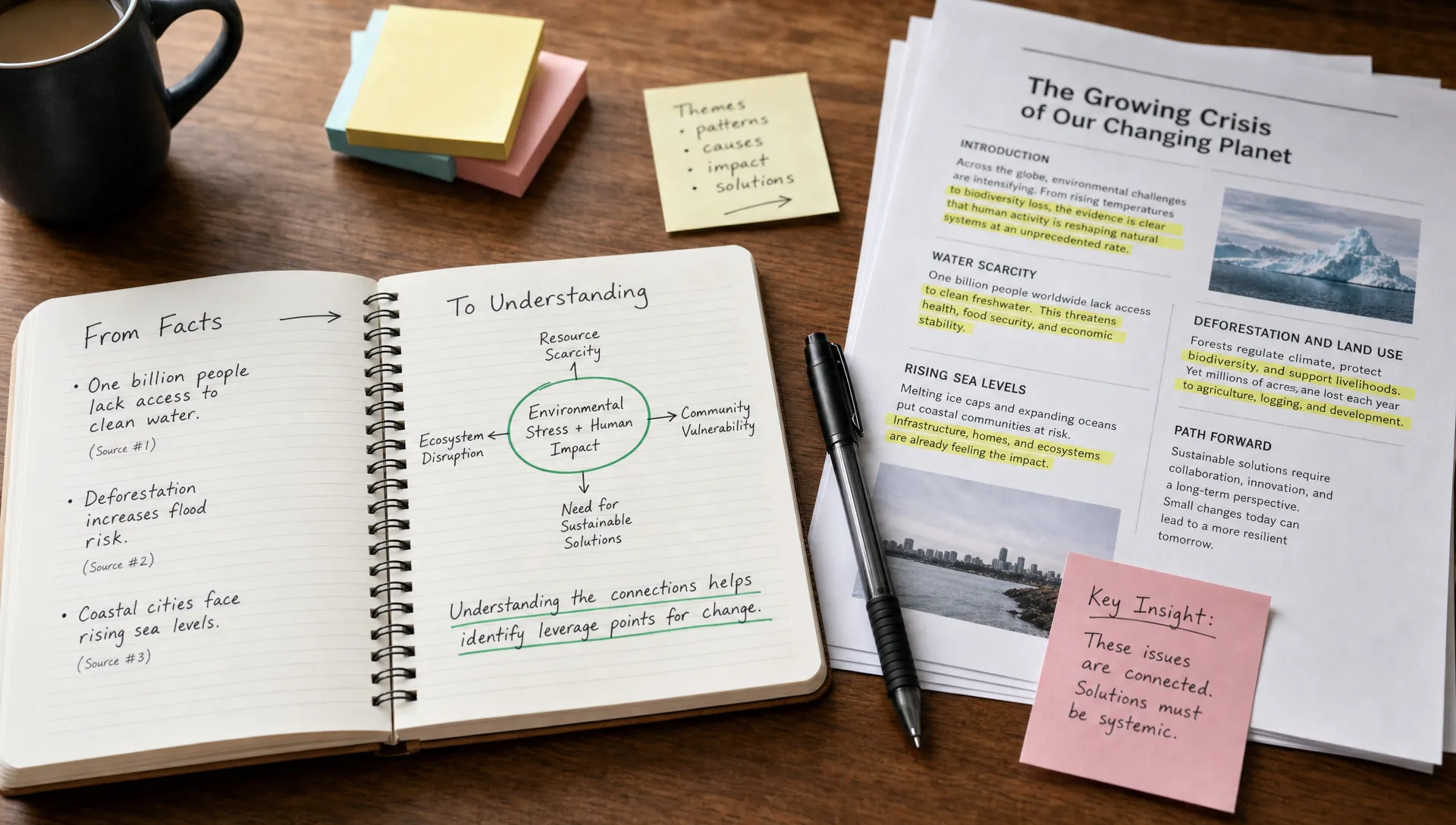
A practical loop for building both
If you are working through complex material, do not ask only “How do I remember this?” Ask “How do I build knowledge and understanding together?” The following loop works for students, researchers, professionals and creators.
Start with orientation
Before reading deeply, get a quick map of the material. Look at the title, abstract, headings, conclusion, figures, summary or transcript. Your goal is not mastery yet. It is to know what kind of source you are dealing with and what questions it may answer.
For a research paper, identify the research question, method and main claim. For a report, identify the decision context and key findings. For a video lecture, identify the topic sequence and examples.
This stage builds initial knowledge so the deeper reading has somewhere to attach.
Define the key terms
Dense material often becomes difficult because a few terms carry a lot of meaning. Write down the terms that appear repeatedly or seem essential to the argument.
Do not only copy definitions. Add a plain-language version and a simple example. If you are learning Bayesian reasoning, for example, “prior probability” becomes much easier when you can say, “This is what I believed before seeing the new evidence.”
Connect ideas, not just notes
Notes become more useful when they show relationships. Instead of writing disconnected bullet points, capture links between ideas: cause, contrast, sequence, evidence, exception and implication.
A concept map can help here, especially when the source is dense or interdisciplinary. If you want a more visual workflow, these concept map maker tips for complex topics and dense reading show how to represent relationships rather than just collect fragments.
Explain the idea from memory
After reading, close the source and explain the topic in your own words. You can write a short paragraph, record a voice note or teach it to someone else.
The point is not performance. It is diagnosis. If your explanation becomes vague, circular or dependent on exact phrases from the source, you have found a gap. Return to the material with that gap in mind.
Apply it to a new case
Understanding becomes stronger when you use an idea outside its original setting. If you read a theory, apply it to a different example. If you study a method, ask when it would not work. If you read a report, ask what decision would change if the conclusion were true.
This step separates recognition from usable comprehension. You are no longer asking, “Have I seen this before?” You are asking, “Can I work with it?”
Examples across common reading situations
The knowledge-understanding relationship looks different depending on your goal.
A student preparing for an exam needs enough knowledge to recall definitions, formulas and examples. But understanding is what allows them to solve unfamiliar questions. If every practice problem must look like the homework example, the student knows the procedure but may not understand the principle.
A researcher reading a paper needs knowledge of the literature, methodology and terminology. But understanding is what allows them to evaluate the paper’s contribution. They need to see why a method was used, what assumptions shape the findings and how the paper compares with other work.
A professional reading an industry report needs to know the numbers, risks and recommendations. But understanding means translating those points into decisions. Which risks are material? Which assumptions are uncertain? Which recommendation depends on a condition that may not hold?
A creator repurposing a long article into a newsletter, script or lesson needs to know the source accurately. But understanding is what lets them change the format without distorting the meaning. They must know what can be simplified, what needs context and what should not be overstated.
An educator preparing to teach a topic needs both. Knowledge keeps the lesson accurate. Understanding helps them sequence ideas, choose examples and anticipate misconceptions.
How AI tools can support the loop without replacing your judgment
AI can be useful when it helps you move between knowledge and understanding. A good reading workflow might use AI to generate an initial overview, explain unfamiliar terms, reframe a section in simpler language or turn a transcript into study questions.
But AI output should be treated as a learning aid, not a substitute for thinking. It can help you see structure faster, but you still need to verify claims, check the source and decide whether the explanation fits your purpose.
This is where a tool like unrav.io can fit naturally. It is designed as an AI-powered reading companion for articles, PDFs, videos, podcasts and pasted text. Instead of only producing a short summary, it can help you look at the same content through different thinking modes, such as a quick grasp when you need orientation or a teach-it style when you want to test whether the material can be explained clearly.
Used well, this kind of tool supports the loop: orient, clarify, connect, explain and revisit. The goal is not to avoid reading. The goal is to read with better scaffolding.
Common mistakes that separate knowledge from understanding
One mistake is highlighting too much. Highlighting can feel productive because it marks information, but it does not guarantee that you have processed the meaning. A useful rule is to write a short note beside any highlight explaining why it matters.
Another mistake is collecting summaries without returning to the source. Summaries are excellent for orientation and review, but if the original argument is complex, you may need to inspect the evidence, definitions and caveats yourself.
A third mistake is confusing fluency with comprehension. If a sentence sounds familiar, you may feel you understand it. To test that feeling, explain the idea without the original wording. Then apply it to a new example.
Finally, learners often avoid gaps because gaps feel uncomfortable. In reality, a gap is useful information. It tells you where to reread, ask a better question, find an example or slow down.
A simple self-check
When you finish a source, ask five questions:
- What are the three most important things I now know?
- How do those things connect to each other?
- What example could I use to explain the main idea?
- What part am I least sure about?
- Where could I use this idea outside the original source?
If you can answer these clearly, knowledge and understanding are starting to work together. If not, you do not need to start over. You need a more targeted pass through the material.
Frequently Asked Questions
What is the difference between knowledge and understanding? Knowledge is the information you can recall, such as facts, terms, examples and procedures. Understanding is the ability to explain how those pieces relate, why they matter and how to use them in new situations.
Can you have knowledge without understanding? Yes. You can memorize a definition or repeat a claim without knowing how to apply it, explain it or connect it to other ideas. This is common when studying relies only on rereading, highlighting or flashcards.
Can you understand something without knowledge? Only in a limited way. You may grasp the general idea, but without enough facts, terms and examples, your understanding can become vague or inaccurate. Strong understanding needs a base of reliable knowledge.
How do I improve both at the same time? Use a loop: preview the source, define key terms, connect ideas, explain the topic from memory, apply it to a new case and revisit gaps. This builds recall and meaning together.
Are summaries useful for understanding? Yes, summaries are useful for orientation and review. They become a problem only when they replace deeper engagement with the source, especially when reasoning, evidence or nuance matters.
The next step is to make learning active
Knowledge and understanding work together when you stop treating reading as simple intake. Collect the facts, but also organize them. Learn the terms, but also explain the relationships. Use summaries, but also test whether you can apply the ideas yourself.
The next time you read a difficult paper, report, article or transcript, try one extra step after summarizing it: explain the main idea in your own words and name one place where you could use it. That small shift turns information into something more durable and useful.