
How AI Can Summarize an Article Without Losing Nuance
AI can summarize an article without losing nuance, but only if you stop treating summarization as a single command.
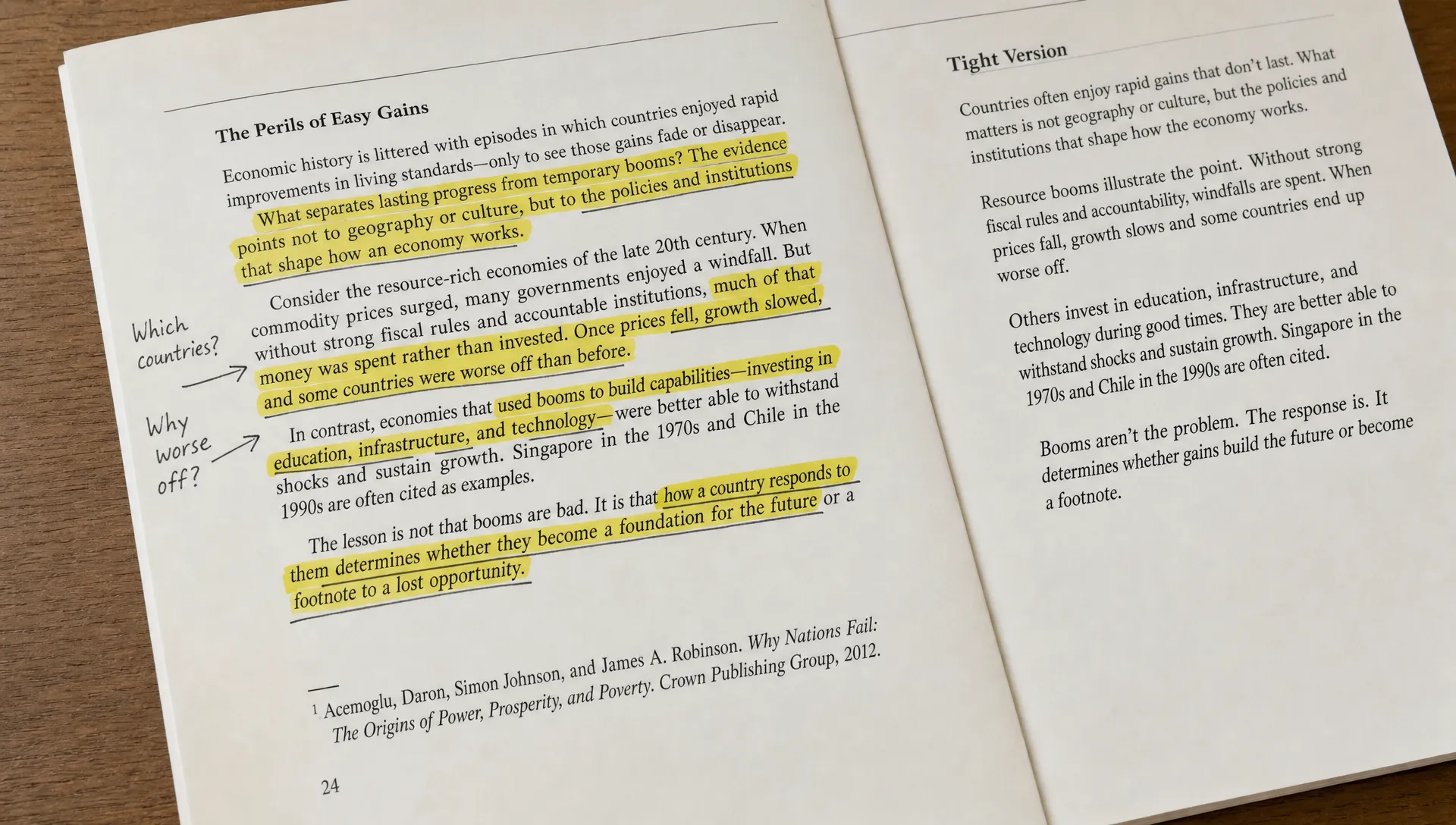
A plain request like summarize this article usually produces a shorter version, not necessarily a better understanding. It may compress the author's argument, remove uncertainty, skip the evidence and turn a careful piece of writing into a generic takeaway. That is useful when you only need orientation. It is risky when you need to study, cite, brief a team or create something based on the article.
The better approach is to use AI as a reading companion: first identify what the article is doing, then decide what kind of summary you need, then check whether the important qualifications survived the compression.
This guide explains how AI can summarize an article while preserving nuance, where AI summaries often go wrong and how to prompt for outputs that keep the author's point intact.
What nuance means in an article summary
Nuance is not just extra detail. In a good article summary, nuance is the difference between what the author actually argued and what the topic sounds like after it has been simplified too aggressively.
A nuanced summary usually preserves:
- The main claim, not just the topic
- The reasoning behind the claim
- The type and strength of evidence used
- Important caveats, exceptions and limitations
- The author's level of certainty
- Competing views or unresolved tensions
- The context that changes how the conclusion should be interpreted
For example, an article about remote work might not simply argue that remote work is good or bad. It might argue that remote work improves focus for experienced employees but can weaken onboarding for new hires unless teams design better communication rituals. A weak summary would flatten that into remote work increases productivity. A better summary would preserve the conditions and tradeoffs.
That distinction matters for students writing reading responses, researchers comparing arguments, professionals preparing briefs and creators repurposing long articles into accurate scripts or newsletters.
Why basic AI summaries lose nuance
Most AI summarization failures come from the same basic problem: the model is asked to compress before it has been asked to understand the article's structure.
A short summary has limited space, so the AI has to choose what to remove. If the prompt does not tell it what to protect, it often removes the very parts that carry nuance: qualifiers, examples, counterarguments, methodological limits and tonal signals.
This is why a summary can sound fluent and still be misleading. It may keep the conclusion but drop the conditions under which that conclusion holds. It may turn a cautious claim into a confident one. It may merge the author's view with the evidence, even when the article distinguishes between data, interpretation and speculation.
Long articles add another challenge. Even when models can accept large inputs, they may not use every part of the text equally well. The 2023 paper Lost in the Middle by Nelson F. Liu and coauthors showed that language models can struggle to use relevant information placed in the middle of long contexts. Models have improved since then, but the practical lesson remains useful: do not assume that a single long prompt will preserve every important detail.
If you want a deeper explanation of why a quick summary can create the illusion of understanding, unrav.io has a related guide on how summarizing falls short without real understanding.
The difference between shortening and summarizing well
Shortening removes words. Summarizing well changes the form of the information while keeping the article's intellectual shape.
A good AI summary should answer several questions at once. What is the article about? What is the author trying to convince the reader of? What evidence supports that view? What should the reader not overstate? What remains uncertain?
Those questions are different depending on your goal. A student may need a summary that supports recall before an exam. A researcher may need a summary that captures the method and limitations. A product manager may need the practical implications for a decision. A content creator may need the article's argument, examples and possible angles for repurposing.
| Summary goal | Best AI output | Nuance to preserve |
|---|---|---|
| Quick orientation | A short overview of the article's topic and main point | Scope, tone and what the article is not claiming |
| Study notes | A structured explanation with key ideas and definitions | Relationships between concepts and likely exam relevance |
| Research review | A claim, evidence and limitation breakdown | Method, assumptions, findings and uncertainty |
| Work brief | A decision-ready summary for a team or stakeholder | Risks, constraints, tradeoffs and action implications |
| Content repurposing | An outline, script angle or newsletter draft | Author intent, examples and original context |
The same article can support all of these outputs, but not from the same prompt. The clearer your purpose, the less likely the AI is to flatten the text.
A practical workflow for nuance-preserving AI summaries
The most reliable way to use AI to summarize article content is to summarize in stages. Each stage protects a different part of the article from being lost.
Step 1: Define the job of the summary
Before pasting an article into an AI tool, decide what the summary is for. Do you need to understand the argument, prepare for discussion, extract citations, brief a colleague or create notes for later?
A useful prompt starts with the reader's goal:
I am summarizing this article for a graduate seminar. Focus on the author's thesis, supporting reasoning, key evidence, limitations and questions for discussion. Do not turn cautious claims into definitive claims.
For a professional brief, the same article might need a different instruction:
Summarize this article for a product team. Focus on the practical implications, assumptions, risks, examples and decisions this could affect. Keep the author's caveats visible.
The goal tells the AI what to preserve.
Step 2: Ask for an argument map before the final summary
Do not jump straight to the polished summary. First ask the AI to identify the article's structure.
A good argument map includes the central claim, supporting points, evidence, counterpoints and conclusion. This intermediate step helps you see whether the AI has understood the article before it compresses it.
Try this:
Before summarizing, map the article's argument. Identify the main claim, supporting claims, evidence, examples, caveats, counterarguments and final conclusion. If the article is uncertain or balanced, show that uncertainty.
Once you have the map, you can ask for a shorter summary based on it. This gives you a better chance of keeping the article's logic intact.
Step 3: Summarize in layers
A single summary length is rarely enough. Start broad, then add depth where needed.
For example, you might ask for a 3 sentence overview, then a 200 word summary, then a section-by-section breakdown. The short version helps you orient yourself. The longer version preserves reasoning. The section breakdown catches details that a compact summary may omit.
This is especially useful for dense material such as essays, policy reports and academic articles. If your source is a paper rather than a general article, you may want a more specialized process like the one in unrav.io's guide to summarizing a research paper without losing the point.
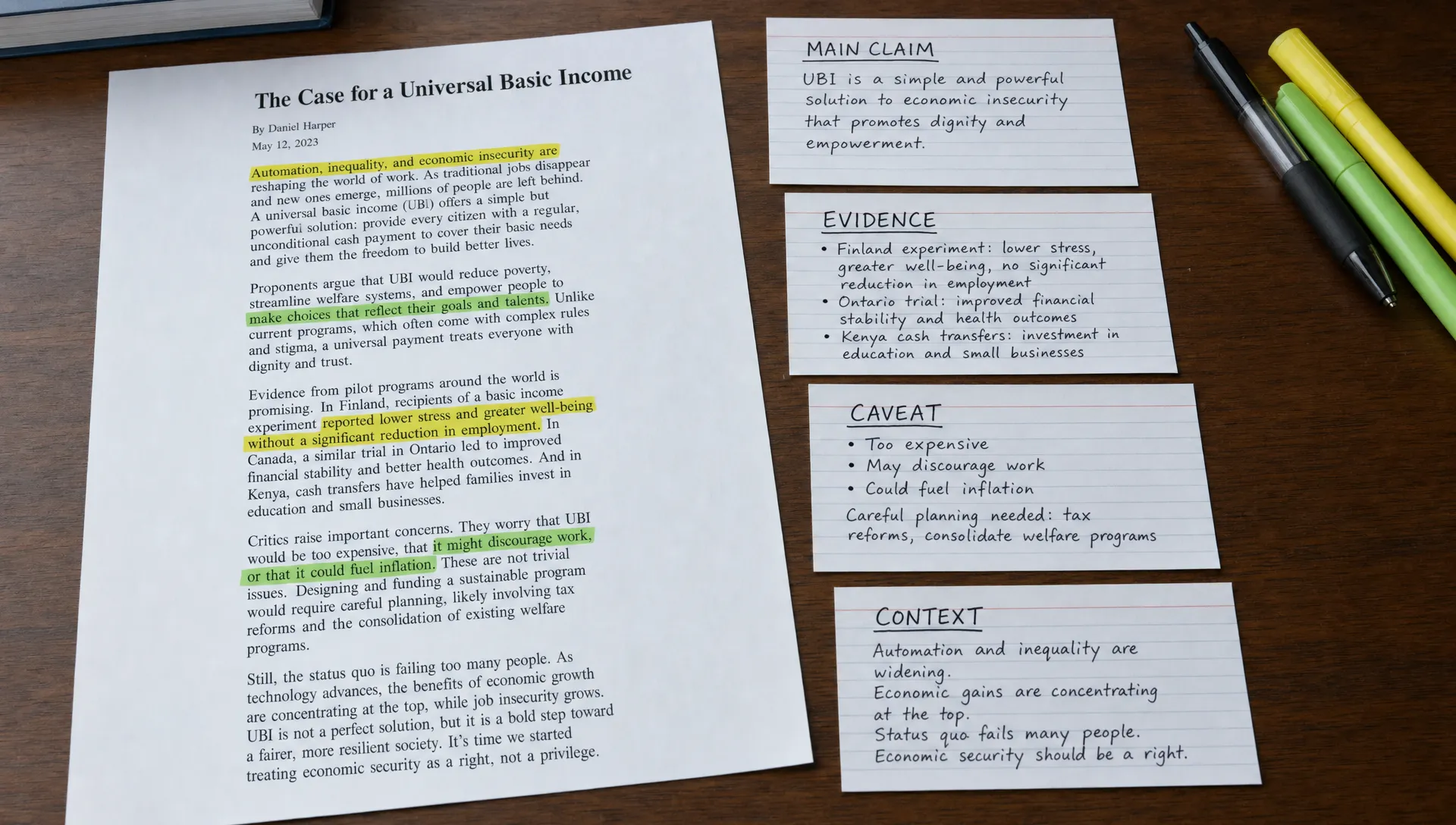
Step 4: Force separation between claim, evidence and interpretation
Many poor summaries blend together what the author says, what the evidence shows and what the AI thinks follows from it. That can produce a confident-sounding summary that is not faithful to the article.
Ask the AI to separate these layers:
Create a summary with three sections: what the author claims, what evidence or examples are used and what conclusions or implications the author draws. Do not add implications that are not supported by the article.
This format is useful for researchers, analysts and students because it reduces the risk of treating interpretation as fact.
Step 5: Ask for a nuance check
After the AI produces a summary, ask it what may have been lost. This is one of the simplest ways to improve the result.
Use a prompt like this:
Review the summary against the original article. What caveats, exceptions, uncertainties, examples or counterarguments were removed? Revise the summary so the most important nuance is restored without making it much longer.
This works because the first summary is often optimized for brevity. The second pass is optimized for fidelity.
Step 6: Verify against the source
AI can help you read faster, but it should not be the final authority when accuracy matters. Always compare the summary with the original article before using it in a paper, client memo, classroom discussion or public content.
Check the headline, introduction, section headings, conclusion and any passages the AI marked as important. If the article includes data, quotes or technical claims, inspect those directly in the source. For academic or legal material, do not rely on the summary alone.
Prompts that help AI keep nuance
A better prompt does not need to be complicated. It just needs to tell the AI what kind of understanding you want.
Here is a general-purpose prompt for articles:
Summarize the article in clear language. Preserve the author's main claim, reasoning, evidence, examples, caveats and tone. Distinguish between what the article states, what it implies and what remains uncertain. Avoid overgeneralizing.
Here is a shorter prompt for busy professionals:
Give me a concise but nuanced brief. Include the main point, why it matters, key evidence, risks, limitations and practical implications.
Here is a prompt for students:
Turn this article into study notes. Include the thesis, key concepts, supporting arguments, important examples, possible exam questions and areas where the author is cautious or uncertain.
Here is a prompt for creators:
Summarize this article for repurposing. Keep the author's argument accurate, list the strongest examples, identify possible content angles and flag any nuance that should not be simplified in a script or post.
The pattern is the same in each case: name the output, name the audience and name the nuance you want preserved.
Example: shallow summary vs nuanced summary
Imagine an article arguing that AI tools can improve student learning when they are used for feedback, explanation and revision, but can weaken learning when students use them to bypass thinking.
A shallow summary might say:
AI helps students learn faster and improves education.
That version is short, but it loses the article's actual point. It removes the condition, the risk and the distinction between helpful and harmful use.
A nuanced summary would say:
The article argues that AI can support student learning when it is used to explain difficult ideas, provide feedback and help students revise their thinking. However, the author warns that learning gains depend on how the tool is used. If students use AI to skip reading or outsource their reasoning, it may reduce understanding rather than improve it.
The second version is only a little longer, but it is much more faithful. It keeps the claim, the mechanism and the caution.
When AI summaries are most useful
AI summaries are strongest when they help you move from information overload to structured reading. They can give you orientation before reading, produce a first-pass outline, extract recurring themes and help convert an article into useful notes.
They are especially useful for:
- Long essays where you need the argument before reading closely
- Industry reports where you need decisions, risks and implications
- Academic papers where you need the research question and limitation quickly
- News analysis where tone and uncertainty matter
- Content research where you need examples, angles and takeaways
They are less reliable when the article is highly technical, heavily mathematical, legally sensitive or dependent on exact wording. In those cases, use the AI summary as a map, not as a replacement for the territory.
If your goal is to build a reusable knowledge system, the next step is not only summarizing but turning the article into notes. The guide on turning articles into notes for work or study explains how to make summaries easier to review and apply later.
How unrav.io fits into this workflow
unrav.io is built around the idea that understanding is not the same as shortening. You can use it as an AI-powered reading companion for articles, PDFs, pasted text, YouTube videos and podcasts, then reframe the same source through different lenses depending on your goal.
That matters because nuance often appears when you look at the same material more than one way. A quick grasp mode can help you orient yourself. A deeper explanation can help you follow the reasoning. A teach-it mode can make the material easier to explain to someone else.
For students, that can mean turning assigned readings into clearer study material. For researchers, it can mean separating a paper's claim, method and limitation. For professionals, it can mean moving from a long article to a useful brief. For creators, it can mean repurposing an article without stripping out the original argument.
The tool does not remove the need to think. It helps you see the structure of the content faster so you can decide where to read more closely.
Frequently Asked Questions
Can AI summarize an article accurately? AI can create useful article summaries, especially when the prompt is specific and the source is clear. Accuracy still depends on checking the summary against the original, particularly for technical, academic or high-stakes material.
How do I stop AI from oversimplifying an article? Ask the AI to preserve claims, evidence, caveats, uncertainty and counterarguments. A nuance check after the first summary also helps restore important details that were removed for brevity.
Is a longer AI summary always better? Not necessarily. A longer summary can still be vague if it repeats general ideas. A good summary is long enough to preserve the article's argument, evidence and limitations, but short enough to be useful.
Should I read the original article after using AI? If the article matters for a paper, decision, presentation or published work, yes. Use the AI summary to orient yourself, then read the key sections of the original more carefully.
What is the best prompt for using AI to summarize article text with nuance? A strong prompt names the purpose, audience and details to preserve. For example: summarize the article for a class discussion, keep the thesis, evidence, examples, caveats, counterarguments and uncertainty visible.
Try a more thoughtful way to summarize articles
The best AI summaries do not simply make articles shorter. They help you keep the author's point, reasoning and limitations in view while reducing the time it takes to understand the material.
If you want to practice this workflow, try opening an article, PDF, video or pasted text in unrav.io. Start with a quick grasp, then use another lens to explore the argument, explain it in simpler terms or turn it into notes. The aim is not to skip thinking, but to make complex content easier to work with.