
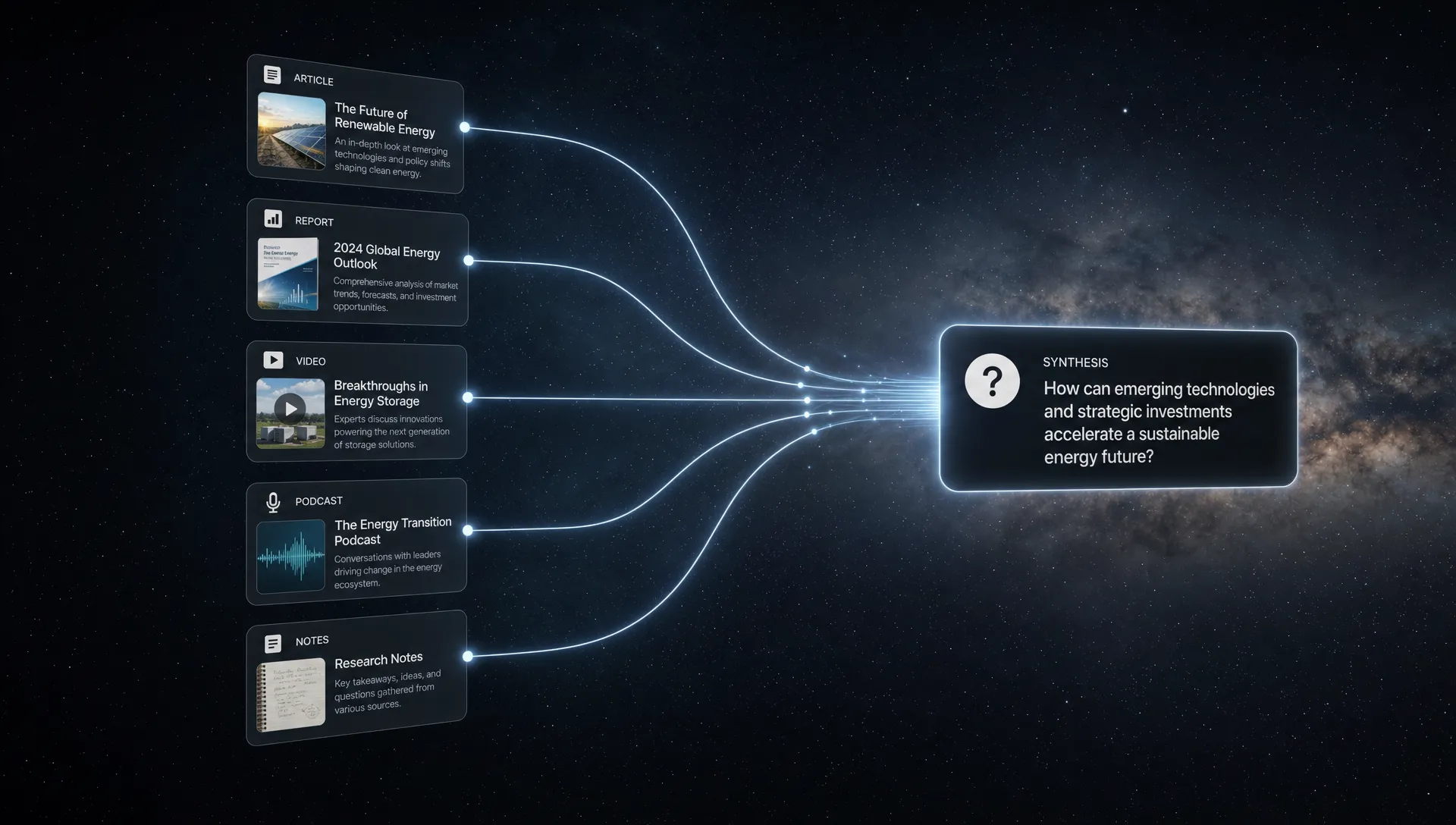
Build Holistic Understanding From Multiple Sources
When a topic is spread across papers, reports, videos, podcasts, expert commentary and your own notes, understanding becomes harder than reading one source well. Each source gives you a piece of the picture, but the pieces rarely line up neatly.
You may finish with many highlights and summaries, yet still struggle to answer simple questions: What matters most? Which sources agree? Where do they disagree? What explains the disagreement? What should I believe, question or investigate next?
That is where holistic understanding matters. It is the ability to see a topic as a connected whole, not as a pile of separate facts. For students, it turns readings into exam-ready insight. For researchers, it helps compare methods and findings. For professionals, it turns reports into decisions. For creators and educators, it turns scattered material into clear explanations.
This guide gives you a practical workflow for building holistic understanding from multiple sources without drowning in notes.
What holistic understanding means
Holistic understanding means you can explain how the parts of a topic relate to each other. You do not only know what each source said. You understand the structure behind the information: the main concepts, causes, evidence, assumptions, tradeoffs, gaps and consequences.
For example, if you are learning about climate adaptation in cities, a narrow reading might leave you with separate notes about heat islands, flood planning, infrastructure costs and policy incentives. A holistic understanding lets you explain how those issues interact. Heat risk affects housing policy. Infrastructure costs shape political feasibility. Flood planning depends on both engineering data and community trust.
In other words, the goal is not to collect more information. The goal is to connect information into a usable mental model.
If you want a deeper explanation of the difference between collecting facts and making meaning from them, unrav.io has a helpful guide on how knowledge and understanding work together.
Why multiple sources make understanding harder
Multiple sources improve learning because they expose you to different evidence, viewpoints and levels of detail. They also create friction. Each source has its own vocabulary, assumptions and purpose. A research paper may define a term narrowly, while a podcast guest uses the same term loosely. A company report may emphasize business impact, while an academic review focuses on methods and limitations.
This mismatch is not a problem to avoid. It is the material you need to think with.
The mistake is treating every source as if it should produce the same kind of notes. A dense PDF, a lecture video, a news article and a technical report serve different roles in your understanding. You need to know what each source is good for and what it cannot give you.
| Source type | What it can contribute | What to watch for |
|---|---|---|
| Research paper | Methods, evidence, limitations, precise definitions | Narrow scope, technical language, uncertain generalization |
| Review article | Patterns across studies, major debates, research gaps | Simplification of individual studies |
| Report or white paper | Practical implications, market or policy context | Organizational bias, selective framing |
| Lecture or video | Intuitive explanation, examples, sequence of ideas | Missing citations, oversimplified claims |
| Podcast or interview | Expert reasoning, current debates, lived context | Anecdotes presented as broad evidence |
| Textbook or guide | Foundational concepts and stable frameworks | May be less current than recent papers |
A summary can help you start, but it should not be the endpoint. Summaries often hide reasoning, uncertainty and disagreement. If you rely only on compressed versions of complex sources, you may feel informed without being able to reconstruct the argument. That problem is explored in more detail in this article on why summarizing falls short without real understanding.
Start with a synthesis question
Before reading across sources, define the question your sources are supposed to help answer. Without a question, every detail feels potentially relevant. With a question, you have a filter.
A good synthesis question is specific enough to guide reading but broad enough to allow connections. Instead of asking, What is machine learning?, ask, How does machine learning change the way hospitals predict patient risk, and what are the main limitations? Instead of asking, What is remote work?, ask, What conditions make remote work effective for knowledge teams?
Different audiences need different synthesis questions:
- Students might ask how several assigned readings explain the same theory differently.
- Researchers might ask whether studies agree because their evidence is strong or because they share the same assumptions.
- Professionals might ask what several reports imply for a decision, risk or strategy.
- Creators might ask which ideas from a long source set can become a newsletter, video outline or teaching module.
Write the question at the top of your notes. Then return to it after each source. If the question changes as you learn, revise it. That revision is often a sign that your understanding is getting sharper.
Build a balanced source set
A strong source set does not mean the longest possible reading list. It means you have enough variety to see the topic from different angles.
For most learning or research tasks, aim for a mix of foundation, evidence, interpretation and application. Foundation sources explain key concepts. Evidence sources show data or methods. Interpretation sources compare views. Application sources show how the idea appears in practice.
You also need to check whether your sources are independent from each other. Five articles that all cite the same original study may look like five sources but function like one. For evaluating online sources, Mike Caulfield's SIFT method is a useful habit: stop, investigate the source, find better coverage and trace claims back to their original context.
You do not need perfect coverage before you start. Begin with a reasonable set, then add sources only when you discover a gap. A common workflow is to start with one overview, two or three primary sources, one critical perspective and one practical example.
Read for structure before detail
When people feel behind, they often read harder. For multi-source understanding, reading harder is less useful than reading in passes.
Your first pass should locate the structure of each source. Identify the main claim, the evidence used to support it, the assumptions behind it and the audience it was written for. Do not highlight every interesting sentence yet. You are building a map of the source, not mining it for quotes.
For a research paper, look at the abstract, introduction, methods, results, discussion and limitations. For a report, study the executive summary, section headings, charts and conclusion. For a video or podcast, note the sequence of claims and examples. With unrav.io, you can use different thinking modes to reframe articles, PDFs, YouTube videos, podcasts or pasted text depending on whether you need a quick grasp, deeper insight or a teachable explanation.
This first pass reduces cognitive load. Once you know what role a source plays, details become easier to place.
Extract comparable notes from each source
The fastest way to lose the thread is to take different kinds of notes for every source. One source gets quotes. Another gets a summary. Another gets random highlights. By the end, you have notes that cannot be compared.
Use a repeatable note template instead. Keep it short enough that you will actually use it.
| Note field | What to capture |
|---|---|
| Main claim | What the source is mainly arguing or explaining |
| Key evidence | The data, examples, reasoning or references that support the claim |
| Scope | What the source covers and what it leaves out |
| Assumptions | What the author seems to take for granted |
| Useful terms | Definitions, keywords or concepts you need to track |
| Tension points | Where the source conflicts with, complicates or improves another source |
| Your takeaway | What this source changes in your understanding |
This template works because it keeps your notes aligned. You are not just saving information. You are preparing sources to talk to each other.
Separate claims, evidence and interpretation
Many readers merge three different things into one note: what a source claims, what evidence it provides and what they personally think it means. That makes synthesis messy.
Keep those layers separate. A claim is the position or conclusion. Evidence is what supports it. Interpretation is the meaning you draw from it. When sources disagree, this separation helps you see where the disagreement actually lives.
Two sources may agree on the data but interpret it differently. Two authors may agree on the problem but recommend different solutions because they value different outcomes. A study and a policy report may appear to conflict, but one is asking whether an intervention works and the other is asking whether it can be implemented affordably.
This distinction is especially useful for technical readers and researchers. It prevents you from treating every disagreement as a contradiction and helps you identify whether the issue is evidence, method, definition, scope or values.
Map relationships among ideas
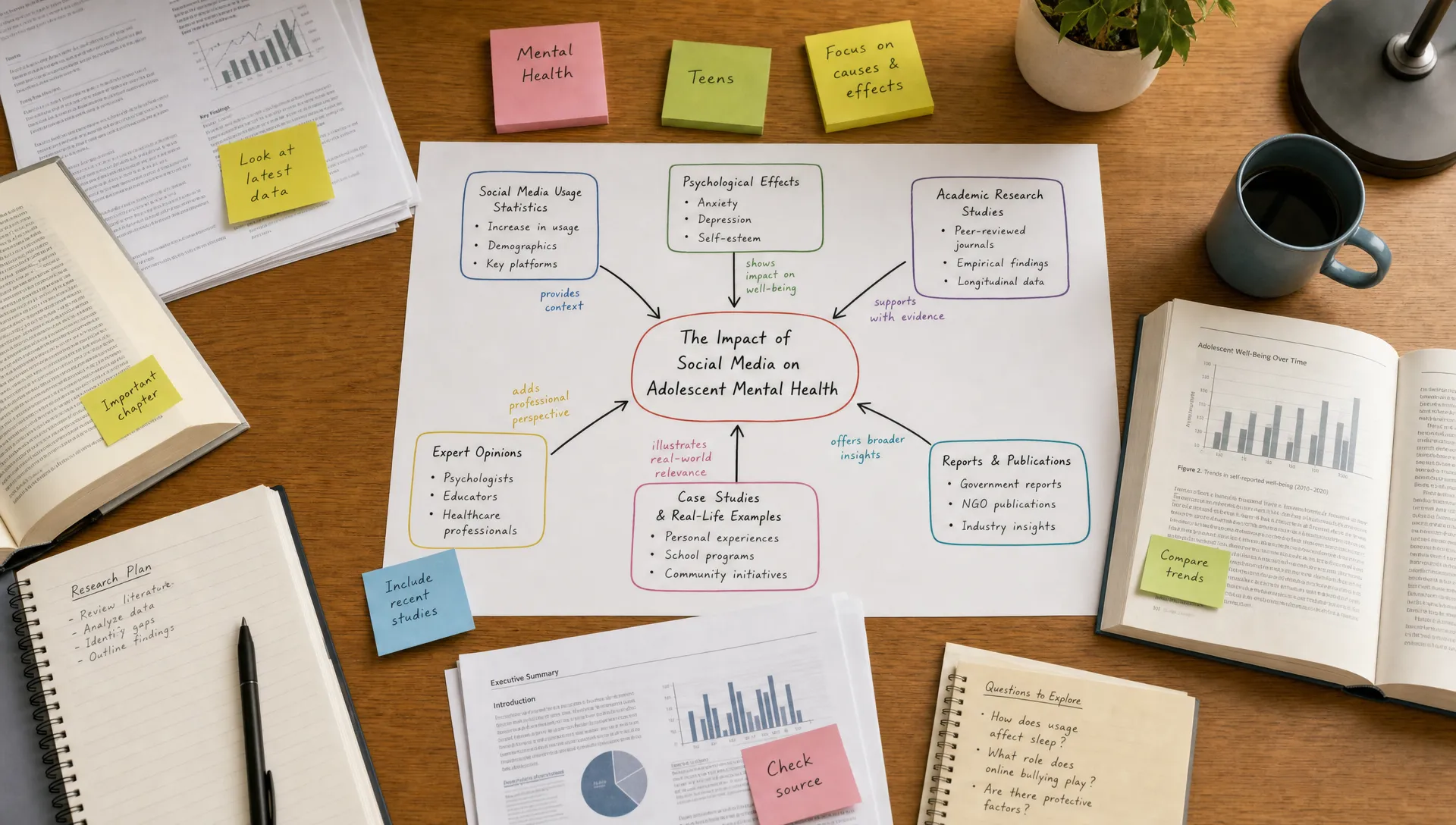
Holistic understanding depends on relationships. Linear notes are useful for capturing a source in order, but they often hide connections across sources. A concept map, argument map or simple relationship table can make those connections visible.
Start with the central topic in the middle. Around it, place the major concepts that keep recurring. Then connect ideas with relationship labels such as causes, depends on, contradicts, supports, limits, defines or applies to. The labels matter because they force you to name the nature of the connection.
For example, if you are studying misinformation, your map might connect platform design to attention incentives, attention incentives to sharing behavior, sharing behavior to social trust and social trust to public health outcomes. A single article might mention only two of those links, but several sources together reveal the wider system.
If your topic is too complex for linear notes, these concept map maker tips for complex topics and dense reading can help you turn source notes into a clearer structure.
Look for agreement, disagreement and gaps
Once you have comparable notes, review the sources side by side. Your goal is not to declare one winner too quickly. Your goal is to understand the pattern.
Agreement can mean a claim is well supported, but it can also mean your sources are drawing from the same evidence base. Disagreement can mean one source is wrong, but it may also reveal different methods, definitions or contexts. Gaps show what none of your sources explain well.
A simple comparison table can clarify the pattern:
| Question | Source A | Source B | Source C | Your synthesis |
|---|---|---|---|---|
| What is the main cause? | Emphasizes incentives | Emphasizes culture | Emphasizes regulation | The causes interact, but incentives appear most actionable |
| What evidence is used? | Case studies | Survey data | Legal analysis | Evidence types answer different parts of the question |
| What is missing? | User perspective | Long-term outcomes | Technical constraints | Need a source focused on implementation and user behavior |
This kind of matrix is especially useful when writing a literature review, preparing a briefing, planning a lesson or creating a content outline. It turns a stack of sources into a field of relationships.
Rewrite the topic in layers
After comparing sources, write your synthesis at several levels of detail. This forces you to move between the big picture and the evidence.
Begin with one sentence. Then write one paragraph. Then write a structured explanation with sections. If you cannot compress the topic, you may not yet know what matters most. If you cannot expand it with evidence, your big picture may be too vague.
Try four layers:
- One-sentence version: The topic in its simplest useful form.
- One-paragraph version: The core idea, main tension and why it matters.
- Teaching version: An explanation with examples for someone new to the topic.
- Expert version: A version that includes methods, uncertainty, definitions and limitations.
This layered rewriting works for many goals. Students can turn it into study notes. Researchers can use it to draft literature review sections. Professionals can turn it into an executive brief. Creators can turn it into scripts, threads, newsletters or course material.
Test whether your understanding is actually holistic
The final step is to test your understanding, not just admire your notes. Recognition feels easy when the sources are in front of you. Understanding shows up when you can use the material in a new context.
Try explaining the topic without looking at your notes. Then check what you missed. Next, explain how two sources relate to each other. Do they support the same claim? Do they use different evidence? Does one expose a limitation in the other?
You can also test your understanding by applying it to a case. If you studied a policy debate, apply the ideas to a different country, institution or time period. If you studied a technical concept, explain what would happen if one assumption changed. If you studied a market trend, describe what evidence would weaken your conclusion.
Strong holistic understanding usually passes three tests: you can explain the topic simply, you can defend the explanation with evidence and you can name what remains uncertain.
How unrav.io fits into a multi-source workflow
AI tools should not replace careful reading, especially for academic, legal, medical or high-stakes professional work. They can, however, make the reading process easier to manage.
unrav.io is built around comprehension rather than simple summarization. You can use it to work through articles, PDFs, YouTube videos, podcasts, links or pasted text, then reframe the content depending on your goal. A quick grasp can help you orient yourself before reading closely. A deeper mode can help you examine reasoning and implications. A teach-it mode can help you turn dense material into an explanation you can actually use.
A practical workflow might look like this: use unrav.io to get an initial grasp of each source, create comparable notes using your own template, map the relationships manually or visually, then return to the original sources whenever a claim matters. The tool speeds up orientation and reframing, but you remain responsible for judgment, citation, context and final interpretation.
Common mistakes to avoid
The first mistake is collecting too many sources before forming a question. More material does not automatically create better understanding. It often creates more noise.
The second mistake is summarizing each source in isolation. Isolated summaries are easier to produce than synthesis, but they do not show how ideas relate. After every source, ask how it changes, challenges or supports what you already thought.
The third mistake is ignoring uncertainty. Holistic understanding includes the limits of what you know. If your synthesis has no caveats, scope conditions or open questions, it may be too smooth.
The fourth mistake is treating visual maps as decoration. A map is useful only if it helps you name real relationships. Pretty notes are not the same as connected thinking.
Frequently Asked Questions
What is holistic understanding? Holistic understanding is the ability to see how facts, claims, evidence, assumptions and examples connect into a larger whole. It goes beyond knowing what each source says by helping you explain how the sources relate.
How many sources do I need to build holistic understanding? There is no fixed number. For a small assignment, three to five well chosen sources may be enough. For research or professional analysis, you may need more. Quality, variety and relevance matter more than volume.
Is summarizing multiple sources enough? Summarizing is a useful first step, but it is not enough by itself. To build understanding, compare sources, identify patterns, trace evidence, note disagreement and produce your own synthesis.
How do I handle sources that contradict each other? First identify the exact point of disagreement. Then check whether the sources use different definitions, methods, evidence, time frames or assumptions. Contradiction often becomes clearer once you separate claims from evidence and interpretation.
Can AI help me understand multiple sources? AI can help you grasp, reframe and organize complex material faster. It should still be paired with your own reading, source checking and judgment, especially when accuracy and nuance matter.
Build your next synthesis deliberately
Holistic understanding is not a talent you either have or lack. It is a workflow. Start with a clear question, choose a balanced source set, extract comparable notes, map relationships, compare patterns and rewrite the topic in your own words.
The next time you face a long reading list, a folder of PDFs or several hours of video and podcast material, do not try to remember everything. Try to connect what matters. If you want help turning complex sources into clearer views, you can use unrav.io as a reading companion while keeping your own judgment at the center of the process.