
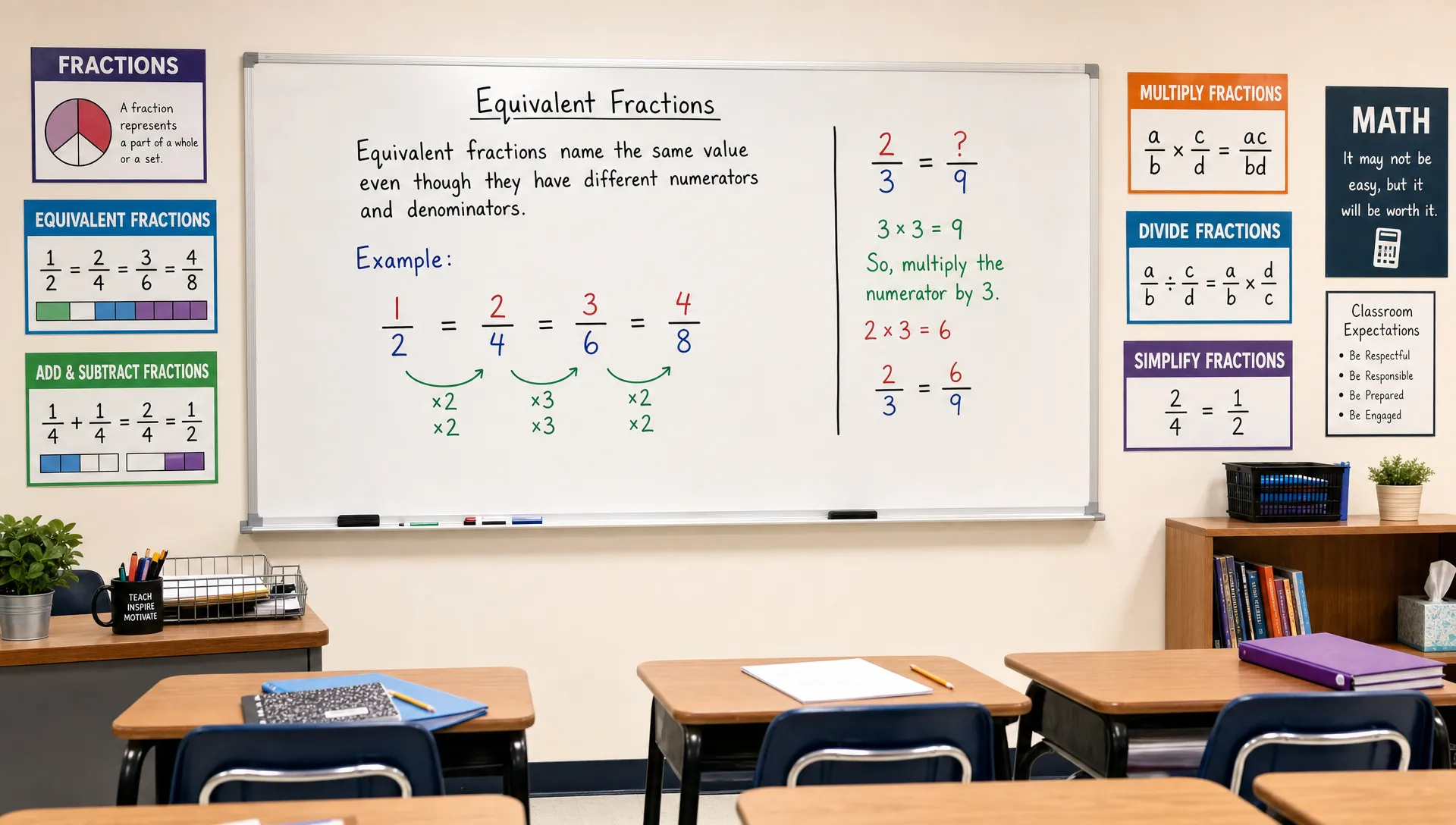
An Example of Understanding You Can Use in Class
If you need an example of understanding you can use in class, choose one that makes the difference between knowing the answer and explaining the idea visible. A student who can repeat a definition may have useful knowledge, but a student who understands can explain the idea in their own words, connect it to another situation and notice when a similar answer is wrong.
The example below uses equivalent fractions because it is simple enough for many classrooms, but the pattern works in science, history, literature, research methods and workplace training. You can use it as a short lesson, an exit ticket, a discussion prompt or a model answer for students who are learning what real comprehension looks like.
The goal is not to embarrass students who memorize. Memorization has a place. The goal is to show that understanding is something students can demonstrate, practice and improve.
What an example of understanding should show
A useful classroom example should make thinking visible. It should not only ask students to state what something is. It should ask them to explain why it works, where it applies and what would change if the situation changed.
That is the main difference between surface knowledge and deeper comprehension. Knowing a rule helps students start. Understanding helps them use the rule when the problem looks unfamiliar. If you want a fuller explanation of that distinction, unrav.io has a guide on the meaning of understanding beyond memorizing facts.
A good example of understanding usually includes five signs:
- The student can explain the idea in their own words.
- The student can give a concrete example, not just repeat a label.
- The student can connect the idea to a rule, cause or pattern.
- The student can apply the idea to a new but related situation.
- The student can identify a common mistake or explain why an answer is wrong.
These signs work because they ask for reasoning, not recognition. Recognition is what happens when a student sees a familiar term and thinks, I have seen this before. Understanding is what happens when the student can do something meaningful with that term.
A ready-to-use example of understanding: equivalent fractions
Use this prompt with students:
Explain why 2/3 and 4/6 can represent the same amount. Use a picture, a real-life example or a short explanation. Then explain one mistake someone might make when comparing them.
This prompt works because it does not stop at the correct answer. A student has to show the relationship between the two fractions, represent the relationship and address a misconception.
A memorized answer
A student who has memorized the rule might answer:
2/3 and 4/6 are the same because you multiply the top and bottom by 2.
This answer is not useless. It shows the student remembers the procedure. But by itself, it does not prove that the student understands why the value stays the same. The student may be following a pattern without knowing what the numerator, denominator or whole amount means.
An answer that shows understanding
A stronger student answer might look like this:
If one same-size pizza is cut into 3 equal slices and I eat 2 slices, I ate 2/3 of the pizza. If another same-size pizza is cut into 6 equal slices, each slice is smaller. Eating 4 of those 6 smaller slices covers the same amount of pizza as 2 of the 3 larger slices. The amount did not change. Only the number of pieces changed. A mistake would be saying 4/6 is bigger just because 4 is bigger than 2, because the pieces in sixths are smaller than the pieces in thirds.
This is an example of understanding because the student is not just naming a rule. They are explaining the meaning of the rule. They show that the whole must be the same size, the pieces must be equal and the comparison depends on the size of the parts, not only the numbers.
| Part of the student response | What it reveals |
|---|---|
| Same-size pizza | The student understands that fractions depend on the same whole. |
| Cut into 3 equal slices and 6 equal slices | The student understands the role of the denominator. |
| 2 larger slices match 4 smaller slices | The student can connect a visual model to the numbers. |
| The amount did not change | The student understands equivalence, not just multiplication. |
| 4 is bigger than 2 can be misleading | The student can spot a common misconception. |
This table is useful because it gives students a clearer target. Instead of telling them to understand better, you can show them what understanding looks like in an answer.
How to use this example in class
Start by giving students the prompt without showing the model answer. Let them answer alone first. This makes their current thinking visible and gives you a baseline for discussion.
Next, show the memorized answer and ask students what it proves. Most will see that it is partly correct. That matters because the point is not to say memorization is bad. The point is to show that remembering the procedure is only one layer.
Then show the stronger answer and ask students to mark the parts that show understanding. They can underline the real-life example, circle the explanation of equal parts and box the misconception. This turns an abstract word, understanding, into evidence they can see.
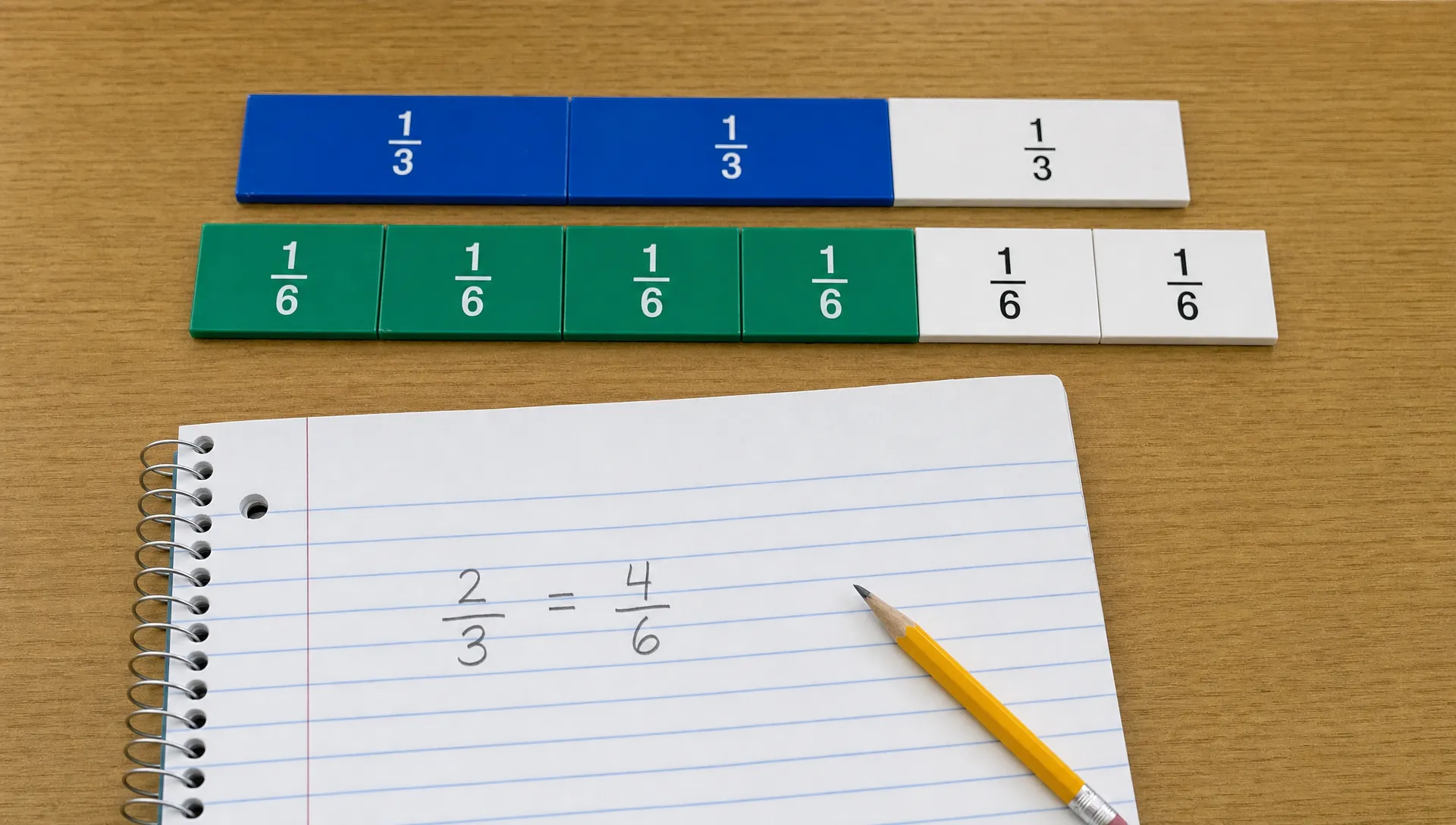
After that, give a transfer question. For example, ask whether 3/4 and 6/8 can represent the same amount. Students should not only say yes. They should explain it with a model, a story or a number line. If they can transfer the same reasoning to a new pair of fractions, the class has stronger evidence of understanding.
End with a misconception check. Ask students to respond to this statement: 6/8 is bigger than 3/4 because 6 is bigger than 3 and 8 is bigger than 4. Students who understand can explain why that reasoning is flawed. They can say that both fractions can describe the same share of the same whole, even though the numerator and denominator are larger.
How to adapt the example to other subjects
The same structure works in almost any class. Pick one important idea, ask students to explain it, then ask them to apply it and correct a misconception. The subject changes, but the evidence of understanding stays similar.
| Subject | Class prompt | What understanding might look like |
|---|---|---|
| Science | Explain why plants need light for photosynthesis. | The student connects light to making glucose and explains why a plant in darkness may struggle to grow. |
| History | Explain why one cause of an event was more important than another. | The student connects cause, context and consequence instead of listing dates. |
| Literature | Explain how a character changes over a story. | The student uses evidence from the text and explains why the change matters. |
| Writing | Explain why this paragraph needs a stronger topic sentence. | The student connects sentence structure to reader clarity. |
| Research methods | Explain why correlation does not prove causation. | The student gives a possible third variable and explains why the claim needs more evidence. |
This kind of prompt is especially helpful in mixed-ability classrooms because it gives multiple ways to show thinking. One student may use a diagram. Another may use an example. Another may explain a misconception. All three can be valid evidence, as long as the response shows reasoning.
For older students, you can make the prompt more demanding by asking them to compare two explanations. For example, students reading a journal article might compare the authors' claim with a limitation in the methods section. Students watching a lecture can pause at a key concept and write a teach-it explanation for a younger audience.
If you want more ways to check whether students have moved past recognition, use these practical tests for whether you truly understand a topic. They pair well with exit tickets, study groups and peer review.
A simple class routine: explain, apply, challenge
A repeatable routine helps students practice understanding without needing a completely new activity each time. You can use three prompts:
- Explain the idea in your own words.
- Apply it to a new example.
- Challenge a mistake someone might make.
For the fraction lesson, explain means describing why 2/3 and 4/6 can be equal. Apply means trying the same reasoning with 3/4 and 6/8. Challenge means correcting the mistaken idea that bigger numbers always mean a bigger fraction.
For a science lesson, explain might mean describing evaporation. Apply might mean predicting what happens to a puddle on a hot day. Challenge might mean correcting the misconception that water disappears rather than changes state.
For a literature lesson, explain might mean describing a theme. Apply might mean connecting that theme to a new scene. Challenge might mean correcting an interpretation that ignores key evidence.
This routine is short enough for daily use, but it pushes students beyond copying notes. It also helps teachers see where confusion begins. If a student can explain but not apply, they may need more examples. If a student can apply but not challenge a mistake, they may need to compare similar cases more carefully.
How students can use this as a self-test
Students can use the same pattern while studying. After reading a textbook section, watching a video or reviewing class notes, they can pause and ask whether they can explain, apply and challenge the idea without looking.
This matters because summaries can feel like understanding even when they only provide a shortcut. A summary is helpful for orientation, but it may hide the reasoning behind an idea. That is why unrav.io's article on how summarizing falls short without real understanding is a useful companion to this classroom example.
When the source material is dense, students can also use unrav.io to reframe a reading, PDF, video or pasted text into a simpler explanation or a teach-it version. The useful part is not copying the output. The useful part is comparing the clearer version with the original, then writing your own explanation from memory.
A student who wants to test real understanding can close the source and write three sentences. The first explains the concept. The second gives an example. The third warns against a mistake. If those three sentences are accurate and clear, the student is much closer to understanding than recognition.
Common mistakes when teaching understanding
One common mistake is asking for an example without asking for reasoning. If a student gives the right example but cannot explain why it fits, the example may be memorized too. Add a why question.
Another mistake is treating long answers as stronger answers. Some students write more because they are uncertain. A shorter answer can show better understanding if it identifies the key relationship clearly.
A third mistake is using the same context every time. If students only practice equivalent fractions with pizza pictures, they may attach the idea to pizza rather than to equivalence. Change the representation. Use fraction strips, number lines, recipes, distance or money so students see the underlying idea.
Finally, do not assume that a correct answer means the student understands. Correctness matters, but understanding also involves explanation, transfer and correction. The best classroom prompts give students a chance to show all three.
Frequently Asked Questions
What is a simple example of understanding? A simple example of understanding is a student explaining why 2/3 and 4/6 can represent the same amount, using a picture or real-life situation, then correcting the mistake that 4/6 must be bigger because 4 is bigger than 2.
How is understanding different from memorization? Memorization means remembering information, steps or definitions. Understanding means explaining why the information works, applying it in a new situation and recognizing when a similar answer is wrong or incomplete.
How can I ask students to show understanding in class? Ask students to explain an idea in their own words, apply it to a new example and correct a common misconception. This gives you more evidence than a definition or one correct answer.
Can a summary show understanding? A summary can support understanding, but it does not prove understanding by itself. To show understanding, students should add reasoning, examples, connections and limits.
Can AI help students understand difficult class material? AI can help by reframing dense material into clearer language, study prompts or teach-it explanations. Students still need to check accuracy, compare with the original source and produce their own explanation.
Next step: use the example with your next lesson
If you need one classroom-ready example, start with equivalent fractions. It is concrete, easy to model and clear enough to show the difference between repeating a rule and understanding an idea.
For any other topic, keep the same pattern: explain the idea, apply it to a new case and challenge a misconception. That simple structure gives students a practical way to show what they understand, and it gives teachers better evidence than recall alone.
If your class is working from a dense article, PDF, research paper or video, use unrav.io to help students get a first clear view of the material. Then ask them to produce their own explanation, example and misconception check. That is where the learning becomes visible.