
A Short Summary of Research Paper Example That Actually Helps
If you searched for a short summary of research paper example, you probably do not need another vague explanation of what a summary is. You need to see what a useful one looks like, why it works, and how to write your own without copying the abstract.
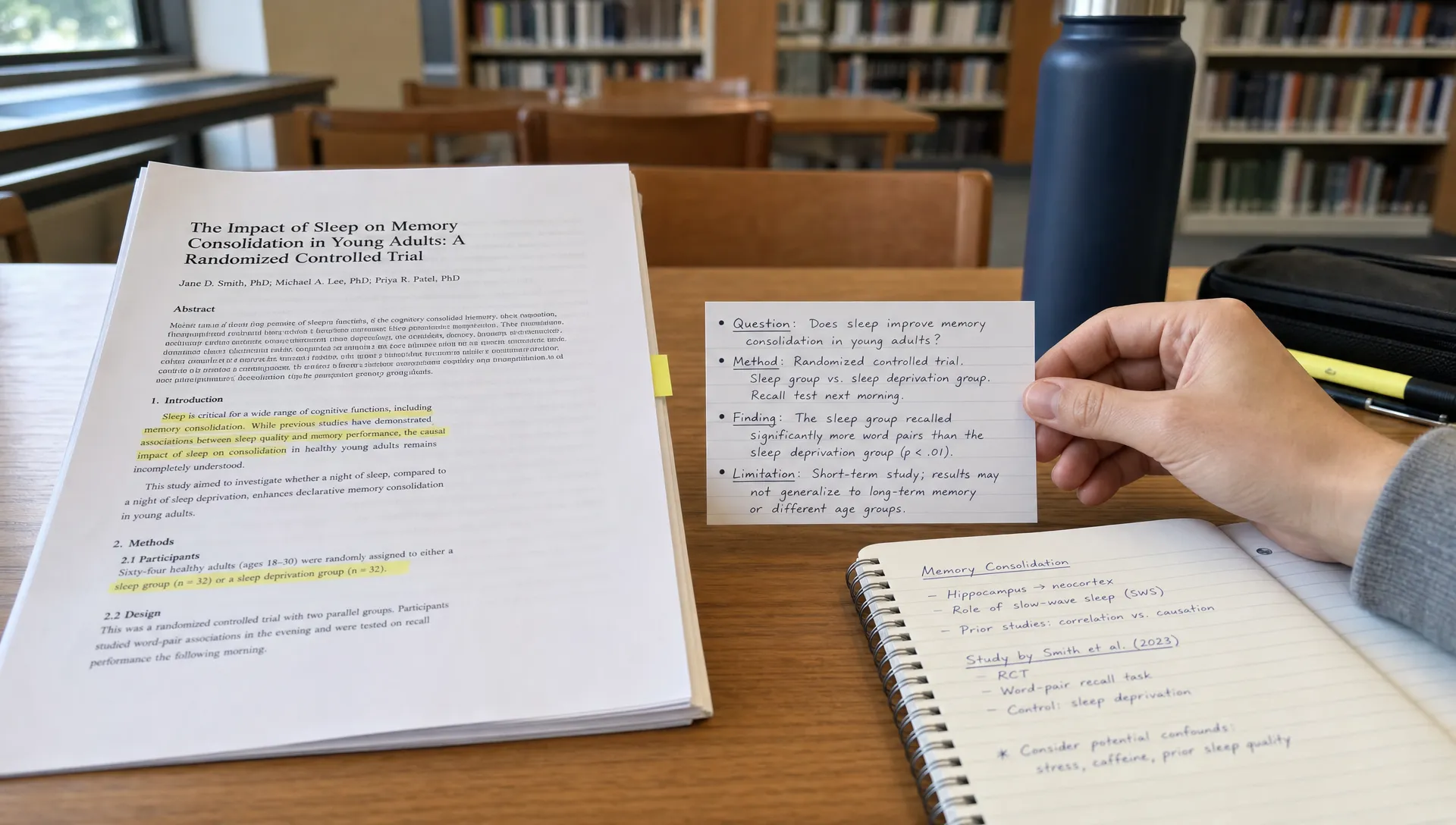
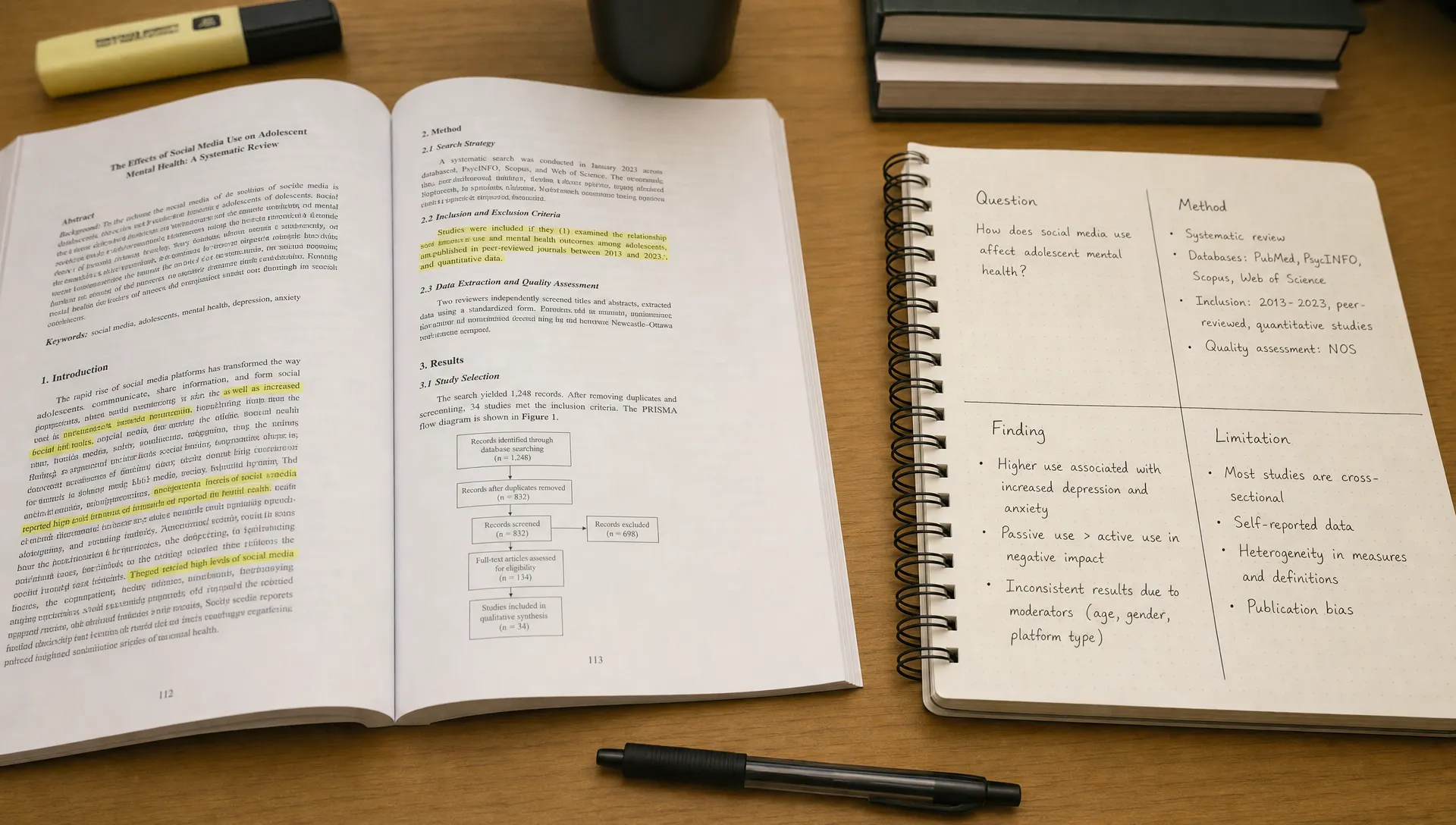
A good short research paper summary should help someone understand the paper’s main point quickly. It should answer four questions: What did the study ask? How did the researchers investigate it? What did they find? Why does it matter, including any important limitation?
That sounds simple, but it is easy to get wrong. Many summaries become too general, too long, or too close to the paper’s own wording. Below is a practical example you can adapt for class notes, literature reviews, work briefs, or personal study.
What makes a short research paper summary actually useful?
A short summary is not the same as an abstract. The abstract is written by the paper’s authors and often follows disciplinary conventions. Your summary is written for a reader with a specific need, such as preparing for discussion, comparing studies, briefing a team, or deciding whether to read the full paper.
A useful short summary usually includes:
- The research question or problem
- The study type, data, or method
- The main finding, not every result
- The significance of the finding
- One important limitation or caution
For most student or professional use cases, 100 to 200 words is enough. Shorter than that, and you may lose the method or nuance. Longer than that, and you are often writing notes rather than a summary.
If you need a more detailed process, this guide to summarizing a research paper without losing the point walks through the full reading workflow. Here, we will focus on the example itself.
A short summary of research paper example
To avoid misrepresenting a real study, the example below uses a fictional research paper. The topic is realistic, but the paper details are invented for demonstration.
| Paper element | Example details |
|---|---|
| Fictional title | “The Effect of Retrieval Practice on Exam Performance in Introductory Biology Students” |
| Field | Education psychology |
| Research question | Does weekly retrieval practice improve exam performance compared with rereading notes? |
| Participants | 180 undergraduate biology students |
| Method | Students were assigned to weekly practice quizzes or guided rereading for eight weeks |
| Main finding | Students using retrieval practice scored higher on the final exam |
| Limitation | The study was limited to one course at one university |
Here is a helpful short summary:
This paper examines whether weekly retrieval practice helps undergraduate biology students perform better on exams than guided rereading. The researchers studied 180 students in an introductory biology course over eight weeks, comparing students who completed regular practice quizzes with students who reviewed notes using a structured rereading activity. The quiz group scored higher on the final exam, suggesting that actively recalling information may improve long-term retention more than passive review. The study is useful for students and educators because it connects a simple study habit with measurable performance. However, the results should be interpreted cautiously because the sample came from one course at one university, so the findings may not apply equally across subjects, institutions, or student populations.
This is the kind of short summary that helps because it gives the reader enough context to understand the paper without pretending to replace it.
Why this summary works
The example above is not just shorter than the paper. It is structured around understanding.
| Summary part | What it does |
|---|---|
| “examines whether weekly retrieval practice helps...” | Identifies the research question |
| “180 students... over eight weeks” | Gives the study context and scale |
| “comparing students who completed regular practice quizzes...” | Explains the method in plain language |
| “scored higher on the final exam” | States the main finding clearly |
| “useful for students and educators...” | Explains why the finding matters |
| “sample came from one course...” | Adds a limitation so the summary is not overstated |
The best summaries do not list every detail. They select the details that change how the reader understands the paper.
Notice that the summary avoids phrases like “the paper talks about” or “the article is interesting.” Those phrases are usually too vague. Instead, it uses precise verbs such as “examines,” “studied,” “comparing,” and “suggesting.”
A weak short summary example
Now compare the helpful version with a weak one:
This paper is about retrieval practice and exam scores. It says that students who take quizzes do better than students who reread notes. The researchers did a study in a biology class and found that quizzes are better. This is important for students.
This is short, but it is not very useful. It leaves out the size of the study, the time frame, the comparison, and the limitation. It also overstates the conclusion by saying “quizzes are better” without explaining the context.
Here is what goes wrong:
| Problem | Why it hurts the summary | Better approach |
|---|---|---|
| Too vague | “This paper is about...” does not show the research question | State what the paper investigates |
| Missing method | The reader cannot judge how the finding was produced | Mention study design, sample, or data source |
| Overgeneralized conclusion | “Quizzes are better” sounds universal | Tie the finding to the study context |
| No limitation | The summary sounds more certain than the paper likely is | Include one caution or boundary |
Short does not mean shallow. A strong summary is concise, but it still preserves the logic of the research.
A simple template for writing a short research paper summary
You can use this template when you need a quick but complete summary:
This paper investigates [research question] in [population, dataset, or context]. The authors use [method or study design] to examine [main relationship, intervention, or issue]. They find that [main result], suggesting [interpretation or significance]. The paper is useful because [why it matters], although [key limitation or caution].
Here is the same template filled in for the fictional paper:
This paper investigates whether retrieval practice improves exam performance in undergraduate biology students. The authors use an eight-week classroom study to compare weekly practice quizzes with guided rereading. They find that students in the quiz group scored higher on the final exam, suggesting that active recall may support long-term retention more effectively than passive review. The paper is useful because it gives students and educators evidence for a practical study strategy, although the findings are limited by the single-course sample.
This version is slightly shorter than the earlier example. It would work well in a reading log, annotated bibliography, or study note.
How to write your own short summary in 7 minutes
When you are working with a dense PDF or journal article, do not start by summarizing sentence by sentence. Start by finding the paper’s structure.
- Read the abstract last if you are easily influenced by wording: Skim the title, introduction, headings, tables, and conclusion first so you form your own understanding before compressing the authors’ abstract.
- Find the research question: Look for phrases like “we examine,” “this study investigates,” “we test,” or “the aim of this paper.”
- Identify the method in plain English: Ask what the researchers actually did, such as running an experiment, interviewing participants, analyzing survey data, reviewing prior studies, or building a model.
- Choose the main finding: Do not include every result. Pick the result that best answers the research question.
- Add one limitation: Look in the discussion or conclusion for caveats about sample size, context, measurement, assumptions, or generalizability.
- Rewrite for your reader: Use your own words and adjust the level of detail depending on whether the summary is for class, work, research, or teaching.
This process keeps you from producing a compressed copy of the paper. It also helps you notice when you do not fully understand something yet.
If you are working with many papers, an AI reading companion can help you move faster, especially at the first-pass understanding stage. For example, unrav.io can help reframe PDFs, links, videos, podcasts, or pasted text using different reading modes, such as quick grasp or teach-it. You should still verify important claims against the paper itself, but tools like this can make dense material easier to approach.
Short research paper summary examples for different situations
The “right” summary depends on why you are writing it. A class discussion summary should not look exactly like a literature review summary or an executive brief.
| Use case | What to emphasize | Mini example |
|---|---|---|
| Class notes | Main argument and why it matters for the course | “The paper argues that retrieval practice improves retention by requiring students to actively recall information rather than recognize it passively.” |
| Literature review | Research gap, method, and relationship to other studies | “This study adds classroom-based evidence to prior retrieval-practice research by testing the strategy in an undergraduate biology course.” |
| Work brief | Decision-relevant finding and limitation | “The findings suggest that low-stakes quizzes may improve learning outcomes, but the evidence comes from one academic setting and may need testing in other contexts.” |
| Teaching prep | Conceptual explanation and classroom application | “The study can be used to show students why practice testing is not just assessment, but also a learning strategy.” |
| Content creation | Core insight and audience takeaway | “A useful takeaway for learners is that trying to recall material from memory can be more effective than simply rereading notes.” |
If you are summarizing a journal article for class or workplace use, this guide on the best ways to summarize a journal article for class or work gives more context-specific approaches.
What to include and what to leave out
One reason research paper summaries become too long is that readers try to preserve every section equally. But not every part of the paper deserves the same amount of space in a short summary.
| Include | Usually leave out |
|---|---|
| Research question | Full literature review history |
| Study context or dataset | Every cited author |
| Core method | Technical procedure details unless essential |
| Main result | Secondary findings that do not answer the main question |
| Interpretation | Long quotations from the paper |
| Key limitation | Minor caveats that do not affect understanding |
A good test is this: if someone read only your summary, would they understand the paper’s central contribution and its boundaries? If yes, your summary is probably doing its job.
How to avoid copying the abstract
It is tempting to take the abstract and make it shorter. The problem is that abstracts are often already compressed. If you compress them further without understanding, you may remove the most important context.
Instead, use the abstract as a checkpoint, not as your source text. After writing your own summary, compare it with the abstract and ask:
- Did I capture the same research question?
- Did I preserve the main finding accurately?
- Did I avoid stronger claims than the authors make?
- Did I include enough method detail for the result to make sense?
- Did I write in my own words?
This is especially important for scientific and technical papers, where cautious wording matters. If you need to simplify dense academic language, you may also find this guide to summarizing a scientific article in plain English useful.
Common mistakes in short research paper summaries
The most common mistake is writing a topic summary instead of a research summary. “This paper is about climate change and agriculture” tells the reader the subject area, but not the study’s question, evidence, or contribution.
Another mistake is reporting the conclusion without the method. If you say “the intervention improved outcomes,” the reader needs to know whether that came from an experiment, a survey, a model, or a small set of interviews. Method context helps the reader judge the strength of the claim.
A third mistake is removing all uncertainty. Research papers usually make bounded claims. Your summary should reflect that. Words like “suggests,” “indicates,” and “in this sample” are often more accurate than “proves.”
Finally, avoid filling the summary with background. Background can be useful in notes, but a short summary should prioritize the paper’s specific contribution.
FAQ
How long should a short research paper summary be? For most class, work, or study purposes, 100 to 200 words is enough. If the paper is highly technical, you may need a longer note, but the short summary should still focus on the research question, method, finding, significance, and limitation.
Is a research paper summary the same as an abstract? No. An abstract is written by the authors to preview the paper. A summary is written by you for a specific reader or purpose. Your summary should use your own words and may emphasize different details depending on your goal.
Can I use AI to summarize a research paper? Yes, AI can help with first-pass understanding, plain-English explanations, and reorganizing dense material. However, you should verify important claims, check methods and limitations yourself, and avoid treating AI output as a substitute for reading when accuracy matters.
What is the best structure for a short summary of a research paper? A reliable structure is: research question, method, main finding, significance, and limitation. This keeps the summary short while preserving the logic of the paper.
Should I include citations in a short research paper summary? If the summary is part of academic work, follow your instructor’s or style guide’s requirements. In informal notes, you should at least record the paper title, authors, year, and source so you can find it later.
Take the next step
A short research paper summary should make a dense paper easier to understand, not flatten it into a vague sentence. The example above works because it preserves the paper’s question, method, finding, importance, and limitation in a compact form.
The next time you read a paper, try writing one sentence for each of those five parts before turning it into a paragraph. If you want help getting an initial grasp of a PDF, article, or pasted text, unrav.io can help you reframe complex material into clearer formats while you stay in control of the final summary.