
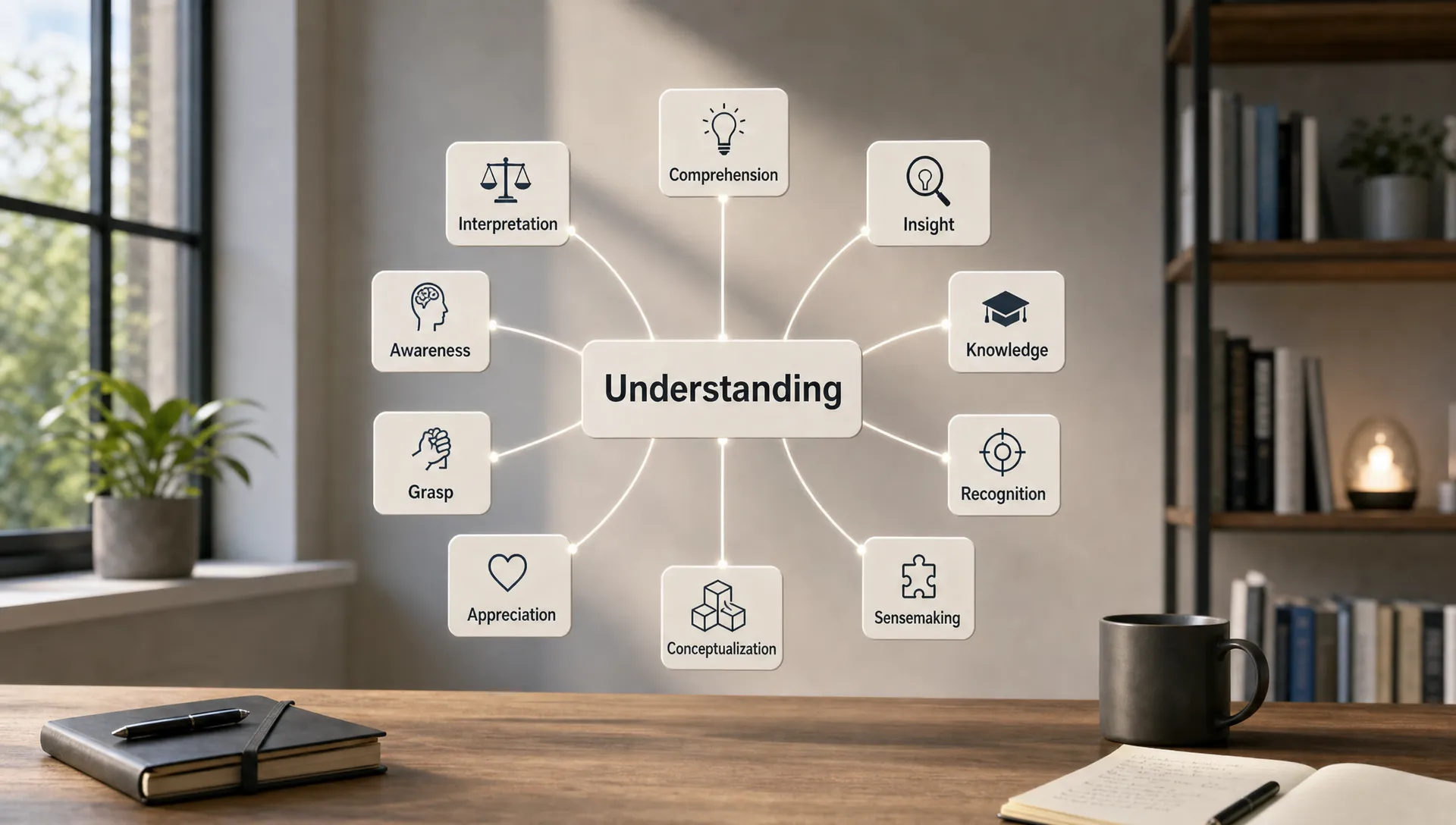
10 Words for Understanding in Academic Writing
Why word choice matters when you write about understanding
In academic writing, the word understanding is useful, but it can also be vague. A sentence like The study improves our understanding of student motivation may be acceptable, but it does not tell the reader what kind of understanding changed. Did the study clarify a mechanism? Reveal a pattern? Support an interpretation? Increase awareness of a problem? Build factual knowledge?
That difference matters. Academic writing rewards precision. The best words for understanding are not just fancier synonyms. They help you state the level, type, and evidence behind a claim.
This guide explains 10 practical words you can use in essays, literature reviews, research summaries, and reports. Each word includes its meaning, when to use it, and an example sentence.
If you are working with dense academic material, it also helps to separate vocabulary from comprehension. A clearer word will not fix a weak reading of the source. If you want to test whether you really understand the material before writing about it, this guide on how to tell if you truly understand a topic is a useful companion.
Quick guide: 10 words for understanding
Use this table as a fast reference before choosing a term.
| Word | Best used for | Academic example |
|---|---|---|
| Comprehension | Basic or measurable understanding | The intervention improved students' comprehension of statistical concepts. |
| Interpretation | Meaning drawn from evidence | This interpretation is supported by the interview data. |
| Insight | A useful realization or deeper view | The findings offer insight into how teams respond to uncertainty. |
| Awareness | Recognition that something exists or matters | The course increased awareness of ethical issues in data collection. |
| Knowledge | Established information or learned content | Prior knowledge influenced participants' reading strategies. |
| Grasp | A firm practical or conceptual hold on an idea | Students developed a stronger grasp of causal reasoning. |
| Recognition | Identifying significance, patterns, or problems | Recognition of structural barriers shaped the policy discussion. |
| Appreciation | Nuanced understanding of value, complexity, or limits | The analysis encourages an appreciation of methodological constraints. |
| Conceptualization | How an idea is defined, framed, or mentally organized | The paper conceptualizes literacy as a social practice. |
| Sensemaking | Organizing confusing information into meaning | Managers engaged in sensemaking during the crisis response. |
The 10 most useful words for understanding in academic writing
1. Comprehension
Comprehension refers to the ability to understand information, especially written, spoken, or taught material. It is common in education research, psychology, reading studies, and learning contexts.
Use comprehension when you mean that someone understands content at a basic or measurable level. It is often appropriate when discussing students, readers, participants, or learners.
Example: The visual glossary improved students' comprehension of key biological processes.
Comprehension is more specific than understanding because it usually points to the reception and processing of information. It works well when the focus is on whether people can follow, explain, or answer questions about material.
Avoid using comprehension when you mean a broad theoretical contribution. For example, This study improves comprehension of climate policy sounds awkward unless you are discussing how readers or learners understand climate policy. In that case, insight, interpretation, or knowledge may be more accurate.
2. Interpretation
Interpretation is understanding that comes from analyzing meaning. It is especially useful when the evidence could be read in more than one way.
Use interpretation in literature, history, qualitative research, media studies, philosophy, law, and any field where meaning depends on context and argument.
Example: This interpretation suggests that participants viewed remote work as both a benefit and a source of isolation.
Interpretation is not the same as fact. It signals that the writer is making a reasoned claim based on evidence. That makes it useful when you want to stay academically cautious.
For instance, instead of writing The interviews show that employees dislike hybrid work, you might write One interpretation of the interviews is that employees value flexibility but find hybrid coordination burdensome. The second version is more careful and more precise.
3. Insight
Insight means a meaningful realization or deeper view into a topic. In academic writing, it often appears in phrases such as offers insight into, provides insight into, or yields insight into.
Use insight when a source helps reveal a pattern, mechanism, relationship, or explanation. It is stronger than awareness but usually less absolute than proof.
Example: The longitudinal data provide insight into how study habits change during the first year of university.
Insight is useful because it suggests value without overstating certainty. A study can provide insight even if it does not settle a debate completely.
Be careful not to use insight as a generic compliment. The phrase valuable insights can become empty if you do not explain what the insight is. Whenever possible, name the specific insight: The study provides insight into why novice programmers struggle with debugging, not just The study provides useful insights.
4. Awareness
Awareness means noticing, recognizing, or becoming conscious of something. It is often used when the understanding is preliminary rather than deep.
Use awareness when discussing social issues, risks, ethical considerations, health information, public communication, or learner attitudes.
Example: The workshop increased participants' awareness of privacy risks in online data sharing.
Awareness is weaker than comprehension, knowledge, or mastery. Someone may be aware of a problem without fully understanding its causes or implications.
That makes the word useful when you want to avoid exaggeration. For example, after a short training session, it may be more accurate to claim increased awareness of accessibility principles than full understanding of accessibility design.
5. Knowledge
Knowledge refers to information, facts, concepts, or skills that a person or group has acquired. It is one of the most common academic alternatives to understanding, but it is not always interchangeable.
Use knowledge when you are discussing what is known, what someone has learned, or what a field has established.
Example: Prior knowledge of economic theory shaped how students interpreted the case study.
Knowledge works well when you can point to content: definitions, principles, evidence, procedures, or facts. It is less suitable when the focus is on meaning-making, ambiguity, or personal perspective.
For example, knowledge of grammar suggests familiarity with rules and structures. Understanding of grammar may include the ability to apply those rules in context. Interpretation of grammar would be more likely in a linguistic analysis of how grammar functions in a specific text or community.

6. Grasp
Grasp means a firm hold on an idea. It is slightly less formal than comprehension or knowledge, but it is still acceptable in many essays and academic discussions when used carefully.
Use grasp when you want to describe practical or conceptual command of a topic.
Example: By the end of the module, students demonstrated a stronger grasp of argument structure.
Grasp is often useful in teaching and learning contexts because it suggests that a person can work with an idea, not merely repeat it. A student with a grasp of probability can usually explain basic concepts, solve problems, and notice common mistakes.
In highly formal writing, you may prefer comprehension, command, or knowledge. Still, grasp can be clear and natural, especially when writing for a broad academic audience.
7. Recognition
Recognition means identifying something as present, important, familiar, or significant. In academic writing, it often describes the moment when a pattern, issue, relationship, or implication becomes visible.
Use recognition when the emphasis is on noticing significance rather than explaining every detail.
Example: Recognition of historical context is essential for evaluating the policy's long-term effects.
Recognition is useful in arguments because it can show a shift in perspective. For example, recognition of bias does not necessarily mean the writer has solved the bias. It means the bias has been identified as relevant.
This word is especially helpful when writing about limitations, social structures, ethical concerns, and theoretical assumptions.
8. Appreciation
Appreciation can mean liking something in everyday speech, but in academic writing it often means nuanced understanding of value, difficulty, complexity, or importance.
Use appreciation when you want to signal that the reader or researcher understands more than the surface meaning.
Example: A close reading of the archive allows for a fuller appreciation of the author's political constraints.
Appreciation is common in humanities, education, social sciences, and reflective writing. It can be especially useful when describing complexity: appreciation of methodological limitations, appreciation of cultural context, appreciation of competing explanations.
Do not use appreciation if it might sound emotional or evaluative in the wrong way. In a scientific report, increased appreciation of enzyme activity may sound less precise than improved understanding of enzyme activity or clearer knowledge of enzyme function.
9. Conceptualization
Conceptualization refers to how an idea is defined, framed, or mentally organized. It is not just understanding an idea. It is the structure used to think about the idea.
Use conceptualization when discussing theories, models, definitions, frameworks, or research constructs.
Example: The article conceptualizes digital literacy as a set of social, technical, and critical practices.
This word is especially important in academic writing because many disagreements are not just about evidence. They are about how a concept is framed. For example, researchers may conceptualize intelligence, wellbeing, identity, or literacy in different ways.
Conceptualization is more technical than understanding, so use it only when the sentence is really about framing or defining a concept. If you simply mean that a student understood a chapter, comprehension is better.
10. Sensemaking
Sensemaking refers to the process of organizing unclear, complex, or confusing information into a meaningful pattern. It is common in organizational studies, communication, education, crisis research, and learning sciences.
Use sensemaking when people are dealing with uncertainty, incomplete information, or changing situations.
Example: The study examines how nurses engaged in sensemaking during the transition to new clinical software.
Sensemaking is different from comprehension because it emphasizes process. The person is not just receiving information. They are actively connecting cues, context, prior knowledge, and possible explanations.
This word is useful for research about decision-making, group communication, professional judgment, and learning from complex material. If you are summarizing dense sources, sensemaking also describes what good readers do when they connect methods, findings, assumptions, and implications instead of only collecting facts.
How to choose the right word
A good synonym for understanding depends on what you want to claim. Before replacing understanding, ask what the sentence is really doing.
Use these questions as a quick test:
- Are you describing a learner's ability to follow material? Use comprehension or grasp.
- Are you explaining meaning from evidence? Use interpretation.
- Are you naming a useful realization? Use insight.
- Are you describing basic recognition of an issue? Use awareness or recognition.
- Are you referring to established facts or learned content? Use knowledge.
- Are you discussing definitions or theoretical framing? Use conceptualization.
- Are you describing how people organize ambiguity? Use sensemaking.
The goal is not to avoid understanding every time. Sometimes understanding is the best word. But if your sentence feels broad, flat, or repetitive, a more precise term can sharpen your argument.
Example rewrites for academic sentences
Here are a few ways to revise vague uses of understanding into more precise academic wording.
| Vague sentence | More precise version | Why it is stronger |
|---|---|---|
| This paper improves our understanding of online learning. | This paper provides insight into how students manage attention during online learning. | It names the specific contribution. |
| The course helped students understand climate change. | The course improved students' comprehension of climate feedback loops. | It identifies the content learned. |
| The interviews show an understanding of workplace stress. | The interviews support an interpretation of workplace stress as both organizational and personal. | It clarifies that the claim comes from analysis. |
| Researchers need understanding of the study's limits. | Researchers need an appreciation of the study's methodological limits. | It signals nuanced awareness. |
| The article explains the understanding of identity. | The article conceptualizes identity as relational and context-dependent. | It points to theoretical framing. |
This kind of revision is especially useful when summarizing academic sources. If you are turning a paper into notes, it helps to label whether the author is offering evidence, interpretation, insight, or a new conceptualization. For a broader reading workflow, you can use this step-by-step guide on how to summarize an academic article before choosing final wording.
A simple rule: match the word to the evidence
Many academic writing problems come from claiming more than the evidence supports. Word choice can help you stay accurate.
If a study includes a short survey after a workshop, it may support increased awareness, but not deep expertise. If a paper analyzes interview themes, it may offer an interpretation, not a universal conclusion. If a review compares many studies, it may build knowledge about a field, but still leave uncertainty about specific causes.
This is why words for understanding are also words for intellectual honesty. They help readers see how strong your claim is and what kind of contribution you are making.
If you use AI tools to work through source material, apply the same standard. Tools like unrav.io can help reframe articles, PDFs, videos, and pasted text into clearer forms, but you should still check the original source and decide which word best fits the evidence. AI can support comprehension and organization. It should not replace your judgment about meaning, nuance, or accuracy.
For researchers, analysts, and students, this distinction is important. A summary can tell you what a text says, but good academic writing also asks what kind of understanding the text creates. If you often summarize complex material for other people, this guide on summarizing findings so people actually understand can help you move from raw information to clearer communication.
Common mistakes to avoid
The first mistake is choosing the most formal-sounding word instead of the most accurate one. Conceptualization may sound academic, but it is only appropriate when you are discussing how a concept is framed. If the sentence is about reading ability, comprehension is clearer.
The second mistake is using insight without naming the insight. The study offers insights into education is weaker than The study offers insight into how feedback timing affects student revision.
The third mistake is overstating understanding. Words like mastery, expertise, and command suggest a high level of ability. Use them only when the evidence supports that level.
The fourth mistake is treating all understanding as individual. In many fields, understanding can be collective, cultural, institutional, or disciplinary. For example, a field can develop knowledge, a research team can engage in sensemaking, and a community can share an interpretation.
Frequently Asked Questions
What is a formal word for understanding? Comprehension, knowledge, interpretation, and conceptualization are all formal options, but they mean different things. The best choice depends on whether you mean learning, evidence-based meaning, factual knowledge, or theoretical framing.
Is comprehension the same as understanding? Not exactly. Comprehension usually refers to the ability to understand information that has been read, heard, or taught. Understanding is broader and can include interpretation, application, insight, and judgment.
Can I use grasp in academic writing? Yes, but use it carefully. Grasp is clear and natural when describing a firm hold on a concept, especially in education-related writing. In very formal contexts, comprehension or command may be better.
What is the best word for deep understanding? Insight, appreciation, and grasp can all suggest deeper understanding, but each has a different emphasis. Insight points to a meaningful realization, appreciation points to nuance or complexity, and grasp points to firm command of an idea.
Should I always replace understanding with another word? No. Understanding is sometimes the clearest word. Replace it only when another term makes the sentence more precise, more accurate, or less repetitive.
Final takeaway
Academic vocabulary is not about sounding more complicated. It is about making your thinking easier to follow.
When you write about understanding, choose the word that tells readers what kind of understanding you mean. Use comprehension for learning, interpretation for meaning, insight for useful realization, awareness for recognition, knowledge for established information, grasp for conceptual command, recognition for identifying significance, appreciation for nuance, conceptualization for framing, and sensemaking for organizing complexity.
The next time you revise an essay, report, or research summary, search for the word understanding and pause at each use. If the word is doing enough work, keep it. If it feels vague, replace it with a term that matches your evidence and your argument.