
How to Write a Summary of a Thesis Clearly
Writing a summary of a thesis can feel harder than summarizing an article because a thesis is not one argument in a few pages. It may include months or years of work, a long literature review, detailed methods, data, findings, limitations, and a conclusion that depends on all of the earlier chapters.
A clear summary does not compress every chapter equally. It helps a reader understand the purpose, approach, main findings, and significance of the thesis without needing to read the full document first.
Whether you are a student preparing a submission, a researcher reviewing someone else’s work, a supervisor writing notes, or a professional trying to understand an academic report, the goal is the same: write a summary that is accurate, readable, and focused.
What a summary of a thesis should do
A summary of a thesis should answer five basic questions:
- What problem or question does the thesis address?
- Why does that problem matter?
- What method or approach was used?
- What were the main findings or arguments?
- What does the thesis contribute, prove, challenge, or clarify?
The summary should not read like a table of contents. A weak summary says, “Chapter 1 introduces the topic, Chapter 2 reviews the literature, Chapter 3 explains the method.” That may describe the structure, but it does not explain the meaning of the work.
A strong summary tells the reader what the thesis is really about. It identifies the central research question, the evidence used to answer it, the main result, and the broader implication.
Thesis summary vs abstract vs conclusion
Before writing, make sure you know what type of summary you need. People often use the terms summary, abstract, and conclusion interchangeably, but they serve different purposes.
| Section | Main purpose | Typical reader need |
|---|---|---|
| Abstract | Gives a very short overview of the entire thesis | Decide whether to read the full work |
| Thesis summary | Explains the thesis clearly in a condensed form | Understand the project without reading every chapter |
| Conclusion | Interprets the findings and closes the argument | See what the research means after reading the thesis |
| Executive summary | Focuses on practical implications and decisions | Help a non-specialist or stakeholder act on the findings |
If you are asked for a “summary of a thesis,” clarify the expected length and audience. A 250-word summary for a thesis database will be very different from a 1,500-word summary for a supervisor, defense committee, or workplace report.
Start with the reader and purpose
A thesis summary is only clear when it is written for a specific reader. A summary for your professor can use more technical language. A summary for classmates should explain the context more plainly. A summary for a non-academic audience should reduce jargon and focus on why the findings matter.
Before drafting, write one sentence that defines the audience:
“The reader is a graduate student in my field who has not read the full thesis.”
“The reader is a manager who needs to understand the practical implications of the research.”
“The reader is a general academic reviewer deciding whether the thesis is relevant.”
This one sentence will help you decide what to include, what to explain, and what to leave out.
Read the thesis strategically before summarizing
If you are summarizing your own thesis, you already know the material. Still, you should reread it with a summary mindset. If you are summarizing someone else’s thesis, do not try to read every page with equal attention on the first pass.
Start with the parts that reveal the structure of the argument:
- Title and subtitle
- Abstract
- Introduction
- Research questions or hypotheses
- Chapter introductions and conclusions
- Methods section
- Results or findings section
- Final conclusion
Then return to the full chapters to verify details. This prevents a common problem: writing a summary that sounds polished but misses the actual logic of the thesis.
If you regularly summarize academic work, it can help to compare thesis summaries with shorter research outputs. For example, this guide on how to summarize a research paper without losing the point is useful when you need to preserve the argument instead of reducing everything to a few generic bullet points.
Identify the thesis core before writing
The easiest way to write a confused summary is to start with the first chapter and move forward sentence by sentence. Instead, extract the core of the thesis first.
Use the table below as a worksheet before drafting.
| Element to capture | Question to answer | Example phrasing |
|---|---|---|
| Topic | What is the thesis about? | This thesis examines remote work communication in software teams. |
| Problem | What gap, issue, or debate motivates it? | Existing studies focus on productivity but less on informal knowledge sharing. |
| Research question | What does the thesis try to find out? | It asks how distributed teams maintain shared context across time zones. |
| Method | How was the research conducted? | The study uses interviews and document analysis across three organizations. |
| Main findings | What did the thesis discover or argue? | The findings show that informal rituals and written norms reduce coordination gaps. |
| Contribution | What does the thesis add? | It extends research on remote collaboration by explaining how context is maintained. |
| Limitations | What should readers be careful about? | The sample is limited to mid-sized technology companies. |
Once you can fill this table, the summary becomes much easier to write. You are no longer trying to shrink the whole thesis. You are explaining its essential structure.
Use a simple thesis summary structure
A clear summary of a thesis usually follows the same basic order as the research itself, but in a compressed form. You do not need to mention every chapter unless the assignment specifically asks for a chapter-by-chapter summary.
A reliable structure is:
- Introduce the topic and research problem.
- State the purpose, research question, or thesis argument.
- Briefly explain the background or gap in existing research.
- Describe the method, sources, or theoretical approach.
- Present the main findings or arguments.
- Explain the significance and limitations.
This structure works for most disciplines because it mirrors how academic research is evaluated. Readers want to know what was studied, why it matters, how it was studied, what was found, and what follows from it.
Decide the right length
There is no single correct length for a thesis summary. The right length depends on the assignment, audience, and document type. A summary that is too short may become vague. A summary that is too long may become a mini-thesis.
| Summary length | Best for | What to include |
|---|---|---|
| 150 to 250 words | Abstract-style database entry | Topic, question, method, key finding, contribution |
| 300 to 600 words | Class assignment or reading note | Problem, method, main findings, significance, limitation |
| 800 to 1,500 words | Supervisor report or detailed summary | More background, chapter logic, evidence, findings, implications |
| 2,000 words or more | Extended synopsis | Chapter-level detail, methods, results, discussion, contribution |
If no length is given, aim for enough detail that a reader can understand the thesis without reading it, but not so much detail that they lose the main thread.
Write the first sentence carefully
The first sentence should orient the reader immediately. Avoid opening with broad statements that could apply to thousands of papers.
Weak opening:
“Education has always been an important topic in society.”
Clear opening:
“This thesis examines how first-generation university students use peer networks to navigate academic support services during their first year.”
The second version gives the topic, population, and focus. It is specific enough to guide the rest of the summary.
For technical or scientific theses, the first sentence can include the research object and method:
“This thesis uses computational modeling to investigate how urban heat islands affect nighttime temperature patterns in high-density neighborhoods.”
For humanities theses, it may include the text, archive, period, or argument:
“This thesis argues that three postwar novels use fragmented narration to represent memory as a social process rather than a private experience.”
Summarize the method without drowning the reader in detail
Many thesis summaries become unclear because the methods section is either missing or too detailed. The reader needs to understand how the evidence was produced, but they usually do not need every sampling criterion, software setting, or coding procedure.
For a short summary, one or two sentences may be enough:
“The study draws on 32 semi-structured interviews with secondary school teachers and analyzes the transcripts using thematic analysis.”
For a longer summary, you can add why the method fits the question:
“This qualitative approach was chosen because the thesis aims to understand how teachers interpret policy changes in daily classroom practice, rather than measure policy effects at scale.”
That second sentence helps the reader understand the logic of the research design, not just the mechanics.
Present findings as claims, not isolated details
A thesis may contain many findings, but a summary should focus on the most important ones. Do not list every result. Group related findings into two or three larger claims.
Instead of writing:
“The thesis found that students used WhatsApp groups, asked older students for advice, attended workshops, and searched university websites.”
Write:
“The thesis finds that students relied more heavily on informal peer networks than official support channels, especially when they needed timely, practical advice.”
The second version turns several details into a meaningful finding. It also prepares the reader to understand the significance of the work.
Include limitations without weakening the summary
A good thesis summary does not hide limitations. Including them shows accuracy and academic judgment. The key is to state limitations clearly without making the work sound useless.
For example:
“Because the study focuses on three urban schools, the findings should not be treated as representative of all school systems. However, they offer detailed insight into how policy is interpreted in high-pressure teaching environments.”
This is balanced. It tells the reader what the thesis cannot claim while still explaining what it contributes.
Use plain language, even for complex topics
Clear does not mean simplistic. A thesis summary can be intellectually serious without being overloaded with specialized terms. Use technical vocabulary when it is necessary, but explain concepts that a reader outside the immediate subfield may not know.
A useful rule is to keep the research terms but simplify the connecting language. The reader should not have to fight through long sentences just to understand the basic relationship between the problem, method, and findings.
If a sentence contains three or more abstract nouns, try rewriting it. For example:
Dense version:
“The investigation foregrounds the operationalization of institutional responsiveness within the framework of participatory governance.”
Clearer version:
“The thesis examines how institutions respond to public feedback within participatory governance systems.”
The clearer version still sounds academic, but it is easier to understand.
Avoid common thesis summary mistakes
Many thesis summaries fail for predictable reasons. The most common problem is excessive background. Writers often spend half the summary explaining the field before they state what the thesis actually does.
Another common mistake is summarizing chapters instead of ideas. Chapter structure matters, but the reader is usually more interested in the argument than in the order of sections.
Watch for these issues:
- Too much literature review and not enough original contribution
- Too many minor results and no clear main finding
- Method described in extreme detail but not connected to the research question
- Vague claims such as “the thesis explores many issues”
- No explanation of why the findings matter
- Overuse of direct quotations from the thesis
A summary should be mostly written in your own words. If you use exact phrasing from the thesis, quote it only when the wording is essential.
Example of a clear thesis summary paragraph
Here is a short example that combines topic, gap, method, findings, and significance:
“This thesis examines how community health workers support diabetes management in rural clinics. It responds to a gap in existing research, which often measures patient outcomes without examining the everyday communication practices that shape care. Using interviews with 24 health workers and observations from four clinics, the study finds that workers act as informal translators between medical guidelines and patients’ daily constraints. The thesis argues that diabetes support depends not only on clinical knowledge but also on trust, local adaptation, and repeated follow-up. While the study is limited to one region, it contributes to public health research by showing how frontline workers make formal care systems more usable for patients.”
Notice that the paragraph does not summarize every chapter. It gives the reader the core logic of the thesis.
How AI can help you write a thesis summary responsibly
AI tools can be useful when you are working with a long thesis, especially if you need to extract structure, compare sections, or turn dense academic prose into clearer notes. But AI should not replace your own reading or judgment. Thesis summaries often need precision, and you are responsible for checking the output against the original document.
A practical workflow is to use AI for early comprehension, then revise manually. For example, you can ask a tool to identify the research question, method, findings, and limitations from a thesis PDF. Then you can compare that output with the actual introduction, methodology, results, and conclusion.
This is where a reading companion like unrav.io can help. It is designed to turn complex content such as PDFs, articles, videos, podcasts, and pasted text into clearer outputs using different thinking modes. For a thesis, you might use it to get a quick grasp first, then reframe the same material in a teach-it mode so you can explain the work in plain language.
The important point is that summarizing is not just shortening. As explained in this article on why summarizing falls short without real understanding, a useful summary depends on grasping relationships between ideas, not simply deleting sentences.
If you are summarizing a thesis for a business, product, or audience-research context, keep external market signals separate from the thesis evidence. For instance, a team might use tools that surface relevant Reddit conversations to understand what people are asking about a topic, but those insights should not be presented as findings from the thesis unless the thesis itself studied them.
A simple editing checklist
After drafting your summary, read it once for accuracy and once for clarity. Accuracy means the summary matches the thesis. Clarity means a reader can follow it without already knowing the whole project.
Use this checklist before submitting:
- Does the first paragraph state the topic and research problem clearly?
- Is the research question, argument, or purpose easy to identify?
- Is the method described briefly but accurately?
- Are the main findings grouped into clear claims?
- Does the summary explain the contribution or significance?
- Are limitations included where relevant?
- Have you removed unnecessary chapter-by-chapter description?
- Could a non-specialist understand the main point after one reading?
If you answer “no” to any of these, revise that part before polishing the language.
Frequently Asked Questions
How long should a summary of a thesis be? It depends on the purpose. A short abstract-style summary may be 150 to 250 words, while a detailed thesis summary for a supervisor or committee may be 800 to 1,500 words. Always follow the assignment or institutional guidelines if they are provided.
Should a thesis summary include the literature review? Yes, but only briefly. Include the research gap or debate that motivates the thesis, not a full review of every source. The summary should focus more on the thesis’s own question, method, findings, and contribution.
Can I summarize a thesis chapter by chapter? You can if the assignment specifically asks for it. Otherwise, it is usually clearer to summarize by idea: problem, question, method, findings, and significance. A chapter-by-chapter summary can become repetitive and may hide the main argument.
Should I include citations in a thesis summary? Usually, a summary of a thesis does not need many citations unless your instructor or publication format requires them. If you mention specific authors, theories, or quoted phrases, cite them according to the required style.
Can AI write my thesis summary for me? AI can help you extract structure, simplify dense sections, and create a draft, but you should verify every claim against the thesis. A good summary requires judgment about what matters most, and that responsibility stays with the writer.
Make the thesis easier to explain
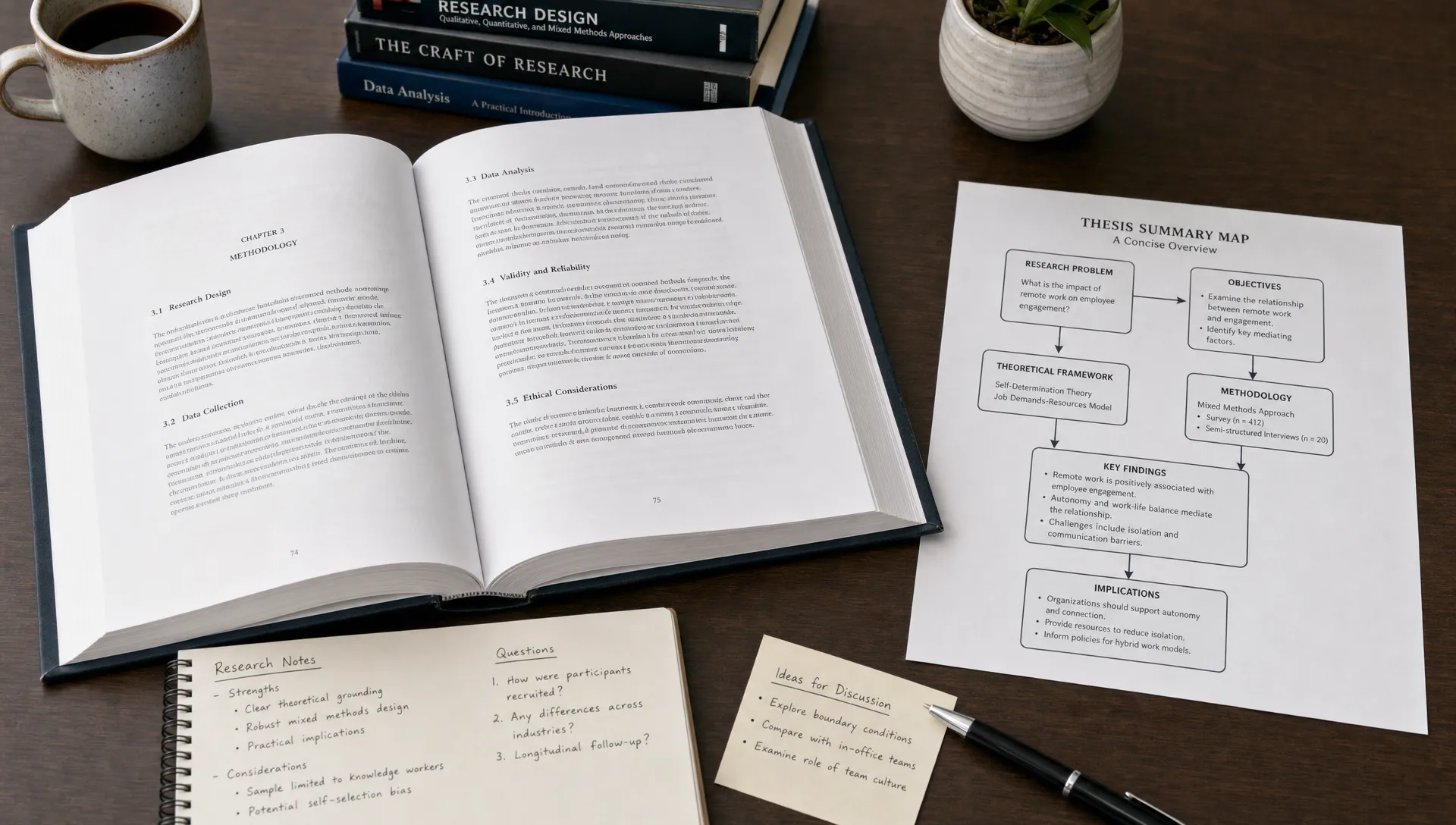
A clear thesis summary gives the reader a map of the work: the problem, the route taken, the evidence found, and the reason it matters. It should be concise, but not shallow. It should be accurate, but not overloaded with detail.
If you are stuck, do not begin by cutting paragraphs from the thesis. Start by identifying the core question, method, findings, and contribution. Once those pieces are clear, the summary becomes much easier to write.
For long PDFs or dense academic material, unrav.io can help you move from first-pass understanding to clearer notes and explanations. Use it as a support tool, then refine the final summary in your own words so it matches the thesis and serves your reader.