
How to Understand Research Papers Before You Summarize
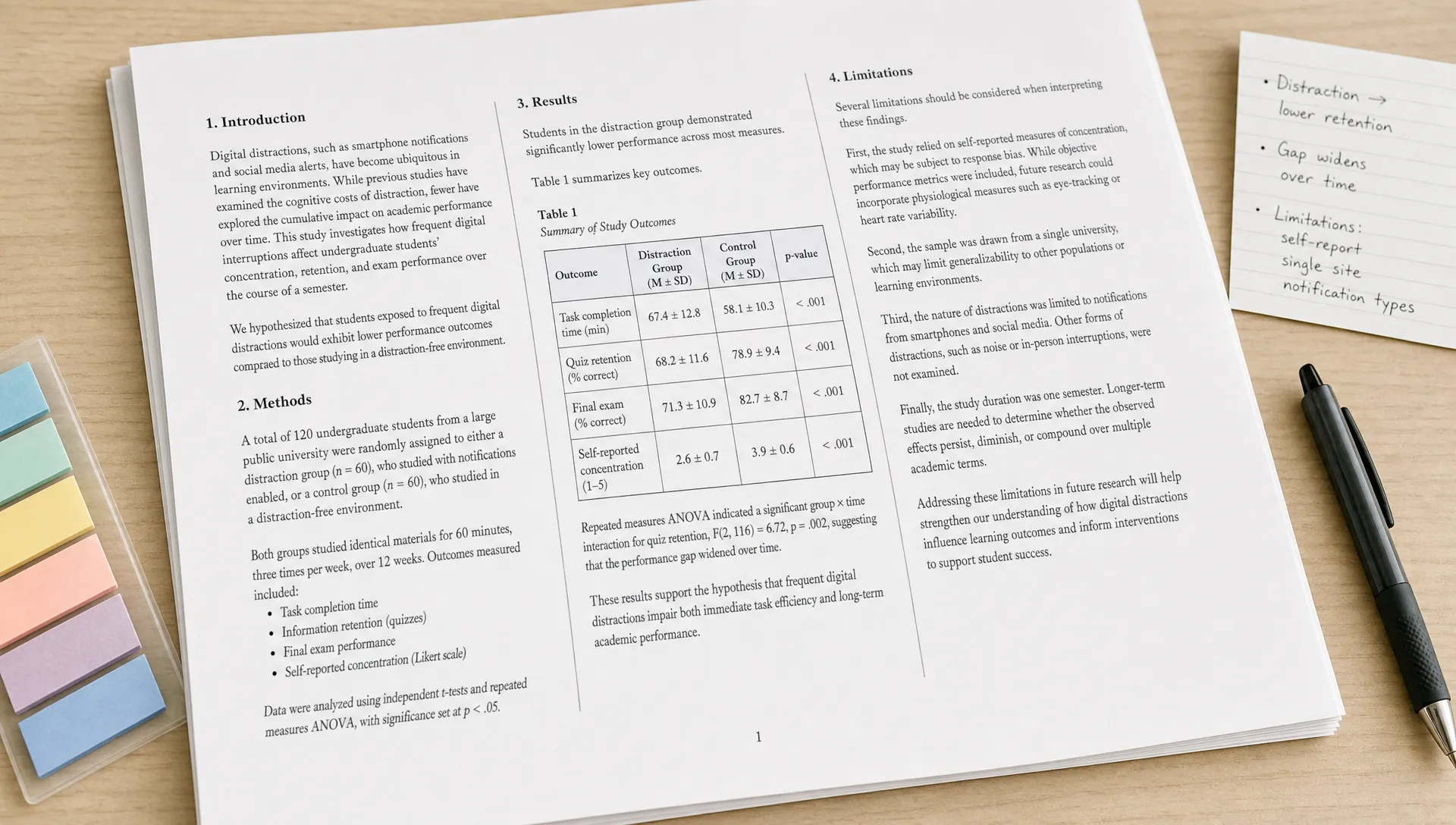
A research paper is not hard only because it is long. It is hard because it compresses a lot of decisions into a formal structure: what the authors chose to ask, what they measured, which assumptions they made, how they interpreted the results and what they left unresolved.
If you summarize too early, you often compress the paper before you understand it. The result may sound polished, but it can miss the actual contribution, flatten uncertainty or repeat the abstract without adding clarity.
This guide is about the step before summarizing. It will help you understand research papers well enough to create a summary that is accurate, useful and honest about what the paper does and does not show.
Why understanding comes before summarizing
A summary is not just a shorter version of a paper. It is a judgment about what matters most.
To make that judgment, you need to know more than the headline finding. You need to understand the research question, the method, the evidence, the limitations and the reason the paper exists in the first place. Without that, summarizing becomes a copy-and-compress exercise.
This is why shallow summaries can feel clear but still mislead. They may state the conclusion without explaining how the authors reached it, or they may ignore the conditions under which the conclusion applies. If you want a deeper explanation of that problem, unrav.io has a useful companion article on how summarizing falls short without real understanding.
Before you write a summary, aim to answer six basic questions:
- What problem is the paper trying to solve?
- What question or hypothesis guides the study?
- What did the authors actually do?
- What did they find?
- How strong is the evidence?
- What should a careful reader not overclaim?
If you can answer those in your own words, you are ready to summarize. If you cannot, you are probably still orienting yourself.
Start by identifying the paper’s purpose
Not every research paper is trying to do the same job. Some papers test a hypothesis. Some introduce a method. Some review a field. Some challenge an existing assumption. Others provide a dataset, framework or theoretical argument.
Before reading closely, ask: what kind of paper is this?
This one question changes how you read. If it is an empirical paper, you will pay close attention to the study design and results. If it is a review article, you will focus on how the authors organize the field and evaluate prior work. If it is a methods paper, the main value may be the technique, not a single finding.
Your own purpose matters too. A student preparing for an exam reads differently from a researcher building a literature review. A policy analyst may need the practical implication, while a content creator may need the central idea and a few careful examples.
| Your reason for reading | What to focus on first | What to avoid at first |
|---|---|---|
| Studying for a class | Main argument, key terms and instructor-relevant concepts | Getting lost in every citation |
| Writing a literature review | Research question, contribution, method and relationship to other papers | Treating the paper as an isolated fact |
| Evaluating evidence for work | Method, sample, assumptions, limitations and applicability | Quoting conclusions without checking context |
| Creating educational content | Core idea, examples, definitions and caveats | Oversimplifying beyond what the paper supports |
| Exploring a new field | Abstract, introduction, figures and repeated terminology | Reading linearly from page one with no map |
A summary written for exam prep will not look the same as a summary written for a research memo. Understanding starts with knowing what kind of understanding you need.
Read in layers, not from top to bottom
Many people try to read research papers like books: start at the first word, move sentence by sentence and hope everything becomes clear by the end. That can work for short essays, but it is often inefficient for academic papers.
Research papers are designed for selective reading. Their sections give you different kinds of information. You do not need to understand every detail on the first pass.
A practical approach is to read in layers. This is similar to S. Keshav’s well-known three-pass approach to reading research papers, where each pass gives you a different level of understanding.
On the first pass, you are not trying to master the paper. You are trying to build a map. Read the title, abstract, introduction headings, conclusion, figures and tables. Look for repeated terms. Notice what the paper seems to care about.
On the second pass, read the introduction, methods and results more carefully. Try to understand how the authors move from question to evidence. Do not worry if some technical details are still unclear.
On the third pass, focus on the parts that matter for your goal. That may be the statistical model, the theoretical framework, the experimental setup or the limitations section. This deeper pass is where you decide what the paper can reasonably support.
Layered reading prevents a common mistake: spending 40 minutes decoding a methods paragraph before you even know whether the paper is relevant.
Turn the abstract into questions
The abstract is usually the densest part of the paper. It compresses the problem, method, finding and significance into one short block. That makes it useful, but also easy to misunderstand.
Instead of treating the abstract as a mini-summary, turn it into a set of questions. For example, if the abstract says the paper “investigates the relationship between remote work and collaboration quality,” your questions might be:
- How do the authors define collaboration quality?
- What kind of remote work are they studying?
- Who or what is included in the sample?
- Is the relationship causal, correlational or descriptive?
- What evidence supports the conclusion?
This small shift makes you an active reader. You are no longer passively accepting the abstract. You are using it as a checklist for the rest of the paper.
When you later summarize, those questions help you avoid vague statements like “the paper is about remote work.” You can write something more precise, such as “the paper examines whether teams with more remote work days report lower collaboration quality, using survey responses from a specific workplace setting.”
Build a paper map before taking detailed notes
A paper map is a simple outline of what each section is doing. It is not a summary yet. It is a navigation tool.
This is especially useful for dense papers, interdisciplinary papers or papers outside your main area of expertise. Before you highlight heavily or copy notes into a document, map the structure.
| Paper section | Question to ask | What this prevents |
|---|---|---|
| Title | What topic and relationship does the paper signal? | Misreading the paper’s scope |
| Abstract | What claim is being previewed? | Treating compressed claims as full evidence |
| Introduction | What gap or problem motivates the study? | Missing why the paper was written |
| Literature review | Which prior ideas is the paper building on or challenging? | Summarizing the paper as if it appeared from nowhere |
| Methods | What did the authors do to generate evidence? | Trusting conclusions without checking support |
| Results | What was actually found? | Confusing findings with interpretation |
| Discussion | How do the authors explain the findings? | Repeating speculation as fact |
| Limitations | What weakens or narrows the claim? | Overgeneralizing the conclusion |
This map does not have to be long. A few phrases per section are enough. The goal is to know where the paper’s main moves happen before you compress it.
Separate claims, evidence and interpretation
One of the most important skills in reading research papers is separating what the paper claims from what it shows.
A claim is what the authors argue. Evidence is the data, observations, analysis or reasoning used to support that claim. Interpretation is what the authors think the evidence means.
Those three things are related, but they are not identical.
Imagine a paper finds that students who used a specific study technique scored higher on a test than students who did not. The claim may be that the technique is associated with better performance. The evidence may be a controlled classroom study. The interpretation may be that the technique improves retention.
A careful reader would still ask about sample size, assignment method, prior student ability, test design and whether the result applies outside that setting. The paper may be valuable, but the summary should not say “this technique always improves learning” unless the evidence supports that level of certainty.
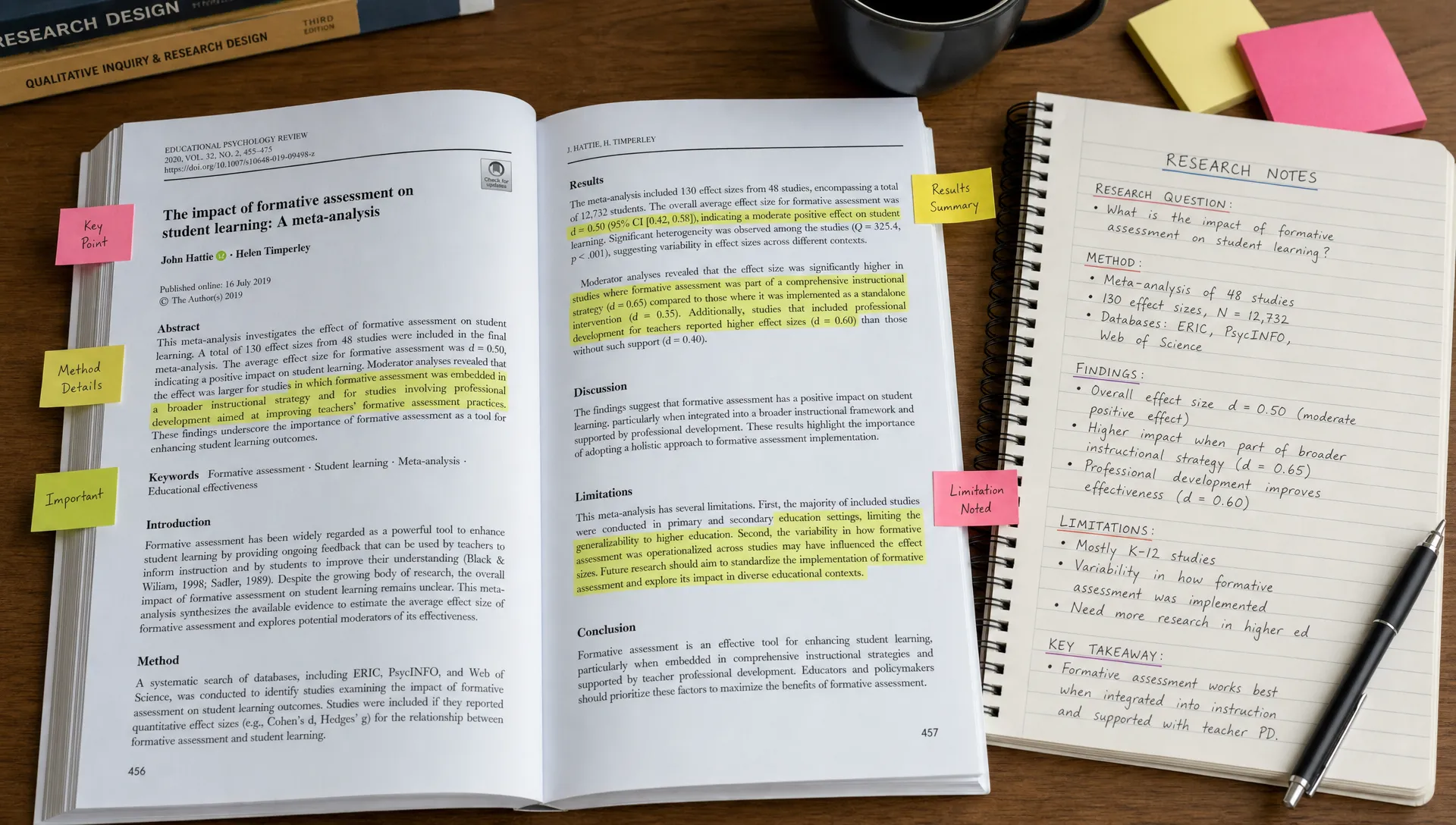
A useful pre-summary habit is to write three short lines:
Claim: The authors argue that...
Evidence: They support this by...
Interpretation: They suggest this means...
If those lines blur together, slow down. You may be summarizing the authors’ confidence rather than the paper’s actual support.
Check the method before trusting the conclusion
You do not need to become a statistician, lab scientist or field specialist to understand every paper. But you do need to understand the method well enough to know what kind of evidence the paper provides.
The method is where the paper earns its conclusion. It tells you what was measured, who or what was studied, how data was collected and how the authors analyzed it.
For different kinds of papers, focus on different method questions:
- In an experiment, ask what was manipulated, what was measured and whether comparison groups were appropriate.
- In a survey study, ask who responded, how questions were worded and whether the sample represents the group being discussed.
- In a qualitative study, ask how participants or materials were selected, how themes were identified and what evidence is quoted or described.
- In a computational paper, ask what dataset was used, what assumptions the model makes and how performance was evaluated.
- In a review or meta-analysis, ask how sources were selected, what was excluded and whether the review process was systematic.
You are looking for the shape of the evidence. A small exploratory study can still be useful, but it should not be summarized like a definitive answer. A model tested on one dataset may be promising, but its performance may not transfer to every real-world setting.
Good summaries preserve that distinction.
Translate technical language without removing precision
Many readers get stuck because research papers use specialized terms, dense noun phrases and cautious academic phrasing. The solution is not to strip away all technical language. The solution is to translate it carefully.
A term like “statistically significant” does not simply mean “important.” A phrase like “associated with” is not the same as “caused by.” “Participants” are not always the same as “patients,” “users,” “students” or “people in general.”
When you encounter a technical phrase, ask two questions. What does this mean in plain English? What precision would be lost if I simplified it too much?
For example, “X was associated with Y” can often be translated as “X and Y tended to appear together in the data.” That is clearer, but it still avoids claiming causation.
This is where AI can be helpful if used carefully. A tool like unrav.io can help reframe a dense PDF, link or pasted passage into a clearer explanation, for example by giving you a quick grasp of the paper or helping you understand it in a teach-it style. The key is to use the output as a reading aid, not as a replacement for checking the paper itself.
A good AI-assisted workflow looks like this: read the abstract and conclusion yourself, ask the tool to explain difficult sections, then return to the paper to verify the wording, evidence and limitations. That loop keeps you in control of the interpretation.
Make a pre-summary note
Before writing the actual summary, create a short pre-summary note. This is your comprehension checkpoint. It does not need polished language. It needs accuracy.
Use a simple structure like this:
Citation or paper title:
Topic:
Research question:
Why the question matters:
Type of paper:
Method or approach:
Main finding:
Evidence behind the finding:
Key limitation:
Terms I need to define:
What I still do not fully understand:
The last line is important. Acknowledging what you do not understand is part of serious reading. It tells you where to reread, what to ask a teacher or colleague and what not to overstate in your summary.
For students, this note can become a study guide. For researchers, it can become part of an annotated bibliography. For professionals, it can become the basis for a decision memo. For creators and educators, it can become the raw material for an outline, lesson or explainer.
Know when you are ready to summarize
You are ready to summarize when you can explain the paper without leaning on its exact sentences.
Try the one-minute test. Close the paper and explain it out loud or in writing. Do not aim for elegance. Aim for control.
A solid explanation usually sounds something like this:
This paper asks whether...
The authors study this by...
They find that...
The evidence comes from...
This matters because...
However, the conclusion is limited by...
If you can fill in those sentences accurately, you have the foundation for a useful summary. If you cannot, the issue is probably not writing. It is comprehension.
Once you reach that point, you can move into compression. If you want a practical process for the next stage, the guide on how to summarize a research paper without losing the point walks through how to turn understanding into a clear summary.
Common mistakes to avoid
Reading only the abstract and conclusion
The abstract and conclusion are helpful entry points, but they are not enough for careful summarizing. They usually present the paper at its highest level of confidence and compression. Without the methods and results, you may miss how narrow, tentative or context-specific the findings are.
Highlighting before you understand the structure
Highlighting can feel productive, but early highlighting often marks what sounds important rather than what is actually central. Build the paper map first, then highlight the parts that answer your main questions.
Copying the paper’s language into your notes
Academic sentences can sound authoritative even when you do not understand them. If your notes are mostly copied phrases, you may be postponing comprehension. Rewrite key ideas in your own words, then compare your version with the paper to make sure you did not distort the meaning.
Treating limitations as an afterthought
Limitations are not a weakness to hide. They are part of the meaning of the paper. A summary that includes one clear limitation is usually more trustworthy than one that presents the finding as universal.
Confusing relevance with agreement
A paper can be useful even if you disagree with its interpretation. Understanding a paper means grasping what it contributes, how it argues and where it fits. You do not need to accept every conclusion to summarize it fairly.
Frequently Asked Questions
How long should I spend understanding a research paper before summarizing it? It depends on the paper and your goal. For a familiar topic, 20 to 30 minutes may be enough to build a basic map. For a dense or important paper, you may need several passes. Spend more time when the summary will support a grade, decision, literature review or public-facing explanation.
Can I summarize a research paper after reading only the abstract? You can create a very rough overview from the abstract, but not a reliable summary. The abstract usually does not give enough detail about methods, evidence, uncertainty or limitations. For serious work, check at least the introduction, methods, results and conclusion.
What should I do if I do not understand the methods section? Start by identifying the basics: what was studied, what was measured, how data was collected and how the authors judged results. If the technical analysis is beyond you, note that honestly and use trusted references, instructors, colleagues or careful AI reframing to clarify the specific terms.
Can AI help me understand research papers? Yes, AI can help explain dense passages, define terms, reframe arguments and create study notes. It should not replace your own reading, especially for methods, findings and limitations. Always compare AI-generated explanations with the original paper.
What is the difference between understanding and summarizing a paper? Understanding means you can explain the paper’s question, method, evidence, conclusion and limits. Summarizing means you can compress that understanding for a specific audience or purpose. Good summarizing depends on prior understanding.
Take the next step
Before your next research paper summary, do one thing differently: pause before writing and make a paper map. Identify the question, method, main finding, evidence and limitation in your own words.
That small step changes the quality of the summary. It helps you avoid vague abstracts, unsupported claims and overconfident conclusions.
If you are working through dense PDFs, academic articles or technical material, unrav.io can help you reframe complex content into clearer views while you stay responsible for the final understanding. Use it to get oriented, explain difficult sections and turn reading into notes you can actually use.