
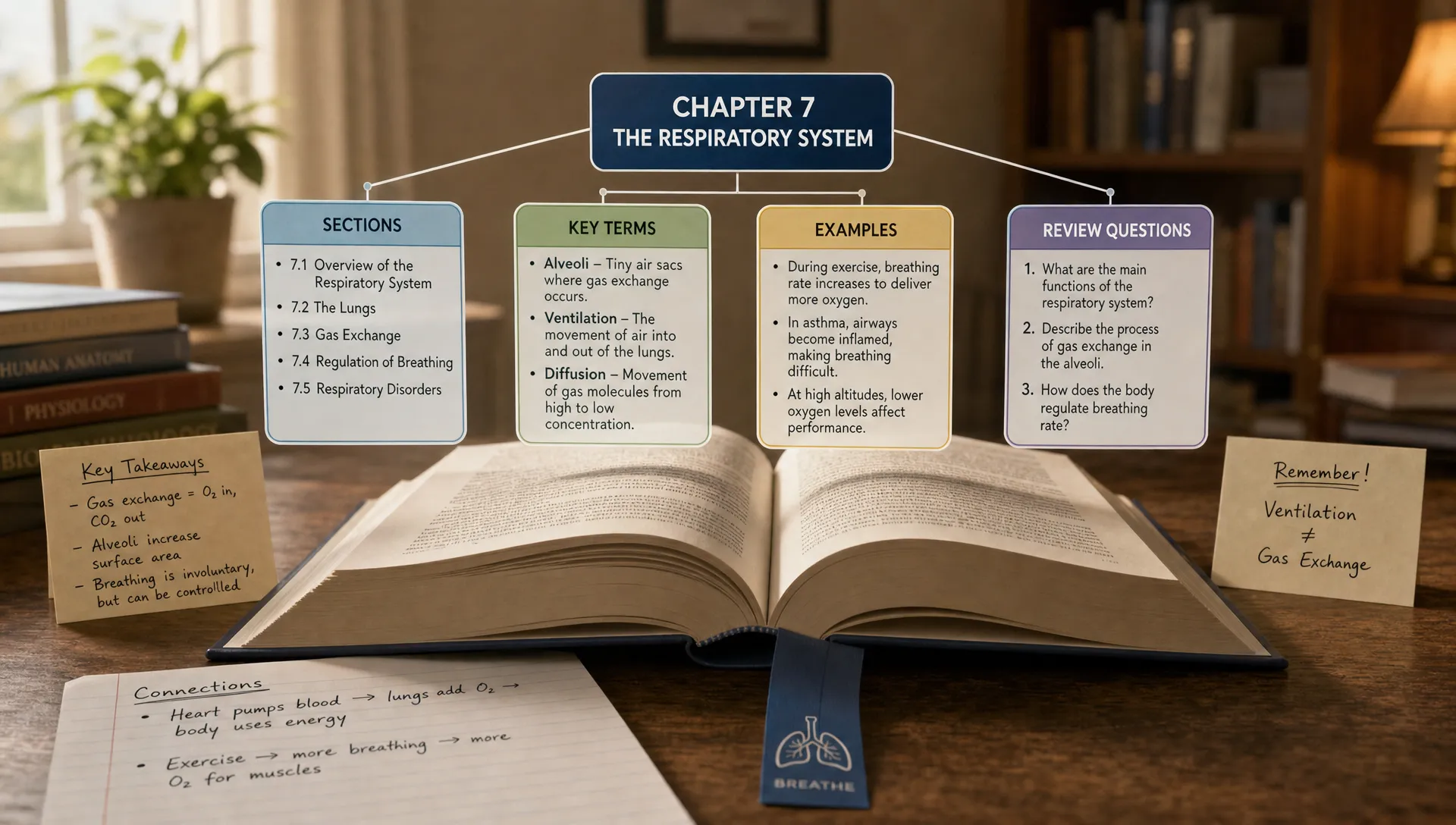
How to Summarize a Chapter for Better Studying
If you have ever looked at a long textbook chapter and thought, “Can someone summarize a chapter for me so I can actually study it?”, you are not alone. Chapters can be dense, repetitive, and full of details that feel equally important while you are reading.
But a useful chapter summary is not just a shorter version of the chapter. For studying, the goal is to create something you can review, explain, and use later in an exam, discussion, essay, or project. That means your summary should capture the structure of the chapter, the main ideas, the key evidence, and the concepts you still need to understand.
Here is a practical method you can use for textbooks, assigned readings, nonfiction books, course packets, PDFs, and long online chapters.
What a good chapter summary should do
A chapter summary for studying has a different job than a summary written for someone who only wants the gist. If you are studying, you need enough detail to remember the argument, connect ideas, and answer questions later.
A strong chapter summary should help you:
- Understand what the chapter is mainly about
- See how the ideas are organized
- Identify key terms, people, events, theories, formulas, or examples
- Separate core ideas from supporting details
- Prepare for quizzes, exams, discussions, or writing assignments
- Notice what you still do not understand
The most common mistake is summarizing too early. If you try to summarize every paragraph as you read, you may end up copying sentences instead of learning. A better approach is to read in sections, pause, and write the point in your own words.
This matters because summarizing without understanding can create notes that look useful but do not help you think. If you want to go deeper on that problem, unrav.io has a helpful explanation of why summarizing falls short without real understanding.
Start by deciding why you are summarizing
Before you write anything, ask one simple question: what will I use this summary for?
Your purpose changes what you should include. A student preparing for a multiple-choice exam needs definitions, distinctions, dates, and examples. A student preparing for an essay needs arguments, themes, evidence, and connections between chapters. A researcher reading a book chapter may care about the author’s framework, assumptions, sources, and contribution to a field.
Here is a quick way to choose your focus:
| Study goal | What your summary should emphasize |
|---|---|
| Exam preparation | Key terms, definitions, examples, comparisons, likely test points |
| Class discussion | Main argument, important passages, questions, disagreements |
| Essay writing | Thesis, evidence, themes, useful quotes, links to other readings |
| Research | Method, framework, claims, limitations, relationship to other sources |
| Teaching or presentation | Simple explanation, sequence of ideas, memorable examples |
Once you know your purpose, you can stop treating every sentence as equally important. That alone makes the chapter easier to handle.
How to summarize a chapter step by step
Use this process when you need a summary that is short enough to review but detailed enough to study from.
- Preview the chapter before reading closely: Look at the title, introduction, section headings, bold terms, charts, images, conclusion, and review questions. This gives you a rough map of where the chapter is going.
- Write the chapter’s central question: Most chapters are trying to answer something, even if it is not written as a question. For example, “Why did this movement succeed?”, “How does this biological process work?”, or “What problem does this theory solve?”
- Read one section at a time: After each section, stop and write one sentence that explains the main point. Do not copy the textbook unless you are saving an exact definition or quote.
- Mark key terms and concepts: Write down terms that are repeated, defined, used in headings, or connected to diagrams and examples. Include short definitions in your own words.
- Capture evidence and examples: For each major idea, note one or two examples, facts, studies, events, formulas, or cases that support it. These details make the summary useful for exams and essays.
- Identify how the sections connect: Ask whether the chapter is moving chronologically, comparing ideas, building an argument, explaining a process, or showing cause and effect.
- Write the summary from memory first: Close the book or PDF and explain the chapter in a few paragraphs. Then reopen the chapter to check what you missed.
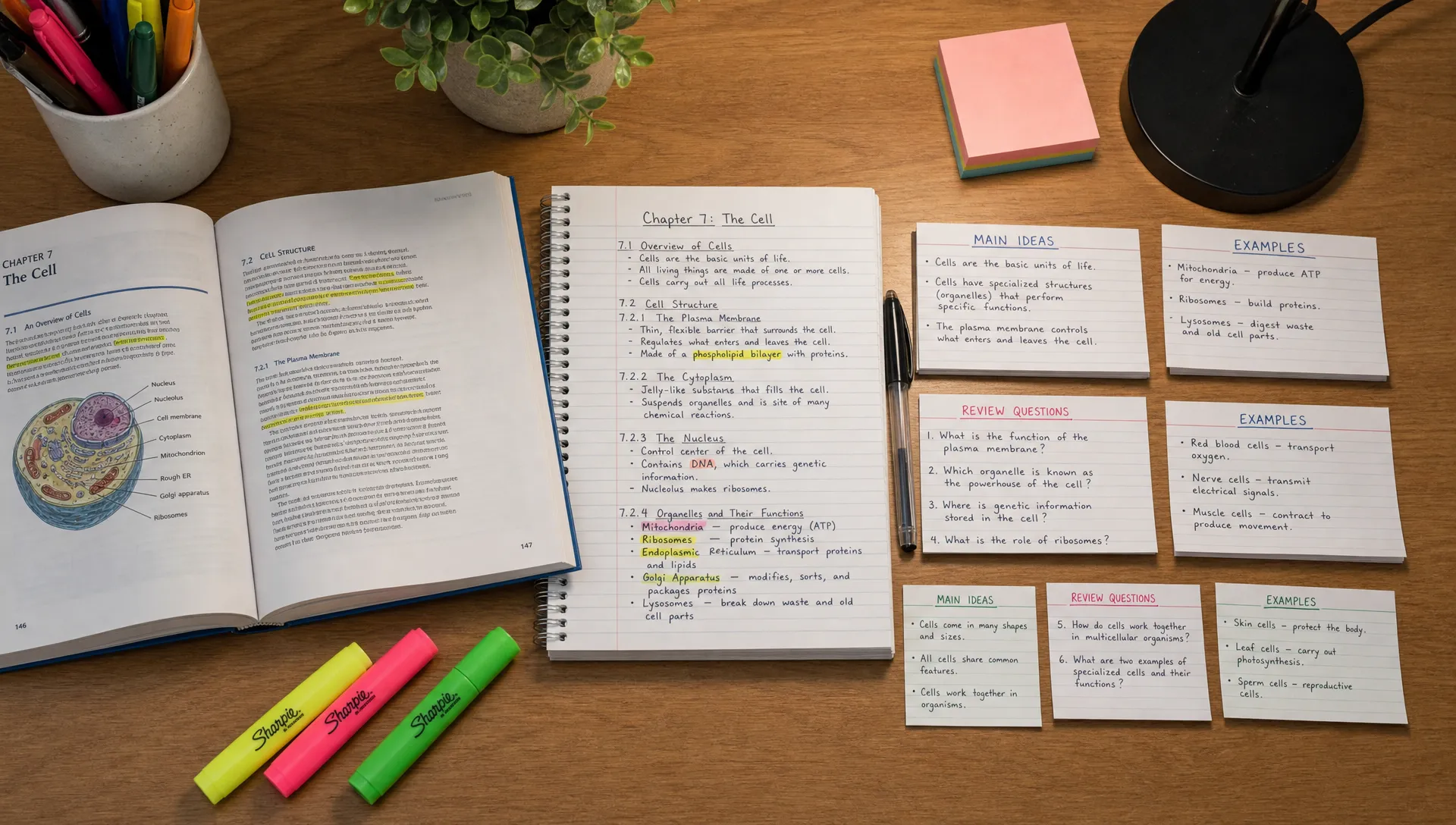
- Compress the summary into a study format: Turn the summary into review notes, flashcards, questions, a concept map, or a short teaching script.
The “from memory first” step is especially important. It forces retrieval, which is one of the most reliable ways to strengthen learning. You are not just storing information, you are practicing getting it back.
A simple chapter summary template
You do not need a complicated format. In fact, the best study summaries are usually consistent and easy to scan. Use the same structure each time so your notes become predictable.
Try this template:
| Section | What to write |
|---|---|
| Chapter title and topic | What the chapter is about in one sentence |
| Main idea | The central claim, lesson, process, or argument |
| Key concepts | Important terms with short definitions |
| Structure | How the chapter is organized |
| Supporting details | Examples, evidence, cases, events, formulas, or studies |
| Connections | Links to earlier chapters, lectures, assignments, or real-world cases |
| Questions | What you still do not understand or need to review |
| One-paragraph summary | A clean version you can reread before class or an exam |
Here is what that might look like in a short example:
Chapter topic: The causes of urbanization during industrialization.
Main idea: Industrialization changed where people lived and worked by concentrating jobs, transportation, and economic opportunity in cities.
Key concepts: Urbanization, industrial labor, migration, public health, infrastructure.
Supporting details: Factory work attracted rural workers, railways connected markets, cities grew faster than housing and sanitation systems could adapt.
One-paragraph summary: The chapter explains how industrialization accelerated urban growth by creating new factory jobs and concentrating economic activity in cities. It shows that urbanization was not only a demographic change but also a social and political challenge, since rapid population growth strained housing, sanitation, transportation, and public health systems.
Notice that this example does not include every detail. It keeps the chapter’s main logic visible.
How long should a chapter summary be?
The right length depends on the chapter and your goal, but shorter is usually better once you have understood the material.
For a typical textbook chapter, aim for:
- 5 to 8 bullet points for a quick review summary
- 1 to 2 pages for detailed study notes
- 1 paragraph for a final exam review version
- 5 to 10 questions if you are turning it into active recall practice
A good rule is to create two versions. First, write a fuller summary while the material is fresh. Then, after a day or two, reduce it into a shorter review sheet. The second version is often better because you can see which ideas actually matter.
If your summary is almost as long as the chapter, it is probably not a summary. If it is so short that you cannot explain the chapter after reading it, it is too thin.
Use AI to help, but do not outsource your thinking
AI tools can help when a chapter feels overwhelming, especially if it is in a PDF, online reading, transcript, or pasted text. The key is to use AI for comprehension and organization, not as a substitute for learning.
For example, instead of asking only “summarize a chapter for me,” ask for a study-focused output:
Summarize this chapter for studying. Identify the main idea, key concepts, section-by-section points, important examples, and 5 review questions. Keep the language simple and note anything that seems important for an exam.
You can also ask different follow-up questions depending on your goal:
- “Explain this chapter as if I am new to the topic.”
- “Turn this chapter into active recall questions.”
- “What are the most likely exam points?”
- “What are the author’s main claims and supporting evidence?”
- “What concepts should I compare with earlier chapters?”
This is where a tool like unrav.io can fit into a study workflow. It is designed to help you reframe content in different ways, such as getting a quick grasp, teaching the material back, or understanding PDFs, videos, podcasts, links, and pasted text. That is useful when you do not just want a shorter text, but a clearer way to think about the material.
Still, always check the output against the assigned chapter. AI can miss nuance, overemphasize less important points, or simplify something your instructor expects you to know precisely.
Turn your chapter summary into study material
A chapter summary becomes much more useful when you convert it into practice. Rereading a summary can help, but active studying usually works better.
Here are practical ways to reuse your summary:
- Turn headings into questions and answer them without looking
- Make flashcards for key terms, formulas, dates, theories, or distinctions
- Create a one-page review sheet before an exam
- Compare the chapter with a lecture, article, or previous reading
- Teach the chapter aloud in three minutes
- Write a short paragraph explaining why the chapter matters
For example, if your summary says, “The chapter explains three causes of inflation,” turn that into: “What are the three causes of inflation explained in the chapter, and how are they different?”
If your summary says, “The author criticizes earlier theories of motivation,” turn that into: “Which theories does the author criticize, and what alternative explanation is offered?”
This small shift changes your notes from storage into practice.
Common mistakes to avoid
The biggest problem with chapter summaries is not that students write too little. It is that they write the wrong kind of summary.
Avoid these mistakes:
- Copying long sentences without translating them into your own words
- Listing facts without explaining how they connect
- Ignoring section headings and chapter structure
- Keeping examples but missing the main idea they support
- Writing a summary before you understand the chapter
- Depending only on AI output without checking the original text
- Making notes that are neat but not useful for recall
Another common issue is treating all readings the same. A textbook chapter, academic article, scientific paper, and thesis chapter require different summary strategies. If your assigned reading is closer to a scholarly article than a textbook chapter, you may find this guide on how to summarize an academic article step by step more relevant.
A quick checklist before you finish
Before you call your chapter summary done, test it with a few questions:
- Can I explain the chapter’s main idea without looking?
- Do I know the most important terms?
- Can I describe how the chapter is organized?
- Did I include examples or evidence, not just vague claims?
- Do I know what might appear on a quiz or exam?
- Did I write down what I still need to clarify?
If you can answer these, your summary is probably doing its job. If not, return to the chapter and strengthen the weak spots.
Frequently Asked Questions
What is the fastest way to summarize a chapter? Preview the headings, read the introduction and conclusion, then summarize each major section in one sentence. After that, combine those sentences into a short paragraph and add key terms, examples, and review questions.
Should I summarize a chapter before or after reading it? You can preview before reading, but the real summary should come after you understand each section. Writing the final version from memory after reading helps you test what you actually learned.
How detailed should a chapter summary be for studying? It should include the main idea, key concepts, structure, important examples, and questions for review. For most chapters, one to two pages of detailed notes and one shorter review paragraph work well.
Can AI summarize a textbook chapter accurately? AI can help create a first draft, simplify difficult language, and organize ideas, but you should still compare the summary with the original chapter. This is especially important for technical material, assigned readings, or anything that will be graded.
Is summarizing enough to study for an exam? Not usually. Summarizing helps you understand and organize material, but you should also practice retrieval through questions, flashcards, teaching, and practice problems.
Make your next chapter easier to study
A good chapter summary is not just shorter. It is clearer, more organized, and easier to review. Start with the chapter’s purpose, break it into sections, write the main ideas in your own words, and turn the result into questions you can practice later.
If the chapter is long, dense, or trapped inside a PDF, transcript, article, or pasted text, unrav.io can help you get a clearer first pass and reframe the material for studying. Use it as a reading companion, then bring your own judgment, course goals, and instructor expectations to the final summary.