
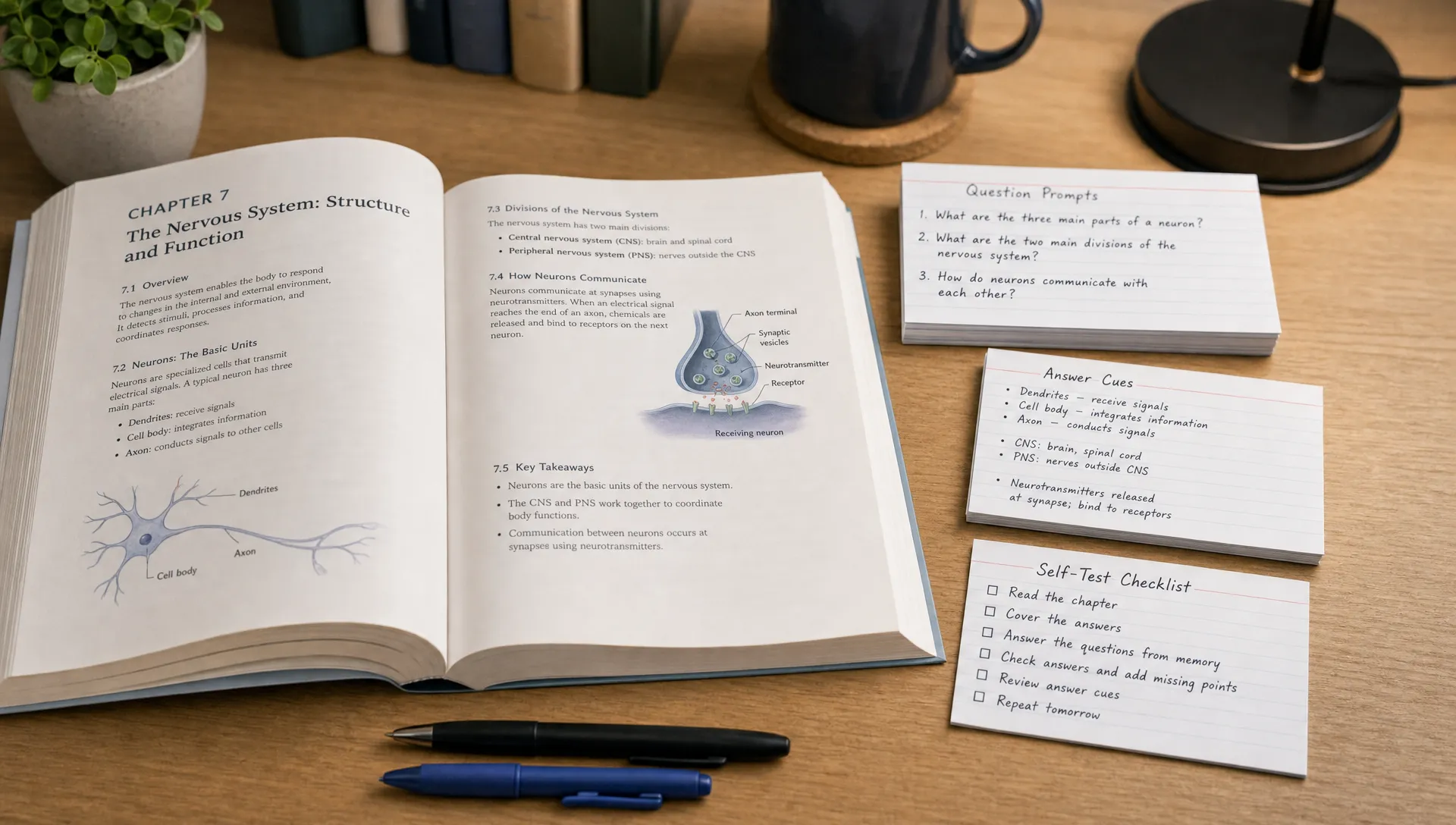
How to Choose a Study Guide Generator That Aids Recall
Most study guides look helpful when you first create them. The real test comes later, when the notes are closed and you have to explain the material from memory.
That is where many tools fall short. A basic study guide generator can condense a chapter, article, lecture, PDF, or research paper into cleaner notes. A better one helps you practice recall, spot weak areas, and rebuild the ideas in your own words.
If you are choosing a study guide generator for school, research, training, or professional learning, do not judge it only by how polished the summary looks. Judge it by whether it helps you remember, retrieve, and use the material later.
Why recall should matter more than summary length
A short summary feels useful because it reduces the reading burden. But recognition is not the same as recall. You can reread a clean summary and feel familiar with the topic, then struggle when asked to explain it without looking.
Recall is different. It forces your brain to retrieve information, connect it to context, and notice gaps. That is why a recall-focused study guide should create prompts, questions, examples, and review cues, not just paragraphs of compressed text.
Research on learning supports this. In a widely cited review, Dunlosky and colleagues found that practice testing and distributed practice are among the most effective learning techniques for many students and subjects. You can read the full review on effective learning techniques for more detail.
This does not mean summaries are useless. A summary is a starting point. It helps you understand the landscape before you test yourself. But if a tool stops at summarization, it may help you feel prepared without actually improving memory.
A stronger study guide generator should help you move through three stages:
- Understand the source well enough to know what matters.
- Convert key ideas into questions, explanations, and relationships.
- Review the material in a way that reveals what you can and cannot recall.
What a recall-focused study guide generator should produce
The best output depends on your source and goal. A student preparing for an exam needs different guidance than a founder reading a market report, a researcher comparing papers, or a content creator repurposing a webinar.
Use this table as a quick way to match source type to study guide format.
| Source type | Useful study guide elements | Why it helps recall |
|---|---|---|
| Textbook chapter | Key terms, section summaries, exam-style questions, worked examples | Helps you test concepts instead of rewriting the chapter |
| Research paper | Research question, method, variables, findings, limitations, critique prompts | Helps you remember the argument and evaluate the evidence |
| Lecture or YouTube video | Timeline of ideas, definitions, examples, follow-up questions | Helps you recover the logic of the lesson after watching |
| Business report | Main claims, metrics, risks, decisions, action questions | Helps teams discuss and apply the information |
| Long article or essay | Thesis, supporting arguments, counterpoints, discussion prompts | Helps you explain the piece without rereading every paragraph |
For textbook-heavy workflows, it can also help to learn how to summarize a chapter for better studying before turning that summary into recall prompts.
The most important criteria when choosing a study guide generator
A study guide generator should save time, but speed alone is not enough. If it creates vague notes, misses important context, or invents unsupported claims, it can slow you down later.
Here are the criteria that matter most when your goal is recall.
1. It stays grounded in the source
A useful study guide should make it clear where the important ideas came from. This is especially important for research papers, legal reading, technical documentation, academic articles, and dense reports.
Look for outputs that preserve the source's structure. For example, if you upload a paper, the guide should distinguish the research question from the method, results, discussion, and limitations. If you provide a video, it should not flatten the entire talk into generic takeaways.
Source grounding also helps you check accuracy. AI can be useful for comprehension, but it should not replace your judgment. You still need to verify claims, especially when studying for high-stakes exams or making professional decisions.
2. It turns information into questions
A recall-focused guide should include questions that make you retrieve information. Good questions ask for explanation, comparison, application, or critique.
Weak questions often look like this: What is photosynthesis? That may be fine for a definition, but it does not always test understanding.
Better questions might ask: Why does photosynthesis depend on both light reactions and the Calvin cycle? How would plant growth change if light intensity increased but carbon dioxide stayed limited?
For nonacademic material, the same principle applies. If you are reviewing a strategy report, a good guide might ask: What assumptions does this recommendation depend on? What evidence would change the decision?
3. It supports multiple levels of understanding
Sometimes you need a quick overview. Sometimes you need to teach the topic, debate it, or apply it to a project. A good study guide generator should let you reframe the same material at different depths.
For example, a student might start with a quick grasp of a biology chapter, then ask for teach-it explanations, then generate exam questions. A researcher might first extract the paper's claim, then compare methods across studies. A professional might turn a dense PDF into briefing notes, then into decision questions for a meeting.
This is also what separates a simple summarizer from a deeper AI study tool. If you want a broader evaluation framework, this guide on what makes a good AI study tool for deep learning explains why comprehension features matter more than neat notes alone.
4. It works with the formats you actually use
Before choosing a tool, list the sources you study most often. Many people do not only learn from clean web articles. They learn from PDFs, lecture slides, YouTube videos, podcasts, newsletters, transcripts, scanned readings, and messy copied text.
Students may need support for textbook chapters and PDFs. Researchers may need long papers and citation-heavy articles. Professionals may need reports, meeting documents, and industry analysis. Content creators may need to convert podcasts, interviews, or webinars into outlines and scripts.
Professional readers can benefit from this too. For instance, a small business owner reviewing a technical marketing audit from an SEO partner such as SEO Bridge could use a study guide workflow to turn recommendations into key terms, action questions, and follow-up items.
The point is simple: choose a study guide generator that fits your real inputs, not an idealized version of your workflow.
5. It makes relationships visible
Recall improves when ideas are connected. If a guide lists facts without showing relationships, you may memorize fragments but miss the structure.
Look for features or outputs that show cause and effect, hierarchy, comparisons, arguments, sequences, and dependencies. This is especially useful when studying systems, theories, frameworks, or debates.
For visual learners, concept maps can be a strong complement to study guides. If your material feels tangled rather than simply long, you may want to pick a concept map creator for study and research alongside your study guide workflow.
Features that look useful but may not aid recall
Some features make a tool feel impressive without improving learning. They are not necessarily bad, but they should not be the reason you choose a generator.
| Feature | Why it can be misleading | What to look for instead |
|---|---|---|
| Very long summaries | They may reproduce the source in shorter form without helping memory | Concise summaries plus recall questions |
| Polished wording | Smooth writing can hide missing nuance | Clear structure and source-grounded points |
| Instant flashcards | Flashcards can be too shallow if they only test definitions | Application, comparison, and explanation prompts |
| One-click outputs | Fast generation may skip your learning goal | Adjustable depth and format options |
| Generic templates | They may ignore the type of source | Templates matched to chapters, papers, videos, or reports |
The best tools make you do some thinking. That may sound less convenient, but it is the point. A generator should reduce friction, not remove the mental work that creates learning.
Run a 10-minute test before committing to a tool
You do not need weeks to evaluate a study guide generator. Use one dense source and test whether the output actually helps you recall.
- Choose one representative source: Pick a chapter, article, PDF, paper, or video similar to what you study every week.
- Generate a study guide: Ask for key ideas, structure, terms, and recall questions.
- Close the source: Answer the questions without looking at the original material.
- Check your gaps: Reopen the source and mark what you missed, misunderstood, or could not explain.
- Revise the guide: See whether the tool lets you refine the output into better questions, examples, or explanations.
A good tool will expose gaps without making you feel lost. A weak tool will give you notes that look complete but do not help you answer anything from memory.
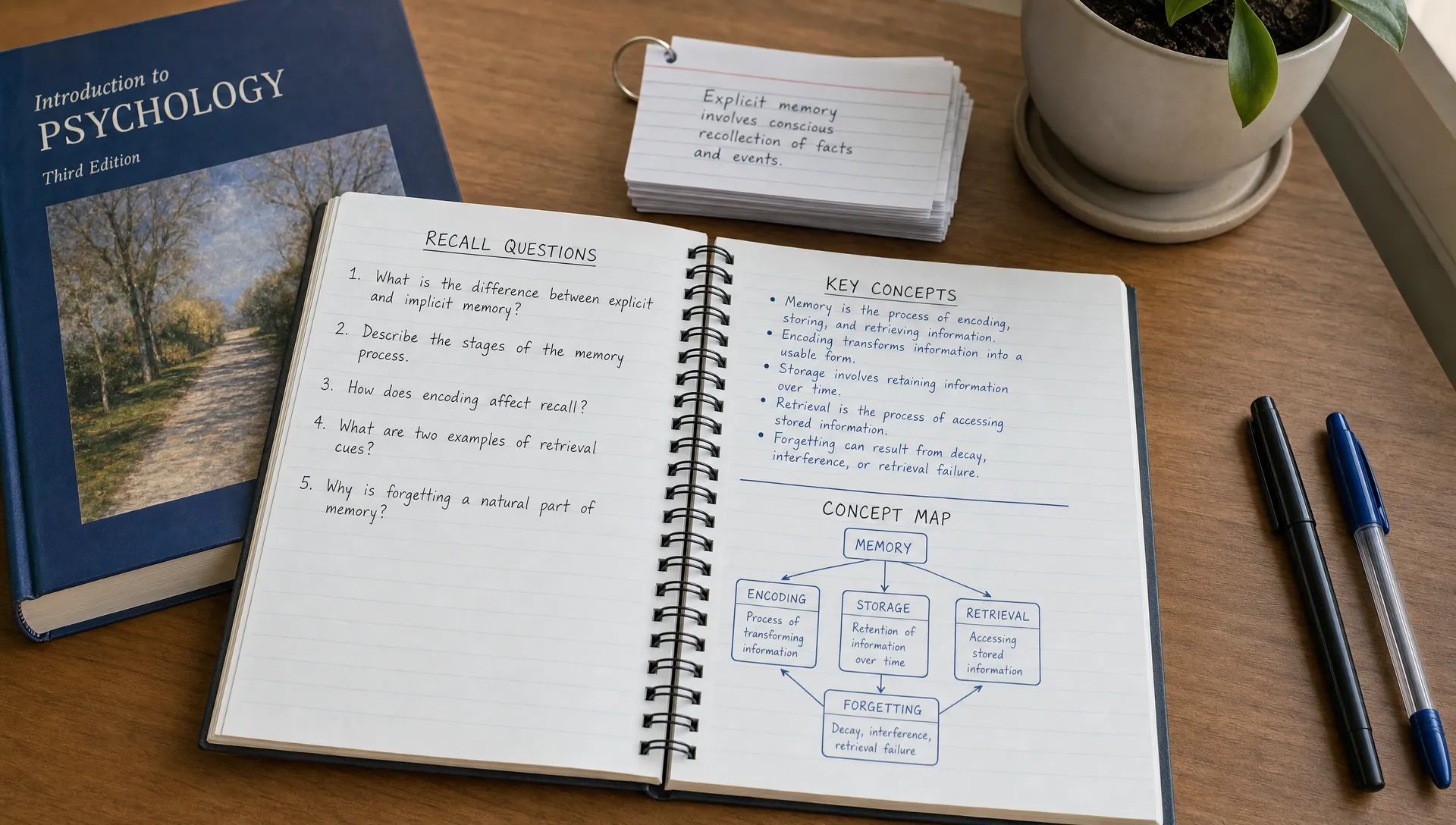
How unrav.io fits into a recall-centered workflow
unrav.io is designed as an AI-powered reading companion for people who need to understand complex content, not just shorten it. You can use it with articles, PDFs, YouTube videos, podcasts, links, or pasted text, then reframe the material depending on your goal.
That matters because recall often requires more than one view of the same source. You might begin with a quick grasp to understand the main argument. Then you might switch into a deeper explanation mode to unpack confusing sections. After that, you can use a teach-it style approach to see whether you can explain the material simply.
For students, this can turn long readings into more useful review material. For researchers, it can help separate claims, methods, and limitations. For knowledge workers, it can make dense reports easier to discuss. For creators and educators, it can turn complex material into outlines, teaching notes, or clearer explanations.
The important limitation is that you should still review the original source when accuracy matters. AI can help you find structure, clarify meaning, and create study prompts, but it should not be treated as the final authority.
A simple decision framework
If you are comparing several tools, do not start with the feature list. Start with the kind of recall you need.
| Your goal | Choose a generator that emphasizes |
|---|---|
| Pass an exam | Practice questions, key terms, examples, spaced review prompts |
| Understand research | Methods, evidence, limitations, critique questions |
| Prepare a presentation | Teach-it explanations, outlines, analogies, audience questions |
| Review professional documents | Decisions, risks, assumptions, action items |
| Learn from videos or podcasts | Segment summaries, timestamps or sections, follow-up prompts |
| Connect ideas across sources | Concept mapping, comparison tables, thematic grouping |
If a tool cannot adapt to your goal, it may still be a useful summarizer. But it may not be the best study guide generator for recall.
Common mistakes to avoid
The biggest mistake is choosing the tool that produces the prettiest output. Clean formatting is helpful, but memory depends on retrieval, feedback, and repetition.
Another common mistake is generating too much. If your study guide becomes almost as long as the original source, you have created another reading assignment. A good guide should focus your attention on what you need to understand, recall, and apply.
Be careful with flashcards as well. They are useful when designed well, but weak flashcards can reduce complex ideas to isolated facts. Mix definition cards with prompts that ask you to explain why something matters, compare two ideas, or apply a concept to a new case.
Finally, do not skip review. A guide created once and never revisited is usually less effective than a shorter guide used repeatedly. Recall improves when you return to the material after some time has passed.
Frequently Asked Questions
What is a study guide generator? A study guide generator is a tool that turns source material such as chapters, PDFs, articles, videos, or notes into organized study material. The best ones include summaries, key terms, questions, examples, and review prompts.
How is a study guide generator different from a summarizer? A summarizer shortens content. A study guide generator should also help you learn from it by creating structure, recall questions, explanations, and review cues.
Can AI-generated study guides replace reading the source? Not for important material. They can help you understand and review faster, but you should still check the original source for nuance, evidence, and accuracy.
What features help recall the most? Look for active recall questions, source-grounded summaries, concept relationships, adjustable depth, and prompts that ask you to explain ideas in your own words.
Should students use flashcards or study guides? Both can help. Study guides are better for structure and understanding, while flashcards are useful for repeated retrieval. The strongest workflow often combines the two.
Take the next step
The right study guide generator should make you more active, not more passive. It should help you understand the source, ask better questions, and test what you can recall without looking.
If you want to try this workflow with real material, open a dense article, PDF, video, podcast, or pasted text in unrav.io and reframe it into a clearer learning path. Start with a quick grasp, move into deeper explanation, then turn the material into questions you can answer from memory.