How a Brain Map Maker Can Help You Connect Ideas Faster
Long content does not only create a time problem. It creates a connection problem.
You can read an article, watch a lecture, skim a PDF, and still feel stuck because the ideas are scattered across paragraphs, examples, definitions, and side notes. A summary may tell you what the content says, but it may not show how the pieces fit together.
A brain map maker helps with that missing layer. Instead of leaving you with a flat block of notes, it turns ideas into a visual structure, with main concepts, supporting points, examples, and relationships arranged so you can see the logic faster.
For students, that can mean studying a chapter without rewriting every section. For researchers, it can mean seeing how a paper connects theory, method, evidence, and limitations. For professionals and creators, it can mean turning a dense report or long video into a clear set of ideas you can use.
What a brain map maker actually does
A brain map maker, in this context, is a tool that helps you create a visual map of ideas. It is often similar to a mind map maker or concept map tool, but the goal is not just to make notes look nicer. The goal is to reveal structure.
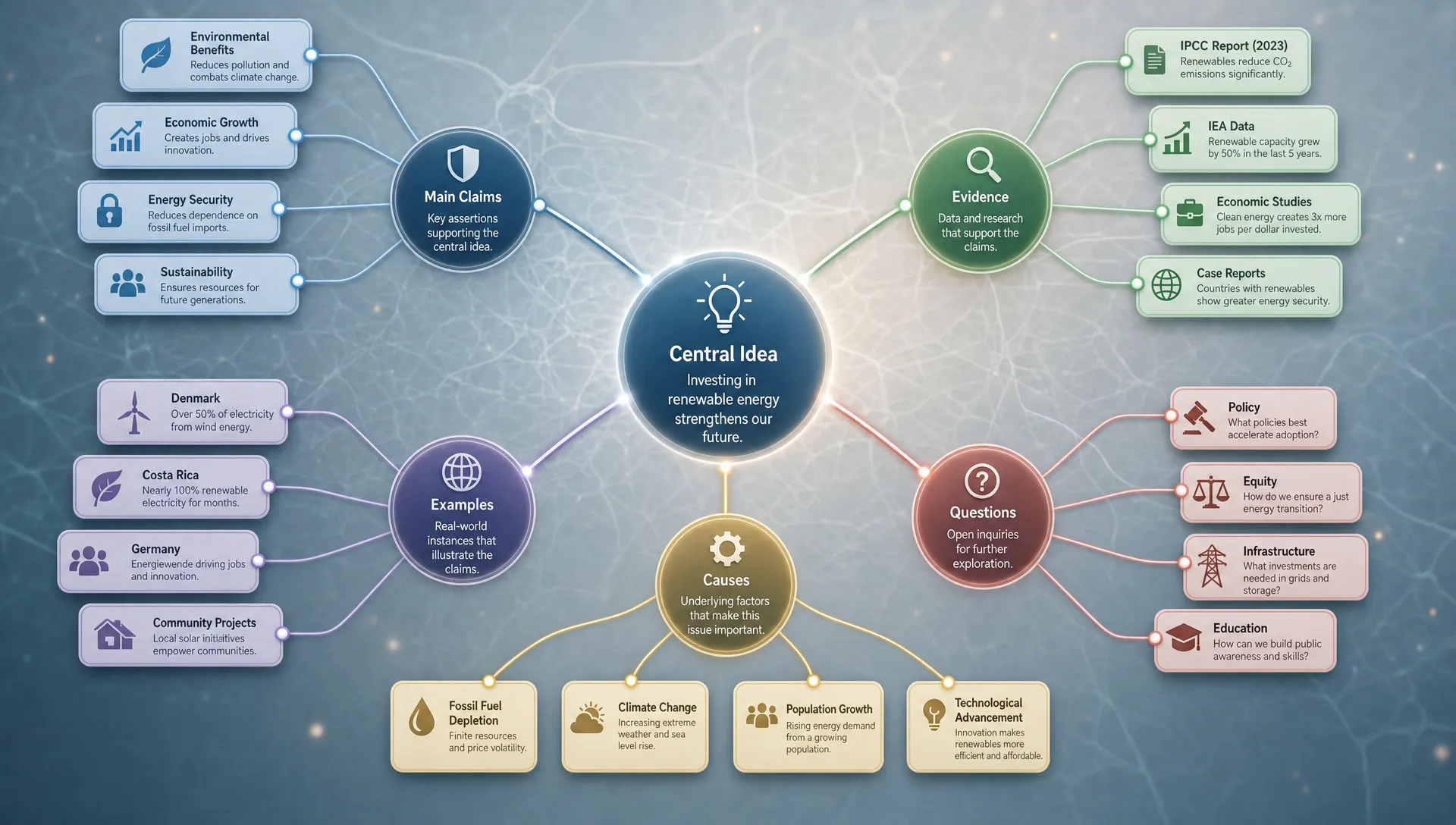
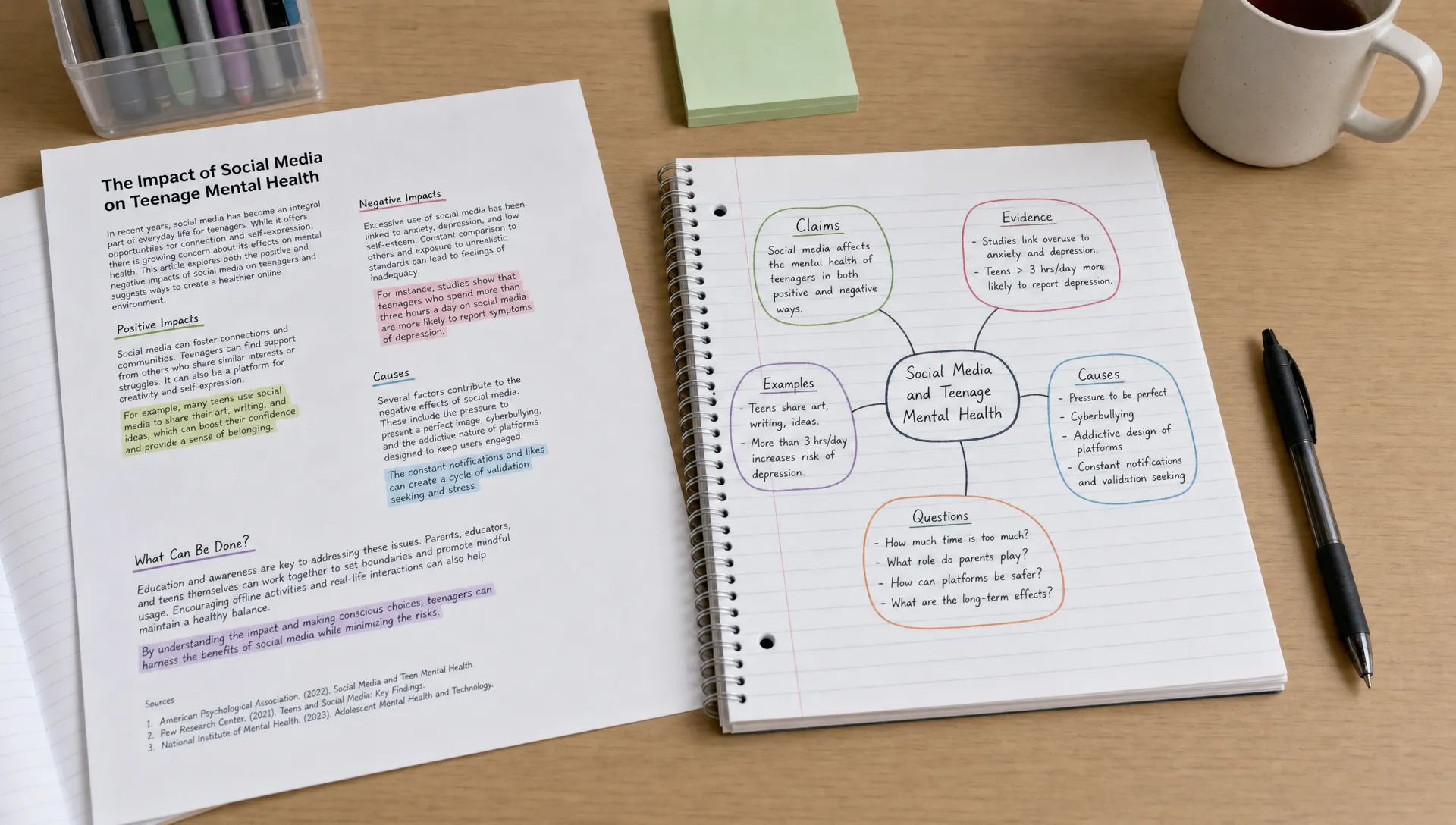
A useful brain map usually includes a central topic and connected branches such as definitions, claims, evidence, examples, objections, causes, effects, and next questions. Some maps are radial, with ideas branching outward from a center. Others look more like networks, where related ideas connect across sections.
This matters because complex material is rarely linear in the way your understanding develops. A research paper may introduce a concept in the literature review, test it in the methods section, discuss it in the findings, and qualify it in the limitations. A brain map lets you pull those related pieces together.
That is also why a brain map is different from a simple summary. A summary compresses content. A brain map organizes relationships. Both can be helpful, but they solve different problems. If you often finish summaries and still feel unsure what the material means, it may help to understand why summarizing falls short without real understanding.
Why connecting ideas is harder than collecting notes
Many people do not struggle because they lack information. They struggle because they have too much of it.
You may have highlighted quotes, copied definitions, saved links, and written notes in multiple places. But unless those notes are connected, they remain fragments. Your brain has to keep asking: Which points are central? Which examples support which claim? Which ideas contradict each other? What should I remember later?
Learning research has long emphasized that understanding depends on organizing knowledge, not just receiving it. The National Academies report How People Learn explains that experts tend to organize knowledge around core concepts and relationships, which helps them retrieve and apply ideas more effectively.
Concept mapping follows the same principle. Joseph Novak and Alberto Cañas describe concept maps as tools for representing relationships between concepts, often using linking words to clarify meaning. Their guide from IHMC on the theory underlying concept maps is a useful foundation if you want to understand the learning science behind this approach.
A brain map maker gives you a practical way to apply that principle while reading, watching, or researching. It helps turn scattered information into a structure you can inspect.
What a brain map helps you see faster
The biggest advantage of a brain map is that it makes hidden relationships visible. When ideas are buried in paragraphs, you have to mentally hold them together. When they are mapped, you can compare them at a glance.
Here are the kinds of connections a good map can help you notice:
| Relationship type | Question it answers | Example |
|---|---|---|
| Hierarchy | What is the main idea, and what supports it? | A chapter topic branches into theories, terms, and examples. |
| Cause and effect | What leads to what? | A policy change affects incentives, behavior, and outcomes. |
| Claim and evidence | What proof supports this point? | A study claim connects to data, method, and sample size. |
| Contrast | How are two ideas different? | Two authors disagree on whether motivation comes before action. |
| Sequence | What happens first, next, and later? | A process moves from input to analysis to conclusion. |
| Application | Where can this idea be used? | A productivity principle becomes a study routine or team workflow. |
This is especially useful when the content is dense, technical, or cross-disciplinary. If you are reading about AI ethics, for example, you may need to connect law, philosophy, engineering, business incentives, and social impact. A linear note may hide those links. A map can surface them.
Brain map vs summary vs outline
A brain map maker is not always the right tool. Sometimes you only need a short summary. Sometimes an outline is enough. The key is choosing the right format for the task.
| Format | Best for | Limitation | Use it when |
|---|---|---|---|
| Summary | Getting the main point quickly | Can flatten nuance and relationships | You need a fast overview before deciding what to read deeply. |
| Outline | Following structure in order | Can stay too close to the original sequence | You need section-by-section notes or a writing plan. |
| Brain map | Connecting ideas across the material | Can become cluttered if too detailed | You need to understand relationships, compare points, or study actively. |
A strong workflow often uses more than one format. You might start with a quick summary, then create a brain map to see the structure, then turn the map into notes, flashcards, a briefing, or an essay outline.
A simple workflow for using a brain map maker
You do not need a complicated system to get value from a brain map. Start with one source and one purpose. The clearer your purpose, the better the map will be.
- Choose the source: Start with a single article, paper, lecture transcript, YouTube video, PDF, report, or set of pasted notes. Avoid mapping ten sources at once until you know what you are looking for.
- Define the question: Ask what you want the map to help you understand. For example, What are the main causes?, How does the argument work?, What should I remember for an exam?, or How can I turn this into content?
- Generate the first map: Let the tool create an initial structure with the main topic, supporting ideas, evidence, examples, and subtopics.
- Inspect the hierarchy: Check whether the center of the map is actually the main idea. If the map starts from a minor detail, rename or reorganize it.
- Add cross-links: Look for ideas that belong together even if they appeared in different parts of the source. These links are often where insight happens.
- Convert the map into an output: Use the map to create study notes, a research comparison, a presentation outline, a newsletter draft, or a list of questions for deeper reading.
AI can speed up the first pass, but you should still review the result. Important work, especially academic, legal, medical, or strategic work, requires judgment. Treat the map as a thinking aid, not a substitute for understanding.
If your source material includes articles, PDFs, videos, or pasted text, unrav.io can help you turn content into an interactive mind map and explore the relationships instead of only reading a summary.
How different people can use brain maps
A brain map maker is useful because the same structure can support different goals. The map does not have to look the same for everyone. A student, researcher, analyst, and creator may map the same source differently.
| Audience | What to map | What it helps connect | Useful output |
|---|---|---|---|
| Students | Textbook chapters, lecture notes, assigned readings | Terms, examples, formulas, exam themes | Study guide, review sheet, flashcards |
| Researchers | Papers, literature reviews, methods sections | Theory, variables, method, findings, limitations | Paper notes, comparison matrix, research questions |
| Professionals | Reports, briefs, market analysis, internal docs | Risks, recommendations, assumptions, evidence | Executive brief, decision memo, meeting prep |
| Creators | Long videos, interviews, essays, podcasts | Stories, arguments, examples, audience takeaways | Article outline, script, newsletter, content series |
| Educators | Complex readings, lesson material, source packs | Core concepts, misconceptions, examples, discussion prompts | Lesson plan, handout, simplified explanation |
The same source can produce different maps depending on the question. A student mapping a paper for an exam may focus on definitions and key findings. A researcher may focus on methodology and gaps. A creator may focus on memorable examples and story angles.
Example: from dense article to connected ideas
Imagine you are reading a long article about remote work and productivity. A basic summary might say that remote work can improve focus, but may reduce collaboration if teams lack clear communication norms.
That is useful, but it is not yet a connected understanding. A brain map could show the argument more clearly.
| Map node | Connected idea | Why it matters |
|---|---|---|
| Remote work and productivity | Focus time | Shows one reason productivity may improve. |
| Focus time | Fewer interruptions | Explains the mechanism behind the benefit. |
| Collaboration challenges | Communication norms | Shows that the problem is not remote work alone, but how teams coordinate. |
| Manager trust | Autonomy | Connects culture to performance outcomes. |
| Hybrid policy | Team rituals | Turns the idea into a practical design question. |
Now you can see more than the conclusion. You can see the logic. Productivity is not treated as one simple result. It is connected to focus, interruptions, management style, communication rules, and team rituals.
This is where brain maps become especially valuable. They help you move from what did this say? to how does this work?
How to make your brain maps more useful
The best brain maps are not the biggest ones. They are the clearest ones. A map with fifty unlabeled branches can be just as confusing as the original document.
Use these habits to keep your maps helpful:
- Name the relationships: Instead of connecting two ideas with a blank line, label the link with supports, causes, contradicts, depends on, or example of.
- Keep the first layer small: Start with three to seven major branches, then expand only where detail is necessary.
- Separate claims from evidence: This helps you see whether an argument is well supported or only persuasive on the surface.
- Add questions: A good map should include what you do not understand yet, not only what you already know.
- Review after a break: If the map still makes sense later, it is more likely to support retention.
A map is a thinking surface. You should be able to look at it and explain the material out loud. If you cannot, the map may need clearer labels, fewer nodes, or a better central question.
Common mistakes to avoid
Mapping everything at once
A brain map maker can process a lot of content, but your attention still has limits. If you add too many sources too early, the map can become a pile of topics rather than a useful structure.
Start smaller. Map one article, one chapter, one paper, or one video. Once you understand the core structure, you can add another source and compare the two.
Accepting the first AI output as final
AI-generated maps are useful drafts. They can identify main ideas quickly, but they may miss nuance, overemphasize repeated terms, or create connections that need checking.
Review the map against the original source. Rename vague nodes. Delete irrelevant branches. Add missing context. The value comes from the combination of AI speed and human judgment.
Confusing visual design with clarity
A beautiful map is not automatically a useful map. Color, spacing, and layout can help, but the real test is whether the map improves understanding.
Ask yourself: Can I explain the main idea from this map? Can I see which evidence supports which claim? Can I identify what is still unclear? If not, simplify the structure.
Choosing the right brain map maker
The best brain map maker for you depends on what you read, watch, and create. If you mostly brainstorm your own ideas, a blank-canvas mapping tool may be enough. If you work with long source material, look for a tool that can understand input directly.
For reading and research, useful features include support for links, PDFs, pasted text, YouTube videos, and long-form content. It also helps if the tool can reframe content in different modes, because sometimes you need a quick grasp and other times you need a deeper teaching-style explanation.
This is where AI-assisted tools can save time. Instead of manually copying every heading into a map, you can use the tool to extract the initial structure, then spend your energy editing, questioning, and connecting ideas. If you are deciding whether mapping fits your workflow, this guide on when to use a mind map maker for reading and research can help you choose the right moments.
Frequently Asked Questions
Is a brain map maker the same as a mind map maker? They are closely related. A mind map usually starts with one central topic and branches outward. A brain map maker may be used more broadly to describe a tool that visually connects ideas, concepts, evidence, and questions.
Can a brain map maker replace reading? No. It can help you understand structure faster, but you should still read important sections, verify details, and apply your own judgment, especially for academic or professional work.
Is a brain map useful for research papers? Yes. It can help separate the research question, theory, method, findings, limitations, and future research directions. This makes it easier to compare papers and spot gaps.
What should I do after creating a brain map? Use it as a bridge to an output. Turn it into study notes, a presentation outline, a literature review comparison, a content brief, or a list of questions for further reading.
How detailed should a brain map be? Detailed enough to show the important relationships, but not so detailed that it becomes unreadable. If every sentence becomes a node, the map is probably too crowded.
Turn scattered information into connected understanding
A brain map maker helps you connect ideas faster because it changes the task. Instead of rereading dense material and trying to hold every detail in your head, you can see the structure, inspect the relationships, and decide what deserves deeper attention.
Start with one difficult source. Create a map. Check whether the main idea, supporting evidence, and open questions are clear. Then use that structure to study, write, teach, brief, or create.
For complex content, the goal is not to read less carefully. It is to understand more deliberately. A good brain map gives you a clearer path from information to insight.