
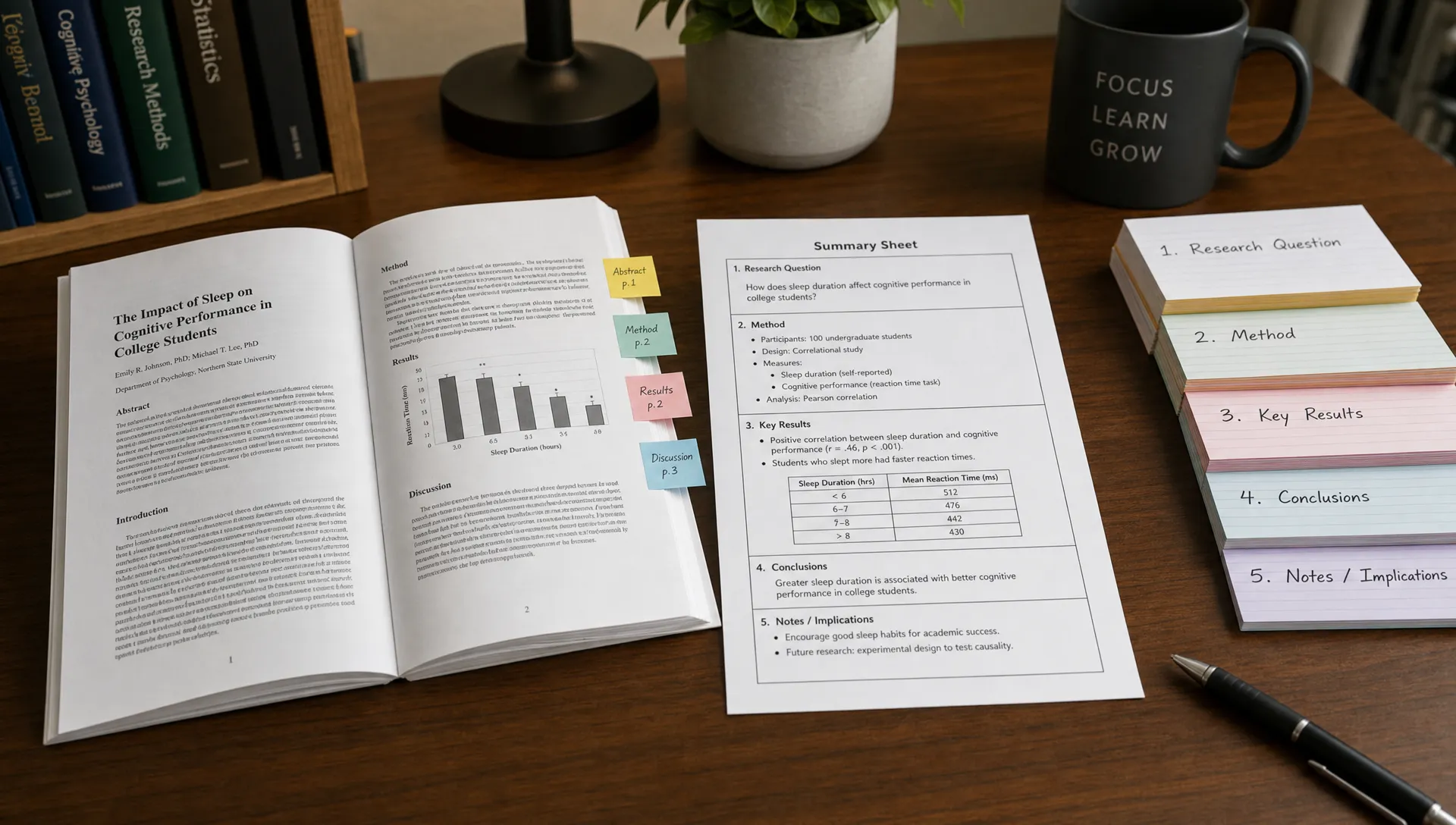
Example Summary of Research Paper With Simple Structure
When you search for an example summary of research paper, you usually need more than a polished paragraph. You need a structure you can reuse, especially when the paper is long, technical, or full of unfamiliar terms.
A good research paper summary does not simply shorten the article. It explains the paper's purpose, method, findings, and meaning in a way that someone else can understand without reading every page first. That matters whether you are preparing for class, writing an annotated bibliography, comparing studies, or turning academic work into notes for a report.
Below is a simple structure you can use for most research papers, followed by a full example using a fictional study. The example is invented for teaching purposes, so you can focus on the summary method rather than the topic itself.
What a research paper summary should do
A research paper summary should answer one practical question: what did this paper try to find out, and what did it show?
That sounds simple, but many summaries go wrong because they focus only on the abstract or copy phrases from the discussion section. A useful summary should make the paper easier to understand, not just shorter.
At minimum, your summary should include:
- The topic or problem the paper addresses
- The research question, purpose, or hypothesis
- The method or evidence used
- The most important findings
- The author's interpretation of those findings
- Any major limitations or cautions
- Why the paper matters for your assignment, project, or field
You do not need to include every statistic, citation, or background detail. Your job is to preserve the argument and evidence, while leaving out details that do not change the main point.
If you are still learning the full process, this guide on how to summarize a research paper without losing the point walks through the reading and note-taking steps in more depth.
A simple structure for a research paper summary
Most research articles follow a predictable pattern, even when the topic is complex. The structure below works especially well for scientific papers, social science studies, education research, business reports, and many humanities articles.
| Summary part | Question it answers | What to write |
|---|---|---|
| Context | What is the paper about? | Name the topic and the problem the study responds to. |
| Purpose | What did the authors want to know? | State the research question, goal, or hypothesis. |
| Method | How did they study it? | Mention the study design, data, participants, texts, or materials. |
| Findings | What did they find? | Summarize the main results, not every detail. |
| Meaning | Why do the findings matter? | Explain the implication or contribution. |
| Limits | What should readers be careful about? | Note major limitations, scope, or uncertainty. |
You can turn that structure into a reusable paragraph template:
This paper examines [topic/problem]. The authors aim to find out whether/how/why [research question]. To answer this, they use [method/data]. The study finds that [main findings]. These findings suggest that [meaning or implication]. However, the paper is limited by [main limitation], so its conclusions should be understood as [scope or caution].
This template is not meant to make every summary sound identical. It is a starting point. Once you understand the paper, you can adjust the order and style for your purpose.
Example summary of research paper using the simple structure
To make the structure concrete, let us use a fictional research paper.
Fictional paper used for this example
Title: The Effect of Active Recall Practice on Exam Performance in Undergraduate Biology Students
Authors: Maya Chen and Luis Romero
Journal type: Education research journal
Main idea: The paper studies whether weekly active recall exercises help undergraduate biology students perform better on exams than traditional rereading.
Again, this is not a real paper. It is a realistic example designed to show how a summary can be built.
One-paragraph summary example
Chen and Romero examine whether active recall practice improves exam performance among undergraduate biology students. The authors compare students who completed weekly short-answer recall exercises with students who reviewed the same material through rereading. Over a 12-week course, the active recall group performed better on cumulative exam questions, especially questions that required applying concepts rather than recognizing definitions. The study suggests that frequent retrieval practice may help students retain and use scientific concepts more effectively than passive review. However, because the research was conducted in one course at one university, the findings may not apply equally to other subjects, student groups, or course formats.
This summary is short, but it still includes the key pieces: topic, purpose, method, findings, meaning, and limitation.
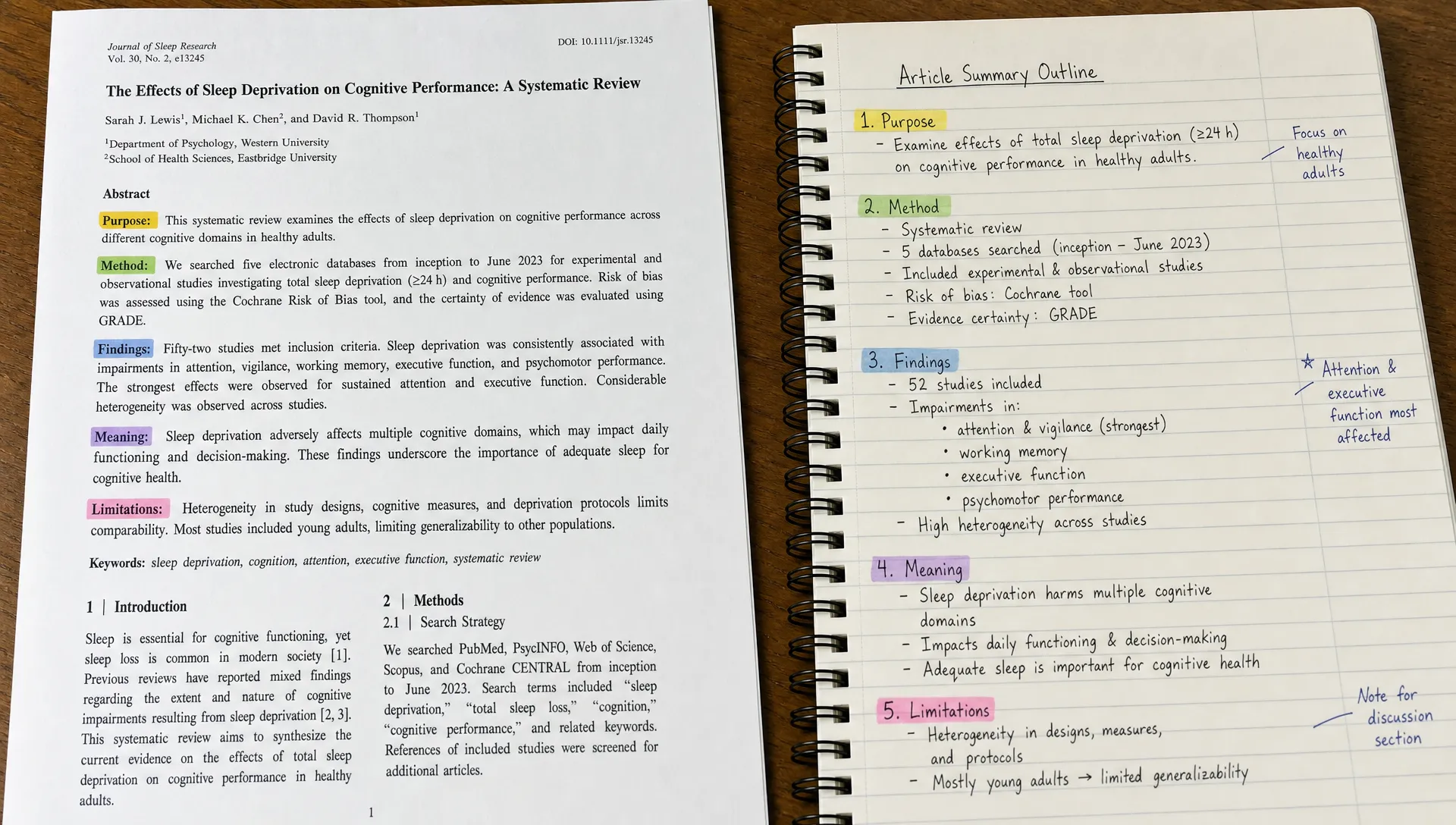
Structured summary example
Context: Many students reread notes or textbooks when preparing for exams, but rereading can create a false sense of familiarity. The paper addresses the problem of how students can study in ways that improve long-term retention.
Purpose: The authors investigate whether active recall, which requires students to retrieve information from memory, leads to better exam performance than rereading.
Method: The study compares two groups of undergraduate biology students across a 12-week course. One group completes weekly short-answer recall exercises. The other group spends the same amount of time rereading assigned material.
Findings: Students in the active recall group score higher on cumulative exam questions than students in the rereading group. The difference is strongest on questions that ask students to apply ideas to new examples.
Meaning: The findings suggest that active recall may support deeper learning because it forces students to practice retrieving and using information, not just recognizing it.
Limitations: The study is limited to one course and one student population. It also does not show whether the same results would appear in other disciplines, longer courses, or less structured study environments.
Why this example works
The example works because it does not treat the research paper as a pile of facts. It treats the paper as an argument supported by evidence.
Notice what the summary does not do. It does not list every background source. It does not include all numerical results. It does not copy technical phrases just because they sound academic. Instead, it focuses on the paper's central contribution.
A strong summary usually has three qualities.
First, it is selective. It chooses the information that changes the reader's understanding of the paper.
Second, it is accurate. It does not exaggerate the findings or make the study sound broader than it is.
Third, it is useful. It helps the reader decide what the paper contributes and whether they need to read the full article more closely.
For a shorter model, you may also find this short summary of research paper example helpful if your assignment or workflow requires only a brief version.
How to write your own research paper summary
A simple structure helps, but the quality of your summary still depends on how you read the paper. Here is a practical workflow you can use.
Start with the abstract, but do not stop there
The abstract gives you a quick preview of the paper's purpose, method, and findings. Use it to orient yourself, not as the only source for your summary.
Abstracts are compressed. They often leave out important caveats, definitions, and methodological details. If you only summarize the abstract, you may miss what the paper actually proves and what it does not prove.
Read the introduction for the problem
The introduction usually explains why the study exists. Look for the gap in current knowledge, the debate the authors are joining, or the practical problem they want to solve.
For your summary, you usually need only one or two sentences of context. Avoid rewriting the entire literature review unless your assignment specifically asks for it.
Find the research question or aim
Many papers state their purpose directly with phrases such as the study examines, this paper investigates, or we ask whether. When the question is not obvious, infer it from the end of the introduction or the beginning of the methods section.
A good purpose sentence might look like this:
The authors investigate whether weekly active recall exercises improve biology exam performance compared with rereading.
That sentence is clearer than a vague sentence like:
The paper is about studying and exams.
Summarize the method in plain language
You do not need to explain every technical detail unless the method is central to your assignment. Instead, answer: what kind of evidence did the authors use?
For example, write that the authors compared two student groups over a semester, analyzed survey responses, reviewed historical documents, or tested a model on a dataset.
If the method affects how much you trust the findings, include that too. A randomized experiment, a small interview study, a case study, and a literature review all support different kinds of conclusions.
Turn results into meaning
Results are what the paper found. Meaning is why those findings matter.
A weak summary says:
The active recall group scored higher.
A stronger summary says:
The active recall group scored higher, suggesting that retrieval practice may help students apply concepts more effectively than passive review.
The second version connects the result to the paper's larger contribution.
End with a limitation or caution
Limitations are not flaws to hide. They help readers understand the scope of the paper.
Common limitations include small sample size, narrow population, short study duration, self-reported data, limited geographic context, or uncertainty about whether findings apply to other settings.
A balanced summary does not say the paper proves something for everyone. It says what the paper supports, based on the evidence provided.
Common mistakes to avoid
Research paper summaries often become confusing when they include too much detail in the wrong places. Use this table as a quick check before you submit or share your summary.
| Mistake | Why it weakens the summary | Better approach |
|---|---|---|
| Copying the abstract | It may repeat the author's wording without showing your understanding. | Use the abstract as a guide, then rewrite in your own words. |
| Including too much background | The main argument gets buried. | Keep only the context needed to understand the study. |
| Ignoring the method | Readers cannot judge what kind of evidence supports the claim. | Summarize the method in one clear sentence. |
| Listing results without interpretation | The summary feels like disconnected facts. | Explain what the findings suggest. |
| Overstating the conclusion | It makes the paper sound more certain than it is. | Include scope and limitations. |
These mistakes are especially common when you are summarizing under time pressure. A structure protects you from leaving out the method, missing the findings, or overstating the conclusion.
How to adapt the summary for different uses
The best summary depends on what you need it for. A class assignment, a literature review, and a workplace briefing do not require the exact same level of detail.
| Use case | What to emphasize | Suggested length |
|---|---|---|
| Class reading response | Main argument, method, and your understanding | 150 to 300 words |
| Annotated bibliography | Research question, findings, relevance to your project | 100 to 200 words |
| Literature review notes | Method, findings, limitations, relationship to other studies | 200 to 500 words |
| Workplace briefing | Practical takeaway, evidence quality, implications | 100 to 250 words |
| Teaching material | Plain-language explanation, key concepts, examples | Flexible |
For students, the priority is usually showing that you understood the paper. For researchers, the priority is connecting the paper to other evidence. For professionals, the priority is often knowing what decision or next step the paper supports.
Using AI to help without losing your own understanding
AI tools can help you move faster through dense research papers, but they should not replace careful reading when accuracy matters. A good use of AI is to create a first-pass explanation, identify the structure of the paper, or turn technical sections into plain language.
For example, with unrav.io, you can work with PDFs, links, pasted text, YouTube videos, or podcasts and reframe the material depending on your goal. You might use a quick grasp mode to understand the paper's main point, then use a teach-it style explanation to check whether you really understand the method and findings.
A practical AI-assisted workflow looks like this:
- Ask for the paper's research question, method, findings, and limitations.
- Compare the AI output against the paper itself.
- Rewrite the summary in your own words.
- Add details your assignment or project specifically requires.
- Check that the final summary does not overstate the evidence.
If you use AI in an academic setting, follow your institution's policy. Some readers also need to understand how AI-generated writing may be evaluated, and resources such as AI-writing detection guides can help you learn more about that landscape. The safest habit is still to use AI for comprehension and organization, then produce a summary you can explain and defend yourself.
A copy-ready research paper summary template
Use this template when you need a clean first draft. Replace the bracketed sections with details from your paper.
[Author name or names] examine [topic/problem]. The paper aims to determine [research question or purpose]. To investigate this, the authors use [method, data, participants, or sources]. The main finding is that [main result]. The authors argue that this matters because [interpretation or implication]. However, the study is limited by [limitation or scope], which means the findings should be applied carefully when [context where caution is needed].
Here is the same template filled with the fictional paper:
Chen and Romero examine study strategies in undergraduate biology education. The paper aims to determine whether active recall improves exam performance more than rereading. To investigate this, the authors compare two groups of students across a 12-week course. The main finding is that students who completed weekly active recall exercises performed better on cumulative exam questions, especially questions requiring application. The authors argue that this matters because retrieval practice may support deeper learning than passive review. However, the study is limited by its single-course setting, which means the findings should be applied carefully to other subjects or student populations.
This version is clear enough for many class notes, reading logs, or early literature review notes. If you need a more formal assignment, you can expand it with more detail about the method, findings, and relationship to your course theme.
Quick self-check before you finish
Before you submit or save your summary, ask yourself a few simple questions.
Can someone understand the paper's purpose without reading the full article? Did you explain how the authors studied the question? Did you include the main findings rather than minor details? Did you state why the findings matter? Did you include at least one limitation or caution?
If the answer is yes, your summary is probably doing its job.
If the answer is no, return to the paper and look for the missing part. Most weak summaries are not weak because the writer is bad at writing. They are weak because one essential piece of the paper's logic is missing.
Frequently Asked Questions
How long should a research paper summary be? It depends on the assignment or use case. A short class summary may be 150 to 300 words, while literature review notes may be longer. The summary should be long enough to explain the purpose, method, findings, meaning, and limitations without repeating unnecessary details.
Can I summarize a research paper using only the abstract? You can use the abstract to get oriented, but you should not rely on it alone for important work. The introduction, methods, results, and discussion often contain caveats and details that change how the paper should be understood.
What is the easiest structure for a research paper summary? The easiest structure is context, purpose, method, findings, meaning, and limitations. This sequence works because it follows the logic of most research papers and helps you avoid leaving out important information.
Should a summary include my opinion? Usually, a summary should focus on the author's work, not your personal reaction. If your assignment asks for critique, keep the summary separate from your evaluation so the reader can tell what the paper says and what you think about it.
How do I summarize a paper I do not fully understand? Start by identifying the research question, method, and conclusion. Then look up key terms and reread the results and discussion. If needed, use a comprehension tool to reframe difficult sections in simpler language, but always check the output against the original paper.
Make your next research paper easier to understand
A strong research paper summary is not just shorter text. It is a clear map of the paper's purpose, evidence, findings, and limits.
Use the simple structure from this guide whenever you feel stuck: context, purpose, method, findings, meaning, and limitations. Once you can identify those pieces, dense papers become easier to read, discuss, compare, and remember.
If you want help getting from a complex paper to clearer notes, you can use unrav.io as a reading companion to reframe PDFs, links, pasted text, videos, or podcasts into more understandable outputs. Start with a quick grasp, then move into deeper explanation when the paper deserves closer attention.